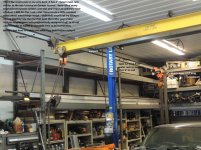
Pallet rack beams are not designed for point loading. The OP, shows in photo #4 that he's point loaded the beams....Beam capacities are rated as a uniformly distributed load over the length of the beams and symmetrically loaded between the pair....ie a 6K beam will support 6k lbs, uniformly spread down the length of the beam and symmetrically placed between the pair of beams.
Sound like someone who has read a lot of engineering books but never actually worked in a warehouse. Since your avatar depicts an airplane, I'll point out that no matter how much calculation you do, things still have to be proven to work in the real world. Before Cessna debuted the recent "Skycatcher" it crashed twice because of miscalculation. Thats after a 100 years experience and a bunch of engineering. So the proof is always in the final testing anyway. The last few years before I retired I was a property manager for a government contractor. I'll guarantee you that plenty of things that are set on pallet racking by forklift drivers are not evenly distributed. Further, many of the items have small footprints that concentrate loads in spots along the beams.
No one even has a clue how much weight is on a rack and I guarantee you nothing ever gets weighed before being put on a rack. Such is life.......
In my case I have built several "home engineered" cranes to TLAR standards.
I have 3 cranes....no, make that 4 if you count the little one in the leanto.
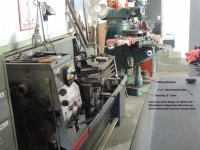
First one is a simple 10" I beam built about 30 years ago. Its in my garage where I used it to load/unload several large lathes, a milling machine, a large granite inspection table and a multitude of other heavy items.
I have another heavy duty crane in my pole barn that I have lifted lots of very heavy items with. I have a 10 ft sheetmetal brake. I regularly lift complete chassis with engine/trans/rearend installed, and I can raise a complete chassis up and set it on my welding tables in about 5 minutes with no help. Probably the heaviest thing I ever lifted was a steel welding table I bought at a govt auction. One of those tables with a solid steel top and large pipe legs. They had a 3/8 top on it and then welded a 1/2 plate over that.
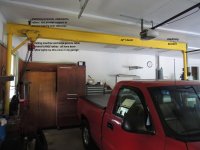
THEN they put a 3/4 steel top on that. It was appx 5' wide and 10' long. WHY ? I don't know....it was the government. I don't use the trolley beams with the really heavy stuff like that. I have just an I beam across the top of the main rails that I use when I have something really heavy to unload. I'm afraid the trolleys might break, not the beams.This lift has 10" main rails and two 8" trolley beams.
I also have another crane in the pole barn that is similar to the one I posted. It uses 4" main rails. I use an arbitrary 1,000 lb limit, but thats subjective cause I can't weigh things. The one I posted is actually supported better than this 4" one, and I have been using this one for about 15 years with no issues. All this being said, anyone who "engineers" a crane does so at their own risk. Always err on the side of "overbuilding" and always be careful about where you stand when using a crane. As for the comment about "point loading" the beams.....
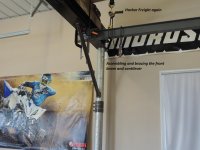
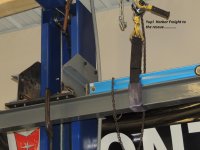
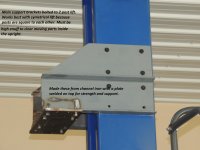
everything has to have a point of attachment. The points I chose are widely spaced and near the uprights which will impart the load much better than the one picture that showed someone with a single point of loading in the middle of a pallet rack beam. The uprights weren't supported by any other crossbeams or complimentary racking. And, he just flatly exceeded the ability of his equipment. My design would probably collapse too if it were trying to move that particular milling machine. I do have all the beams labeled with an arbitrary 1,000 lb stencil except for the very front 6" crossbeam mounted on two large poles. I put a 2,000 lb label on it. So I have confidence based on my experience with other cranes I built that it will easily meet the needs my son has in his shop. See attached pictures....but build at your own risk. As for me, I'm happy with what we have. Its for "light" 1,000 lb loads....not 10K or even 6K.
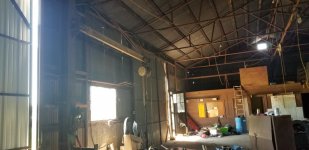
One more thing....my son has another building that we put up two 35' long 6" H beams. They are mounted atop four 4" diameter poles. We will tie the uprights at each end together with some x bracing to make it very stable. The poles are mounted in concrete and we are waiting to pour a floor that will help stabilize it. 35' is a long span even for a 6" beam....so we are going to make movable supports that can be slid along the beams and placed in positions to provide intermediary support when desired/needed. So anything really heavy will be unloaded in that building.




 Nice post