To avoid these ads, REGISTER NOW!

BX Cabling?

Miss the Pontiacs

Well-known member
Joined
Nov 7, 2016
Messages
16,436
Location
Saskatchewan Canada
I’m planning on using BX cable/armoured metal sheath cabling. I’m also planning on stubbing conduit to my ceiling trusses. My question is can I pull BX into the box and anchor the cable by simply tying the ground into the outlet box?
 
To avoid these ads, REGISTER NOW!

wyliesdiesels

Well-known member
Joined
Aug 14, 2012
Messages
19,998
Location
Modesto, CA
BX cable doesnt exist anymore. It was replaced by AC cable.

If i understand you correctly, youre gonna run AC into the conduit?

Or transition to another wiring method to go in the conduit?
 
OP
M

Miss the Pontiacs

Well-known member
Joined
Nov 7, 2016
Messages
16,436
Location
Saskatchewan Canada
BX cable doesnt exist anymore. It was replaced by AC cable.

If i understand you correctly, youre gonna run AC into the conduit?

Or transition to another wiring method to go in the conduit?

I know armoured cable is referred to AC but haven’t heard it used much, mind you I don’t hang around electricians much.
I was thinking I could transition by mounting a 4x4 box in truss but was just going to directly run the AC into the conduit and ground in the outlet box and loop ground to the device.
 

Norcal

Well-known member
Joined
Mar 16, 2008
Messages
13,753
That or MC. Might tbe regional but everyone uses MC around here and some still call it BX.

The problem is that AC & MC are different materials with different installation requirements spelled out in the individual NEC articles for each of them. The OP is in Canada, which may still use AC cable.
 

wyliesdiesels

Well-known member
Joined
Aug 14, 2012
Messages
19,998
Location
Modesto, CA
I know armoured cable is referred to AC but haven’t heard it used much, mind you I don’t hang around electricians much.
I was thinking I could transition by mounting a 4x4 box in truss but was just going to directly run the AC into the conduit and ground in the outlet box and loop ground to the device.

I woulsnt run AC down the conduit.

Instead transition to THHN or just run AC the entire way to the j box.

Is this being surface mounted?
 

ard

Well-known member
Joined
Feb 16, 2015
Messages
4,391
Location
Sierra Foothills... California
OP
There are specific connectors to clamp the armored part of the cable that then attaches to the box knockout w a stadard locknut/threaded fitting. This fitting is ground connection to the metal sheath.

Is this your question??
 

u2slow

Well-known member
Joined
Nov 20, 2011
Messages
3,585
Location
BC
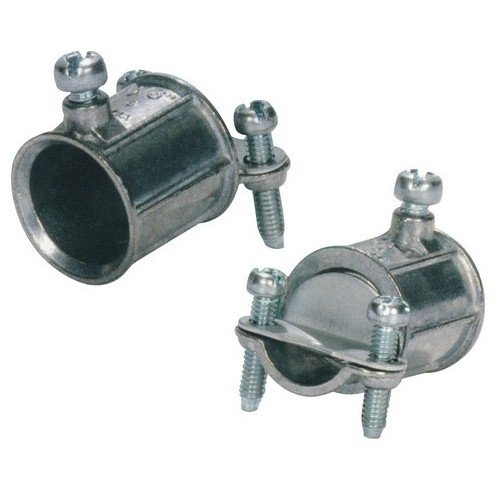
Back when I was an apprentice, we used these for EMT stub-downs...

41BaK6jAt2L.jpg


Strip back however much armour you need (we were doing 8-10' whips) and tape the anti-short bushing on. Was ok with the AHJ at the time... but times change, so check if in doubt.
 

alfredeneuman

Well-known member
Joined
Mar 3, 2011
Messages
4,580
Location
Fullerton, CA
Strip back however much armour you need (we were doing 8-10' whips) and tape the anti-short bushing on.

That fitting is for NM to EMT. AC connectors have stops to retain the antishort bushings.
Just as stripping the insulation off of NM and using the individual conductors in conduit is not acceptable, stripping the armor of AC or MC cable is no better.
 

MattT

Well-known member
Joined
Feb 20, 2010
Messages
3,201
The problem is that AC & MC are different materials with different installation requirements spelled out in the individual NEC articles for each of them. The OP is in Canada, which may still use AC cable.

Exactly:thumbup: The OP needs to clarify whether he's using AC or MC.
 

MattT

Well-known member
Joined
Feb 20, 2010
Messages
3,201
Just as stripping the insulation off of NM and using the individual conductors in conduit is not acceptable, stripping the armor of AC or MC cable is no better.

I've never seen NM where the individual conductor insulation had any kind of rating other than voltage. And no noticeable outer covering to protect the insulation other than the sheathing.

The Southwire MC I use has THHN/THWN rated conductors so stripping it back and pulling it through conduit would be "better" than doing it with NM. Maybe not code compliant though??
 

u2slow

Well-known member
Joined
Nov 20, 2011
Messages
3,585
Location
BC
That fitting is for NM to EMT. AC connectors have stops to retain the antishort bushings.
Just as stripping the insulation off of NM and using the individual conductors in conduit is not acceptable, stripping the armor of AC or MC cable is no better.

I agree on the lack of stops. It was debated. Like I said, it was acceptable to the AHJ at the time. 100+ instances of those connectors on whips on a gov't institution job. Sometimes it doesn't hurt to ask the inspector.

The other version was PVC stub, female adapter, and a std AC set screw connector. But the PVC setup wasn't permissable in certain spaces per specification.
 
OP
M

Miss the Pontiacs

Well-known member
Joined
Nov 7, 2016
Messages
16,436
Location
Saskatchewan Canada
I woulsnt run AC down the conduit.

Instead transition to THHN or just run AC the entire way to the j box.

Is this being surface mounted?

I will likely do as you suggest and transition to THHN at the 4x4 junction Box from MC cable. The conduit will be inside the wall. Will run a couple and will show by pic. Thanks Wylie

OP
There are specific connectors to clamp the armored part of the cable that then attaches to the box knockout w a stadard locknut/threaded fitting. This fitting is ground connection to the metal sheath.

Is this your question??[/QUOTE
I might have not been initially clear enough, sorry about that.
Not exactly I will be running conduit within the wall. But of course will use the connector you are referring to on the junction box before transitioning to THHN.
Thanks Ard


Back when I was an apprentice, we used these for EMT stub-downs...

41BaK6jAt2L.jpg


Strip back however much armour you need (we were doing 8-10' whips) and tape the anti-short bushing on. Was ok with the AHJ at the time... but times change, so check if in doubt.

Thanks U2slow
I never seen these before but then again I’m not an electrician. I might ask about these at the supplier but have a feeling they might not be to

I knew that the term BX was outmoded and AC was the new term. MC was new to me. I did look up what the difference is between AC and MC. Correct me if I ask wrong.
With AC the ground is a strip or smaller gauge of wire from the power leads.
MC all conductors are the same gauge. This might be a scaled down definition but should be sufficient. I guess MC is the new norm as I have never seen AC as a new purchase but have recovered some from some tear downs.

For years what most of my peers referred to as BX was actually MC cable. Sort of like referring to 110/220 volt instead of 120/240 volt it just is easier. The blank looks you get when you refer to 120/240 vs 110/220. The ones that know simply understand what you are talking about. I guess it just easier not having to explain to someone that could really care less.
This is why I enjoy GJ you simply learn new terms, methods, view points etc.
Thanks for all input.
 

tfi racing

Well-known member
Joined
Apr 19, 2008
Messages
2,907
Location
Cedar,BC
Why are you using AC90 anyways? Unless it is an all steel building (where you should be using EMT for 95% of it), you are just adding a lot of grief and expense for little to no benefit or safety.
 

alfredeneuman

Well-known member
Joined
Mar 3, 2011
Messages
4,580
Location
Fullerton, CA
The other version was PVC stub, female adapter, and a std AC set screw connector. But the PVC setup wasn't permissable in certain spaces per specification.
Would an AC connector, a rigid conduit coupling, and an EMT connector be permissible according to your inspector?
 
OP
M

Miss the Pontiacs

Well-known member
Joined
Nov 7, 2016
Messages
16,436
Location
Saskatchewan Canada
Why are you using AC90 anyways? Unless it is an all steel building (where you should be using EMT for 95% of it), you are just adding a lot of grief and expense for little to no benefit or safety.


The garage you might say is form over function. While I will be using the garage to complete projects, part of it is sort of a display area. I like the formation and symmetry of the armoured cable. I can buy it fairly cheap from my wholesale so that also was a factor. I always use the term, I'm only coming this way one time. So much of the build could be considered over the top.

The funny thing is taking all this into account, I found some SS solid bottom tray 6" wide for less than a $1 a foot. So I could have went with a cheaper alternative as it will be hidden but I already have the cable sitting in my garage.
 

ItsNemo

Well-known member
Joined
Mar 5, 2016
Messages
4,805
Location
Canada
They make specific screw down clamps for AC (aka BX) cable into boxes and you use boxes with 1/2" knockouts rather than the wire clamps built into boxes for NMD wire.
 

MattT

Well-known member
Joined
Feb 20, 2010
Messages
3,201
The other version was PVC stub, female adapter, and a std AC set screw connector. But the PVC setup wasn't permissable in certain spaces per specification.

I don't see how that's permissible anywhere:headscrat How were you grounding it?
 
To avoid these ads, REGISTER NOW!

Terry D

Well-known member
Joined
Mar 25, 2015
Messages
2,202
Location
St. Louis, MO.
They do not make a approved fitting to go from MC to EMT. I often have taken a MC connector and threaded it into a threaded heavy wall coupling and threaded a EMT connector in other end. To me there is nothing wrong with this, But some of the inspectors around here will not pass it. The main thing is not to use a romex connector because it is not designed to retain the red head bushing
 

alfredeneuman

Well-known member
Joined
Mar 3, 2011
Messages
4,580
Location
Fullerton, CA
To me there is nothing wrong with this, But some of the inspectors around here will not pass it.

No EMT to MC adapters are available because>

The reason is because you must remove the armor when you get to the stop in the connector, and the individual wires underneath aren't labeled with the info required by Code.
All inspectors should be turning this down (not just some)
 

Terry D

Well-known member
Joined
Mar 25, 2015
Messages
2,202
Location
St. Louis, MO.
No EMT to MC adapters are available because>

The reason is because you must remove the armor when you get to the stop in the connector, and the individual wires underneath aren't labeled with the info required by Code.
All inspectors should be turning this down (not just some)

I understand that things are done differently across the US. Yes, there is the NEC, but things are done differently. Missouri is not a state license yet, they are trying to adapt it. So we have a lot of jurisdictions with a lot of inspectors for each of them. At any time, a local authority having jurisdiction can override the code. Some municipality's here are still in the 2008 code. That is just how it is here. Now back to the question, if I was running MC above a drop ceiling, and needed to bring it down a wall into a conduit stub, lets say for a receptacle. The do not make a approved fitting to go from MC to EMT. What most here want to see, is a J box on top of the conduit, and the MC brought into that box with a MC box connector fitting, some fittings require a bushing and some do not, then the wire brought down the conduit to the device. With no splices, except for the ground. You would not be able to see any markings on the wire anyway, maybe you do it different there, once we strip the metal jacket off, we also cut that tape inside with the writing, it does not enter the box. I merely said you can take 3 separate fittings and make a fitting that will do this, and yes, there are some municipality's here that would pass it. What about Wiremold, they make a fitting that has a 1/2 inch knockout on top with a little cover that snaps on it, no room for splices. That's how we go from MC to Wiremold, put a fitting on top, strip the metal jacket and run the conductors down the Wiremold to the device
 

alfredeneuman

Well-known member
Joined
Mar 3, 2011
Messages
4,580
Location
Fullerton, CA
some fittings require a bushing and some do not, then the wire brought down the conduit to the device.

MC Cable doesn't REQUIRE a bushing.
I once personally called Southwire, and they told me that the bushings enclosed in a bag on the roll is just a measure for increased protection; that the mylar wrapping was sufficient.
AC Cable is a different story however because it's wrap is paper, and require bushings.
 

AntonLargiader

Well-known member
Joined
Nov 20, 2016
Messages
1,372
Location
Charlottesville, VA
Around here it's pretty common to run NM or MC into conduit (jacket removed) for the final exposed run down the wall. I'm looking at some MC-into-EMT right now, in my commercial space, and I recently demoed some NM-into-PVC at my house.
 

wyliesdiesels

Well-known member
Joined
Aug 14, 2012
Messages
19,998
Location
Modesto, CA
I understand that things are done differently across the US. Yes, there is the NEC, but things are done differently. Missouri is not a state license yet, they are trying to adapt it. So we have a lot of jurisdictions with a lot of inspectors for each of them. At any time, a local authority having jurisdiction can override the code. Some municipality's here are still in the 2008 code. That is just how it is here. Now back to the question, if I was running MC above a drop ceiling, and needed to bring it down a wall into a conduit stub, lets say for a receptacle. The do not make a approved fitting to go from MC to EMT. What most here want to see, is a J box on top of the conduit, and the MC brought into that box with a MC box connector fitting, some fittings require a bushing and some do not, then the wire brought down the conduit to the device. With no splices, except for the ground. You would not be able to see any markings on the wire anyway, maybe you do it different there, once we strip the metal jacket off, we also cut that tape inside with the writing, it does not enter the box. I merely said you can take 3 separate fittings and make a fitting that will do this, and yes, there are some municipality's here that would pass it. What about Wiremold, they make a fitting that has a 1/2 inch knockout on top with a little cover that snaps on it, no room for splices. That's how we go from MC to Wiremold, put a fitting on top, strip the metal jacket and run the conductors down the Wiremold to the device

No, a local AHJ CANNOT override an adopted code. They cannot take away requirements from the code. They can only make written amendments that make the code stricter.

Around here it's pretty common to run NM or MC into conduit (jacket removed) for the final exposed run down the wall. I'm looking at some MC-into-EMT right now, in my commercial space, and I recently demoed some NM-into-PVC at my house.

That is completely incorrect and wrong for NM because the individual conductors are not labeled. MC has a mylar strip running the length of the cable that identifies the conductor type and gauge.
 

mobiledynamics

Well-known member
Joined
Mar 14, 2010
Messages
5,037
Location
Gotham City
Call me Old School. I still call it AC cabling. And I use BX all the time.....even in my weekend house where Romex is approved, I still prefer to sling BX. Old habits are hard to use.
 

wyliesdiesels

Well-known member
Joined
Aug 14, 2012
Messages
19,998
Location
Modesto, CA
Call me Old School. I still call it AC cabling. And I use BX all the time.....even in my weekend house where Romex is approved, I still prefer to sling BX. Old habits are hard to use.

youre old school but still call it AC, which is a newer cable, and even though AC replaced the old school BX cabling? :headscrat

And BX isnt made anymore. you have a pile of it sitting around somewhere?
 

u2slow

Well-known member
Joined
Nov 20, 2011
Messages
3,585
Location
BC
Would an AC connector, a rigid conduit coupling, and an EMT connector be permissible according to your inspector?

Possibly. But you know big contract jobs.... save a buck here and there... x100... x1000. It adds up.

I don't see how that's permissible anywhere:headscrat How were you grounding it?

The bare copper bond wire in the AC was taken back to the junction box,... along with the rest of the insulated conductors.
 

Terry D

Well-known member
Joined
Mar 25, 2015
Messages
2,202
Location
St. Louis, MO.
MC Cable doesn't REQUIRE a bushing.
I once personally called Southwire, and they told me that the bushings enclosed in a bag on the roll is just a measure for increased protection; that the mylar wrapping was sufficient.
AC Cable is a different story however because it's wrap is paper, and require bushings.

There are certain fittings that are designed so a bushing is not required. They usually have a red plastic end on them. The kind I use, the MC just pushes in them. As far as not using bushings on any kind of connector, I have never heard of anything like that. We use them here. It would not pass a inspection if caught. I personally would not rely on anyone from a wiring manufacture telling me that.
 

Terry D

Well-known member
Joined
Mar 25, 2015
Messages
2,202
Location
St. Louis, MO.
No, a local AHJ CANNOT override an adopted code. They cannot take away requirements from the code. They can only make written amendments that make the code stricter.


That is completely incorrect and wrong for NM because the individual conductors are not labeled. MC has a mylar strip running the length of the cable that identifies the conductor type and gauge.

You are wrong, they can and do. At least around these parts. We are not a state wide license. St. Louis County is in the 2008 Code, they did not adopt the requirements for all the arc faulting of branch circuits, just bedrooms and do not require tamper proof receptacles. But its right in the NEC that you do. And your right about they can make you do things that are stricter than the code, and they do that here to. I was doing some out of town work in Illinois, In the small rural areas that I was in, they do not ground any of there boxes, Its right in the NEC that you must, even has a 10/32 hole tapped in it. I even talked to a contactor over there, they said its not common practice. I still did it though. As far as me installing arc fault breakers when there not required by the local jurisdiction, why would I spend hundreds of dollars more when the other guy isn't
 

alfredeneuman

Well-known member
Joined
Mar 3, 2011
Messages
4,580
Location
Fullerton, CA
From 320.40 AC Cable "in addition, an insulating bushing or its equivalent protection shall be provided between the conductors and the armor."
Is not in the Article for MC Cable
Explain to me why it's not in both Articles
 

wyliesdiesels

Well-known member
Joined
Aug 14, 2012
Messages
19,998
Location
Modesto, CA
There are certain fittings that are designed so a bushing is not required. They usually have a red plastic end on them. The kind I use, the MC just pushes in them. As far as not using bushings on any kind of connector, I have never heard of anything like that. We use them here. It would not pass a inspection if caught. I personally would not rely on anyone from a wiring manufacture telling me that.

thats funny.

The wiring manufacturer is the authority on their own products and the ones who got their product listed with an NRTL such as U/L, after spending thousands, so it can be used in electrical system.

If you wouldnt rely on the manufacturer who else would you rely on? An inspector that has no clue how the product is tested or listed for use?

Your logic is flawed.

You are wrong, they can and do. At least around these parts. We are not a state wide license. St. Louis County is in the 2008 Code, they did not adopt the requirements for all the arc faulting of branch circuits, just bedrooms and do not require tamper proof receptacles. But its right in the NEC that you do. And your right about they can make you do things that are stricter than the code, and they do that here to. I was doing some out of town work in Illinois, In the small rural areas that I was in, they do not ground any of there boxes, Its right in the NEC that you must, even has a 10/32 hole tapped in it. I even talked to a contactor over there, they said its not common practice. I still did it though. As far as me installing arc fault breakers when there not required by the local jurisdiction, why would I spend hundreds of dollars more when the other guy isn't

Just because they do doesnt mean its legal or right. But you wouldnt know since you dont challenge them.

Ive challenged inspectors before on B/S and they got in trouble for not knowing their own job. It didnt create any issues for me....
 

Terry D

Well-known member
Joined
Mar 25, 2015
Messages
2,202
Location
St. Louis, MO.
Do you think they lied to me?
:bounce:
(I also called AFC and they told me the same thing)

I'm not trying to get into a argument here, all I'm saying it is common practice here to use them when they are required by the fitting style. I personally try to use fittings where they are not required. I know some of the bushings have a little tail on them that protrudes passed the fitting into the box, I was told a long time ago this was for the inspector to verify that it was installed. I'm sure they told you that, and its probably true. I have just always installed them, and probably always will. Call me old school. Im sure they cost next to nothing to produce, but why would they attach a bag to the roll of MC. Personally, it gives me peace of mind that there installed when the fittings require them.
 

Terry D

Well-known member
Joined
Mar 25, 2015
Messages
2,202
Location
St. Louis, MO.
thats funny.

The wiring manufacturer is the authority on their own products and the ones who got their product listed with an NRTL such as U/L, after spending thousands, so it can be used in electrical system.

If you wouldnt rely on the manufacturer who else would you rely on? An inspector that has no clue how the product is tested or listed for use?

Your logic is flawed.


Just because they do doesnt mean its legal or right. But you wouldnt know since you dont challenge them.

Ive challenged inspectors before on B/S and they got in trouble for not knowing their own job. It didnt create any issues for me....

Its not the inspectors making the call, its the local authority. we are not a state wide license. when I was licensed 17 years ago, there was only 4 states that were not state wide. I'm sure your state wide. Every municipality here has there own electrical board, who determines what code cycle they are in, and what parts they are going to adopt for it. Some of the smaller municipality's will just follow bigger municipality's rules. So each one has there own inspectors following there local rules. It has nothing to do with getting a inspector in trouble. Just because a new code cycle comes out, doesn't mean the we have to start applying it. Its has to be adopted by each municipality. so depending where you are working here, you have to know what code there in. It is crazy at times. I currently keep about 4 licenses active each year, yes most larger municipalities have their own license here. we are working on a state wide license, where St. Louis county would be the standard for the whole state. So I hope you understand more what I mean. Its not the inspectors being able to change the code at there will, its the municipality they are employed with. I know someone that works for a contractor across the river in Illinois, they are also not state wide license. When they wire new homes, they will bore 2 inch holes through the basement joist for all their home runs, they put them all in one big hole. If we tried something like that here, they would look at us like we had three heads. Only one romex per hole
 

Norcal

Well-known member
Joined
Mar 16, 2008
Messages
13,753
MC cable does not require redheads I use them but that is a code plus practice, unless it has been adopted by the local authority it cannot be required only other way they can be required is job specs. A inspector cannot require something because they want to.
 
To avoid these ads, REGISTER NOW!
Top Bottom