nadogail
Well-known member
IMHO, it seems to be a holdover from when the Whitworth system was commonly used.


That's incorrect. The difference is in application. A bolt passes through both parts and threads into a nut. A screw passes through one part and threads into a tapped hole in the other.
The exact same fastener could be a bolt or a screw depending on how it's used.

I think it's a bad idea. I see a lot of youtube mechanics doing that.
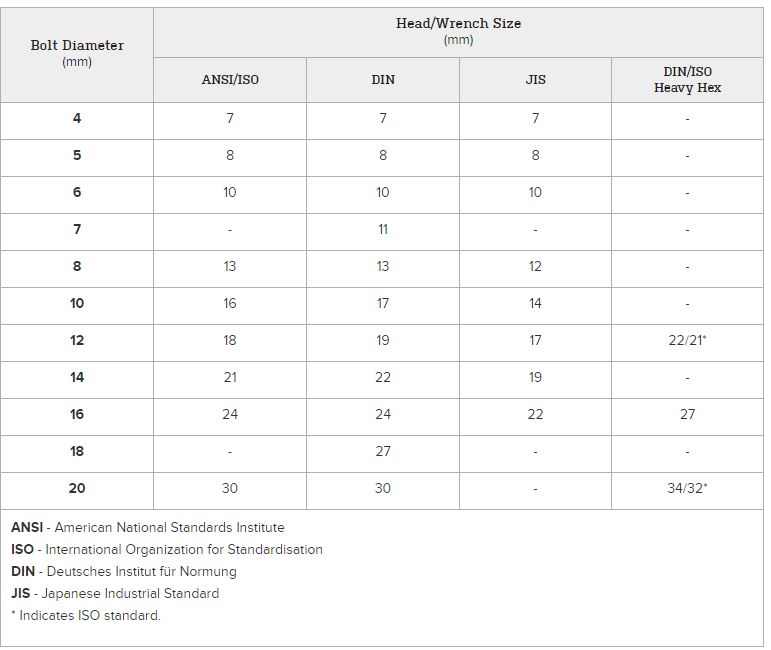
An M6-1.0 bolt is not a 10mm bolt. It's a 6mm bolt. It may measure 10mm across the width of the hex flats, but it's not a 10mm bolt. And when it comes to SAE, I've always thought of 5/16'' bolts as 5/16'' bolts. I never once thought of them as 1/2'' bolts just because they measure 1/2'' across the flats. Maybe I'm wired differently, but I like the way I do it better.
A youtube mechanic will say "Remove the 7/16" bolt on the strut"
I never thought this would be made into something complicated...
That's how I do it.
If I'm referring to a fastener to identify it to another person, I'll typically use head size. If the head is the only visible part of the fastener, how can i identify it by shank and pitch?
Now if I need a replacement fastener, I'll specify by shank and pitch. I have 10/12/13/14mm head, m8x1.25 bolts in my "m8 bucket". I don't care in that instance as to head size, it's pitch that matters.
Now, to be fair, most people can't identify pitch by eye, especially at a distance. Yes, many can spit ball 3 or 4 common NC sizes. But can you eyeball m10 x 1.25 or m10x 1.50? Can you do that from the same distance as determining a 17mm or 19mm head? With the same confidence? I sure can't. I can tell a 14 vs a 12 from 6' away. My glasses aren't good enough to call the pitch, unless I'm working with a specific vehicle and know the pitch and shank based on bolt design. As you said, if it's got a 10mm head on it, 99% of the time it's going to be m6x1.
According to my wife the size of the head or the size of the shank isn't so important if the bolt still works is all she cares about.
Sent from my ONEPLUS A6013 using The Garage Journal mobile app
If you know the size of the bolt [ the size of the threaded ] you know the size of the head. A 3/8s bolt has a 9/16s head a SAE 10mm has a 15mm head. What is so hard about using the proper terminology and not sounding like you don't know what you are talking about.
If you know the size of the bolt [ the size of the threaded ] you know the size of the head. A 3/8s bolt has a 9/16s head a SAE 10mm has a 15mm head. What is so hard about using the proper terminology and not sounding like you don't know what you are talking about.
Does anybody give a **** about any of this? An M6 can have three different head sizes depending upon whether its JIS, DIN or SAE. Use whatever wrench fits.
BTW to those who give a ****, SAE bolt spec's refer to English units (American as some say). Not Metric fasteners.
Big thumbs of there. I struggle with that training people or dealing with new people. I entered the industry struggling with "proper" names for things. Now I've internalized them, and can find it hard to ignore. For instance I've changed over from "12 volts" to "B+" or system voltage, because the latter is actually what I'm looking for.
You better check your facts on that statement. There are SAE specs for metric hardware.
lg
no neat sig line
Danger Will Robinson...Danger...... Using B+ denotes voltages over 100 VDC in everything that uses vacuum tubes, or as my Brit cousins would say, “valves”. Semantics, most definitely, but doesn’t eliminate the need to be careful.
BTW, most things I work on these days have 12, 28 and 270 volt batteries and power busses.
BUT what really grinds my gears is when someone calls a nut a tap. I once had a "helper" that did that. My blood pressure went up about 20PSI every time.
B+ has nothing to do with any particular voltage. Schematics for post 1957-ish car radios will show a B+ line at 12 (nominal) volts. The car tube radios from around 1960 had space charge tubes designed to work at 12 volts.
The "B" term is a leftover from the early days of radios which used an "A" battery for the filaments, a "B" battery for the plates and a "C" battery for grid bias.
Ya want to get people up in arms and arguing then try and define the difference between a bolt and a screw.
To cut to the bottom line FOR ME it is defined in machinerys hand book. A screw is torqued by its head and a bolt is torqued by a nut, Think carriage bolt.
lg
no neat sigline
from what i can tell, it's actually a pretty easy designation. screws have internal fastening interfaces and bolts have external interfaces. meaning you insert the driver into the screw vs insert the bolt into the wrench/socket/board.
In this area, we typically call them "lag bolts".Then what do you call a lag screw that has say a 1/2 hex head on it?
Sent from my iPhone using Garage Journal

Then what do you call a lag screw that has say a 1/2 hex head on it?
 ........... Now I just point co-workers towards the book.