To avoid these ads, REGISTER NOW!

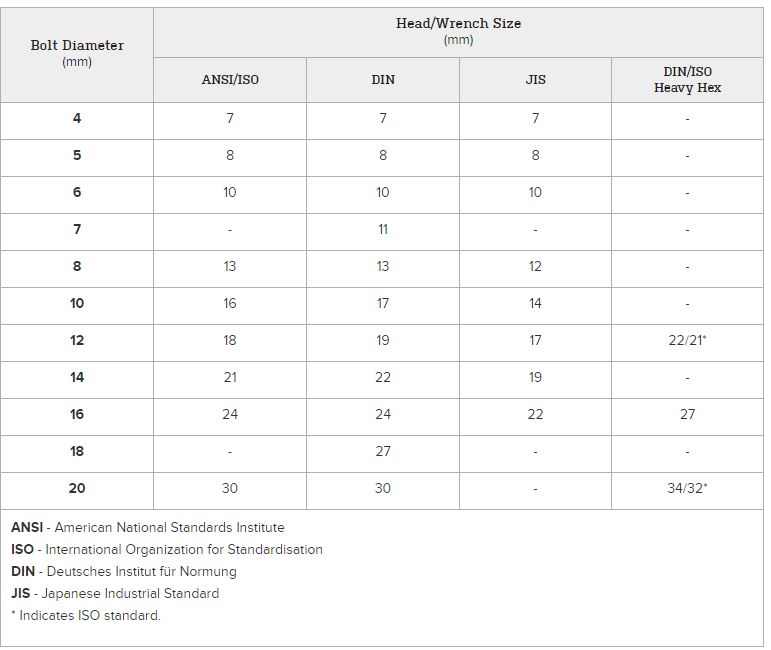
Calling a bolt by its head size

To avoid these ads, REGISTER NOW!

tonyciambrone

Well-known member
Joined
Nov 4, 2015
Messages
1,152
Location
Northern Illinois
I think it's a bad idea. I see a lot of youtube mechanics doing that.

An M6-1.0 bolt is not a 10mm bolt. It's a 6mm bolt. It may measure 10mm across the width of the hex flats, but it's not a 10mm bolt. And when it comes to SAE, I've always thought of 5/16'' bolts as 5/16'' bolts. I never once thought of them as 1/2'' bolts just because they measure 1/2'' across the flats. Maybe I'm wired differently, but I like the way I do it better.

Uhh because it does not help the viewer to know the shank diameter or thread pitch of the fastener to be removed or installed. A youtube mechanic will say "Remove the 7/16" bolt on the strut" because saying "remove the 1 3/4" long 1/4" x 20 tpi hex head fastener" is a little wordy, and it doesn't tell the viewer which wrench to grab.

I never thought this would be made into something complicated...
 

larry_g

Well-known member
Joined
Apr 28, 2007
Messages
16,874
Location
oregon
A youtube mechanic will say "Remove the 7/16" bolt on the strut"

I never thought this would be made into something complicated...

Since I haven't seen the offending vid are you sure the instruction wasn't "Use a 7/16" wrench to remove the strut bolt"?

lg
no neat sig line
 

gtsgarage

Well-known member
Joined
Oct 31, 2017
Messages
482
Location
California
That's how I do it. :beer:

If I'm referring to a fastener to identify it to another person, I'll typically use head size. If the head is the only visible part of the fastener, how can i identify it by shank and pitch?

Now if I need a replacement fastener, I'll specify by shank and pitch. I have 10/12/13/14mm head, m8x1.25 bolts in my "m8 bucket". I don't care in that instance as to head size, it's pitch that matters.


Now, to be fair, most people can't identify pitch by eye, especially at a distance. Yes, many can spit ball 3 or 4 common NC sizes. But can you eyeball m10 x 1.25 or m10x 1.50? Can you do that from the same distance as determining a 17mm or 19mm head? With the same confidence? I sure can't. I can tell a 14 vs a 12 from 6' away. My glasses aren't good enough to call the pitch, unless I'm working with a specific vehicle and know the pitch and shank based on bolt design. As you said, if it's got a 10mm head on it, 99% of the time it's going to be m6x1.


This is how I do it as well. Taking it out is one thing, replacing it with like for like is another.
 

joecon

Well-known member
Joined
Oct 4, 2010
Messages
679
If you know the size of the bolt [ the size of the threaded ] you know the size of the head. A 3/8s bolt has a 9/16s head a SAE 10mm has a 15mm head. What is so hard about using the proper terminology and not sounding like you don't know what you are talking about.
 

Cruzan80

Well-known member
Joined
Jul 22, 2015
Messages
4,192
Location
Denver, CO
I am with you on this. If I am watching a video and it says a 7/16" bolt, I am grabbing a 5/8 wrench to start. Otherwise, say "Use a 7/16 wrench on this bolt".
If you know the size of the bolt [ the size of the threaded ] you know the size of the head. A 3/8s bolt has a 9/16s head a SAE 10mm has a 15mm head. What is so hard about using the proper terminology and not sounding like you don't know what you are talking about.

Sent from my Phone 2 using The Garage Journal mobile app
 

Citation

Well-known member
Joined
Jan 20, 2016
Messages
3,212
Location
Indy
If you know the size of the bolt [ the size of the threaded ] you know the size of the head. A 3/8s bolt has a 9/16s head a SAE 10mm has a 15mm head. What is so hard about using the proper terminology and not sounding like you don't know what you are talking about.

That is not at all true. Yes, there is the most common size but there are a lot of alternatives heads as well. I can get 12 point nuts, various socket heads, etc. If I look at 1/4" bolt on McMaster they have 3 different hex head sizes, 5/16, 3/8, 7/16. For example a flange head bolts are very common in automotive use and will have a smaller hex vs a standard bolt. Most of the bolts I've seen on my cars are flanged and there are plenty of application specific fasteners on cars like drain plugs where the threading and head size can vary.
 

nbpt100

Well-known member
Joined
Oct 19, 2016
Messages
2,301
Location
Massachusetts
Does anybody give a **** about any of this? An M6 can have three different head sizes depending upon whether its JIS, DIN or SAE. Use whatever wrench fits.

You obviously don't. That is fine. But anyone who has to buy fasteners needs to understand this to some extent.

BTW to those who give a ****, SAE bolt spec's refer to English units (American as some say). Not Metric fasteners.
 

larry_g

Well-known member
Joined
Apr 28, 2007
Messages
16,874
Location
oregon
BTW to those who give a ****, SAE bolt spec's refer to English units (American as some say). Not Metric fasteners.

You better check your facts on that statement. There are SAE specs for metric hardware.

lg
no neat sig line
 

tom coffey

Well-known member
Joined
May 9, 2018
Messages
131
Location
western NC
It irritates the **** out of me to work with someone who calls bolt sizes by the head size. I have a friend in his seventies that does that and he's been messing with cars since his early teens. I don't guess he'll ever change. And he has no idea of the thread count. He can tell course from fine though. Bless his heart.
BUT what really grinds my gears is when someone calls a nut a tap. I once had a "helper" that did that. My blood pressure went up about 20PSI every time.
 
Last edited:

cvairwerks

Well-known member
Joined
Aug 12, 2016
Messages
7,206
Location
Within hearing distance of Texas Motor Speedway
:beer:

Big thumbs of there. I struggle with that training people or dealing with new people. I entered the industry struggling with "proper" names for things. Now I've internalized them, and can find it hard to ignore. For instance I've changed over from "12 volts" to "B+" or system voltage, because the latter is actually what I'm looking for.

Danger Will Robinson...Danger...... Using B+ denotes voltages over 100 VDC in everything that uses vacuum tubes, or as my Brit cousins would say, “valves”. Semantics, most definitely, but doesn’t eliminate the need to be careful.

BTW, most things I work on these days have 12, 28 and 270 volt batteries and power busses.
 
To avoid these ads, REGISTER NOW!

nbpt100

Well-known member
Joined
Oct 19, 2016
Messages
2,301
Location
Massachusetts
You better check your facts on that statement. There are SAE specs for metric hardware.

lg
no neat sig line

OK, relative to strength, yield point etc.... Do they specify linear dimensions? show me. I will stand corrected. thanks.
 

Mechanical Noise

Well-known member
Joined
Apr 25, 2014
Messages
2,635
Location
Southeast of O'Hare
Danger Will Robinson...Danger...... Using B+ denotes voltages over 100 VDC in everything that uses vacuum tubes, or as my Brit cousins would say, “valves”. Semantics, most definitely, but doesn’t eliminate the need to be careful.

BTW, most things I work on these days have 12, 28 and 270 volt batteries and power busses.

B+ has nothing to do with any particular voltage. Schematics for post 1957-ish car radios will show a B+ line at 12 (nominal) volts. The car tube radios from around 1960 had space charge tubes designed to work at 12 volts.

The "B" term is a leftover from the early days of radios which used an "A" battery for the filaments, a "B" battery for the plates and a "C" battery for grid bias.
 

cvairwerks

Well-known member
Joined
Aug 12, 2016
Messages
7,206
Location
Within hearing distance of Texas Motor Speedway
B+ has nothing to do with any particular voltage. Schematics for post 1957-ish car radios will show a B+ line at 12 (nominal) volts. The car tube radios from around 1960 had space charge tubes designed to work at 12 volts.

The "B" term is a leftover from the early days of radios which used an "A" battery for the filaments, a "B" battery for the plates and a "C" battery for grid bias.

Actually it predates radio as we know it. It comes from De Forest's research resulting in the Audion tube. The "B" supply provided power for the plate within his tube, with the negative side running thru the "telephone" and tying into the positive side of the "A" source. This pushed plate voltages higher than either supply source individually. In De Forest's lab work, it was all done with dry cells. His original research work only specifies a range of cell quantities at that time time, and not specific voltages for the plate or filaments.

Once a number of other people began working with Audions and what then became the triode, plate voltages were rapidly pushed into the hundreds of volts, and ultimately, well into the kilovolt ranges. By 1924, plate voltages for almost any triode exceeded 100VDC.

As to the car stuff...Lots of portable and automotive, as well as aircraft radios used vibrators running off of the DC supply to produce the necessary plate voltages, until the power requirements got to the point that dynamotors had to be used. I've got one radio for my aircraft that will run off a 6 volt battery, but the B+ supply is 250VDC, coming from the ********.
 

joecon

Well-known member
Joined
Oct 4, 2010
Messages
679
Most people who work on cars know if it is an American car the 6mm bolts have a 10mm head the 8mm bolt has a 13mm head and a 10mm bolt has a 15mm head. Japanese cars use 10mm, 12mm, 14mm. There are standers, yes there are heavy duty heads but they are rare in automotive.
 

mc4life27

Well-known member
Joined
Jul 2, 2014
Messages
404
Ya want to get people up in arms and arguing then try and define the difference between a bolt and a screw.

To cut to the bottom line FOR ME it is defined in machinerys hand book. A screw is torqued by its head and a bolt is torqued by a nut, Think carriage bolt.

lg
no neat sigline


I always thought a screw does not use a separate nut, the nut is whatever material that the fastener is screwing into. Where as a bolt uses a separate nut (also a washer in most cases) to fasten whatever is being fastened. Now I was thought that if using a torque wrench on said fastener, you torque from the nut side of possible if no nut being used the you use the bolt.


Sent from my iPhone using Garage Journal
 

mc4life27

Well-known member
Joined
Jul 2, 2014
Messages
404
from what i can tell, it's actually a pretty easy designation. screws have internal fastening interfaces and bolts have external interfaces. meaning you insert the driver into the screw vs insert the bolt into the wrench/socket/board.


Then what do you call a lag screw that has say a 1/2 hex head on it?


Sent from my iPhone using Garage Journal
 

elidas

Well-known member
Joined
Dec 2, 2015
Messages
349
Location
Waterbury,Ct
Now try explaining the markings on the bolt head. Whenever we got someone new I would go over "bolts" to at least keep us on the same page.
 

WNYflyer

Well-known member
Joined
Sep 13, 2009
Messages
2,119
Location
Lockport, NY
Bolt versus Screw, at least for products that fall under ANSI/ASME B18.2.1 specification. Pages but not from latest edition.

Taken from the fastener "Bible" aka "Fastener Standards" as published by the Industrial Fastener Institute. Got this oh 600 page book because of lazy co-workers copying old bill of materials that contained incorrect fastener information on them. Got tired of suppliers/contractors calling and telling me that there is no such animal is made/readily available/pre-qualified, etc. :headshake........... Now I just point co-workers towards the book.

I know, more than you probably want to know :lol:

View media item 106948

View media item 106949
 

noid

Well-known member
Joined
Jul 15, 2010
Messages
1,341
Boltheadsize2.jpg
 
To avoid these ads, REGISTER NOW!
Top Bottom