e-tec,
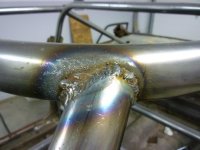
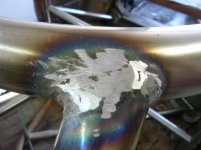
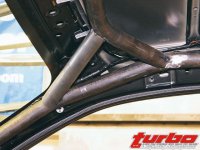
This is one place that we just agree to disagree. I deal with structural welds on some fairly large projects that are done to high standards. At the least they are visually inspected with a good percentage being mag particle or UV dye tested. The critical welds must pass ultrasonic or radiographic testing. In this case, the pipe should fit well and be beveled to obtain a 45 degree bevel. It will not be a full penetration weld but can be a pre qualified partial pen weld. To be a pre-qualified full pen weld, you must either have a backer bar with a root opening or a backer weld that is arc gouged to obtain good base metal. neither one of those can be done in this case.
With this being thin wall tubing, it is not as critical and will work fine without the steps required for thicker material. There is still the safety issue involved however, and even though the odds are in his favor, the fact remains that he might need to depend on this cage for his life. A lot depends on what he is doing with it.
A drag racer might never have a crash in their entire career while a dirt tracker will have at least 2 or 3 in a season. A rock crawler will take a hit on the cage every time they go out. Poor welds might be able to take a hit, maybe even two but they will fail if pushed where a good quality weld will not. I don't have anything against someone learning how to weld, far from it, but I do not think that a roll cage is the appropriate place to learn the techniques required. Typical welds on a cage include down hand, uphill, downhill and overhead. That is a lot of new positions to learn if you have never done them before.
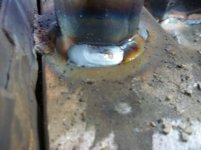
The last weld that he posted (cage to frame weld) looks OK but is also in the easiest position to weld in (down hand). If his weld in the other positions looked similar, I would still have a problem with the pipe fitment but would let it go due to the weld quality. In this case, both items are an issue and at least one of them should be corrected.