To avoid these ads, REGISTER NOW!

Casting Aluminum

R.Anderson

Well-known member
Joined
May 26, 2012
Messages
906
Location
Wisconsin
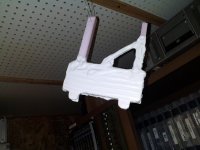
Did a search didn't see a thread on this so thought I take some pictures of some aluminum castings I'm getting ready for. Investment/lost foam casting is what I am doing here. Name plates, some blocks to machine into some plastic injection molds,and a small milling vise (no pictures of the last two yet).

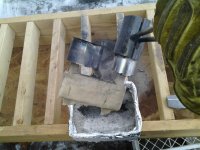
I'm trying a premixed joint compound, I grabbed this box by mistake thinking it was the just add water type oops but I'm trying it anyways. With my other castings several years ago I used a texture compound or joint compound can't remember and it worked well.

I mixed in more water to some for the first few coats, makes it easier to get in the small detail niches. As it dried it formed cracks in the 90 degree corners. I just added some in and over the cracks that take care of it.

This is as far as I am now on this. I will be brushing on another coat or two. I plan on casting them during Christmas break.
 

Attachments

  • 1210130544.jpg
    1210130544.jpg
    134.5 KB · Views: 490
  • 1210130544a.jpg
    1210130544a.jpg
    127 KB · Views: 383
  • 1210130545.jpg
    1210130545.jpg
    127.4 KB · Views: 346
  • 1212132155.jpg
    1212132155.jpg
    130.5 KB · Views: 355
  • 1212132151.jpg
    1212132151.jpg
    131.2 KB · Views: 342
  • 1212132032b.jpg
    1212132032b.jpg
    135.4 KB · Views: 334
  • 1212132158.jpg
    1212132158.jpg
    143.3 KB · Views: 346
To avoid these ads, REGISTER NOW!

ADSR

Well-known member
Joined
Jan 12, 2013
Messages
10,713
sub'd!

Awesome! I can't wait to see how it turns out!
 

DeadSock

Well-known member
Joined
Sep 17, 2006
Messages
161
Location
Sterling, AK
Post a pic of your foundry. I'm hoping to one put together this spring.
Also, what are you using for source material?
 

Kevin54

MEMBER EMERITUS
Joined
Jan 12, 2005
Messages
29,341
Location
Urbana, Ohio
Interesting. I wouldn't think joint compound would handle the heat. Looking forward to seeing how this turns out.
 

Thumper68

Well-known member
Joined
May 16, 2013
Messages
5,134
Location
Duluth MN
I would also like to know what you are using for source material, many years ago I had to cast a part for my uncles sail boat and the only material I had on hand were Al cans, took a ton of them but the part turned out well and is still in use.
 

toms73novass

Well-known member
Joined
Nov 10, 2005
Messages
483
Location
grand island, ny
I use old hard drive bodies, old car rims. Anything that is cast originally will make a nice pour. Old cans have little alloy in them and are much softer, however, can work in many applications.

If using unknow aluminum, I highly recommend cleaning a spot and putting vinegar on it and see if it bubbles or turns black. If so STAY AWAY, it has Magnesium in it and will burn down your furnace!
 

James_B

Well-known member
Joined
Jun 24, 2013
Messages
674
Location
Nova Scotia, Canada (started in Brisbane, Australi
I'm very interested in this. It's something I want to try.
I have a Form One 3D printer, and like a lot of people on the Form Labs forum, I am eagerly awaiting the promised release of a "burn out" resin compound for creating the masters for "lost wax" castings using Form One 3D printers.

Another interesting resource is this YouTube account detailing the entire process involved in doing sand castings in a backyard foundry ... from patern making to building the furnace. At the moment, there's something like 35 uploaded videos in the series.
 
OP
R

R.Anderson

Well-known member
Joined
May 26, 2012
Messages
906
Location
Wisconsin
Very nice! You didn't happen to learn that trick from www.buildyouridea.com did you?
That website was one of my main inspirations to do home casting/cnc. anyone else interested can also check out www.backyardmetalcasting.com for more info.

First time seeing this web site. Lionel's web site www.backyardmetalcasting.com I have checked out in the past.

I did a few sand castings, didn't like the results it works but not great. So I looked into lost foam casting and looked at several posted successful lost foam castings on the web.
 
OP
R

R.Anderson

Well-known member
Joined
May 26, 2012
Messages
906
Location
Wisconsin
I use old hard drive bodies, old car rims. Anything that is cast originally will make a nice pour. Old cans have little alloy in them and are much softer, however, can work in many applications.

If using unknown aluminum, I highly recommend cleaning a spot and putting vinegar on it and see if it bubbles or turns black. If so STAY AWAY, it has Magnesium in it and will burn down your furnace!

Zinc is another one I found that burns violently at high temps when exposed to air. I test unknown scrap by scraping off slivers then hold the sliver in tweezers or needle nose and take a propane torch to it if it just melts its safe to use, if it burns leaving white or yellow soot do not use it.

I have only cast zinc in metal molds I don't think lost foam method will work due to temp of the molten metal. Again just don't over heat zinc it will burn.

I have used pop cans but that is a slow process and a dirty one as well. I use cleaner scrap that contains more aluminum, cpu heat sinks, window frames, hard drive chassis as mentioned, etc. Aluminum rims I have some saved for this but waiting to come up with an idea how break them up into small pieces with little work. I have not tried a plasma cutter I should. One Idea I read they put a rim in a small fire heating it up fairly hot and smack it up a bit with a 3 lb hammer into chunks.
 
Last edited:
OP
R

R.Anderson

Well-known member
Joined
May 26, 2012
Messages
906
Location
Wisconsin
Interesting. I wouldn't think joint compound would handle the heat. Looking forward to seeing how this turns out.


It just needs to hold its shape once the foam has been melted and replaced with molten aluminum, the sand that gets packed around it prior to casting holds the weight. I will be posting pic of this as time comes.
 

A_Pmech

Well-known member
Joined
May 8, 2007
Messages
8,002
Location
IL
If you care at all about the quality of your castings, don't use scrap. Or at least not mixed scrap. Break up a transmission housing or cylinder head and use that, but don't use aluminum cans, screen doors and such junk. Besides having a massive dross problem on your hands, mystery scrap isn't likely to pour well.

Give your project a chance to succeed and use some good material. :)
 
OP
R

R.Anderson

Well-known member
Joined
May 26, 2012
Messages
906
Location
Wisconsin
If you care at all about the quality of your castings, don't use scrap. Or at least not mixed scrap. Break up a transmission housing or cylinder head and use that, but don't use aluminum cans, screen doors and such junk. Besides having a massive dross problem on your hands, mystery scrap isn't likely to pour well.

Give your project a chance to succeed and use some good material. :)

Would love too use transmissions or heads but I don't have any of those laying around. Scrap auto parts are scarce around here with two big scrap yards operating in the area and both have a strict policy not to sell scrap to the public. I have a friend that works at one, he can't even buy any thing anymore that comes in. You would be surprised at what comes in: anvils, aluminum fishing boats that are in good shape, working boat motors that are well worth more than scrap. Its unreal what people throw away or scrap. When I heard him say anvils I was a little sick to my stomach, I didn't dare ask what shape they where in.

I even tried an add on crags list for unwanted/junk transmissions for the aluminum for casting and gears for art few responses but they all wanted a ungodly amount for em. Kinda the same thing for my broken unwanted microwaves craigs list add when I was gathering for transformers and blowers for a couple of projects one was for a foam cutter. I got a few, but a lot of the responses wanted too much money for em. One offered a broken nonworking microwave for 20 bucks firm :lol:

So I use what I can get my hands on. I Don't go from scrap to casting to risky for a bad pour. I turn scrap into ingots and then go from there. When I say clean aluminum I mean nothing painted or coated (like pop cans) So far this works for me except for when I unknowingly ran into some zinc scrap that was fun. From then on I did the sliver melt or burn test on unknown scrap no problems since. When I fire up the furnace I pour my castings then turn what scrap I have into ingots.

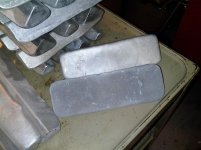
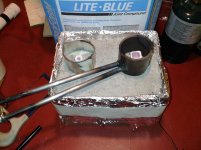
In the first two pictures, the dark grey ingot I made from pop cans 5-6yrs ago the other from clean scrap. Needless to say I never used pop cans again.

The other shows my tiny zinc ingots and the ingot mold for em. Two brass ingots and all of my aluminum ingots.
 

Attachments

  • 1214131503a.jpg
    1214131503a.jpg
    139.4 KB · Views: 209
  • 1214131504a.jpg
    1214131504a.jpg
    135 KB · Views: 180
  • 1214131504.jpg
    1214131504.jpg
    139.2 KB · Views: 208
OP
R

R.Anderson

Well-known member
Joined
May 26, 2012
Messages
906
Location
Wisconsin
Here is the foam cutter I made for making foam patterns for casting.

Its a real beauty ain't it :lol: but hey it works.
 

Attachments

  • 1212132024.jpg
    1212132024.jpg
    139.3 KB · Views: 176
  • 1212132025.jpg
    1212132025.jpg
    135.6 KB · Views: 154
  • 1212132025a.jpg
    1212132025a.jpg
    133 KB · Views: 152
  • 1212132028.jpg
    1212132028.jpg
    138.3 KB · Views: 146
  • 1212132026a.jpg
    1212132026a.jpg
    139.2 KB · Views: 128
OP
R

R.Anderson

Well-known member
Joined
May 26, 2012
Messages
906
Location
Wisconsin
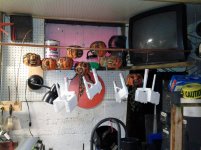
Here are the vise and plastic injection mold parts. This is the first time making parts that I will be machining so I hoping it works out.

Some of the parts a hanging out with a few of my Halloween props I'm making for next year.
 

Attachments

  • 1214131508a.jpg
    1214131508a.jpg
    140.1 KB · Views: 118
  • 1214131508b.jpg
    1214131508b.jpg
    138.2 KB · Views: 122
  • 1213132255.jpg
    1213132255.jpg
    144.1 KB · Views: 117
  • 1213132247.jpg
    1213132247.jpg
    136 KB · Views: 127
  • 1213132255a.jpg
    1213132255a.jpg
    137.5 KB · Views: 121
  • 1214131508.jpg
    1214131508.jpg
    139.7 KB · Views: 116
  • 1214131506.jpg
    1214131506.jpg
    146.5 KB · Views: 131

James_B

Well-known member
Joined
Jun 24, 2013
Messages
674
Location
Nova Scotia, Canada (started in Brisbane, Australi
Here is the foam cutter I made for making foam patterns for casting.

Its a real beauty ain't it :lol: but hey it works.
I had a great hot wire foam cutter that I constructed out of nichrome resistance/heating wire and a transformer from an old British Scope soldering iron (3V @ 30A). It was all 240V stuff, so I left it in Australia when I moved here. These days, my only hotwire foam cutter is a really cheap unit I got from a craft shop that runs on 2 D cells.
 

pop pop

Well-known member
Joined
Apr 1, 2010
Messages
2,859
Location
Virginia
R.A., with your experience casting Al, I assume you know about moisture and cast aluminum. If not, I would be amiss if I didn't forewarn. Molten Al when exposed to trapped moisture (vapor or microscopic on a mold surface!) causes a steam explosion. The steam atomizes the molten Al which triggers a secondary explosion using the Al as the source of energy. It is usually fatal and always catastrophic, even if rare. We used to use a mold release and ALWAYS preheat molds to above 250 degrees before making any pour. FWIW, I had 30 years with one of the biggest Al companies working in primary and foundry units for many of those years.

Be safe!
 
To avoid these ads, REGISTER NOW!

garboui

Well-known member
Joined
Jun 30, 2011
Messages
999
Location
Southern Ontario
R.A., with your experience casting Al, I assume you know about moisture and cast aluminum. If not, I would be amiss if I didn't forewarn. Molten Al when exposed to trapped moisture (vapor or microscopic on a mold surface!) causes a steam explosion. The steam atomizes the molten Al which triggers a secondary explosion using the Al as the source of energy. It is usually fatal and always catastrophic, even if rare. We used to use a mold release and ALWAYS preheat molds to above 250 degrees before making any pour. FWIW, I had 30 years with one of the biggest Al companies working in primary and foundry units for many of those years.

Be safe!

After reading this thread I've been considering trying to cast some ornamental lugs for some speaker stands. Your cautionary post is somewhat worrying though. Does this potential hazard depend on scale? Obviously matchbox car sized parts wouldn't create too bug of a disaster, but I am more concerned about some fist/softball sized parts (volume wise) I am considering as firsts.
 
OP
R

R.Anderson

Well-known member
Joined
May 26, 2012
Messages
906
Location
Wisconsin
R.A., with your experience casting Al, I assume you know about moisture and cast aluminum. If not, I would be amiss if I didn't forewarn. Molten Al when exposed to trapped moisture (vapor or microscopic on a mold surface!) causes a steam explosion. The steam atomizes the molten Al which triggers a secondary explosion using the Al as the source of energy. It is usually fatal and always catastrophic, even if rare. We used to use a mold release and ALWAYS preheat molds to above 250 degrees before making any pour. FWIW, I had 30 years with one of the biggest Al companies working in primary and foundry units for many of those years.

Be safe!

Good waring, reminds me to warn about melting scrap. Make sure the scrap is completely dry. Steam explosion can happen when a little water manages to make it under molten aluminum when adding scrap.

I believe Pop Pop is talking about casting aluminum in metal molds. When you sand cast metals you have green sand (uses water as the binder) and Synthetic Sand such as Petrobond (uses oil as a binder) When the molten metal is poured steam/gas is created it vents through the sand and vent holes (if added)
The method I use the joint compound is dry enough when the molten metal is poured what little steam that is created is vent out into the sand around it. Also when you pour the aluminum the foam melts instantly floats on top of the aluminum, as the cavity fills it burns off.
 
OP
R

R.Anderson

Well-known member
Joined
May 26, 2012
Messages
906
Location
Wisconsin
Post a pic of your foundry. I'm hoping to one put together this spring.
Also, what are you using for source material?

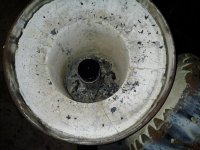
Ill have pics of it when I fire it up in a couple of weeks. Just to warn you its kinda ugly, old, used and abused. I want to build a new one but this one is holding up and can't bring myself to replace it when it still works. Portland cement mixed with natural clay is the refractory I made for it and I can't believe its held up as long as it did.

Any one here built one? any pics?
 

pop pop

Well-known member
Joined
Apr 1, 2010
Messages
2,859
Location
Virginia
After reading this thread I've been considering trying to cast some ornamental lugs for some speaker stands. Your cautionary post is somewhat worrying though. Does this potential hazard depend on scale? Obviously matchbox car sized parts wouldn't create too bug of a disaster, but I am more concerned about some fist/softball sized parts (volume wise) I am considering as firsts.

Good waring, reminds me to warn about melting scrap. Make sure the scrap is completely dry. Steam explosion can happen when a little water manages to make it under molten aluminum when adding scrap.

I believe Pop Pop is talking about casting aluminum in metal molds. When you sand cast metals you have green sand (uses water as the binder) and Synthetic Sand such as Petrobond (uses oil as a binder) When the molten metal is poured steam/gas is created it vents through the sand and vent holes (if added)
The method I use the joint compound is dry enough when the molten metal is poured what little steam that is created is vent out into the sand around it. Also when you pour the aluminum the foam melts instantly floats on top of the aluminum, as the cavity fills it burns off.

Correct RA. Usually CI molds except for the exotic methods not in reference here.
Garb, don't believe scale would have much to do with it, although research continued when I retired. The amount of energy in even a small amount of molten aluminum is tremendous. (It is used for rocket fuel) The likelihood of the event happening is not great, just disastrous when it does. I've had steam "pops" and minor burns many times. Have only seen the results after the secondary explosions. Distroyed complete casting plants.
On the other hand, every automotive part made of Al is usually die cast -- metal molds! Just read up on it and follow the practices you find as recommended. Just don't make steam. Can't relate to sand cast and will tip to RA's experience.
 

A_Pmech

Well-known member
Joined
May 8, 2007
Messages
8,002
Location
IL
That's unfortunate you can't get transmissions and cylinder heads, but explains what you're up to with the other scrap.

It looks like your ingots are clean, so you shouldn't have any trouble there. Carry on!

I'm looking forward to seeing your results.

:)
 

zkling

Well-known member
Joined
Jan 23, 2007
Messages
16,939
O man, your post is really getting me excited, and making me regret getting rid of my foundry setup. :sad:

Ill have pics of it when I fire it up in a couple of weeks. Just to warn you its kinda ugly, old, used and abused. I want to build a new one but this one is holding up and can't bring myself to replace it when it still works. Portland cement mixed with natural clay is the refractory I made for it and I can't believe its held up as long as it did.

Any one here built one? any pics?

Yea post up some pics of your foundry if you can. What is your pouring capacity? How do you fire it?

I use to be real big into casting and forging. Started with the good old flower pot furnace and then finally built a proper one a few years later. Went from charcoal to propane to electric then finally waste oil, but I didn't use a homemade burner, just a modified commercial Beckett burner. :beer:

I understand your scrap source prediciments. Back when I was casting ~3+ years ago. Scraper weren't nearly as prolific and crazy as they are today. You could easily find aluminum blocks and heads sitting at the curb for good raw stock. Don't even get me started on bronze. :willy_nil
 
Last edited:
OP
R

R.Anderson

Well-known member
Joined
May 26, 2012
Messages
906
Location
Wisconsin
Correct RA. Usually CI molds except for the exotic methods not in reference here.
Garb, don't believe scale would have much to do with it, although research continued when I retired. The amount of energy in even a small amount of molten aluminum is tremendous. (It is used for rocket fuel) The likelihood of the event happening is not great, just disastrous when it does. I've had steam "pops" and minor burns many times. Have only seen the results after the secondary explosions. Distroyed complete casting plants.
On the other hand, every automotive part made of Al is usually die cast -- metal molds! Just read up on it and follow the practices you find as recommended. Just don't make steam. Can't relate to sand cast and will tip to RA's experience.

Is this a Die casting machine explosion or something else?

Is it just steam that causes the explosion like a boiler explosion or is it a chemical reaction explosion triggered by steam explosion? I know little about die casting and am just wondering, you have mentioned rocket fuel, the only one I am familiar with that contains aluminum is solid rocket fuel made of Ammonium perchlorate(oxidizer) and aluminum powder(fuel).
I'm a bit of a pyro if you can't tell:FIREdevil
 
OP
R

R.Anderson

Well-known member
Joined
May 26, 2012
Messages
906
Location
Wisconsin
O man, your post is really getting me excited, and making me regret getting rid of my foundry setup. :sad:


Yea post up some pics of your foundry if you can. What is your pouring capacity? How do you fire it?

I use to be real big into casting and forging. Started with the good old flower pot furnace and then finally built a proper one a few years later. Went from charcoal to propane to electric then finally waste oil, but I didn't use a homemade burner, just a modified commercial Beckett burner. :beer:

I understand your scrap source prediciments. Back when I was casting ~3+ years ago. Scraper weren't nearly as prolific and crazy as they are today. You could easily find aluminum blocks and heads sitting at the curb for good raw stock. Don't even get me started on bronze. :willy_nil

Propane with a homemade forced air burner, I have tired waste oil but I found it to be a real mess. Capacity not really sure, my homemade steel crucibles are made of 4" x4" tubing 1/4" wall 8" -12" tall. I when I build a new furnace I'm really thing of making it bigger to increase capacity.

Right, copper and copper alloys(brasses and bronze) are like gold these days. There has been cases of houses that have been striped of the copper wiring, some power lines, and even urns from cemeteries, its getting sad.
 

KerryH

Well-known member
Joined
Jun 23, 2013
Messages
113
Location
Ga
I've got a project that I've been itching to do, and it would need to be cast aluminum.

I've never done it before so I will be watching this thread for tips and ideas!
 

EdT

Well-known member
Joined
Sep 21, 2010
Messages
1,104
Location
North Georgia
One of the best things I have ever seen on casting is done by a guy in England who has taken the time (a lot I would judge) to post a bunch of home casting instructional videos. He also has videos on machining the castings and making them into working engines of various types. Take a look at the MYFORDBOY site on you tube. Just Google MYFORDBOY and you'll find it.
 
OP
R

R.Anderson

Well-known member
Joined
May 26, 2012
Messages
906
Location
Wisconsin
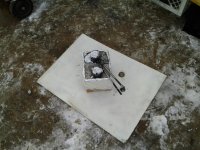
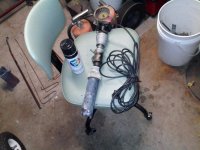
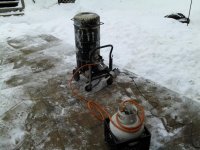
Pictures of the furnace and tools used.

I need to replace the end pipe on the burner its getting a little beat up.
 

Attachments

  • 1226131439.jpg
    1226131439.jpg
    146.5 KB · Views: 63
  • 1226131337.jpg
    1226131337.jpg
    140.6 KB · Views: 66
  • 1223131632.jpg
    1223131632.jpg
    134.3 KB · Views: 58
  • 1223131633.jpg
    1223131633.jpg
    138 KB · Views: 60
  • 1223131635.jpg
    1223131635.jpg
    146.8 KB · Views: 61
  • 1223131636a.jpg
    1223131636a.jpg
    144.9 KB · Views: 65
  • 1226131357.jpg
    1226131357.jpg
    143.4 KB · Views: 70
Last edited:
OP
R

R.Anderson

Well-known member
Joined
May 26, 2012
Messages
906
Location
Wisconsin
`

Some more pictures
 

Attachments

  • 1226131450.jpg
    1226131450.jpg
    137.1 KB · Views: 81
  • 1226131516.jpg
    1226131516.jpg
    141.6 KB · Views: 66
  • 1226131440a.jpg
    1226131440a.jpg
    143 KB · Views: 61
  • 1223131630a.jpg
    1223131630a.jpg
    139.9 KB · Views: 61
  • 1223131634a.jpg
    1223131634a.jpg
    135.5 KB · Views: 60
  • 1226131440.jpg
    1226131440.jpg
    147.5 KB · Views: 63
  • 1226131439a.jpg
    1226131439a.jpg
    147.8 KB · Views: 56
OP
R

R.Anderson

Well-known member
Joined
May 26, 2012
Messages
906
Location
Wisconsin
Kira's name plate was a poured a little cold. At first I thought I was going to have to start over on this one. Tesla's name plate poured just fine. The vise parts didn't turn out. The sand gave enough for the mud coat to crack and ya no good.
I wired brushed Kira's name plate, Tesla's is not.
 

Attachments

  • 1226131619.jpg
    1226131619.jpg
    140.1 KB · Views: 110
  • 1226131631.jpg
    1226131631.jpg
    132.6 KB · Views: 125
To avoid these ads, REGISTER NOW!
Top Bottom