Wow.. you builder did you a great service by running all that in! He just connected it up for phone, which is all most people required, but at least you have a structured wiring installation - the skeleton, if you will.
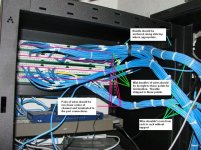
Here's my structured wiring panel as an example of what you can do. The house was never equipped with anything more than the standard telephone loop when it was built, I've added on the wiring to support my needs (ie: office, gaming, etc) and my office location has moved (due to kids). The panel has also undergone a few revisions over the years as I grew the network and consolidated the network and telephone to one location. It's pretty much outgrown the board and needs some neatening up, especially for when I add the satellite (RG6) network, but that's still a year or so away).
I like to have lots of extra wire at the panel, just is case I screw something up and need a fix. When I wired up the new office, I had a bit extra wire that I didn't want to cut back more, hence the difference in size between the loops.
The office has an adundance of RJ45 jacks to support pretty much any configuration I might require since I work from home quite a bit. There's 14 ports for a 16x20 room!

The rest of the house has at least one jack in every room. I want to add another jack to the living room for when I add a kid's computer and then I'll probably want to add a couple in the basement plus another for the shop (need to replace the phone line there this summer so will bury some Cat5).
No wireless... not yet anyway. Everything I own is or can be hard wired and that's my preference. BIL is always harping on at me that his iPhone doesn't connect to wifi at my house. So buy me a wireless router and it will, I tell him. LOL
The incoming phone line terminates at RJ11 jacks, one for each pair (4 total in a cat5 cable). Then, I took one insert for my bix panel and made loops of wire connected to pairs of punchdowns (12 for the primary line, 4 ea for the additional lines). The pigtails were then wired to a second set of RJ11 jacks and a small patch cord made to connect the two jacks. This gives an internal demark, a way to cross connect lines, etc. Flexibility. The incoming cat5 cables from the various rooms were then split and wired (green and orange pairs) to a 24port bix RJ45 panel and to the upper insert on my telephone panel. Small bits of excess wire are then used to inconnect the lower supply to the upper destination. Again, the cross connect possibilities are endless, it's easy to disconnect a phone, temporarily reassign a phone to a different line, etc.
There are a few extra wires, particularly phone wires, that are loose, mostly because I wanted to leave room for expansion - I knew I'd be adding more cabling and didn't want to tie up all ports with pairs I'd never use. Ideally they should be terminated somewhere.