To avoid these ads, REGISTER NOW!

Ceiling Joists

WordMan

ALLIANCE MEMBER
Joined
Jul 4, 2018
Messages
3,772
Location
Harriman, Tennessee
Just had a thought...

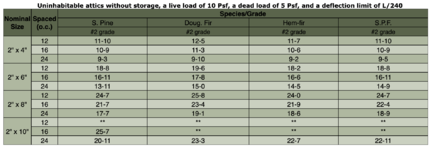
I have a stick built roof (rafters, not trusses) with 2X6 ceiling joists and a central supporting wall. I want to get rid of the supporting wall. Could I sister the joists with Douglas Fir 2X10s to achieve a 24' span? We have no storage in the attic.


1701841638371.png
 
To avoid these ads, REGISTER NOW!

billconner

Well-known member
Joined
Jul 20, 2021
Messages
6,964
Location
Thousand Islands NYS
Is there a ceiling or are these just rafter ties?

What is spacing of 2x6's?

Probably you can but wanted a little more data before saying for sure.
 

strutaeng

Well-known member
Joined
Dec 12, 2011
Messages
2,270
Location
Dallas, TX
Probably Yes. I used 2x12 @ 24" in new construction ceiling joists to span about 22'-6"- ish, but that was mostly to get more insulation space for r38 and to limit the deflection. Used 5/8" gypsum board.

Can you get 2x10s in there in a single piece? Pieces that long are heavy and unwieldy.
 
OP
W

WordMan

ALLIANCE MEMBER
Joined
Jul 4, 2018
Messages
3,772
Location
Harriman, Tennessee
Probably Yes. I used 2x12 @ 24" in new construction ceiling joists to span about 22'-6"- ish, but that was mostly to get more insulation space for r38 and to limit the deflection. Used 5/8" gypsum board.

Can you get 2x10s in there in a single piece? Pieces that long are heavy and unwieldy.

As I am moving some other interior walls around, and thus the existing drywall would be a hodge-podge of repairs, etc., I was thinking of stripping all the drywall off the ceiling which should give me room to manipulate the new joists into place.
 
Last edited:

duneslider

Well-known member
Joined
Jan 20, 2013
Messages
2,262
Location
Riverton, Utah
Getting dimensional lumber that size anymore can be pretty tough to do. You may be happier using an engineered product like I-joists to do this. Worth looking at both ways anyway. I-joist are for sure much lighter and easier to handle.
 

Firebrick43

Well-known member
Joined
May 12, 2015
Messages
14,035
Location
West central Indiana
There is a ceiling. 2x6s are on 16 centers.
Then 2x10s would be great

As I am moving some other interior walls around, and thus the existing drywall would be a hodge-podge of repairs, etc., I was thinking of stripping all the drywall of the ceiling which should give me room to manipulate the new joists into place.
That would be the best. The 2x6 would actually be doing nothing once you put the 2x10s in. You could salvage them for other purposes
 

Kaizen

Well-known member
Joined
Jan 9, 2015
Messages
6,948
Location
New England
OP you did not say how long of a 2x you were thinking of installing. As you should have these on top of the top plates on each end if you are going full length, it is difficult to install if your roof is slanting down at those spots. Even if you cut the right slope the length will be shorter to get them over the top plate. for example if you have 2x4 top plate and 20 feet between them, ideal length would be about 20'7" with 3.5 inches on top of each plate. As your ceiling joists only allow about 15 inches of space you would probably end up cutting shorter and having only a few inches on each top plate.
I think i'd leave in place and look into LVL or use 3/4 plywood cut into strips. use a laser or string line when installing and think about lowering below exiisting ceiling joists a half inch so you don't have to fight to get them all flat....guessing this is an old house.
One last thing to consider is insulation. If you are insulating at the ceiling don't put the sister material all on one side. Alternate them so one bay will still fit insulation you use. If you put them all on the same side and using stuff like rockwool you might need to cut each piece instead of just half of them.
 

billconner

Well-known member
Joined
Jul 20, 2021
Messages
6,964
Location
Thousand Islands NYS
If you're willing to remove ceiling and 2x6 joists, use the 2x10s but higher, so they're just short enough to be easy to lift and attach to rafters, and not try to shift them up onto top plates. It puts a little more load on rafters but I'm thinking you don't have high snow loads in TN.
 

Hank11

Well-known member
Joined
Aug 19, 2019
Messages
1,151
Location
Tennessee
If you have help, lay the 2x10s flat onto the top plates and the middle wall then roll them up into place. Three or four stout guys would be good. If you can’t clear the middle wall, cut it out in pieces one bay at a time, then slide in the new wood. This after you dub the upper corners off to clear the roof decking. I would not take any of the existing joists out, but sister the new joists directly to them.
 
Last edited:

Dig Doug

Well-known member
Joined
Apr 16, 2018
Messages
1,105
I would mimic this

& use T 50 screws not nails, screw from both sides…. If it’s old wood use a pilot drill bit to not split any existing material
IMG_9203.jpeg
 

frankd

Well-known member
Joined
Aug 5, 2014
Messages
677
Location
Long Island, NY
We have a 20x30 garage and the ceiling joists/rafter ties are 2x10 spanning 20 feet. 16 inches on center. At the time we were told that 2x10's shouldn't span more than 20 feet, especially if we'll be storing stuff in the "attic" space. I like dunesliders idea of using engineered lumber.
 

KenC

Well-known member
Joined
Dec 20, 2009
Messages
2,579
You don't specify the length, just the width. But, it the length isn't overly long, you might consider a single engineered beam running down the middle with joist hanger on each side to accept the existing 2x6 joists. I've done this on a couple of remodels to convert two smaller rooms, LR and den, into a more modern living area.
With the drywall down it's pretty simple, at least in the telling. Snap two chalks line in the center of the area, spaced apart the same width as the new beam +1/4" or so. Mark the joists with a speed square at each chalk line and cut. I prefer a circular saw but a sawsall type will work, I just find accurate cuts are easier with a circular saw. Insert beam and add hangars.
 

Hank11

Well-known member
Joined
Aug 19, 2019
Messages
1,151
Location
Tennessee
You don't specify the length, just the width. But, it the length isn't overly long, you might consider a single engineered beam running down the middle with joist hanger on each side to accept the existing 2x6 joists. I've done this on a couple of remodels to convert two smaller rooms, LR and den, into a more modern living area.
With the drywall down it's pretty simple, at least in the telling. Snap two chalks line in the center of the area, spaced apart the same width as the new beam +1/4" or so. Mark the joists with a speed square at each chalk line and cut. I prefer a circular saw but a sawsall type will work, I just find accurate cuts are easier with a circular saw. Insert beam and add hangars.

I've done this but you need to do something to hold the walls in place when you cut everything loose. I used chains around 2X material on the outside of the stud walls.
 

firebirdparts

Well-known member
Joined
Jun 8, 2016
Messages
10,618
Location
Kingsport, TN
I think you guys talking about hanging this from above are flirting with extreme overkill. There are going to be a lot of situations where a really light connection from the center of the ceiling to the roof at each joist is going to be adequate.

Obviously a truckload of 24 foot 2 by 10's is also a lot of money.
 

Innovate1

Well-known member
Joined
Jul 28, 2014
Messages
4,288
Location
Illinois near St. Louis, Missouri
I've done this but you need to do something to hold the walls in place when you cut everything loose. I used chains around 2X material on the outside of the stud walls.
If the beam can be inserted in the attic from the gable end then the joists can be attached before the walls come down and no need for a different support midway through. This would likely need some additional studs in the walls at the ends to support the beam.
 
Last edited:

Innovate1

Well-known member
Joined
Jul 28, 2014
Messages
4,288
Location
Illinois near St. Louis, Missouri
I think you guys talking about hanging this from above are flirting with extreme overkill. There are going to be a lot of situations where a really light connection from the center of the ceiling to the roof at each joist is going to be adequate.

Obviously a truckload of 24 foot 2 by 10's is also a lot of money.
This ^. if the attic will not be used for storage adding a vertical tie to make a king truss should be fine. Just need to make sure the joist to rafter connection is good along with the other connections. Should be pretty stout already to support the roof but should be checked.
 
To avoid these ads, REGISTER NOW!

Firebrick43

Well-known member
Joined
May 12, 2015
Messages
14,035
Location
West central Indiana
This ^. if the attic will not be used for storage adding a vertical tie to make a king truss should be fine. Just need to make sure the joist to rafter connection is good along with the other connections. Should be pretty stout already to support the roof but should be checked.
In post 16 they show a king post with the notation of up to 16’.

The OP garage is 24’ which would need to be a Howe.

And then there is incorrect info post led about using screws (t50???)which is a bad idea as well.

I have built a few site built trusses with ply gussets to engineered plans and the want lots of number 6D nails. As in 50 per side for each gusset. They want lots of little load point spread out, not big screws. Same reason they use mending plates for factory trusses.

It’s hell enough to do so on the ground flat let alone built up in the rafters
 

Innovate1

Well-known member
Joined
Jul 28, 2014
Messages
4,288
Location
Illinois near St. Louis, Missouri
In post 16 they show a king post with the notation of up to 16’.

The OP garage is 24’ which would need to be a Howe.

And then there is incorrect info post led about using screws (t50???)which is a bad idea as well.

I have built a few site built trusses with ply gussets to engineered plans and the want lots of number 6D nails. As in 50 per side for each gusset. They want lots of little load point spread out, not big screws. Same reason they use mending plates for factory trusses.

It’s hell enough to do so on the ground flat let alone built up in the rafters
So some picture says 16 - could be just what some company makes, not a technical limitation. Besides, the Howe isn't even the only one that includes 24 in the picture. If the rafters can support the span (they are existing) and the joists can also then the king post only adds compressing stress on the rafters and tension on the joists with the added ceiling weight. The given sizes are likely for using smaller lumber for efficiency and cost but in this case using less pieces and less gussets would save a lot of effort.

I have built trusses for a pole barn using 6d nails on 2" grid all driven by hand. But today you could do that quickly with a nail gun.

Most of the members are already in place. I don't see this option being that bad as far as effort goes.
 

billconner

Well-known member
Joined
Jul 20, 2021
Messages
6,964
Location
Thousand Islands NYS
Half the ceiling and insulation - 5psf (no storage what do ever,) or 60plf. Storage would quadruple or more, and seems inevitable in the life 8f ty he building.

In TN, it would be like increasing each rafter span a foot, not a lot. More like 3 to 5 feet with storage. Don't know what rafters are now. Do know many older garages have rafters undersized by current code, so if changing with permit, might cause problems.

The 2x10 solution is brute force simple. I'm also skeptical if truss-worthy connections with oveylapping 2x6s and who knows what kind of alignment between rafters and joists. Very unlikely king posts can ve plumb, which would raise eyebrows. And trusses always seem to have a pretty good connection where the rafters meet. How do you do that through a ridge board?

Building your own trusses is fine. Making a truss in situ out of materials of unknown properties and not in one plane is to risky for me.
 

Innovate1

Well-known member
Joined
Jul 28, 2014
Messages
4,288
Location
Illinois near St. Louis, Missouri
Half the ceiling and insulation - 5psf (no storage what do ever,) or 60plf. Storage would quadruple or more, and seems inevitable in the life 8f ty he building.

In TN, it would be like increasing each rafter span a foot, not a lot. More like 3 to 5 feet with storage. Don't know what rafters are now. Do know many older garages have rafters undersized by current code, so if changing with permit, might cause problems.

The 2x10 solution is brute force simple. I'm also skeptical if truss-worthy connections with oveylapping 2x6s and who knows what kind of alignment between rafters and joists. Very unlikely king posts can ve plumb, which would raise eyebrows. And trusses always seem to have a pretty good connection where the rafters meet. How do you do that through a ridge board?

Building your own trusses is fine. Making a truss in situ out of materials of unknown properties and not in one plane is to risky for me.
I agree that it's likely to get storage at some point so would be good to try to size for that. Also that doing this depends on things lining up in the existing framing. The ridge board could be handled by a large gusset just below the ridge board that covers both rafters and the king post.

But for loading you don't just add the ceiling load to the rafter load. That is overly conservative so I guess you could but that's not the actual loading or stress.
 
OP
W

WordMan

ALLIANCE MEMBER
Joined
Jul 4, 2018
Messages
3,772
Location
Harriman, Tennessee
I agree that it's likely to get storage at some point so would be good to try to size for that. Also that doing this depends on things lining up in the existing framing. The ridge board could be handled by a large gusset just below the ridge board that covers both rafters and the king post.

But for loading you don't just add the ceiling load to the rafter load. That is overly conservative so I guess you could but that's not the actual loading or stress.

This is in my living room/dining room area, and it absolutely will not ever get storage (it's not easily accessible).
 

billconner

Well-known member
Joined
Jul 20, 2021
Messages
6,964
Location
Thousand Islands NYS
I agree that it's likely to get storage at some point so would be good to try to size for that. Also that doing this depends on things lining up in the existing framing. The ridge board could be handled by a large gusset just below the ridge board that covers both rafters and the king post.

But for loading you don't just add the ceiling load to the rafter load. That is overly conservative so I guess you could but that's not the actual loading or stress.
I don't see a single vertical that's taking the place of a wall doing other than supporting the joists and their DL and LL, no matter how many nails in the connections.
 

billconner

Well-known member
Joined
Jul 20, 2021
Messages
6,964
Location
Thousand Islands NYS
Didn't know it was a living room. I think I assumed garage. :(

So you probably do not want to raise ceiling. I think I would go to either 2x12s or, perhaps TJIs. TJIs would be more level and easier for one or two persons to get into place, and stay straight enough. I worry the 2x10s will deflect enough to be noticed - ok by me in a garage but not a living room.

The suggestion to install a beam, either in line with joists or - with a lot of thought on connection - maybe on top of joists. I like the ease of installing beam, connecting to joists, and then remove wall. Again I'd have to think that through. Flush with joists and joist hangers doesn't feel like a good connection for the rafter tie function. Maybe needs a steel strap across bottom.
 

firebirdparts

Well-known member
Joined
Jun 8, 2016
Messages
10,618
Location
Kingsport, TN
In post 16 they show a king post with the notation of up to 16’.

The OP garage is 24’ which would need to be a Howe.

And then there is incorrect info post led about using screws (t50???)which is a bad idea as well.

I have built a few site built trusses with ply gussets to engineered plans and the want lots of number 6D nails. As in 50 per side for each gusset. They want lots of little load point spread out, not big screws. Same reason they use mending plates for factory trusses.

It’s hell enough to do so on the ground flat let alone built up in the rafters
That’s not really a “rule” it’s something on a picture.

What makes a real difference here is roof pitch. It’s a lot easier structurally with 8/12 than 4/12. If the building is 4/12 that would’ve probably convinced me not to try the king post style.
 

i4ni

Well-known member
Joined
Jan 23, 2010
Messages
1,015
I have done this but added a large lam beam with adequate support to vault a ceilng.
 

Firebrick43

Well-known member
Joined
May 12, 2015
Messages
14,035
Location
West central Indiana
That’s not really a “rule” it’s something on a picture.

What makes a real difference here is roof pitch. It’s a lot easier structurally with 8/12 than 4/12. If the building is 4/12 that would’ve probably convinced me not to try the king post style.
No it’s not a rule but it does have some basis in it designing trusses in common construction lumber.

If you see large span king post trusses it’s usually done now days for style with larger lumber and bolted gusset plates as the stresses are concentrated into a small area

And I can’t say I have seen any true king post style trusses in 24’ long, eve timber framed. A lot of timber frames are the queen post style in those spans, which for some reason people incorrectly call king post.

But any semantics isnt going to erase the need for an engineer.

7 years ago the minimum charge for a stamped drawing by a practicing engineer was $500. I can’t imagine that it’s stayed the same and would likely be $750 plus. Using joist does not incur an engineers fees.

Menards shows a 24’ 2x10 for $55.69

$750 dollars will buy 13 of them which will do 20’ of the length of the building.

And by the time you buy quality ply for the gussets @$50 a sheet, the vertical members and a nail gun I do not see how you can save any money by converting to a truss.

And it will be a hell of a lot easier setting joist than trying to align and build a truss in situ and keeping them all in plane on the bottom cord even with a siding nailer
 

Innovate1

Well-known member
Joined
Jul 28, 2014
Messages
4,288
Location
Illinois near St. Louis, Missouri
Yeah, all things considered the 2 x 10 solution would be easier and not that expensive, especially if you count your time worth something. And less chance of an issue - hard to get that wrong while the truss requires lots of connections done right.
 

njk4o5

Well-known member
Joined
Dec 9, 2015
Messages
115
Location
Boston, MA
makes me wonder how much safety factor is in the building code.

I have a 30' span in my garage and during framing it snowed about 30" of wet heavy stuff and we only had 6 of the 2x10 rafter ties held in with a couple nails a piece and the walls didn't move an inch
 

Hank11

Well-known member
Joined
Aug 19, 2019
Messages
1,151
Location
Tennessee
Some days you get lucky. What you describe is doing its job of holding the roof and walls in place, but I'd sure re-nail those rafter ties so they are stoutly in place.

What the OP is doing needs something to hold the ceiling up (and the ceiling joists there now which are in 2 pieces) after the center wall is removed.
 
To avoid these ads, REGISTER NOW!
Top Bottom