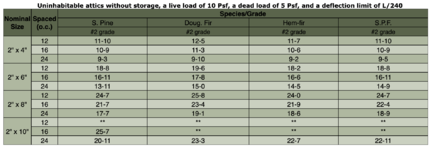
Probably Yes. I used 2x12 @ 24" in new construction ceiling joists to span about 22'-6"- ish, but that was mostly to get more insulation space for r38 and to limit the deflection. Used 5/8" gypsum board.
Can you get 2x10s in there in a single piece? Pieces that long are heavy and unwieldy.
Then 2x10s would be greatThere is a ceiling. 2x6s are on 16 centers.
That would be the best. The 2x6 would actually be doing nothing once you put the 2x10s in. You could salvage them for other purposesAs I am moving some other interior walls around, and thus the existing drywall would be a hodge-podge of repairs, etc., I was thinking of stripping all the drywall of the ceiling which should give me room to manipulate the new joists into place.
You don't specify the length, just the width. But, it the length isn't overly long, you might consider a single engineered beam running down the middle with joist hanger on each side to accept the existing 2x6 joists. I've done this on a couple of remodels to convert two smaller rooms, LR and den, into a more modern living area.
With the drywall down it's pretty simple, at least in the telling. Snap two chalks line in the center of the area, spaced apart the same width as the new beam +1/4" or so. Mark the joists with a speed square at each chalk line and cut. I prefer a circular saw but a sawsall type will work, I just find accurate cuts are easier with a circular saw. Insert beam and add hangars.
If the beam can be inserted in the attic from the gable end then the joists can be attached before the walls come down and no need for a different support midway through. This would likely need some additional studs in the walls at the ends to support the beam.I've done this but you need to do something to hold the walls in place when you cut everything loose. I used chains around 2X material on the outside of the stud walls.
This ^. if the attic will not be used for storage adding a vertical tie to make a king truss should be fine. Just need to make sure the joist to rafter connection is good along with the other connections. Should be pretty stout already to support the roof but should be checked.I think you guys talking about hanging this from above are flirting with extreme overkill. There are going to be a lot of situations where a really light connection from the center of the ceiling to the roof at each joist is going to be adequate.
Obviously a truckload of 24 foot 2 by 10's is also a lot of money.
That was one thing I meant to ask. Is this work being done with a permit? If so it likely requires an engineers ok. Really depends on the area.The hanger/king post truss can work. You may need an engineers blessing if you're doing the work with a building permit.
Nothing prescriptive about a truss home built on site with most of the material of unknown grade.That was one thing I meant to ask. Is this work being done with a permit? If so it likely requires an engineers ok. Really depends on the area.
In post 16 they show a king post with the notation of up to 16’.This ^. if the attic will not be used for storage adding a vertical tie to make a king truss should be fine. Just need to make sure the joist to rafter connection is good along with the other connections. Should be pretty stout already to support the roof but should be checked.
So some picture says 16 - could be just what some company makes, not a technical limitation. Besides, the Howe isn't even the only one that includes 24 in the picture. If the rafters can support the span (they are existing) and the joists can also then the king post only adds compressing stress on the rafters and tension on the joists with the added ceiling weight. The given sizes are likely for using smaller lumber for efficiency and cost but in this case using less pieces and less gussets would save a lot of effort.In post 16 they show a king post with the notation of up to 16’.
The OP garage is 24’ which would need to be a Howe.
And then there is incorrect info post led about using screws (t50???)which is a bad idea as well.
I have built a few site built trusses with ply gussets to engineered plans and the want lots of number 6D nails. As in 50 per side for each gusset. They want lots of little load point spread out, not big screws. Same reason they use mending plates for factory trusses.
It’s hell enough to do so on the ground flat let alone built up in the rafters
live load - snowLL capacity??
Maybe but I doubt the effect is very significant if any. The king post only adds compressive loads to the rafters and no additional bending load.The king post is adding load on the rafters, decreasing their LL capacity.
I agree that it's likely to get storage at some point so would be good to try to size for that. Also that doing this depends on things lining up in the existing framing. The ridge board could be handled by a large gusset just below the ridge board that covers both rafters and the king post.Half the ceiling and insulation - 5psf (no storage what do ever,) or 60plf. Storage would quadruple or more, and seems inevitable in the life 8f ty he building.
In TN, it would be like increasing each rafter span a foot, not a lot. More like 3 to 5 feet with storage. Don't know what rafters are now. Do know many older garages have rafters undersized by current code, so if changing with permit, might cause problems.
The 2x10 solution is brute force simple. I'm also skeptical if truss-worthy connections with oveylapping 2x6s and who knows what kind of alignment between rafters and joists. Very unlikely king posts can ve plumb, which would raise eyebrows. And trusses always seem to have a pretty good connection where the rafters meet. How do you do that through a ridge board?
Building your own trusses is fine. Making a truss in situ out of materials of unknown properties and not in one plane is to risky for me.
I agree that it's likely to get storage at some point so would be good to try to size for that. Also that doing this depends on things lining up in the existing framing. The ridge board could be handled by a large gusset just below the ridge board that covers both rafters and the king post.
But for loading you don't just add the ceiling load to the rafter load. That is overly conservative so I guess you could but that's not the actual loading or stress.
I don't see a single vertical that's taking the place of a wall doing other than supporting the joists and their DL and LL, no matter how many nails in the connections.I agree that it's likely to get storage at some point so would be good to try to size for that. Also that doing this depends on things lining up in the existing framing. The ridge board could be handled by a large gusset just below the ridge board that covers both rafters and the king post.
But for loading you don't just add the ceiling load to the rafter load. That is overly conservative so I guess you could but that's not the actual loading or stress.
That’s not really a “rule” it’s something on a picture.In post 16 they show a king post with the notation of up to 16’.
The OP garage is 24’ which would need to be a Howe.
And then there is incorrect info post led about using screws (t50???)which is a bad idea as well.
I have built a few site built trusses with ply gussets to engineered plans and the want lots of number 6D nails. As in 50 per side for each gusset. They want lots of little load point spread out, not big screws. Same reason they use mending plates for factory trusses.
It’s hell enough to do so on the ground flat let alone built up in the rafters
No it’s not a rule but it does have some basis in it designing trusses in common construction lumber.That’s not really a “rule” it’s something on a picture.
What makes a real difference here is roof pitch. It’s a lot easier structurally with 8/12 than 4/12. If the building is 4/12 that would’ve probably convinced me not to try the king post style.