The garage is in CT and so does see freezing temperatures in winter. I think the cement covering is mostly cosmetic but it's probably a good idea to try and keep the foundation block from being exposed to direct moisture. I suspect the whole side will peel off pretty easy. Would you normally expect the cement to bond better to block? Should I re-stucco?


You are using an out of date browser. It may not display this or other websites correctly.
You should upgrade or use an alternative browser.
You should upgrade or use an alternative browser.
Cement disbond from block foundation wall
- Thread starter MikeC55
- Start date


billconner
Well-known member
I would not expect that failure.
Yes, remove all that is loose, power wash, and apply a fibered coating. Be sure to dampen the base before application. I like Conpro Foundation Coat but sure there are others. I'd probably add their K-88 Admix.
It's tough on the elbows.
Yes, remove all that is loose, power wash, and apply a fibered coating. Be sure to dampen the base before application. I like Conpro Foundation Coat but sure there are others. I'd probably add their K-88 Admix.
It's tough on the elbows.
BillK
Well-known member

Thanks Bill. There aren't too many places that in my neck of the woods that sell that brand and I called two of them and they would have to special order it. Anyone else have experience with a similar product that is more available?
Zeke
Well-known member
Once the source of the problem is fixed, some concrete bonder and exterior stucco patch would do fine. After it cures, seal it.
OCD
Well-known member
Shouldn't there be some kind of mesh behind the parging?
Zeke
Well-known member
Not necessarily. The CMU's can be considered the scratch and brown coat. Although when using colored stucco, we do apply a thin brown coat in order to mask the grout lines.Shouldn't there be some kind of mesh behind the parging?
Funny word. We don't use that terminology here.
billconner
Well-known member
Quickrete Quickwall - big box store. There are others - surface bonding cement. Waterproof and structural.Thanks Bill. There aren't too many places that in my neck of the woods that sell that brand and I called two of them and they would have to special order it. Anyone else have experience with a similar product that is more available?
very typical with parging to fail like that . newer fiber entrained parging will hold up better than old simple mortar based does . I would be quite certain you don't have any issues . parging is merely cosmetic, it's not a protectant for the concrete block, the block will survive just fine without it . look at commercial buildings built with cement block, they last forever without a parge coat on them
billconner
Well-known member
Mike - my HD has the quickwall. fwiw.
It does add waterproofing. As I read, surface bonding cement (which includes fiberglass fibers) was developed initially to build water tanks. I don't know if those were drylaid or mortared. So not needed to protect the block but perhaps more than aesthetic.
It does add waterproofing. As I read, surface bonding cement (which includes fiberglass fibers) was developed initially to build water tanks. I don't know if those were drylaid or mortared. So not needed to protect the block but perhaps more than aesthetic.
pcmeiners
Well-known member
Used WeldCrete for bonding and milk added to the mix for water resistance .
Uncle murph
Well-known member
What you’re seeing is the result of freezing,the only question is when,the separation may have occurred years ago and it’s just now falling off.Properly applied parging is almost impossible to remove,but if it froze while still green the bond was ruined at the beginning.The garage is in CT and so does see freezing temperatures in winter. I think the cement covering is mostly cosmetic but it's probably a good idea to try and keep the foundation block from being exposed to direct moisture. I suspect the whole side will peel off pretty easy. Would you normally expect the cement to bond better to block? Should I re-stucco?
Monza Harry
Well-known member
While I'm far from an expert on these matters, I do have some experience, I can't see a drip edge at the siding/CMU interface, [possible water entrance point] and those blocks are open on the inside also allowing moisture/condensation to enter and freeze further exasperating the situation. Vapour barrier or blueskin wouldn’t be a horrible plan IMHO. Clean/prep and re-parge after the root cause is remedied. Harry
Monza, the shingles overlap the top of the block wall but I don't know if there's any tar paper under there (garage was built in early 60's). But I am sure letting water get to the interior of the blocks is definitely to be avoided.
Mr_fixit
Well-known member
I have a similar problem. But my problem seems to be moisture wicking up the block behind the new stucco type covering. It cracks when it freezes and thaws, freezes, again, cracks more until it falls off in sheets. Maybe your problem is different ?
It is important to wet the surface ... I think this is the most important part. Typically you get a failure after a crack occures and water gets behind .... especially in cold climates. I have had it crack w/o having any visable problmes with the block .... but -- normally the block moves or cracks. Best to imbed some of that fiberglass tape they use on drywall .... have had good luck with that.
The products sold as stucco work the best when doing large areas .... I have used all kinds of stuff to patch old walls. Even the patching cement on the plastic tubs. If I was mixing it -- add lime for stick and flex. On my old houses I use lime mortar
The products sold as stucco work the best when doing large areas .... I have used all kinds of stuff to patch old walls. Even the patching cement on the plastic tubs. If I was mixing it -- add lime for stick and flex. On my old houses I use lime mortar
duneslider
Well-known member
Its pretty normal for that parge coat to come off in sheets after a bunch of years, especially if it wasn't bonded really well. Most of the time I see the guys putting it on dry walls in direct sunlight. It never really bonds well to the wall and after a handful of years it pops off. It is mostly just cosmetic.
When I have done it I just mixed sand, portland, lime. You trowel it on and then rub is smooth with a float. The key to it lasting is making sure the wall is clean and damp and you aren't doing it in hot direct sunlight. You can add bonding agents to the wall first but they shouldn't be needed. My local HD and Lowes carry a foundation plaster which I assume is probably a stucco finish coat cement which some call a brown coat. Its been a while but I think I used to use 6 parts sand, 2-3 parts lime, 1 part portland when I did it. I always used the nicer silica sand for this too, it has a more uniform size and I thought looked nicer than play sand or the other bagged sands.
When I have done it I just mixed sand, portland, lime. You trowel it on and then rub is smooth with a float. The key to it lasting is making sure the wall is clean and damp and you aren't doing it in hot direct sunlight. You can add bonding agents to the wall first but they shouldn't be needed. My local HD and Lowes carry a foundation plaster which I assume is probably a stucco finish coat cement which some call a brown coat. Its been a while but I think I used to use 6 parts sand, 2-3 parts lime, 1 part portland when I did it. I always used the nicer silica sand for this too, it has a more uniform size and I thought looked nicer than play sand or the other bagged sands.
CarBikeGuy70
Well-known member
As others have said the issue is adhesion of skim coat/stucco finish to block wall. You need to remove old coating - keep removing it until you are working hard to do so, or you will be repeating process sooner than you think.. Remember to dig down below grade and reapply coating well below your final grade. Prep is issue - follow what others have said about a clean and damp surface to work with. HD sells a pre formed drip edge that you can slide under the bottom course of shakes and it will push the water away from the wall .
It's just Type-N mortar and fine sand... but you have to remove the alge (green and anything moldy , or loose) chip it off, pressure wash, treat the alge, mix 1:3 (type-N to sand) you can even use some acrylic adhesion promoter, trowel it on. Paint it white, those water proofing thing paints.
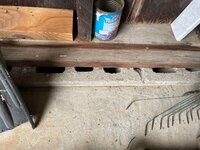
So I had some time today to look closer at what was going on here with that one block pushing out and causing (or at least accelerating) the parge disbond. The block was loose and after removing a couple of shingles, and some scraping of the mortar joints, I was able to remove the outer face of the block. The first thing I notice is the squarish rust spot internal to the block. At first I thought a metal object got dropped into the concrete when the block was cast but after removing a few pieces of the cracked internal webbing of the block, it became clear I was looking at a cast-in J-bolt. I guess this was a thing in the early 60's if you weren't going to pour a cap on your concrete block foundation wall. It appears enough moisture got to the bolt that rust expanded it and forced the block apart.
Funny thing is, the bolt must only go through the 2x6 that lies on top of the block and not the bottom 2x4 of wall. Seems strand that these bolts would go through both but without hurricane clips, etc., I guess it wouldn't make much difference. I could cut the bolt and carefully remove the rest of the block and cement in a new one, I was thinking I might also stick some rebar down in the block holes and thin fill the accessible block holes with concrete as well.
To the left of this block, down to about 8" above grade, the parge was cracked and disbonded for sever feet but this appears to simply be poor adhesion. Maybe the block was not clean closer to grade level when parge was applied.
Funny thing is, the bolt must only go through the 2x6 that lies on top of the block and not the bottom 2x4 of wall. Seems strand that these bolts would go through both but without hurricane clips, etc., I guess it wouldn't make much difference. I could cut the bolt and carefully remove the rest of the block and cement in a new one, I was thinking I might also stick some rebar down in the block holes and thin fill the accessible block holes with concrete as well.
To the left of this block, down to about 8" above grade, the parge was cracked and disbonded for sever feet but this appears to simply be poor adhesion. Maybe the block was not clean closer to grade level when parge was applied.
Attachments


Zeke
Well-known member
It never ceases to amaze me that some construction looks like something from the 3rd world.