Oh come on. $10 versus ~$115? I'd say they fared pretty good considering. Not everyone needs the accuracy of the Mitutoyo.
Just a couple points elluded to in the video, but maybe not clearly expressed:
When you use a mic or caliper, the force you place on the work piece is highly significant. You can take either tool and push it harder and change the reading appreciably. To stop you from crushing the workpiece or flexing the frame, quality mics have some sort of clutch mechanism built into the thimble. This limits the amount of force you can apply and also attempts to help you produce the SAME force consistently.
Calipers don't have this feature. You provide the pressure. Experienced machinists can provide the same pressure repeatedly. You can teach yourself to do this by measuring a standard (mic std, gauge block, ball bearing, etc).
If your caliper has grit in its slide (regardless of its quality) or if your caliper is bent, has rough ground surfaces, the resistance you feel may be caused by these issues and will lead to inaccurate readings. You can clean the ground surfaces of cheap calipers to improve them. I used india, arkansas stone or ceramic "files" to clean up mine. The slide should be smooth and consistent with no hesistations. Good quality caliper must be kept clean. Some machinists recommend VERY light oil coatings, others say oil attracts dust and the tools should be dry. Either way they must be CLEAN. So the cosmetic fit and finish of the tool is not AS important as the smoothness of the slide. Smooth is not a cosmetic or fit and finish issue, its a functional requirement.
The other point to consider is the quality of the jaws- do they meet perfectly or are there gaps? You can try closing them, then holding them up to a strong light source. No light should be discernable. Also, the inside jaws and outside jaws should be perfect. Otherwise, you'd have to zero the jaws independantly, which is not so easy. I've seen Chinese calipers like this.
As for accuracy I think it is a mistake to attempt to characterize the needs of the huge number of GJ readers. I have seen several threads involving the comparison of sockets or wrenches where measurements were taken with digital calipers. .001" may well be the difference between a good socket or wrench and a poor one. The fact that these devices display .00X digits may lead people to believe they are getting that accuracy. So I think it is worth while to have this discussion and it may well be the case that Chinese calipers, out of the box, may not be good enough to accurately compare sockets or open end wrenches.
My suggestions are:- your caliper needs to have a smooth slide action. If it doesn't, you likely won't get accurate readings. You can improve the cheapies through careful filing. Even the best calipers are useless in inexperienced hands. Try practicing with a known trusted reference. Get a sense for how much pressure is required to produce consistent accuracte results. Last, keep your measuring tools clean!



 I won't tell you what I paid for that lot but it was less than a Starrett Last Word all in.
 The 1-2-3 blocks were checked with a Starrett mic (but only in the 1 & 2" dimensions and that was 2 months ago.)


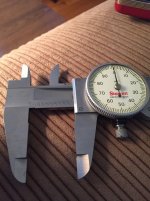
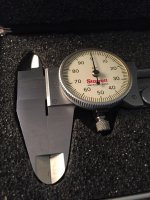
 Metric is 0.05, 0.1, 0.15, etc. (for each mark: 0 |||| 25 |||| 50 |||| 75 |||| 0, or whichever one lines up with the main scale). Now I can see how calipers are marked up much finer than rulers, without looking like it. Glad I got the rulers too, but won't have to use them to improve upon that particular caliper, quite the opposite. I think this is better for me too, because I can reason about the measurements somehow, or count them quicker on scales with practice, and tend to memorize conversions of those to decimals, without relying on digital readouts on these and calculators all the time. Unless the scale has to be finer than such a mechanical one, which is a situation that's practically beyond me.
 Well I'm not going to ponder the mysteries of trivia as a lifestyle ("back in my caliper days I made a short story longer")...