To avoid these ads, REGISTER NOW!

Cheap digital calipers vs. Mitutoyo

superUnknown

Well-known member
Joined
Dec 23, 2014
Messages
52
Location
People's Republic of British Columbia
youtube Cheap caliper teardown, review and tune up

caliper-002.BMP


Pulled out the microscope to have a look at what $10 worth of calipers looks like. Surprise, surprise you get what you pay for!
 
To avoid these ads, REGISTER NOW!

Kracin

Well-known member
Joined
Mar 25, 2013
Messages
1,666
Location
Omaha, NE
very true. i use my HF calipers like they are meant to be used. somewhat accuracy necessary, not really needing anything more than .001 accuracy. i use them to scribe and transfer lines quick on things being fabricated.

and if you need really accurate measurements on bushings, bearings, shafts, gears, etc. you pull out the good mitituyos (mitituyos are all my plant buys). or the mit' mics


but i will say that my HF specials didn't have anywhere near the amount of bur on them that yours did, aside from feeling like they don't slide super easy like mits, they feel good enough for a toss around that doesnt get kept in a case all day.
 

AnonymousToolGuy

Well-known member
Joined
Jan 2, 2015
Messages
75
I don't do anything that requires better than the HF calipers. Company I worked for did have Mitutoyo calipers, had them certified every few months against an in-house gage set, and the gage set was certified periodically as well. Nutso paranoia about accuracy.
 

Tinner

Well-known member
Joined
Aug 31, 2013
Messages
1,101
Location
N.E. Wisconsin
As of two years ago, the metrology company we use at work won't calibrate HF or similar bottom of the barrel instruments. They open them up and give them a yay or nay. If nay, but they are accurate, they get a reference only sticker. If not accurate, you can't use them in our shop.

I talked to the guy who came in to calibrate last year. He said they have no problems with Fowler, SPI, General, etc. in the $50 and up range. They don't have the service life of Mitutoyo or Starrett, but they have no problems calibrating them.
 

Kracin

Well-known member
Joined
Mar 25, 2013
Messages
1,666
Location
Omaha, NE
just so there isn't some kind of "mics are better than calipers" war starting, when i was asking why they wont be accurate enough. i'm simply asking the question of what application.

good calipers are accurate to +/- 0.001" from the box. if you are trying to use a tool that requires a finer measurement then of course you should be using the right tool for the job. and when you take measurements in certain situations you should be using the right tool, like using a caliper on an inside bore isn't always the easiest. it doesn't mean it will be inaccurate, only that it has a higher chance of giving a bad reading because its so difficult to use in that application.


the tool you grab should depend entirely on the situation and the necessity of accuracy, otherwise if you can't trust them to measure within their rated tolerance, why bother keeping them around anyway?
 

wild cowboy

Banned
Joined
Mar 11, 2014
Messages
1,650
Location
Birmingham
I own both the Mitutoyo 6" digital calipers and the cheap Chinese knockoffs of it.

The Chinese ones have 99% of the accuracy for 10% of the price, so unless you are making measurements for a space shuttle or sub-micron semiconductor, the Chinese ones are fine for anything a GJ member is doing.

The one tip I would pass along to everyone is to immediately replace out the junky Chinese battery with a high quality silver oxide battery from a name brand manufacturer (about $5)
 

cowanrg

Well-known member
Joined
Mar 18, 2013
Messages
65
Oh come on. $10 versus ~$115? I'd say they fared pretty good considering. Not everyone needs the accuracy of the Mitutoyo.

I just didn't like how he acts like it's not even usable and it's complete junk. They're $10 and they work well for most people.

"Oh look how bend these are, haha you could drive a truck through it! Let's look at my Mitutoyo. Oh, let's not show it... OK, there's a bit of light coming through, won't bother showing it, probably just from mis-handling, yeah, that's it."
 

corrie

Well-known member
Joined
Mar 7, 2012
Messages
66
why can a caliper not be accurate enough on a shaft to measure down to the thousandth?
In general, the measuring tool needs to be 10 times as accurate as the tolerance. I only trust my mit's and b&s calipers to +/- .005. Even tho I know they are perfect.
 

404

Well-known member
Joined
Aug 23, 2014
Messages
3,463
Location
Mass
why can a caliper not be accurate enough on a shaft to measure down to the thousandth?

Because the measuring instrument should have from 10 to 100 times the resolution of what you are trying to measure.

Bearing press fits for example.
 

rice rocket

Well-known member
Joined
Mar 24, 2011
Messages
3,175
Oh come on. $10 versus ~$115? I'd say they fared pretty good considering. Not everyone needs the accuracy of the Mitutoyo.

I just didn't like how he acts like it's not even usable and it's complete junk. They're $10 and they work well for most people.

"Oh look how bend these are, haha you could drive a truck through it! Let's look at my Mitutoyo. Oh, let's not show it... OK, there's a bit of light coming through, won't bother showing it, probably just from mis-handling, yeah, that's it."

The point is...he's had those Mitutoyos for 10 years with no problems and they're still accurate with great repeatability. It's a buy once-in-a-lifetime sort of tool. Once you get something better, it's not even worth looking at the other stuff.

I'm sure a lot of you feel the same way about Snap-On, it's the same idea.
 

Kracin

Well-known member
Joined
Mar 25, 2013
Messages
1,666
Location
Omaha, NE
Because the measuring instrument should have from 10 to 100 times the resolution of what you are trying to measure.

Bearing press fits for example.

bearing press fit can be done with a caliper just as easily... and it depends on the material and the size that the press fit is being done as to how small of a number you'll be looking at. you can always get more precise with everything, but at some point you have to stop splitting hairs and use whats acceptable.

using either tool the job can be accomplished. (depending on the job and accuracy, if you need .0005 accuracy, then use a tool that can do that, if you need .001 accuracy, use a tool that can do that). after that properly using the tools wins the day, you can always screw up measurements with a mic if you don't know what you're doing.
 

Adam.C

Banned
Joined
Jan 29, 2013
Messages
1,490
Oh come on. $10 versus ~$115? I'd say they fared pretty good considering. Not everyone needs the accuracy of the Mitutoyo.

Just a couple points elluded to in the video, but maybe not clearly expressed:

When you use a mic or caliper, the force you place on the work piece is highly significant. You can take either tool and push it harder and change the reading appreciably. To stop you from crushing the workpiece or flexing the frame, quality mics have some sort of clutch mechanism built into the thimble. This limits the amount of force you can apply and also attempts to help you produce the SAME force consistently.

Calipers don't have this feature. You provide the pressure. Experienced machinists can provide the same pressure repeatedly. You can teach yourself to do this by measuring a standard (mic std, gauge block, ball bearing, etc).

If your caliper has grit in its slide (regardless of its quality) or if your caliper is bent, has rough ground surfaces, the resistance you feel may be caused by these issues and will lead to inaccurate readings. You can clean the ground surfaces of cheap calipers to improve them. I used india, arkansas stone or ceramic "files" to clean up mine. The slide should be smooth and consistent with no hesistations. Good quality caliper must be kept clean. Some machinists recommend VERY light oil coatings, others say oil attracts dust and the tools should be dry. Either way they must be CLEAN. So the cosmetic fit and finish of the tool is not AS important as the smoothness of the slide. Smooth is not a cosmetic or fit and finish issue, its a functional requirement.

The other point to consider is the quality of the jaws- do they meet perfectly or are there gaps? You can try closing them, then holding them up to a strong light source. No light should be discernable. Also, the inside jaws and outside jaws should be perfect. Otherwise, you'd have to zero the jaws independantly, which is not so easy. I've seen Chinese calipers like this.

As for accuracy I think it is a mistake to attempt to characterize the needs of the huge number of GJ readers. I have seen several threads involving the comparison of sockets or wrenches where measurements were taken with digital calipers. .001" may well be the difference between a good socket or wrench and a poor one. The fact that these devices display .00X digits may lead people to believe they are getting that accuracy. So I think it is worth while to have this discussion and it may well be the case that Chinese calipers, out of the box, may not be good enough to accurately compare sockets or open end wrenches.

My suggestions are:- your caliper needs to have a smooth slide action. If it doesn't, you likely won't get accurate readings. You can improve the cheapies through careful filing. Even the best calipers are useless in inexperienced hands. Try practicing with a known trusted reference. Get a sense for how much pressure is required to produce consistent accuracte results. Last, keep your measuring tools clean!
 
Last edited:

Adam.C

Banned
Joined
Jan 29, 2013
Messages
1,490
good calipers are accurate to +/- 0.001" from the box.

I think the accuracy of the (electronic) readers is +/-.001". If the tool is gritty, you will get a stick slip condition which will make the tool much less accurate*.

I suspect ALL the electronic readers are capable of roughly the same accuracy. The technology is similar. The better brands have better screens, not neccessarily bigger, but sometimes clearer and faster reading. They are also better on batteries. But I suspect all do basically the same job. What seperates calipers (in terms of accuracy) are the mechanical parts, not the electronics.

That said, my cheapies (which look identical to those in the video) read .0005-.001" light at 2.000". Everywhere else in the range they are spot on. This is within the tool's tolerance so technically, these could be calibrated. I didn't think this was possible to have one area of the scale read bad. (This was verified using NIST traceable, calibrated Mitutoyo gage blocks and I quadruple checked. They honestly read light at 2".)

Repeating myself, I think people get confused with the difference between resolution and accuracy.

*Just an aside, stick slip and micrometer ratchet thimbles vs friction thimbles is the EXACT same issue we have with achieving accurate torque values using a torque wrench. If the bolt you are torquing is not clean, is not lubbed correctly, then some of the resistance the torque wrench feels is actually the grit/friction under the head.

You need more force to get the wrench moving than to keep it moving so torque achieved while rotating will result in more bolt stretch than torque achieved at the beginning of the next ratchet.
 
Last edited:

Treeman

Well-known member
Joined
Jan 4, 2008
Messages
545
Location
Michigan
Thank you Adam C. for the much needed reminder about knowing measurement principles and precision instrument limitations. So many people think that using a quality tool automatically results in a quality outcome. I especially see this with torque wrenches, but I imagine it happens with calipers too. Quality crimps is also one of these areas of concern. Thanks again.
 

sailah

Well-known member
Joined
Sep 17, 2013
Messages
165
Location
Hingham, MA
After reading this thread last night I went down to my garage and checked a precision ground (by a hydrogen generation lab) 123 block with my mitutoyo digimatics, PEI calipers and my $10 Chinese calipers. The mitutoyo was nuts on, maybe 0.0005" off depending on thumb pressure but I reliably was getting 2.0000" even though I only use calipers for +/- 0.001". The harbor freights were reading 2.001". The PEI, which I thought was a step above the HF, was reading 1.997".

Then I checked it with a starrett caliper and got 2.0000" after checking the caliper to a standard. Of course my garage wasn't 68 degrees, more like 55.

I'm my hobby workshop, on the lathe I'm pleased with anything I can keep to 0.001" and thrilled when I can say tenths accuracy. I find it enjoyable to become increasingly precise as I gain skills and experience in metalworking and measuring. The tools to chase decimal places get really really expensive haha. I just got a 50 millionths (0.00005") mitutoyo digital indicator at auction that is fun to play with on the surface plate. But nothing I have is capable of machining to that tolerance so it's really just a toy to me.
 
To avoid these ads, REGISTER NOW!

Adam.C

Banned
Joined
Jan 29, 2013
Messages
1,490
After reading this thread last night I went down to my garage and checked a precision ground (by a hydrogen generation lab) 123 block with my mitutoyo digimatics, PEI calipers and my $10 Chinese calipers. The mitutoyo was nuts on, maybe 0.0005" off depending on thumb pressure but I reliably was getting 2.0000" even though I only use calipers for +/- 0.001". The harbor freights were reading 2.001". The PEI, which I thought was a step above the HF, was reading 1.997". Then I checked it with a starrett caliper and got 2.0000" after checking the caliper to a standard. Of course my garage wasn't 68 degrees, more like 55.
It would be good if you could check other lengths to see if the calipers only have a problem at that one length or if they read consistently wrong. I check my calipers to several gage blocks between very thin and 3", then every inch to their full range using mic stds.
I just got a 50 millionths (0.00005") mitutoyo digital indicator at auction that is fun to play with on the surface plate. But nothing I have is capable of machining to that tolerance so it's really just a toy to me.

I'm sure you know this because you bought it, but those are extremly handy tools. You can check your tools with it. You may never need it to inspect parts you make, but it can be handy to find out if your 123 blocks are really 123, if your parallels are whole number sizes. Can reduce the time for set ups.
 

sailah

Well-known member
Joined
Sep 17, 2013
Messages
165
Location
Hingham, MA
It would be good if you could check other lengths to see if the calipers only have a problem at that one length or if they read consistently wrong. I check my calipers to several gage blocks between very thin and 3", then every inch to their full range using mic stds.


I'm sure you know this because you bought it, but those are extremly handy tools. You can check your tools with it. You may never need it to inspect parts you make, but it can be handy to find out if your 123 blocks are really 123, if your parallels are whole number sizes. Can reduce the time for set ups.

I checked a few parts as well as some drill rod I had hanging around, the PEI calipers were consistently off. They would go back to zero too.

RE the indicator, yeah it was a surprise buy. I went to a lightly attended auction at said hydrogen generation lab and they had a mixed bag of "measuring and inspection tools". There was a Last Word Starrett, 2 mitutoyos (the batteries were missing so i didn't know what kind it was or resolution), 8 1-2-3 blocks, 10 angle blocks for mill setup and a tone of swagelock fittings. When I got home I took the battery out of my other Mitutoyo and found that one of the indicators was a 0.0001" and the other was a 50 millionths. I was pleased that they both worked too. One had a broken tip stud and I was contemplating sending it out to LI indicator service. I used a carbide scribe and slowly turned it out. :rocker: I won't tell you what I paid for that lot but it was less than a Starrett Last Word all in.

I also got a AA grade surface plate at that auction and plan to start learning as much as I can about checking parts etc so I would imagine that indicator will stay on the surface plate.
 

Kracin

Well-known member
Joined
Mar 25, 2013
Messages
1,666
Location
Omaha, NE
I think the accuracy of the (electronic) readers is +/-.001". If the tool is gritty, you will get a stick slip condition which will make the tool much less accurate*.

I suspect ALL the electronic readers are capable of roughly the same accuracy. The technology is similar. The better brands have better screens, not neccessarily bigger, but sometimes clearer and faster reading. They are also better on batteries. But I suspect all do basically the same job. What seperates calipers (in terms of accuracy) are the mechanical parts, not the electronics.

That said, my cheapies (which look identical to those in the video) read .0005-.001" light at 2.000". Everywhere else in the range they are spot on. This is within the tool's tolerance so technically, these could be calibrated. I didn't think this was possible to have one area of the scale read bad. (This was verified using NIST traceable, calibrated Mitutoyo gage blocks and I quadruple checked. They honestly read light at 2".)

Repeating myself, I think people get confused with the difference between resolution and accuracy.

*Just an aside, stick slip and micrometer ratchet thimbles vs friction thimbles is the EXACT same issue we have with achieving accurate torque values using a torque wrench. If the bolt you are torquing is not clean, is not lubbed correctly, then some of the resistance the torque wrench feels is actually the grit/friction under the head.

You need more force to get the wrench moving than to keep it moving so torque achieved while rotating will result in more bolt stretch than torque achieved at the beginning of the next ratchet.


i agree, and i said the same thing above (in shorter words i guess)

after that properly using the tools wins the day, you can always screw up measurements with a mic if you don't know what you're doing.

knowing how to use them, the feel of how much pressure to put, and keeping them clean and smooth makes the calipers more accurate than buying an expensive caliper.
 

sailah

Well-known member
Joined
Sep 17, 2013
Messages
165
Location
Hingham, MA
This whole post got me to thinking so I broke out my calipers again and checked the 1-2-3 blocks one more time. I'm not a professional by any means and I don't offer this test as anything following procedure just what I found after checking these calipers I have owned for awhile.

The calipers are all 6". Mitutoyos are CD-6"CSX, PEI PE10700, Centechs are...well Centechs:lol: The 1-2-3 blocks were checked with a Starrett mic (but only in the 1 & 2" dimensions and that was 2 months ago.)


I tried to be careful about using equal pressure on the calipers, but the Centech were really gritty and honestly I don't think I have ever even taken them out of the box other than when I checked them yesterday.

3" side

Mitutoyo


Centech


PEI


2"


1"


6" These blocks are just held together with the caliper pressure so I tried to be fair with all the holds


And I never noticed the Centechs but as noted they have a wicked bow to them. Hard to believe they were even remotely close. I guess that's one explanation to why they are reading high on the 6" test.


I wish I had a stand to hold the indicator or my height gage to measure the block but I don't have that setup it's in storage.

And since we all like pics, here's the 2 Mitutoyos indicators I got in that lot. I have another of the 0.0001" digitals and I paid more for that than that whole lot of tools. Oh well. I do need to get a battery cover for it and I'd also like to get a lug back to match the other one.


cheechi

Well-known member
Joined
Feb 29, 2012
Messages
4,384
Location
Triad, NC
I don't do anything that requires better than the HF calipers. Company I worked for did have Mitutoyo calipers, had them certified every few months against an in-house gage set, and the gage set was certified periodically as well. Nutso paranoia about accuracy.
This sounded good until you said 'nutso paranoia about accuracy'

If you are manufacturing or repairing anything and need accuracy, this is not paranoia it's prudence. Some industries you can use a tape measure and not care about anything more exact than 1/8" blade kerf. Others you need a microscope and weekly calibration. There isn't one size fits all.

I own both of the calipers in that video. The Mitu I got second but I keep the cheapo around for dirty jobs. It is reasonably accurate but I also bothered to dig through to find a good one from the store and I keep it fairly nice. Looking back I should have just bought the Mitu but it took me and my budget a while to come around to that line of thinking.
 

SMKS

Well-known member
Joined
Feb 14, 2010
Messages
5,832
Location
USA, planet Earth
Breaking News, an expensive tool is better made than a cheaper tool.


I don't do anything that requires better than the HF calipers.

This is my perspective, as well. For what I use them for in the garage, the HF calipers have done well and I've definitely got my money's worth out of them.

If I used them more or needed ultimate accuracy, perhaps a better pair would be a benefit for me.
 

Adam.C

Banned
Joined
Jan 29, 2013
Messages
1,490
knowing how to use them, the feel of how much pressure to put, and keeping them clean and smooth makes the calipers more accurate than buying an expensive caliper.

Is your point is that a clean cheap caliper in skilled hands can be more accurate than an expensive caliper in untrained hands? Based on what I'm seeing here, that may be stretching things. It doesn't take a rocket scientist to learn how to use calipers correctly. Just a little heightened awareness, which hopefully this thread has provided.
 

cheechi

Well-known member
Joined
Feb 29, 2012
Messages
4,384
Location
Triad, NC
I can kind of agree with both of you. Inexperienced users might not even check if it is bowed or the slop in the front side like the video demonstrated. Really inexperienced people might assume the jaws are perfectly flat without checking. But no amount of know how is going to make a terrible set more precise just by their experience alone.

I kind of feel this way. The cheap ones aren't going away. Learning with a cheap one can help you appreciate a nice set more. Also helps to prioritize what gets used where in dirty ****** situations. If I had a 'cheap' 30-40 name brand set I wouldn't treat them any better or any worse than the HF set, (or in my case I think AAP) but I would be a little more pissed if they turned out no better than the $10 HF set. It's all about perspective vs actual usage in some of these situations.
 

Kracin

Well-known member
Joined
Mar 25, 2013
Messages
1,666
Location
Omaha, NE
Is your point is that a clean cheap caliper in skilled hands can be more accurate than an expensive caliper in untrained hands? Based on what I'm seeing here, that may be stretching things. It doesn't take a rocket scientist to learn how to use calipers correctly. Just a little heightened awareness, which hopefully this thread has provided.

a set of snapon tools in the hands of an inexperienced kid won't produce better results than a set of harbor freight tools in the hands of a master mechanic. the tools might break and make the job more difficult than it has to be, but the end result of craftsmanship depends mostly on the person using the tools, not the tools themselves. of course there are exceptions, but those calipers are not so far out of whack that they can't be used as calipers. give a qc guy who has no sense of feel a set of mitituyo calipers, and you'll see how inconsistent his readings can be.
 

jeejay

Well-known member
Joined
Jun 20, 2016
Messages
465
How about neither? I was looking up what the accurate digital calipers might be, except I don't often need that much accuracy, so now I think that supplementing my non-digital caliper, with a ruler that's graduated in 64ths, for example, would increase its accuracy. I could just set the caliper from what I wanted to measure, and then check the distance between its jaws with a more finely marked ruler (or maybe the bar sticking out of it would be easiest to measure). Well at least I'd get a better ruler out of the concept.
 
Last edited:

jeejay

Well-known member
Joined
Jun 20, 2016
Messages
465
What, no more endless edit button? Okay, so I looked up rulers (one in 64th inch and another in 0.5mm increments), and two of them around here are less than even a cheap digital caliper (with a super coupon, at that), which gets enough horrible reviews for me to think twice. Those things wouldn't fit in as many locations to measure something either, no matter what they cost. Maybe I'll get a box of Cracker Jacks too...
 
Last edited:
Joined
Jul 24, 2016
Messages
3,371
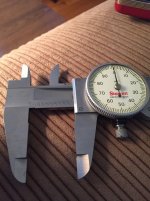
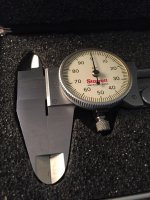
I have an older pair of Starret and Mitutoyo dial calipers and my only complaint about the mit is that it has two dials on the same face which can get confusin'
 

Attachments

  • y24y.jpg
    y24y.jpg
    140.8 KB · Views: 54
  • rhnhfm htm.jpg
    rhnhfm htm.jpg
    136.6 KB · Views: 55
Last edited:

xjfish

Well-known member
Joined
Feb 22, 2014
Messages
1,290
Are the Chinese made ones of pretty consistent quality/same thing no matter who sells them? I use a couple - have been overall very useful and accurate enough for the price. I'm an auto tech, mine are usually used for measuring seals or comparing one smaller diameter part/shaft to another (in rough use, sometimes stuck around an exhaust pipe). Matco guy was selling one that looks identical to one I can purchase at the local big box store... There is a time and place for a mic! I plan to purchase a high quality US/JAP made unit in the future...
 

jeejay

Well-known member
Joined
Jun 20, 2016
Messages
465
I also have an old Tricle brand caliper (made in China), which I didn't use much. Looks like newer pictures of those show a little different scale than mine. I never got around to figuring out the inch and metric subdivisions on there, since estimating based on 16ths is usually close enough for me (it has 0.05mm and 1/128in increments on the sub scales). Then I got those two little rulers (made in USA), and compared them to the bar on this caliper. Aha, it was pretty simple to understand between the two. It's just a little inconsistent how sub-inches are counted: 1/128, 1/64, 3/128, 1/32, 5/128, 6/128, 7/128, 1/16 (but the scale reads 0 ||| 4 ||| 8). :headscrat Metric is 0.05, 0.1, 0.15, etc. (for each mark: 0 |||| 25 |||| 50 |||| 75 |||| 0, or whichever one lines up with the main scale). Now I can see how calipers are marked up much finer than rulers, without looking like it. Glad I got the rulers too, but won't have to use them to improve upon that particular caliper, quite the opposite. I think this is better for me too, because I can reason about the measurements somehow, or count them quicker on scales with practice, and tend to memorize conversions of those to decimals, without relying on digital readouts on these and calculators all the time. Unless the scale has to be finer than such a mechanical one, which is a situation that's practically beyond me.
 
Last edited:

joe_pinehill1

Well-known member
Joined
Feb 23, 2013
Messages
537
Location
Northern Virginia
I have a cheap digital caliper I bought at AutoZone about 5 years ago for $20, now theyre less at Harbor Freight.

I check the calibration now and then with a couple drill bits. It measures to +/-0.001. And I check the drill bits with my micrometer, and they measure with .0005. Thats close enough for my work.
 

BuffettFan

Well-known member
Joined
Jul 11, 2017
Messages
10,859
Location
Central Illinois
Gotta chime in on this one. 27 years as a machinist, lead man, foreman and operations manager at a smaller manufacturing company. 50 employees or less.
I would not allow a $10 set of calipers in the shop. If you're machining a $100 part or a $10000 part, I'm not going to accept you scrapping it because you're too cheap to buy a quality tool. If you want to use $10 calipers, go get a $10 job.
When I was trained as a toolmaker, I was trained that anything needing to be closer than .005" needed to be checked with a micrometer that you had personally just checked against a mic standard.
I realize most home applications don't require the accuracy that is required in the manufacturing that I did, but for a one time investment, why not buy something you can rely on? IMHO, you should invest in quality measurement tools once, and you'll never have any regrets.
 
Last edited:

jeejay

Well-known member
Joined
Jun 20, 2016
Messages
465
Not to argue with humble opinions or years of experience, but I was reading about the relative merits and faults of each, and it looks like getting one shipped could be sketchy, if not shock proof. I guess any of them can be expensive too, so those must be considered equivalent in accuracy to be priced similarly. It seems to be down to convenience or personal preference (if not company policy) otherwise. I'd think a cheaper Vernier caliper would function more reliably than the cheaper digital one though. The last kind I would order is a dial caliper, based on experience with pressure dials being very sensitive to shock, or even vibrations. I hadn't read about the Vernier scale either, which is what I'd been referring to, I wasn't sure because those I'd seen or bought in hardware stores don't exactly have the same scale as my other one, but they're called Vernier too (so I thought it referred to their shape). I think it's ironic that they wouldn't call them "vernier scale calipers", why not be more specific about a more specific instrument? Oh yeah, only I wouldn't know such things at birth. :dunno: Well I'm not going to ponder the mysteries of trivia as a lifestyle ("back in my caliper days I made a short story longer")...
 
Last edited:
To avoid these ads, REGISTER NOW!
Top Bottom