To avoid these ads, REGISTER NOW!

Circuit breaker theory

desert4wd

Well-known member
Joined
Feb 9, 2008
Messages
66
Location
Oregon
A Jeeping friend of mine posed this question to me. I neglected to ask what application he is thinking about using this arrangement for, but I figure the result should be the same whether it's household or auto related. (He could be wiring up his Jeep for heavy duty lighting or a portable welder) What would be the max amperage allowed by this? Thank you. - Doug


If I wire two circuit breakers in parallel (1 @ 30 Amps + 1 @ 50 Amps)
Do I effectively get an 80 amp breaker or do you treat them like resistors?
Thanks
 
To avoid these ads, REGISTER NOW!

pmiranda

Well-known member
Joined
Jul 15, 2008
Messages
1,504
Location
Austin, TX
Interesting, but don't do it... academically, if they have the same resistance at all times, you'd get a 60 Amp breaker. Realistically, you can't depend on any more than the lower of the two. If you care why...
Each one is independently measuring the current passing through it. V=IR or I=V/R tells us that the current passing through the two parallel circuits depends on the resistance of the circuits. Assuming all the cable runs are equal and each breaker has the same resistance, the current will be divided equally between the two. That's a big assumption, though. Even slight differences in the resistance between the two circuits will cause more current to pass through one than the other, so you can't depend on this reliably unless they have specified resistance and the wiring is similarly controlled. I can promise that you'll never get more than 80 amps through that arrangement, and you'll never get less than 30.

If this is an AC circuit, you have a major reason not to do it (and this should be a NEC violation, but I can't cite chapter and verse off the top of my head)... The phase of each leg will be slightly different so instead of combining two identical sine waves, you'll get two sine waves of different phase, and the result will not be a sine wave. Run a motor, transformer, or any other inductive load off that and you can get overheating and buzzing.
 

lametec

Well-known member
Joined
May 5, 2008
Messages
2,099
Location
Michigan
Assuming AC, and that they're both fed off the same phase, they will be in phase. No amount of wire is going to cause enough of a phase shift to matter.

I'd treat the circuit as a 50 amp circuit, 'cause once the 30 amp trips, you're left with the 50. Under ideal circumstances it would be 60A total, but I wouldn't count on that.

Whether it's AC or DC, it's still a bad idea. :)
 

alfadan

Well-known member
Joined
Mar 9, 2007
Messages
2,116
Location
Augusta, ks
if you have one load fed with a 30a and 50a in parallel, if the load draws more than 30a (+ or -), the 30a will trip, but the load is still fed through the 50a till the load draws more than 50a. I dont see at all how you add or subtract those values.
 

flesburg

Well-known member
Joined
Aug 15, 2006
Messages
105
Location
Pontiac, IL
I have been doing wiring for a long time.

Just curious...how would you go about wiring two circuit breakers in parallel?

Why would you even consider it?
 
OP
D

desert4wd

Well-known member
Joined
Feb 9, 2008
Messages
66
Location
Oregon
I agree with flesburg's last sentence!

pmiranda (and the rest), thank you for explaining and clarifying the reasoning. I'll have to dig a little deeper and see what he's really trying to do here...

Thanks again- Doug
 

Mr_fixit

Well-known member
Joined
May 24, 2008
Messages
1,221
Location
Rustylvania
I have wired up 2 circuit breakers in parallel. Automotive...I have some major power hungry devices on a truck. Hydraulic wheel lift, 5000lb crane and 2000lb crane. I didn't want to leave the power cables unprotected from the battery ....as in no circuit breaker, and ithe large crane's winch can be overloaded until ithe motor stops. So the largest resetable breaker I could find was a 200 amp breaker... The stereo guys use them for there noisy stereos.

Ideally I wanted a 400 amp circuit breaker , but couldn't find one,.so I used
(2) 200's.

Works fine, sometimes it trips and then the next one trips, but it's way better than fuses and the cables that run 20 feet to the back of the truck are protected against overloads or worse, short circuits.

I certainly would noy put breakers in parallel for any other purpose... This way works for me... and my truck is not going to burn up...
 
To avoid these ads, REGISTER NOW!

ddawg16

Well-known member
Joined
Jul 11, 2008
Messages
21,005
Location
S. California
Here is a link that goes into details on how they work Wikipedia

While on the surface it might like you could treat them as two parallel devices...and 'assume' that you could add up the current carring capacity....in reality, it's a **** shoot. So many variables come into play such that you can't predict or control how much current is going through each CB.

I think all of us are curious as to what he is trying to do....if he is trying to use some 'backyard' engineering to solve a problem, it sounds like trouble looking for a place to happen.

When it come to electricity, 'short' cuts are not a good idea....and yes, pun intended.
 

PAToyota

Well-known member
Joined
Jan 20, 2006
Messages
4,366
Location
South Central Pennsylvania, USA
I have wired up 2 circuit breakers in parallel. Automotive...I have some major power hungry devices on a truck....

400amps is quite a draw. Are you sure that you are using over 200amps? I'm guessing that when you go over 200amps the first one flips and then the second follows closely behind.

I don't have the electrical engineering background to make a fully informed decision, but my gut tells me that in the original question the circuit would flow through the path of least resistance - which would be the 30amp breaker - and then when that trips it would flow through the 50amp breaker until that tripped. I'm really not seeing that you'd ever get much more than 50amps without something tripping.
 

timgr

Well-known member
Joined
Dec 19, 2006
Messages
544
Location
Medford, MA USA
You will divide the current between the two breakers, certainly. However, the current division depends on the internal impedance of the breaker. IMO this is really asking for trouble, because there's no rule that says that the internal impedance is in any way proportional to the amp setting of the breaker. Might work ok if you use two breakers of the same type from the same manufacturer in parallel to double the capacity. For any other combo, I'd expect that all bets are off.
 
Last edited:

Charles (in GA)

Well-known member
Joined
Jan 11, 2006
Messages
12,489
Location
50 mi south of Atlanta
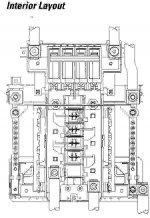
Some manufacturers of panel boards use parallel breakers for the mains in them. I have seen GE meter/service disconnects, and also other circuit breaker panelboards, that had a main breaker that was four 100 amp breakers ganged together. even had special tabs bent and formed to fit in where the wire would go in the breaker. Two breakers were paralleled for one of the buss bars/stabs and the other two were paralleled for the other buss bar/stab. One big long handle tie to operate all of them.

Charles
here is an example of this.............
 

Attachments

  • GE_panelboard.jpg
    GE_panelboard.jpg
    26.2 KB · Views: 24
Last edited:

Mr_fixit

Well-known member
Joined
May 24, 2008
Messages
1,221
Location
Rustylvania
I'm an electrical engineer. And although it's been awhile, a 30 and 50 amp in parallel would give you the ability to get 60 amps, best case, when they're both working. That's assuming that all the connections are good, and you're using the correct guage wire or larger than what's needed to that matching 30 or 50 amp breaker. In the ideal world they would share the load current up to 30 amps each, and when they both exceeded that amount, the smaller would trip, still leaving the other the ability to pass 50 amps... And if you exceeded that, then the other would trip. After all, a circuit breaker is just a switch designed to open at a certain current...

I'd hate to see anyone try this on any 120 volt or 240 volt system. You'd certainly be asking for trouble...!


Yes, I'm sure my crane, when abused needs more than 200 amps. Iam operating an electric/ hydraulic pump the same time I'm overloading an electric winch.
Maybe If I used a ****** block, like I'm supposed to, and if the overload worked, I wouldn't .

Here's the bigger crane... Can't find amp specs.... http://www.venturo.com/demo/products/venturo_et/et25k.htm
 
OP
D

desert4wd

Well-known member
Joined
Feb 9, 2008
Messages
66
Location
Oregon
I didn't get the direct answer to what he's trying to do, but he mentioned it was most similar to Mr_fixit's. My goal was to pass on some good logic on the subject. The only logic I had personally was that it didn't sound like a good idea plus a few thoughts on current and resistance. I prefer the lighter loads myself. Thanks again.
 

sparky1562

Well-known member
Joined
Aug 30, 2008
Messages
115
Location
Nashville, TN
NEC 240-8 prohibits fuses and circuit breakers in parallel, unless they are factory installed and listed as a unit. (1999 reference but it has not changed). Even then, they are matched pairs. I don't know what the specific reason behind this code section is, but I am sure at some point in the past it presented a problem and the code panel for 240 addressed it.

Most of this discussion is accurate, with the conclusion being don't do it! :shocking:

If the impedence in the two 'circuits' is the same, the current will divide evenly, and in effect you have a 60 amp circuit. Once the 30 amp breaker sees more than 80% of 30 amps, it will trip in time (a 30 amp device will not hold 30 amps. It has an indefinite trip time between 80% and 100% of it's rating). Then you will have a 50 amp circuit, until it trips.

(I am an EE and deal with code issues every day!)
 
To avoid these ads, REGISTER NOW!
Top Bottom