To avoid these ads, REGISTER NOW!

Clay soil is killing my trees

MushCreek

Well-known member
Joined
Jan 14, 2015
Messages
9,780
Location
Upstate South Carolina
Our clay is pretty brutal, but sweet gum and Virginia pine seem to think it's OK, as do certain weeds, blackberries, and blueberries. When it gets dry, it's pretty close to brick.
 
To avoid these ads, REGISTER NOW!

Jack84

Well-known member
Joined
Jul 30, 2016
Messages
516
Location
Netherlands
"We have plenty of trees and crops that thrive on clay around here. "


You must have some extremely special clay. Stuff around here has 0% organic material, no nitrogen and requires a jack hammer to dig with; have to admit very good bricks are made of it. Here it takes 20 years of weed growth before enough soil is produced to grow stunted trees, hell, even worms have a hard time.

Care to supply a picture of just one of your thriving crops.


tulpen-noordoostpolder-luchtfoto-r-nathaliepaak.jpg


Tulips.
 

SGKent

Banned
Joined
Feb 12, 2010
Messages
1,959
Location
Citrus Heights CA
I'll trade you my sand for your clay. You'll have plenty of drainage, but you won't be able to grow grass.

Get a couple inches of alfalfa compost and rake it in every year. Get a soil test like I mentioned and add missing nutrients every year. I did this to my (RIP) mom and dad's house in the FL Panhandle and within two years the pure sandy soil was black and rich 6" to 8" deep. Very healthy lawn.
 

jives

Well-known member
Joined
Jan 4, 2013
Messages
2,807
Location
Central NY
There is clay and then there is clay. I suspect most of us with "clayey" soil really have silt-loam. Regardless, it does not seem to make sense to me the considerable effort described here to plant a tree in non-native soil with the hopes it will live.

And, BTW, if it was a landscaper that planted the inappropriate trees (if indeed the wrong tree, and not an overwatering issue), then perhaps they should take responsibility.
 
OP
W

White Shadow

Well-known member
Joined
Jan 26, 2014
Messages
985
Just to follow up on this old thread....I ended up borrowing my neighbor's post hole digger and started digging a hole. It's not the typical post hole digger that you stab into the ground, spread the handles apart, and then lift and dump the dirt. It's an old school tool that you put into the hole and twist until it's full of dirt. The good thing about that type of tool is that there's no limit to the depth of the hole you can dig. I dug down 4' and was still pulling up clay, so I put on a 5' extension and kept digging. When I got about 8' deep, I started to hit what appeared to be gravel. And once I got through the shallow layer of gravel, the dirt I was pulling up was a completely different color (brown versus the red clay) and was obviously not sticky clay. I filled the hole with drainage stone about 2' from the top and then laid a piece of landscape fabric on top. Then I expanded the hole to about 8" wider than the root ball of the new tree, put a few bags of topsoil in the hole and planted the tree with the top of the root ball sticking out of the ground by about 5", surrounding the tree with fresh top soil and using it to make a nice mound up to the tree trunk.

The tree is a Merlot Red Bud (really pretty tree, it's full of purple flowers and then it gets dark red, almost purple colored leaves all season. It was about 8' tall when planted and had a really big root ball on it. The nursery told me to leave the root ball in the cage when I plant it and to just cut slices into the burlap for the roots to expand. Hopefully this one survives.
 

Joemctag

Well-known member
Joined
Aug 11, 2017
Messages
813
Location
Outside raleigh nc
Agree very strongly about locusts. A 3” long thorn could put your eye out. But that’s why the ones you can buy are seedless and thornless. They have a nice shape and you have that partial shade with a lot of light filtering through. They use them in landscaping commercial properties, too. But, yeah, the native locusts are a real plague.
 

nadogail

Well-known member
Joined
Jan 23, 2009
Messages
31,957
Location
Coronado, CA
Planting a tree, IMHO, is somewhat similar to hiring an employee.

You need to select the candidate that will best thrive in conditions over which they have no control.

Not all trees (and people) are alike, they thrive best in conditions that suit them. Find the best combination of candidate and conditions to expect success.

There are sources of information available, try your local agricultural extension office.
 

59 wagon man

Well-known member
Joined
Oct 25, 2010
Messages
1,589
Location
hollywood fla
are they trees your planting considered an invasive species in the area? maybe just find what is native to the area and plant those
 

Leaflessshadetree

Well-known member
Joined
Aug 1, 2013
Messages
7,155
Location
Don't ask.
Just to follow up on this old thread....I ended up borrowing my neighbor's post hole digger and started digging a hole. It's not the typical post hole digger that you stab into the ground, spread the handles apart, and then lift and dump the dirt. It's an old school tool that you put into the hole and twist until it's full of dirt. The good thing about that type of tool is that there's no limit to the depth of the hole you can dig. I dug down 4' and was still pulling up clay, so I put on a 5' extension and kept digging. When I got about 8' deep, I started to hit what appeared to be gravel. And once I got through the shallow layer of gravel, the dirt I was pulling up was a completely different color (brown versus the red clay) and was obviously not sticky clay. I filled the hole with drainage stone about 2' from the top and then laid a piece of landscape fabric on top. Then I expanded the hole to about 8" wider than the root ball of the new tree, put a few bags of topsoil in the hole and planted the tree with the top of the root ball sticking out of the ground by about 5", surrounding the tree with fresh top soil and using it to make a nice mound up to the tree trunk.

The tree is a Merlot Red Bud (really pretty tree, it's full of purple flowers and then it gets dark red, almost purple colored leaves all season. It was about 8' tall when planted and had a really big root ball on it. The nursery told me to leave the root ball in the cage when I plant it and to just cut slices into the burlap for the roots to expand. Hopefully this one survives.

Good luck.
I've had better luck by digging the hole 2-3x the diameter of the root ball. I leave the center at the right height for the root ball but go deeper around the outside. It helps the tree send out roots easier.
 

Charlie51

Well-known member
Joined
Nov 1, 2015
Messages
224
Location
Bolingbrook, Illinois, USA and Michigan's Upper Pe
I had to dig through the clay I hit while digging holes for trees in my backyard (Illinois). It was 1-1 1/2 feet thick. The pin oak I planted is doing fine, as is a burr oak my son started from an acorn (no additional digging needed). The ash trees were done in by the emerald ash borers, an Austrian pine by Zimmerman pine moths, and a River Birch over stressed and chlorotic was taken down. Don't believe the old saying "Trees are forever."
 

Kevin54

MEMBER EMERITUS
Joined
Jan 12, 2005
Messages
29,341
Location
Urbana, Ohio
Unless I'm seriously missing something.....You went down 8 feet into the ground to see what was there, yet you only dug a hole 8 inches wider than the root ball. I read through it twice. Who taught you how to plant trees?
 

LS6 Tommy

Well-known member
Joined
Dec 27, 2013
Messages
26,162
Location
Northern NJ

I will argue that tulip polders are not clay. Polders are made from land reclaimed from the sea that is sandy and loaded with organic material and they are also extremely well drained...

Tommy
 
Last edited:

Kevin54

MEMBER EMERITUS
Joined
Jan 12, 2005
Messages
29,341
Location
Urbana, Ohio
Just to follow up on this old thread....I ended up borrowing my neighbor's post hole digger and started digging a hole. It's not the typical post hole digger that you stab into the ground, spread the handles apart, and then lift and dump the dirt. It's an old school tool that you put into the hole and twist until it's full of dirt. The good thing about that type of tool is that there's no limit to the depth of the hole you can dig. I dug down 4' and was still pulling up clay, so I put on a 5' extension and kept digging. When I got about 8' deep, I started to hit what appeared to be gravel. And once I got through the shallow layer of gravel, the dirt I was pulling up was a completely different color (brown versus the red clay) and was obviously not sticky clay. I filled the hole with drainage stone about 2' from the top and then laid a piece of landscape fabric on top. Then I expanded the hole to about 8" wider than the root ball of the new tree, put a few bags of topsoil in the hole and planted the tree with the top of the root ball sticking out of the ground by about 5", surrounding the tree with fresh top soil and using it to make a nice mound up to the tree trunk.

The tree is a Merlot Red Bud (really pretty tree, it's full of purple flowers and then it gets dark red, almost purple colored leaves all season. It was about 8' tall when planted and had a really big root ball on it. The nursery told me to leave the root ball in the cage when I plant it and to just cut slices into the burlap for the roots to expand. Hopefully this one survives.

Here's your problem, after I read it AGAIN for the third time. You haven't listened to what anyone has told you. The hole needs to be 2-3 times bigger than the root ball. No less. Plus dig the hole deeper than the root ball.

Here's your second problem....by leaving a cage on the root ball. you are "girdling" the roots. This means that the roots are growing around in a circle and the tree is choking itself out. Also, you never want to leave the burlap sticking out above the ground.

Here's how you can fix it......dig a hole 2-3 times larger diameter than the root ball, and deeper than the root ball If your root ball is 18" in diameter (diameter is across the root ball and not around it) then your hole should be not less than 36"-54" wide. And dig the hole at least 2'-3 deep. Fill the hole with a good soil to bring the root ball up to the height it should be. Take and cut all the **** off of the root ball, meaning remove the cage and burlap. Loosen the roots of the tree the best that you can, place it in the hole, then back fill with good dirt, add a little bit of fertilizer, then water. But don't flood it. Once the tree starts to get it root system spread out, the roots will grow into the clay. It will them flourish.

I have **** soil where I live, and have planted quite a few trees over the years, and have never had a problem. Some grew large to the point that we cut them down because the shade was killing the lawn. When we moved into our house 25 years ago, there were 200 white pines that were over 25' tall, but every year we would lose a couple of them. When we removed the dead trees, the root system was girdled. The previous owner planted them all wrong. So we ended up tearing them all out. Each and every one was pushed over with a Bobcat Skidsteer with no effort at all. And each and every one had girdled roots. Other deciduous trees that we planted.....some would take a trackhoe to take out the root system. You have to remember one thing.....Trees will grow out the side of a rock cliff, if they can spread their roots. :thumbup:
 

Jack84

Well-known member
Joined
Jul 30, 2016
Messages
516
Location
Netherlands
I will argue that tulip polders are not clay. Polders are made from land reclaimed from the sea that is sandy and loaded with organic material and they are also extremely well drained...

Tommy


No, it’s clay. My neighbour down the road grows tulips and I’m pretty sure it’s clay.
Problem is that the rain water sits on top of the clay draining slowly. Last year a farmer made the news losing his harvest because they couldn’t get the machinery in in time because of the rain.
When it’s too dry the hard clay damages produces like potatoes during harvest.
 
To avoid these ads, REGISTER NOW!

3onthetree

Well-known member
Joined
Nov 14, 2018
Messages
191
Who taught you how to plant trees?


Here's how you can fix it......dig a hole 2-3 times larger diameter than the root ball, and deeper than the root ball If your root ball is 18" in diameter (diameter is across the root ball and not around it) then your hole should be not less than 36"-54" wide. And dig the hole at least 2'-3 deep. Fill the hole with a good soil to bring the root ball up to the height it should be. Take and cut all the **** off of the root ball, meaning remove the cage and burlap. Loosen the roots of the tree the best that you can, place it in the hole, then back fill with good dirt, add a little bit of fertilizer, then water. But don't flood it. Once the tree starts to get it root system spread out, the roots will grow into the clay. It will them flourish.
This is not the way either. When planting in clay soil, the best way is to raise the root ball, how much depends on seeing how long it takes the clay soil to drain. If the tree has a B&B, the root ball will be clay. So the backfill should be the same clay as well, not amended as this can retain the water, and hinder root growth into differing soils. And you do not dig below the height of the root ball, you want it resting on the virgin compacted soil. Any amendments to the soil is for surrounding the dig and maybe just the top couple inches of the hole backfill.

Any of the other amendments people have been talking about are for gardening, not planting woody root plants into clay soils.

As for the hole filled with gravel, I have seen the OP's "sump" method before as a recommendation, but by also inserting a perforated pipe. Never just a bed of gravel though.

The burlap and string should be removed (at least as much as you can down to the bottom without collapsing the root ball), as even natural burlap takes quite a while to deteriorate. It could be synthetic, then it will impede growth.

The local ag extension offices are the best source of info, here is some on clay soils:
 

Attachments

  • clay1.jpg
    clay1.jpg
    73.8 KB · Views: 19
  • clay2.jpg
    clay2.jpg
    78.4 KB · Views: 19

LS6 Tommy

Well-known member
Joined
Dec 27, 2013
Messages
26,162
Location
Northern NJ
No, it’s clay. My neighbour down the road grows tulips and I’m pretty sure it’s clay.
Problem is that the rain water sits on top of the clay draining slowly. Last year a farmer made the news losing his harvest because they couldn’t get the machinery in in time because of the rain.
When it’s too dry the hard clay damages produces like potatoes during harvest.

Well, I learned a new thing. I would have thought Holland made polders the same way as Denmark and other similar areas I've seen. :thumbup:

Tommy
 

MushCreek

Well-known member
Joined
Jan 14, 2015
Messages
9,780
Location
Upstate South Carolina
I've noticed that around here, in our crappy clay it takes trees and shrubs several years to get their roots down and grow. By the third year, they seem to get used to it and take off. The first couple years they barely survive. We killed a lot of stuff planting it too deep, and watering it too much.
 

dg57

Active member
Joined
Aug 24, 2017
Messages
29
Location
summit county colorado
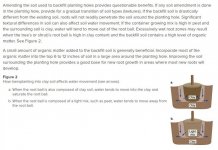
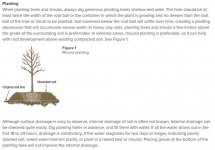
This is not the way either. When planting in clay soil, the best way is to raise the root ball, how much depends on seeing how long it takes the clay soil to drain. If the tree has a B&B, the root ball will be clay. So the backfill should be the same clay as well, not amended as this can retain the water, and hinder root growth into differing soils. And you do not dig below the height of the root ball, you want it resting on the virgin compacted soil. Any amendments to the soil is for surrounding the dig and maybe just the top couple inches of the hole backfill.

Any of the other amendments people have been talking about are for gardening, not planting woody root plants into clay soils.

As for the hole filled with gravel, I have seen the OP's "sump" method before as a recommendation, but by also inserting a perforated pipe. Never just a bed of gravel though.

The burlap and string should be removed (at least as much as you can down to the bottom without collapsing the root ball), as even natural burlap takes quite a while to deteriorate. It could be synthetic, then it will impede growth.

The local ag extension offices are the best source of info, here is some on clay soils:

This AND quit watering every day - particularly on clay. I would try 3 days a week and if you are having problems with runoff, run all zones for a 5 minute set to wet the surface and then come back with the rest of the water.
 

beech1948

Member
Joined
Jun 17, 2011
Messages
13
Having lots of heavy clay causes water to be held in the soil above as well as running across the face of the clay. So much water is held up from draining away that your trees are not being killed by the clay but are drowning in all of the water held in your soil. Root systems when surrounded by water do not work and the tree loses oxygen, nutrients and minerals. Trees can drown just like humans.
 

rtz

Well-known member
Joined
May 27, 2018
Messages
342
Location
Oklahoma City
I got a 40# bag of gypsum at Lowe's and walked around a grass area with bare spots because of clay. It immediately softened up the clay once it was wet and dissolved:

Soil Doctor Pelletized Gypsum Soil Repair 40-lb Organic Gypsum Improves Soil Structure https://www.lowes.com/pd/Soil-Docto...rganic-Gypsum-Improves-Soil-Structure/3062445

Also I read online and have experimented with and it works; using Dawn dish soap. It breaks up the clay and makes it more dusty and sand like and it can take water. Notice two types of Dawn. Don't get the antibacterial one. Get the one that says on the bottle contains biodegradable surfactants. Also Gain has one that is biodegradable. Get the green one unless you want the ground blue till it's washed in. Also bury the clay surface with top soil to get rid of it and get grass growing.
 

3onthetree

Well-known member
Joined
Nov 14, 2018
Messages
191
I got a 40# bag of gypsum at Lowe's and walked around a grass area with bare spots because of clay. It immediately softened up the clay once it was wet and dissolved:
Again, adding gypsum and other amendments to clay soil is only for gardening, not woody root systems. That means you can do it for your grass, tomatoes, and basil, but not trees. And even then you should only be adding based on a pH soil test so you know what and how much. Check your local university extension office, they will not recommend amending clay soil for trees.
 

Kevin54

MEMBER EMERITUS
Joined
Jan 12, 2005
Messages
29,341
Location
Urbana, Ohio
This is not the way either. When planting in clay soil, the best way is to raise the root ball, how much depends on seeing how long it takes the clay soil to drain. If the tree has a B&B, the root ball will be clay. So the backfill should be the same clay as well, not amended as this can retain the water, and hinder root growth into differing soils. And you do not dig below the height of the root ball, you want it resting on the virgin compacted soil. Any amendments to the soil is for surrounding the dig and maybe just the top couple inches of the hole backfill.

Any of the other amendments people have been talking about are for gardening, not planting woody root plants into clay soils.

As for the hole filled with gravel, I have seen the OP's "sump" method before as a recommendation, but by also inserting a perforated pipe. Never just a bed of gravel though.

The burlap and string should be removed (at least as much as you can down to the bottom without collapsing the root ball), as even natural burlap takes quite a while to deteriorate. It could be synthetic, then it will impede growth.

The local ag extension offices are the best source of info, here is some on clay soils:

I said in my reply to raise the root ball to where it needs to be.
 
OP
W

White Shadow

Well-known member
Joined
Jan 26, 2014
Messages
985
As a follow-up two years later, I have to say that what I did absolutely worked to keep my trees alive and thriving, despite having clay soil. I ended up borrowing my neighbor's post hole digger (the kind you have to turn, no the kind with the handles) and I dug down the full length of the tool, which is about 5 feet. I was still pulling up clay, so I added another 5 foot section of pipe on the end and dug down another 5 feet. So yeah, I hand dug 10 feet of clay out of the ground. I did this for 3 different trees over 3 weekends and got plenty of blisters.

I backfilled the holes with pea gravel and placed some landscape fabric over the stones, then I fill the rest with top soil and kept the root balls of the trees about halfway into the ground. Two years later and all three trees are doing great. So for anyone who is struggling to keep trees alive in clay soil, this definitely worked for me.
 

olytdi

Well-known member
Joined
Dec 3, 2011
Messages
2,202
Location
Olympia, Washington
Such a wide variety of advice!

I have dense clay soil and live on acreage that was clear-cut in the 1970s and never replanted (native forest would be Western Red Cedar, Douglas Fir, Western Hemlock, Grand Fir, etc.). I've been trying to re-forest the property since 2018. I've planted around 100 - 150 native shrubs and trees of probably 12 species with really mixed results.

I have found that the sites with the most clay also are seasonal wetlands and therefor difficult given the standing water in winter. I've drowned a number of trees, over watered, under watered, and had a number of raging successes. I cannot completely claim that I yet fully understand the dynamics of why some things thrive and others fail but I'm learning some lessons.

I think that any hole dug in clay forms what is essentially a non-draining bowl that will hold water. Put a tree in that hole and your tree will sit in water -- root rot.

I've started to dig wide and elevate the ball to about surface height and then mound up semi-amended soil such that the tree is not sitting in a bowl of water. I also use lots of wood chips I keep on hand to hold moisture in summer -- something critical here in what is our fourth year of extreme drought. In those cases where I've planted on hills, I've trenched a ditch such that the planting hole can drain downhill.

I'm still learning but believe that with heavy clay, you cannot engineer your way out of it being essential impervious. You have to create a means by which the tree can grow and later start to incorporate its roots into surrounding clay without drowning them in the interim.
 

ace10

Well-known member
Joined
Dec 17, 2017
Messages
1,490
Location
Rural NoVA
First rule of installing trees and shrubs.... Plant what readily grows in your area. And I don't mean in your state. I mean in your neigborhood.

Second rule of installing trees and shrubs... Dig a BIG hole. Not one that barely fits the ball. And don't set the ball too deep.

And if you're putting water on trees that are properly installed and that are suitable for your location, every day.... please stop.
 

YeCats

Well-known member
Joined
Feb 19, 2015
Messages
159
Location
South Carolina
“Never plant a $50 tree in a $5 hole”

We’ve lived on this SC clay for 32 years. In that time, I’ve planted peaches, plums, figs, pears, apples, blueberries, and azaleas. Most have thrived and survived.

I haven’t bought an azalea in 25 years,, just keep transferring small rooted bushes off the mature ones in the fall, all the way till mid-Dec.

Good success from the fruit trees by digging the out 2 ft diameter, the depth is dependent on the rootball. Tease the rootball, then plant, filling to hole with the soil that was taken out. I also like to mulch with pine straw.

Watch the foliage, it will tell you how the plant is doing. Yellowing leaves means too much water, for me anyway.

I don’t consider myself a green thumb by any means,, yet I enjoy spring and fall!
 
OP
W

White Shadow

Well-known member
Joined
Jan 26, 2014
Messages
985
I think that the clay soil is NOT your main problem...
you are literally drowning your trees by watering them every day.
Soil that drains well will not drown your trees despite how much they get water. Soil that doesn't drain well definitely presents a problem for some trees. I have a River Birch that will **** up all the water you give it and be happy to sit in water all day long. But then again, I guess that's why they are called River Birch trees.
 

MushCreek

Well-known member
Joined
Jan 14, 2015
Messages
9,780
Location
Upstate South Carolina
Plant Bald Cypress. They will grow IN water, as well as out. They will also survive further north than many people believe. There's one on the campus of UConn, in CT.
 

FredWanaker

Well-known member
Joined
Mar 27, 2021
Messages
1,470
Location
NorCal
I am just going to throw this out there. For 25 years I have struggled in the garden every year to get certain plants growing. The soil was amended with soil tests every year but the clay and heat are a killer. Last year I noticed that even close to November the winter cover seeds were coming up and rooting in shaded areas but not in the sunny areas that also got summer heat. Conclusion - sun bakes the clay, dries it so microrganisms don't grow in it - hence bad soil. Over watering then causes rot. This year in an experiment we put down a bale of rice straw - not many weeds from it like regular hay. Where I was lucky to get maybe 1 acorn squash and -0- butternut, we have about 20 acorn squash and 10 - 1 5 butternut squash from 2 plants. Nothing wilted all summer, even on 110F days. So - my suggestion for your trees on clay would be to keep a layer of rice straw mulch over the root area to cool the soil until the tree has enough girth and leaves to shade its roots. The other nice thing is that it doesn't take much water to keep the soil evenly moist and not wet. You cannot believe the difference that the rice straw made this year. We started with about 4 - 5 inches and now only a thin layer is left. The worms ate the rest. I've never had so many worms working the soil either. The goal is to just shade the ground - don't mix the straw in.
 
To avoid these ads, REGISTER NOW!
Top Bottom