To avoid these ads, REGISTER NOW!

Cleaning Rusty Tools Using Electrolysis (Pic/Video).

mkdive

Well-known member
Joined
Oct 11, 2008
Messages
2,649
Location
NPB (Socal)
Ok so I wanted to try a new method of cleaning up some of my rusty tools. I as many of you, I dont like to wire wheel any of my tools. I wanted to find a way to clean my tools that have rust that didn't require caustic chemicals, tons of scrubbing with wire brushes etc. So I did some Google searching and found that maybe I should try electrolysis? I did some searching on GJ and only found two threads that even mentioned the process..... (maybe I need to work on my searching skills). So I thought i would write a thread and post back my thoughts on using electrolysis as a de-rusting method. You know I had everything this process requires in the garage & kitchen pantry(as most of you guys probably do also). It took me about 15 minutes to throw together a "dunk tank" and get it going. After about 40 minutes to and hour of soak time the results were amazing!
approval.gif


Here is a link to a great website I used for reference on the DIY electrolysis process:
http://www.<wbr>rickswoodshopcreations.com/<wbr>Miscellaneous/Rust_Removal.htm

Here are "before" pictures of the wrench I used for testing:

024%20%28Medium%29.JPG


025%20%28Medium%29.JPG


023%20%28Medium%29.JPG


Here are the "after" pictures:

IMG_5804%20%28Medium%29.JPG


IMG_5807%20%28Medium%29.JPG


IMG_5808%20%28Medium%29.JPG


The last step (to clean the remaining black oxide), I need to find a better tray for the lemon juice/soda or hydrochloric acid bath. So I just soaked the box end of the wrench in a small plastic cup of lemon juice I had. Wonder if white vinegar would work? :confused:

I think I will run to target or walmart and get a plastic coated cookie cooling rack and use it to set the tools on. That will work a little better than the plastic lid I used. :thumbup:

Here is a quick video I threw together on the crude setup I used. Please excuse the extremely amateurish video. I'm great with DSLR's, but its painfully obvious I'm not too proficient at video or video editing for that matter. :(

<object height="745" width="960">

<embed src="http://www.youtube-nocookie.com/v/9AhKbEL86UM?fs=1&hl=en_US&rel=0&hd=1&color1=0x2b405b&color2=0x6b8ab6" type="application/x-shockwave-flash" allowscriptaccess="always" allowfullscreen="true" height="745" width="960"></object>
 
To avoid these ads, REGISTER NOW!

Grogan14

Well-known member
Joined
Sep 6, 2009
Messages
197
I used the process once on some tractor parts with great results, and it was fun to do. The most difficult part of the whole thing was locating the washing soda.
 
OP
M

mkdive

Well-known member
Joined
Oct 11, 2008
Messages
2,649
Location
NPB (Socal)
I used the process once on some tractor parts with great results, and it was fun to do. The most difficult part of the whole thing was locating the washing soda.

I wonder if I would get even better results with the wash soda? I just used baking soda. :headscrat
 

spongerich

Well-known member
Joined
Apr 17, 2010
Messages
2,339
Location
Monroe, NY
The results will be pretty much the same regardless of the electrolyte (within reason of course) It's just there to conduct the electricity. Washing soda is great because a small amount makes good electrolyte, it's cheap, and non-toxic so you can dump it in the yard when you're done with it.

I've been toying with adding some anti-freeze so I can keep mine going in the winter. I want to test it on some junk tools first to make sure that the anti-freeze doesn't affect the finish. It's also a pain in the **** because it's toxic, so I'll have to deal with disposing of it in the spring.
 

Kirbot

Well-known member
Joined
Sep 25, 2010
Messages
11,001
Location
New Jersey
I've been toying with adding some anti-freeze so I can keep mine going in the winter. I want to test it on some junk tools first to make sure that the anti-freeze doesn't affect the finish. It's also a pain in the **** because it's toxic, so I'll have to deal with disposing of it in the spring.

Let us know how it works out.
I've been thinking about trying the same thing.

My electrolysis tank is now a solid block of ice.
 

Johnny chaos

Well-known member
Joined
Mar 6, 2010
Messages
598
Location
upstate NY
I have heard you should not use this process on parts that often see stress. If I remember correctly it causes some sort of nitrification? I believe you can reverse this by slowly heating the part to around 400 degrees? I read about the process a few years back and remember only bits and pieces :) I'm sure someone hear can shed more light on the subject?
 
OP
M

mkdive

Well-known member
Joined
Oct 11, 2008
Messages
2,649
Location
NPB (Socal)
I have heard you should not use this process on parts that often see stress. If I remember correctly it causes some sort of nitrification? I believe you can reverse this by slowly heating the part to around 400 degrees? I read about the process a few years back and remember only bits and pieces :) I'm sure someone hear can shed more light on the subject?

Interesting....I hope someone chimes in on this.

Is nitrification more than a biological conversion of ammonium to nitrate?
 
Last edited:

Kirbot

Well-known member
Joined
Sep 25, 2010
Messages
11,001
Location
New Jersey
I have heard you should not use this process on parts that often see stress. If I remember correctly it causes some sort of nitrification? I believe you can reverse this by slowly heating the part to around 400 degrees? I read about the process a few years back and remember only bits and pieces :) I'm sure someone hear can shed more light on the subject?

I've heard something like that.

If I remember right, it supposedly effects the very surface of the metal, and makes it more brittle. It might be a concern for tools like hand saws that are very thin. I wouldn't give a second though regarding sockets/wrenches or anything like that however.
 

willy3486

Well-known member
Joined
Jan 14, 2010
Messages
1,594
Location
Middle Tennessee
I have used this method for years. In my area some civil war collectors use this on stuff they find like buckles and such. I have used it on all kinds of stuff and never had any issues with strength of the part afterwards. A few things I will warn you about though. Don't use it on stuff that has chrome on it. It does the opposite of electroplating. I was using it to clean some vent parts on my truck. It cleaned the rust off but the vent levers the chrome came off. It had taken it down to the copper plating between the part and chrome. The other to watch out for is wood. I redid a draw knife once. It had one wooden handle on it so I had to make another which I was going to wait until I had it clean, I am glad I did. The dirty water it makes stained the wood black.

I use a different power supply over a 12 volt charger and have fantastic luck. It has more juice to it if you will. But remember doing this is still electricity,be careful. I bought some hand tools of all types just before thanksgiving. I got a few vise grips,adjustable wrenches,plyers,etc. The tools were in a tub that water had leaked into and the tools were rusted up. None of the tools were loose and free which was a shame since they were all good tools. I used this on all the tools,one by one. I was able to get all free. I was even able to take out the set screw in one of the adjustable wrenches so I could re-oil it better.

I use this when I rebuild tools as well. I have used it for a shaper,scroll saw,drills,saws and other stuff. The shaper I redid was completely red from rust and locked up. I got it apart the best I could and used this on the smaller parts. This is a excellent way to break loose screws as well. After the process all the parts turn. I even had some shaper bits that had been in a jar that water got into. The bits were rusted and dull from the water. There was no sharp edge on it from the rust. After I did this just to see how it would work it had a sharp edge in places where it had not pitted.

As far as baking soda goes thats what I use. Now I have heard of people taking baking soda and putting it in a oven to heat it. Its suppose to change it into the washing soda. But with the setup I have and the way it works so good I don't worry about it. I have heard that people use some swimming pool chemicals to do the same effect. As far as what it does to the metal I explain it this way. When you sand rust you smooth out and take away rust,metal,etc. Wire brushing hits the metal and takes the rust off but the metal gets the abuse as well. But the electrolitic method what it does is causes the oxidation to release from the metal. It doesn't take away any metal but f the metal is pitted it doesn't put it back on. Its a good method and a lot eaiser on the elbows. I usually use this method,then wash it down if it needs it and wipe it off. I then ether primer it if I am going to paint it or oil it good.
 

DeadSock

Well-known member
Joined
Sep 17, 2006
Messages
161
Location
Sterling, AK
Pool suppliers also sell sodium carbonate (aka soda ash/washing soda) as a PH adjuster for swimming pools. Cheaper than the small boxes from arm and hammer.
 

DavidB

Well-known member
Joined
Feb 6, 2010
Messages
734
Location
Navarre, FL
In my experience, electrolysis won't take chrome off unless rust has started to get under it and weaken the bond. I once left a wrench in the tank for 4 days running and the chrome was fine.
 

e-tek

Well-known member
Joined
Dec 19, 2007
Messages
10,690
Location
Saskatoon, SK
Those are some great results!

I just bought 2 quarts of Evapo-Rust. Wondering if I should have tried this first.

I have found EvapoRust ***** - but then I always try to de-rust VERY rusty stuff. Maybe works on stuff like those wrenches better....

Pool suppliers also sell sodium carbonate (aka soda ash/washing soda) as a PH adjuster for swimming pools. Cheaper than the small boxes from arm and hammer.

Thanks - I got LOTS of Sodium Carbonate for the HotTub!
 

spongerich

Well-known member
Joined
Apr 17, 2010
Messages
2,339
Location
Monroe, NY
I have heard you should not use this process on parts that often see stress. If I remember correctly it causes some sort of nitrification? I believe you can reverse this by slowly heating the part to around 400 degrees? I read about the process a few years back and remember only bits and pieces :) I'm sure someone hear can shed more light on the subject?

Hydrogen embrittlement. I've read differing opinions. Some claim it'll make things like lathe chisels too brittle and prone to breakage. I've also read that the effect is minimal and nothing to worry over.

I have found EvapoRust ***** - but then I always try to de-rust VERY rusty stuff. Maybe works on stuff like those wrenches better.

Evaporust works OK, but you'd need $100 worth of it to do something like a large vise. With electrolysis, you need about a buck worth of washing soda and some water.
 

Displaced Hokie

Well-known member
Joined
Sep 19, 2009
Messages
1,778
Location
Western NC
I'd personally be surprised that you could get nitrogen imbrittlement by doing this. NI happens when a tool is heated/made/cooled. We are just affecting the outer layer of the metal.
 

DrkMtnDew

Well-known member
Joined
Sep 24, 2010
Messages
1,465
cool video. i've got some rusty tools that would be excellent canidates for this process. have to give it a try.

:)
 
To avoid these ads, REGISTER NOW!
OP
M

mkdive

Well-known member
Joined
Oct 11, 2008
Messages
2,649
Location
NPB (Socal)
Well tonight I started the slow restore on my Plomb tool mobile cart. I am going to take small steps...so I decided to remove the casters and clean them up. I decided there was a enough rust to warrant trying the electrolysis again. I'm very happy with the results once again!

(BTW I have no idea what that white stuff is, it came rather easy....looked like 40+ year old paint)?


IMG_5876a.jpg


IMG_5881a.jpg


IMG_5884a.jpg


Here are the casters after a 30 minute bath.....

IMG_5888a.jpg


IMG_5889a.jpg
 

HTGTS350

Banned
Joined
Mar 2, 2010
Messages
603
After reading this thread I have tried the elctolysis process myself. My set up consists of a very large battery charger which has two transformers and I am able to adjust the open circuit voltage to a maximum of 96 volts dc and a rather small platis container, I have tried only VERY rusty pieces that have require a couple of days in the bath pulling up to 20 amps at 50+ volts but it has worked very well although due to using a very small anode I have needed to clean several times throughout the process and also at times empty the water as it becomes very black with rust. I am going to get my hands on a 1000litre pod and cut off the top and use a large anode and set up the process outside so I can use it for much larger items such as engine blocks, axle housings, wishbones etc.
 

JayL

Well-known member
Joined
Apr 17, 2008
Messages
1,789
Location
Manila, Philippines
Nice thread.

I have this older battery charger with a smaller capacity. Do you think it is enough for electrolysis work?

IMGP1123.jpg


Thanks
 

evintho

Well-known member
Joined
Apr 6, 2006
Messages
1,358
Location
Santa Rosa, CA.
Vinegar and molasses works very well also. Soaked a bunch of rusty files in a tub of vinegar overnight and all rust was removed. I did have to give them a light wire wheeling to remove the vinegar residue though.

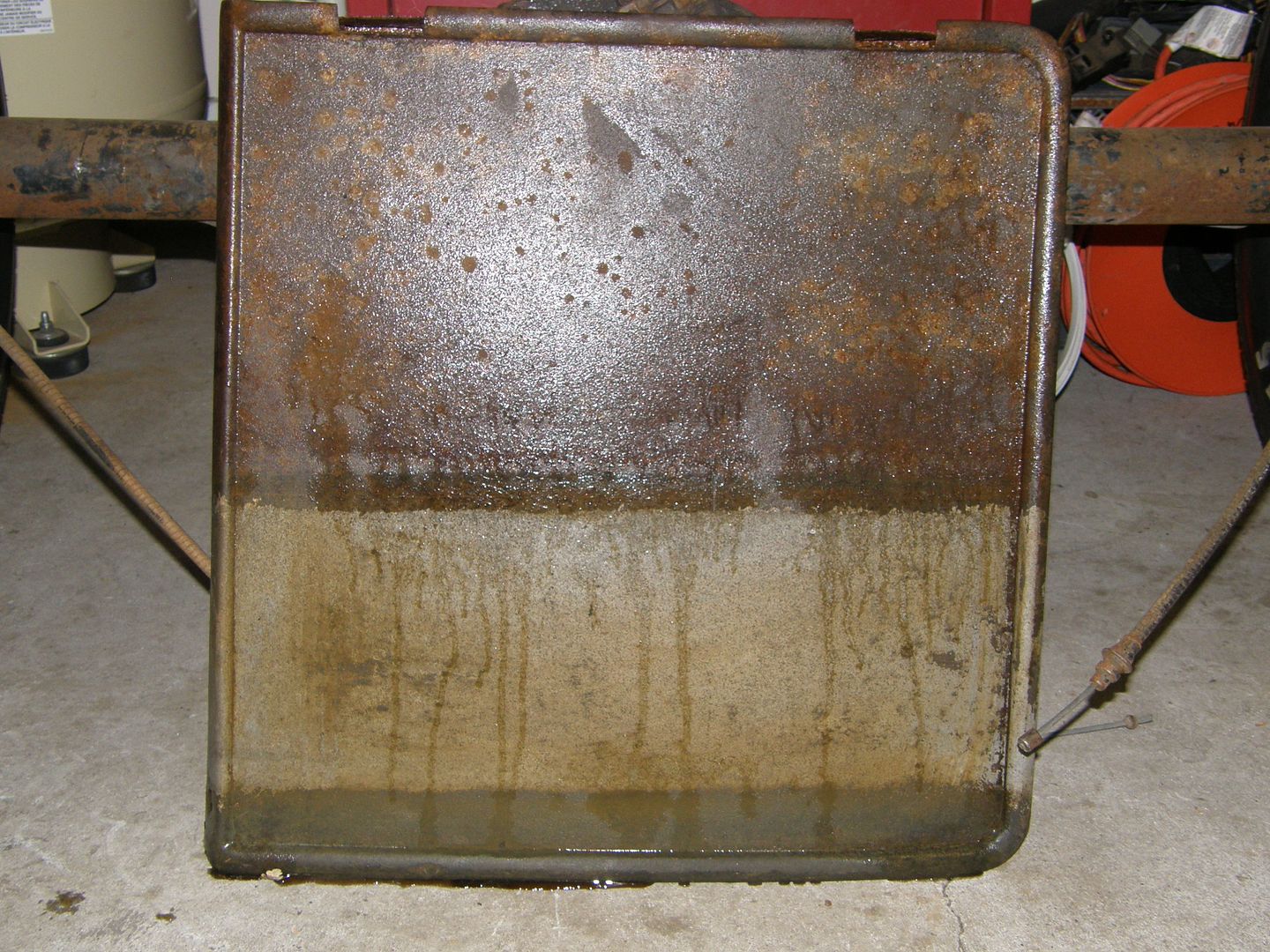
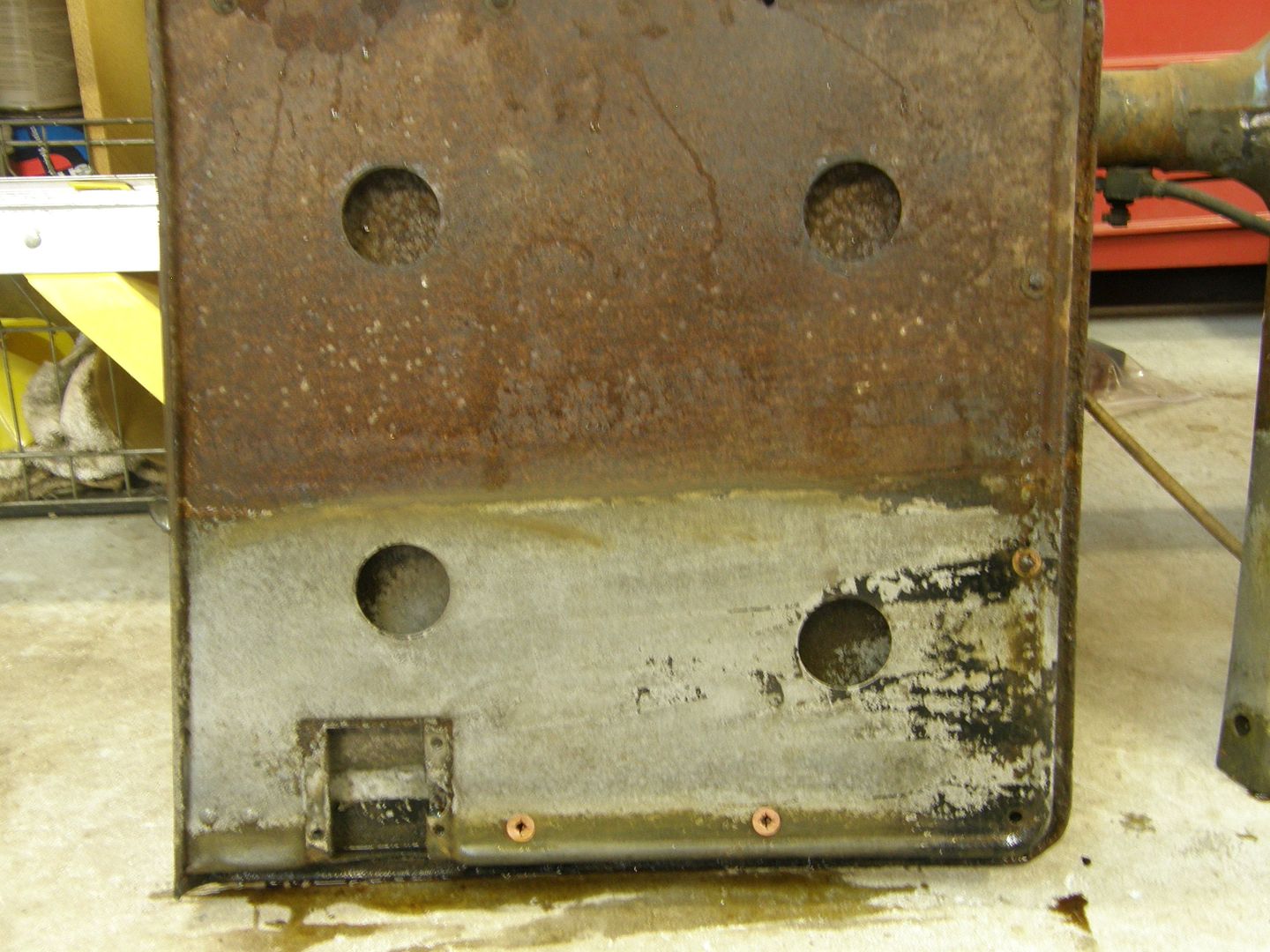
Now molasses, I swear by! Haven't used it for tools but here's the results when I did a test on a '27 Model T roadster door. I set it in 6" of molasses for a week. 80 years of rust disappeared! What was left of the original paint was untouched! The rest of the car is submerged in a molasses bath, as we speak. I'm pulling it out tomorrow.

P1010018.jpg


P1010020.jpg
 

diesel research

Well-known member
Joined
Sep 12, 2010
Messages
5,440
Location
gulf coast, TEXAS
For all of our budding chemists out there, I advise not experimenting with chemical additives to the electrolysis tank. (electrolytes are good to improve conductivity)

The process takes any material made up of multiple elements and splits them up. (some are attracted to anodes, some to cathodes)

For example: rust and iron, or nickle and chromium.

Another example: salt water. Sodium chloride. You effectively split table salt into sodium and chlorine gas. The water itself is also splitting and hydrogen may feel free to associate with any number of other elements to form varying strength acids.

With antifreeze consisting of god only knows what, you can have a real brew of various gases clouding the shop while various new chemicals are formed in the tank to eat away your wrench.

Metal is consumed in this process, especially if you have your anode and cathode wrong.

This is similar to the process that eats aluminum cylinder heads and intakes.
 
OP
M

mkdive

Well-known member
Joined
Oct 11, 2008
Messages
2,649
Location
NPB (Socal)
Nice thread.

I have this older battery charger with a smaller capacity. Do you think it is enough for electrolysis work?

IMGP1123.jpg


Thanks

Yes it should work fine....mine is running around 4-5 amps when it has a good connection to the anode. :thumbup:
 
OP
M

mkdive

Well-known member
Joined
Oct 11, 2008
Messages
2,649
Location
NPB (Socal)
For all of our budding chemists out there, I advise not experimenting with chemical additives to the electrolysis tank. (electrolytes are good to improve conductivity)

The process takes any material made up of multiple elements and splits them up. (some are attracted to anodes, some to cathodes)

For example: rust and iron, or nickle and chromium.

Another example: salt water. Sodium chloride. You effectively split table salt into sodium and chlorine gas. The water itself is also splitting and hydrogen may feel free to associate with any number of other elements to form varying strength acids.

With antifreeze consisting of god only knows what, you can have a real brew of various gases clouding the shop while various new chemicals are formed in the tank to eat away your wrench.

Metal is consumed in this process, especially if you have your anode and cathode wrong.

This is similar to the process that eats aluminum cylinder heads and intakes.

Im sticking to the baking soda and water mix (works great so far).
 

spongerich

Well-known member
Joined
Apr 17, 2010
Messages
2,339
Location
Monroe, NY
For all of our budding chemists out there, I advise not experimenting with chemical additives to the electrolysis tank. (electrolytes are good to improve conductivity)

Another example: salt water. Sodium chloride. You effectively split table salt into sodium and chlorine gas.

You guys worry too much. A little chlorine gas never hurt anyone. :bounce:
 

HTGTS350

Banned
Joined
Mar 2, 2010
Messages
603
After saying how good mine was going I have hit a stumbling block, I de rusted a mill ball in the electrolysis tank and then transferred it to the vinegar, after a day in the vinegar it is now covered in a black grease like substance and when you rub this off it appears that the metal underneath is very porous, any ideas? I believe the mill ball is cast, does this make a difference?
 

kc-steve

Well-known member
Joined
Jun 22, 2010
Messages
4,240
Location
Kansas City
Those are some great results!

I just bought 2 quarts of Evapo-Rust. Wondering if I should have tried this first.

He-he, no you should have tried white vinegar first. :) I have used Evapo-rust and only recently tried white vinegar after someone mentioned in GJ. It works as good as Evapo-rust and a whole LOT CHEAPER.

BTW, the main reason I went back to using the chemicals is because electrolysis is basically the process of separating hydrogen and oxygen from water. And separately both are extremely flammable and dangerous. Explosive is a better word though.

Steve
 
Last edited:

diesel research

Well-known member
Joined
Sep 12, 2010
Messages
5,440
Location
gulf coast, TEXAS
When I first learned of the process it was in chemistry, to separate hydrogen and oxygen.

The oxygen poses no risk.

The hydrogen is of a slight but overstated risk. In order to get enough for an explosion (our goal) we needed to completely surround the anode or cathode (can't remember which side it gathered on) with a glass beaker to capture the bubbles. After 5 or 10 minutes there was barely enough to make a quick "whoosh" and "pop!" when intentionally lighting the contents of the beaker.

In an open environment it would take much more amperage to pose a risk. Charging a battery (whether via charger or alternator) is much more of a "risk".

The risk of producing noxious gases or corrosive chemicals is much more real.

I think KOH aka potassium hydroxide aka lye (NOT sodium lye type) is a safer electrolyte, but I am not sure how it affects metal. Don't think it has too much negative effect, since they like to use it in those home brew hydrogen makers. It does like to consume oxides, so may have a taste for rust.
 

kc-steve

Well-known member
Joined
Jun 22, 2010
Messages
4,240
Location
Kansas City
When I first learned of the process it was in chemistry, to separate hydrogen and oxygen.

The oxygen poses no risk.

The hydrogen is of a slight but overstated risk. . . .

That is completely BOGUS! If I were you I would ask for my money back on that so-called chemistry class. Pure Oxygen is explosive, PERIOD! Just ask the dead NASA astronauts.

And I wouldn't recommend anyone trying to see at what level of concentration Oxygen becomes safe. Ya know, people get sued over stupid comments like that everyday.

Steve
 

diesel research

Well-known member
Joined
Sep 12, 2010
Messages
5,440
Location
gulf coast, TEXAS
That is completely BOGUS! If I were you I would ask for my money back on that so-called chemistry class. Pure Oxygen is explosive, PERIOD! Just ask the dead NASA astronauts.

And I wouldn't recommend anyone trying to see at what level of concentration Oxygen becomes safe. Ya know, people get sued over stupid comments like that everyday.

Steve

You need to get a new source of news. :D The columbia disaster was resultant of a piece of foam falling off. The previous challenger accident was the result of an oring failing allowing PRESSURIZED hot gases and a breached fuel tank.

I have used a torch enough to not fear low levels of oxygen. As mentioned, your batteries produce these gases (unless you have high-zoot battery) at a much greater rate.

Oxygen needs a fuel to oxidize. Plain and simple facts. Not theoretical "maybe it could". It was attempted, but the small quantity produced by a battery charger would not do anything.

That old oak tree out back is producing more volatile hydrocarbons and compounds along with "pure dangerous oxygen" than the typical smaller battery charger. The water itself has a decent concentration of "DO" or dissolved oxygen, temperature dependent.
 

c_mccann

Well-known member
Joined
Mar 30, 2010
Messages
919
How much baking soda per parts of water. I've seen this done before but not in this detail, neat stuff!
 

jduncan459

Well-known member
Joined
Nov 16, 2010
Messages
46
Location
Odenville, Al
You need to get a new source of news. :D The columbia disaster was resultant of a piece of foam falling off. The previous challenger accident was the result of an oring failing allowing PRESSURIZED hot gases and a breached fuel tank.

He's refering to the Apollo 1 accident in 1967.
 

kc-steve

Well-known member
Joined
Jun 22, 2010
Messages
4,240
Location
Kansas City
You need to get a new source of news. :D The columbia disaster was resultant of a piece of foam falling off. . .

Maybe YOU shouldn't jump to conclusions about what I am talking about.

Check it out here,
http://en.wikipedia.org/wiki/List_of_spaceflight-related_accidents_and_incidents

It is never a good idea to make recommendations on something that is potentially hazardous. I'm sorry if I was blunt or gruff about it, but I feel it is more important that everyone understand the potentiall dangers involved in the electrolysis process. White vinegar works great, it's cheaper than Evapo-rust, and much safer.

Steve
 
To avoid these ads, REGISTER NOW!
Top Bottom