kc-steve
Well-known member
Again, I wouldn't recommend anyone try and find out at what level of Oxygen concentration your garage burns down.
Steve
Steve


Maybe YOU shouldn't jump to conclusions about what I am talking about.
Check it out here,
http://en.wikipedia.org/wiki/List_of_spaceflight-related_accidents_and_incidents
It is never a good idea to make recommendations on something that is potentially hazardous. I'm sorry if I was blunt or gruff about it, but I feel it is more important that everyone understand the potentiall dangers involved in the electrolysis process. White vinegar works great, it's cheaper than Evapo-rust, and much safer.
Steve

Since the CM was designed to endure outward pressure in the vacuum of space, the plugs-out test had been run with the cabin pressure at over 16 psi, almost 2 psi above the ambient sea level pressure at Launch Complex 34 and near the upper limits of measuring devices in the spacecraft. This represented over 5 times the oxygen density carried within the Mercury and Gemini spacecraft while in spaceflight (which was only 3 psi but equal to the partial pressure of oxygen at sea level and thus very breathable)....
The review board noted a silver-plated copper wire running through an environmental control unit near the center couch had become stripped of its Teflon insulation and abraded by repeated opening and closing of a small access door. This weak point in the wiring also ran near a junction in an ethylene glycol/water cooling line which was known to be prone to leaks. The electrolysis of ethylene glycol solution with the silver anode was a notable hazard which could cause a violent exothermic reaction, igniting the ethylene glycol mixture in the CM's corrosive test atmosphere of pure, high-pressure oxygen
For all of our budding chemists out there, I advise not experimenting with chemical additives to the electrolysis tank. (electrolytes are good to improve conductivity)
The process takes any material made up of multiple elements and splits them up. (some are attracted to anodes, some to cathodes)
For example: rust and iron, or nickle and chromium.
Another example: salt water. Sodium chloride. You effectively split table salt into sodium and chlorine gas. The water itself is also splitting and hydrogen may feel free to associate with any number of other elements to form varying strength acids.
With antifreeze consisting of god only knows what, you can have a real brew of various gases clouding the shop while various new chemicals are formed in the tank to eat away your wrench.

How much baking soda per parts of water. I've seen this done before but not in this detail, neat stuff!
Washing soda is what you want, not baking soda. (Baking soda will work if it's all you can get). I use about a 1/2 cup of washing soda per gallon of water.
As for the dangers of the released hydrogen, unless your garage is very very small and very very well sealed, you're not going to produce enough to worry about. If you could produce reasonable amounts of hydrogen with a couple of amps of 12v power, we'd all be driving hydrogen powered cars.
Yeah I agree, washing soda works best and hydrogen isn't a big problem. But Oxygen IS a problem
. . . The oxygen poses no risk. . .
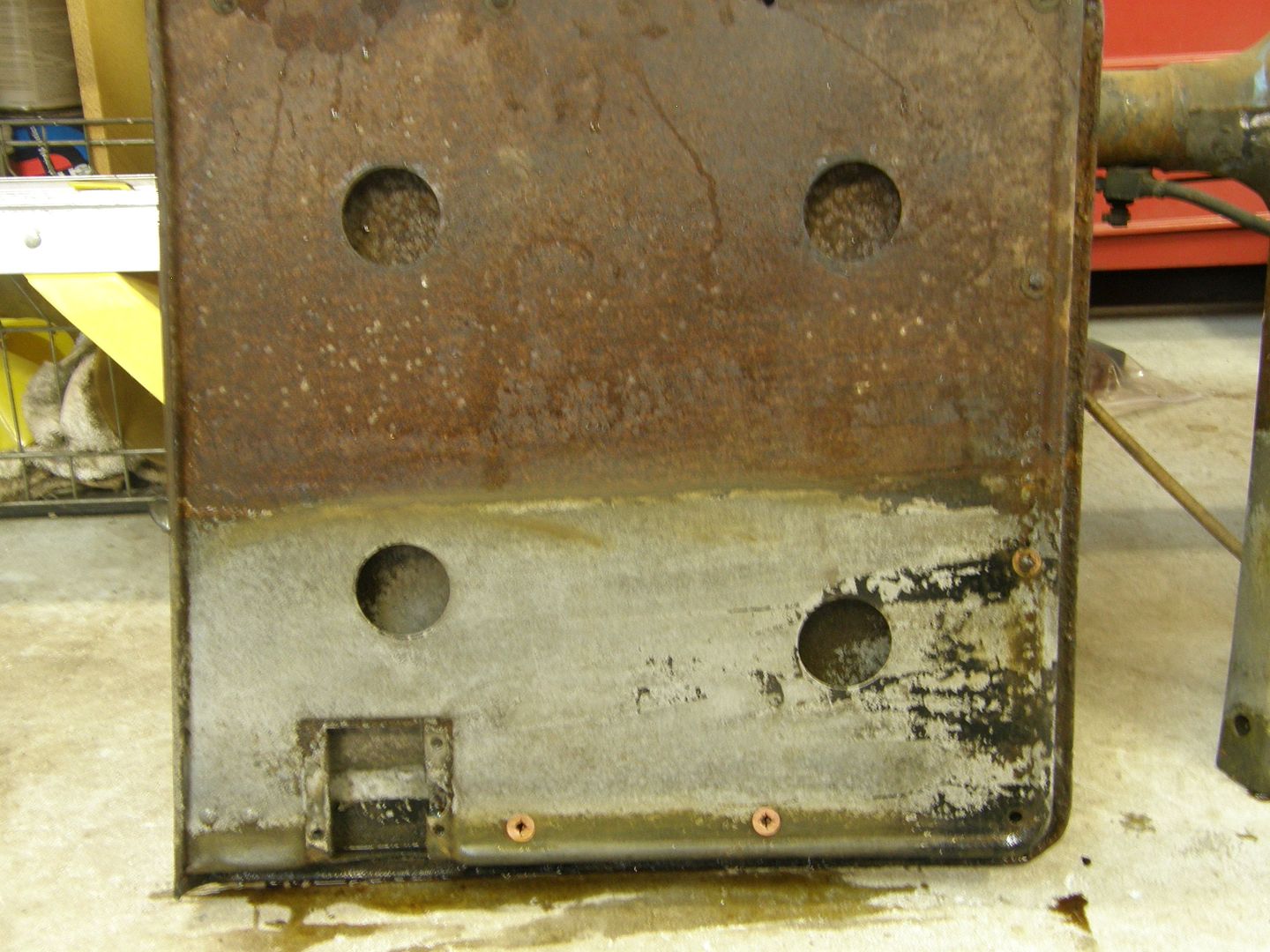
Yeah, I actually pulled the panels out Saturday. Here's my post from jalopyjournal.......
http://www.jalopyjournal.com/forum/showthread.php?t=557996
You guys can ALL do what you wish, ya know? (whew)
The ONLY reason I came into this discussion was because diesel research made the statement that "oxygen poses no risk" and that is blatantly wrong as I proved with examples, and others have backed it up. The explosion examples are only to show what it can do in concentrated form. But who knows what level of concentration oxygen becomes safe in an enclosed area? There are too many variables for anyone to blatantly say electrolysis is safe to use under any circumstance.
While trying to debate that point, suddenly I am a bad guy for trying warn people of the POSSIBLE hazards. I certainly think it is also wrong to tell others it is completely safe. Just the possibility of an injury/fire/property damage lawsuit , real or imagined, is enough for any rational thinking person not to go so far as to say electrolysis is completely safe. Think about it. If it is safe then why hasn't a company packaged an "electrolysis kit" for sale? Obviously, they don't want the liability.
Like I said, I have done it myself outside so go ahead and do what you wish, but don't tell other people it is completely safe. That's just not true.
Steve
In order to get enough for an explosion (our goal) we needed to completely surround the anode or cathode (can't remember which side it gathered on) with a glass beaker to capture the bubbles. After 5 or 10 minutes there was barely enough to make a quick "whoosh" and "pop!" when intentionally lighting the contents of the beaker.
In an open environment it would take much more amperage to pose a risk.
The risk of producing noxious gases or corrosive chemicals is much more real.
blah blah blah
Also interesting to note we are not speaking of a high pressure pure oxygen state. We are speaking of real world involving a battery charger in a open shop and a non-covered vessel. I should further elaborate, not best idea to exceed 10-20 amps since the process becomes quite accelerated above that. Actual current draw being dependent on purity/conductivity of water/solution and distance between anode/cathode.
To stay on topic though, maybe the compromise is suggesting outside. I've never done it outside, only in labs, my kitchen table, and personal garage, but I think that's a reasonable suggestion. Although this current weather is a major deterrent to that method.
I agree, the presence of more oxygen can accelerate a open flame. It does take a good bit extra as noticed by your experiment. It does have to be concentrated into an enclosed container.
Let's just keep this simple and to the point. If you pressurize a space shuttle with oxygen while burning antifreeze, you may have a problem.
If you heat a sealed container of pure oxygen with an open flame, you may have a problem.
If you charge a battery/ perform electrolysis on a wrench with a typical charger at the typical charging rates inside of the typical drafty garage, you have other more serious threats like paper cuts or slip and falls. Open the door if you are worried.
The rate of oxygen production can and has been measured, so the rest of you can sleep relatively sound. There are still other issues like cheap chargers burning up, preventing direct shorts via isolation, and byproducts produced if trying to use stainless or various other non iron metals or alloys.
Does anyone have any good suggestions for easily removing the black residue that is left when I remove my item from an electrolysis bath?
I wish I would have found this site & thread last year. Last summer I junked a large 50V battery charger that was mounted on the wall of the shop when we bought the house. I put a meter on it and it put out right about 50VDC - the original manual was even laying on top. I think that much juice would have worked great for electrolysis, but I couldn't rationalize the wasted wall space at the time.