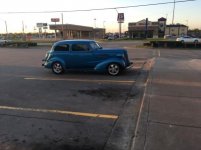
So we start on the 32 Chevy coupe. As I said, a shop in Tulsa replaced the engine and transmission and cut the torque tube off the rear axle. The owner wants to keep the mechanical brakes and factory wire wheels. An axle change just about requires going to hydraulic brakes.
A word to the nay sayers. Mechanical brakes are great. My 31 Victoria stops like it has hydraulic brakes. The issue is that they need to be kept adjusted. Pretty easy for an antique, a little tougher for a daily driver. The big advantage, though, is mechanical brakes can sit for years and are ready to go. No stuck cups, no leaking brake fluid, no water in the brake fluid. I'm sold on mechanical brakes for an original antique. Maybe not for a hot rod, but for drum brakes they do stop very well, when adjusted properly.
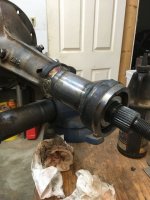
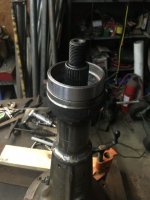
So we're going to put a u-joint on the front of the old axle. To do that I'm making a stub torque tube and using an axle input shaft and yoke from an 82 Chevy 1/2 ton. I'm adding a bearing and seal. I cut the pinion off the input shaft and drilled a 1/2" hole into the shaft. Then turned the old drive shaft where it had been cut off and made a 0.504" stub on the end to match the drilled hole. Pressed together and welded carefully to draw it straight. Came out ok but not perfect.
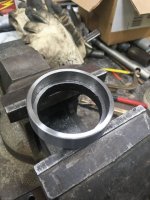
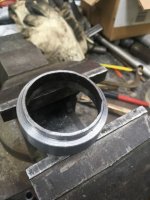
Next I needed a big ring for the bearing and seal. Rolled a piece of 3/8" plate to make the ring, welded and machined. I got it too big and the ID wouldn't clean up.
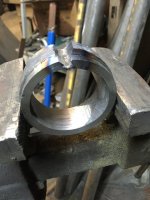
So I cut it and took out 1/4" and rewelded it. Remembered to take a picture. Finally.
To weld a ring like this I weld it on the inside first with plenty of weld cap then grind all the way through from the outside and into the cap so I have one weld from the outside and no junk in the weld.
Cleaned up fine the second time.
Took my time welding it to the stub tube then finished machining for the bearing and seal.
I wound up with three rings because I'm too cheap to buy material. Small ring from pipe adapts the rolled ring to the tube, rolled ring holds the bearing, last ring from pipe holds the seal. The seal ring avoided rolling a wider piece to get the bearing ring made. The seal ring is standard 3" pipe but the bore was too big for the bearing and the O.D. does not give as much meat as I'd like to hold the bearing. So it's a three ring circus.

Then lined it up and welded it to the differential housing with E309.
About 0.008" TIR without the bearing. The bearing will hold it straight.
I have a video of the dial indicator but not sure I'll find time to get it put up.
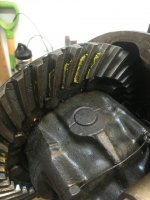
Everything will come back apart. Gearset lash is adjusted by shims in front of the front original pinion bearing. Since it had all been disassembled months ago by others I had to guess on the shims. There is a clamp which hold the bearing forward against the shim. The clamp is a beveled ring with three bolts with tapered ends pressing on the bevel. Of course the gear load also presses it forward. Fortunately the gear lash was ok and the teeth seemed to be aligned ok.