AntiqueBen
Well-known member
- Joined
- Aug 4, 2021
- Messages
- 1,442
Nice find! Keep it clean & it will last forever.


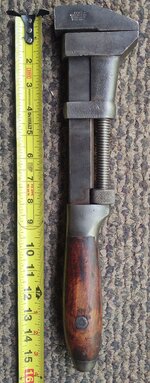
I would just put it in the press and straighten it. It was bent that way cold, and it's not cast that would break. And if something did go wrong, it's not like it's a rare wrench.I have a very similar Coes wrench I'm in the process of restoring, and had a question about straightening it out. Someone in the past managed to bend it, and I want to true it up. Does anyone have any experience in heating it up and straightening it back out? As it stands, it's too bent to close less than about an inch. I have a forge and an oxy acetylene torch. My plan was to get it red hot and bend it true on my anvil. I have no idea what kind of steel these are made of, so I don't want accidentally soften, or over-harden the steel. I'm an amateur bladesmith, so I have some experience working steel, but I don't want to ruin it trying to "fix" it.
As you have the facilities to heat it up I would go ahead and gently straiten it on your anvil. Hot metal is easier to bend than cold.I have a very similar Coes wrench I'm in the process of restoring, and had a question about straightening it out. Someone in the past managed to bend it, and I want to true it up. Does anyone have any experience in heating it up and straightening it back out? As it stands, it's too bent to close less than about an inch. I have a forge and an oxy acetylene torch. My plan was to get it red hot and bend it true on my anvil. I have no idea what kind of steel these are made of, so I don't want accidentally soften, or over-harden the steel. I'm an amateur bladesmith, so I have some experience working steel, but I don't want to ruin it trying to "fix" it.
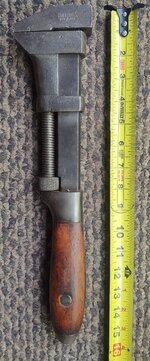
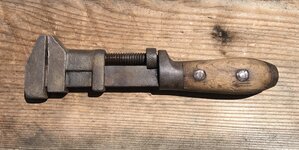
Turns out I have a Coes stamped like yours Lugz, just different patent dates & mine is 8" long. The only other difference I noticed is the metal that comes down into the top of your handle. I think that's how all the 6" handles were.I can count on one hand the number of monkey wrenches - of any brand - that I have purchased at flea markets. They're one of the tools that are so commonly seen I tend to ignore them completely and walk right past without more than a cursory glance. That doesn't mean they aren't cool to collect. Like hand planes, they kind of have their own universe. It's just not one I'm interested in diving into encyclopedically, or even enough to know a rare bird if I saw one. Something has to catch my eye as unusual for me to pick it up on a whim or instinct, and in this case, it was the ferrule.
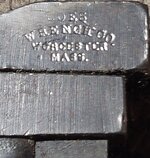
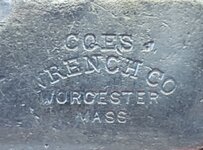
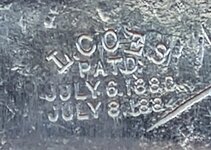
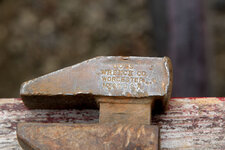
It has the routine "COES WRENCH CO. / WORCESTER, MASS." marking (see Pic 3) on the static jaw. Rather than the more commonly seen "MFD UNDER L. COES' PATS / STEEL" marking on the flip side, however, it's marked "L. COES / PAT'D / DEC. 15 1891 / APR. 30, 1895" (see Pic 4). Those dates refer to patents 465,347 and 538,411 respectively. See Pics 5 & 6 c/o DATAMP.
Those patents were focused on improving the continuity of the bar-shank, the ferrule, and the wooden handle halves. The visible part of that design modification are those pieces of metal protruding into the wooden handle halves, which Loring Coes called, alternately, "tongues," "braces" or "arms," but most frequently "tongues." In Loring's applications, "to render the handle more firm and rigid in connection with the bar-shank," and to provide "over-locking support."
I wouldn't call them rare. This isn't some ultra valuable score. But, per Davistown Museum, Herb Page, and DATAMP, they're apparently less common.
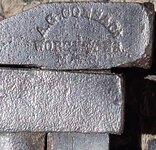
I didn't realize A.G. Coes wrenches were only made from 1869-1881.Here's a nice older 6" A.G. Coes. Note the older shape of the handle & the different logo with the 1871 patent date.
The monkey clan keeps growing in the basement. It recently welcomed a new Bonney member.This thread has lost some of its momentum. (Understatement)
If anybody has something to add, now is a good time.


 -Don
-Don

I've had a few like this. I propped it up upside down & drenched it with some kind of penetrating oil. I let the penetrating oil soak down in there for a day or two & then hit it with some heat. You might have to gently use pliers or something to force the adjustment nut to turn a little to break up the rust on the screw. All of this assuming the bar isn't bent which can prevent it from moving up & down the bar.Silly question, I have a Coes wrench that was rusted stupid solid stuck. I stuck it into Evaporust for a few days, and it looks better, but still stuck stupid solid. It's relatively open, and I managed to get the adjuster to move maybe 3/4 of a rotation, but the jaw never moved. I'm able to get a thin strip between the jaw and the bar, and wiggles fine, with space.
Any clues as to how dislodge the jaw, getting it to move? I've tried heat from a small butane torch, light pressure both opening and closing it, and nothing yet. How much pressure can I exert without breaking it? It's not a collection quality tool, as the flip side shows, so I'm not gonna buy tons of effort into it, mostly a learning exercise. Thanks.
I've had a few like this. I propped it up upside down & drenched it with some kind of penetrating oil. I let the penetrating oil soak down in there for a day or two & then hit it with some heat. You might have to gently use pliers or something to force the adjustment nut to turn a little to break up the rust on the screw. All of this assuming the bar isn't bent which can prevent it from moving up & down the bar.
Try smacking it around, hard, against a piece of scrap wood.Any clues as to how dislodge the jaw, getting it to move?
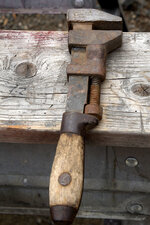


You could buy one in fine condition for less than the effort needed to redo that one.Here's my Coes' Knife Handle Wrench collection:
10" OAL. Everything moves like it should.
I'm wondering how to go about removing some of the rust without screwing up what's left of the handle slabs.
Ah....don't let it die on rust mountain. Just clean it up at the wire wheel & scrub the heck out of the handle with 0000 steel wool & wipe it down with boiled linseed oil. Just use it as a beater around the shop. You'll be happy you did it when it's finished.You could buy one in fine condition for less than the effort needed to redo that one.
My thought is the same.Ah....don't let it die on rust mountain. Just clean it up at the wire wheel & scrub the heck out of the handle with 0000 steel wool & wipe it down with boiled linseed oil. Just use it as a beater around the shop. You'll be happy you did it when it's finished.
Your effort may be worth more than mine.You could buy one in fine condition for less than the effort needed to redo that one.
They don't makem like that anymore. It's rough, but not beyond saving.Your effort may be worth more than mine.
Wanna know where there are a few thousand more? And that was only part of them.They don't makem like that anymore. It's rough, but not beyond saving.
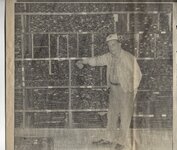
That might be a flask in his right hand. There's still that one elusive Coes Wrench that he could never find & it's driving him crazyWanna know where there are a few thousand more? And that was only part of them.

Soaked mine tip down in a drinking glass shaped evaporust container. Didn’t free it up, but it looks better. Scales were above the liquid line.I'm wondering how to go about removing some of the rust without screwing up what's left of the handle slabs.
Awesome! Another oldie saved from the rust pileJust out of the electrolysis vat w/lye, then a short soak in dilute phos acid. Amazingly, the lye and electrolysis didn't seem to have hurt the already trashed wood flakes much if at all!
Once it cools off, I'll hit it with some 4-0 steel wool to remove the low-loosened surface rust. I think it's going to come out... well... nicer.
****, it's at least 100 years old!

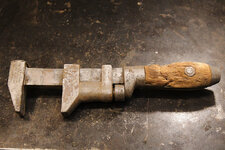
Thanks, man. That's what we do!Awesome! Another oldie saved from the rust pile
Yes it is. Looks much better. That wrench will out last us all.Thanks, man. That's what we do!
That was local to me. 6 to 7 thousand wrenches, 99% Coes. There was an estate sale where they tried to sell them, but only sold a few hundred. I didn't see a single baby Coes in the lot. Did buy the few odd wrenches he had that were good ones. I could have had that pile for $1 apiece at the end of the sale, but passed. The story was the guy was trying to break a bad drinking habit and took up collecting wrenches to keep him busy.That might be a flask in his right hand. There's still that one elusive Coes Wrench that he could never find & it's driving him crazy
7 thousand wrenches instead of 7 thousand beers worked out better for him I'm sureThat was local to me. 6 to 7 thousand wrenches, 99% Coes. There was an estate sale where they tried to sell them, but only sold a few hundred. I didn't see a single baby Coes in the lot. Did buy the few odd wrenches he had that were good ones. I could have had that pile for $1 apiece at the end of the sale, but passed. The story was the guy was trying to break a bad drinking habit and took up collecting wrenches to keep him busy.