
You are using an out of date browser. It may not display this or other websites correctly.
You should upgrade or use an alternative browser.
You should upgrade or use an alternative browser.
Coes Wrenches
- Thread starter Shiftless
- Start date

Private Lugnutz
Well-known member
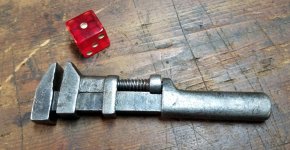
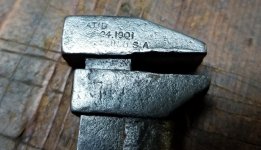
Yes, if it's unusual. I just found a FOAK for me. The marking is worn, but these all steel handle beauties were patented (689,692), explicitly for the all steel handle, on December 24, 1901. It's a 6-incher.
Attachments
woody 73
Well-known member
Private Lugnutz
Well-known member
Thanks for reviving this thread. Zombies arise!
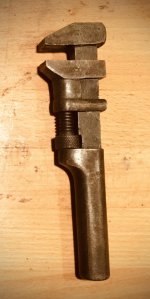
Here is a picture of my only steel handled one. Like yours Lugz, mine is a 6 incher.

drivesitfar
Well-known member
It's really hard not to buy these when I come across them for reasonable pricing. I'm not sure where I have them all at the moment or if any are this brand name, but i'm pretty certain I have about 20 that look like this.
I have one that I bet weighs close to 20 pounds and all steel and I love it, but I like the wood handled ones the best.
I have one that I bet weighs close to 20 pounds and all steel and I love it, but I like the wood handled ones the best.
Here's my Coes and Coes related stuff. Some names on wrenches include:
Coes, Billings, Billings & Coes, Coes Wrench Company, Trimo, Pexto, Perfect Handle, and J.H. Williams with a "W & B" in a diamond.
The two wrenches on the top left were recently unearthed (literally) from the bottom of a crane runway column, like someone squirreled them away 100 years ago and forgot about them.
Woody73's links in post #4 lead to some cool info I didn't know about.
Coes, Billings, Billings & Coes, Coes Wrench Company, Trimo, Pexto, Perfect Handle, and J.H. Williams with a "W & B" in a diamond.
The two wrenches on the top left were recently unearthed (literally) from the bottom of a crane runway column, like someone squirreled them away 100 years ago and forgot about them.
Woody73's links in post #4 lead to some cool info I didn't know about.
Attachments

Last edited:
Thanks for that posting showing your collection. The big one on the right might be a twin to the one Drives has.
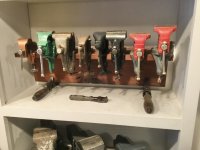
Two of mine have been pressed into service as shelf supports.
I needed a place to display my small collection of clamp on vises. I grabbed a couple of scraps from a redwood deck I had recently demolished and after a quick trip through a surface planer and a couple of coats of boiled linseed oil, I got what I needed.
Two of mine have been pressed into service as shelf supports.
I needed a place to display my small collection of clamp on vises. I grabbed a couple of scraps from a redwood deck I had recently demolished and after a quick trip through a surface planer and a couple of coats of boiled linseed oil, I got what I needed.
Attachments
Last edited:
Thanks for that posting showing your collection. The big one on the right might be a twin to the one Drives has.
Two of mine have been pressed into service as shelf supports.
I needed a place to display my small collection of clamp on vises. I grabbed a couple of scraps from a redwood deck I had recently demolished and after a quick trip through a surface planer and a couple of coats of boiled linseed oil, I got what I needed.
Thanks. Nice re-purpose job of your Coes! That's an awesome set of tiny vises.
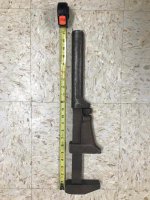
Here's a couple more of the big one you mentioned. I think this one can be dated somewhat by the "Pexto" logo, but I'm not sure what that would be.
I don't think these things are worth a whole lot, but are kind of cool. I think they faded out quickly with the onset of crescent wrenches. They are somewhat the Charlie Browns of wrenches, especially with the "monkey-wrench" moniker. However, I'm sure they served their mechanics well in their time.
Attachments

Private Lugnutz
Well-known member
Love it.Two of mine have been pressed into service as shelf supports.

crguy
Well-known member
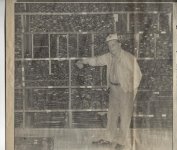
Here's one for the Coes wrench guys: About 20 years ago there was a local estate sale which included this hoard of Coes wrenches, over 6000 of them. This is a picture of the guy and some of them that was in a newspaper story that was done in '93. Very few were sold in the sale even though the price was dropped to a buck apiece. The guy only had about 25 other makes of wrenches, and I bought all the good ones. Went thru the entire thing looking and there wasn't a single baby Coes in the bunch. I asked the estate sale manager years later if he ever found a buyer and he said no and they were still there as far as he knew. I would have bought the pile, but figured I couldn't live long enough to resell them all.
Attachments

Private Lugnutz
Well-known member
5,967 duplicates. He needed an intervention!
5,967 duplicates. He needed an intervention!
Yep!! And I hear, tragically, all he was looking for was a screwdriver....

drivesitfar
Well-known member
Shift: is that real or a salesman type sample?
I've got a 4 foot aluminum one that is at the ready, but haven't needed to use it since I bought it 7 years ago. I bet my 18 inch solid steel wrench that we talked about earlier on this thread weighs less than this 4 foot aluminum one.
I just used my 3 foot long bolt cutters 2 days ago after owning that tool for maybe 10 years. i bought it to cut rebar and it was a no go, but it sure cut's master locks nicely when you lose a key. saved me from getting my grinder and cut off wheel out.
I've got a 4 foot aluminum one that is at the ready, but haven't needed to use it since I bought it 7 years ago. I bet my 18 inch solid steel wrench that we talked about earlier on this thread weighs less than this 4 foot aluminum one.
I just used my 3 foot long bolt cutters 2 days ago after owning that tool for maybe 10 years. i bought it to cut rebar and it was a no go, but it sure cut's master locks nicely when you lose a key. saved me from getting my grinder and cut off wheel out.
crguy
Well-known member
I wonder if that old guy had the biggest one. 72 inches of fun!
Yes, a few of those are known. None of the big Coes key lock wrenches at that sale.
d42jeep
Well-known member
I finally located my Coes wrench. It was hiding with a few others. I have another Whitman and Barnes stashed in a set somewhere so it missed the photo.
-Don


-Don
Last edited:
outofbounds
Well-known member

crguy
Well-known member
Anybody know how many different markings there were on the 4 3/4" Baby Coes wrenches?
And what does the number on the frame mean?
And what does the number on the frame mean?
Attachments



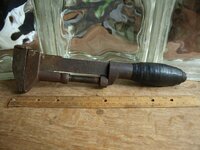
Found this used and abused A. G. Coes Wrench today and we had to have it because of the Stacked Leather Handle.
Attachments
-
 P7155958-th.jpg882.8 KB · Views: 36
 -
 P7155959-th.jpg917.4 KB · Views: 32
 -
 P7155960-th.jpg779.9 KB · Views: 27
 -
 P7155961-th.jpg812.2 KB · Views: 25
 -
 P7155962-th.jpg817.3 KB · Views: 23
 -
 P7155963-th.jpg873.2 KB · Views: 22
 -
 P7155964-th.jpg831.2 KB · Views: 22
 -
 P7155966-th.jpg770.6 KB · Views: 20
 -
 P7155967-th.jpg687.4 KB · Views: 47
Private Lugnutz
Well-known member
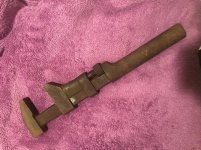
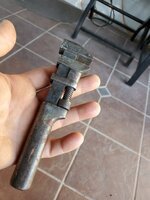
I can count on one hand the number of monkey wrenches - of any brand - that I have purchased at flea markets. They're one of the tools that are so commonly seen I tend to ignore them completely and walk right past without more than a cursory glance. That doesn't mean they aren't cool to collect. Like hand planes, they kind of have their own universe. It's just not one I'm interested in diving into encyclopedically, or even enough to know a rare bird if I saw one. Something has to catch my eye as unusual for me to pick it up on a whim or instinct, and in this case, it was the ferrule.
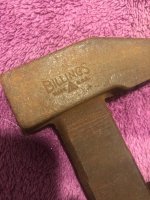
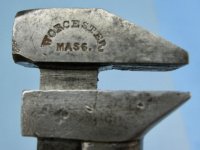
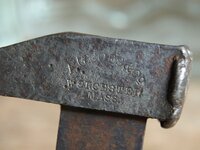
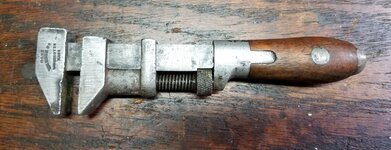
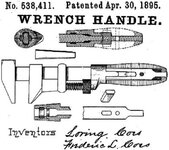
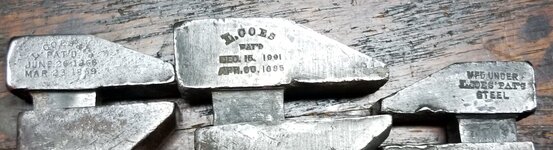
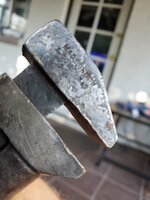
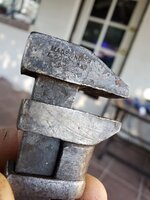
It has the routine "COES WRENCH CO. / WORCESTER, MASS." marking (see Pic 3) on the static jaw. Rather than the more commonly seen "MFD UNDER L. COES' PATS / STEEL" marking on the flip side, however, it's marked "L. COES / PAT'D / DEC. 15 1891 / APR. 30, 1895" (see Pic 4). Those dates refer to patents 465,347 and 538,411 respectively. See Pics 5 & 6 c/o DATAMP.
Those patents were focused on improving the continuity of the bar-shank, the ferrule, and the wooden handle halves. The visible part of that design modification are those pieces of metal protruding into the wooden handle halves, which Loring Coes called, alternately, "tongues," "braces" or "arms," but most frequently "tongues." In Loring's applications, "to render the handle more firm and rigid in connection with the bar-shank," and to provide "over-locking support."
I wouldn't call them rare. This isn't some ultra valuable score. But, per Davistown Museum, Herb Page, and DATAMP, they're apparently less common.
It has the routine "COES WRENCH CO. / WORCESTER, MASS." marking (see Pic 3) on the static jaw. Rather than the more commonly seen "MFD UNDER L. COES' PATS / STEEL" marking on the flip side, however, it's marked "L. COES / PAT'D / DEC. 15 1891 / APR. 30, 1895" (see Pic 4). Those dates refer to patents 465,347 and 538,411 respectively. See Pics 5 & 6 c/o DATAMP.
Those patents were focused on improving the continuity of the bar-shank, the ferrule, and the wooden handle halves. The visible part of that design modification are those pieces of metal protruding into the wooden handle halves, which Loring Coes called, alternately, "tongues," "braces" or "arms," but most frequently "tongues." In Loring's applications, "to render the handle more firm and rigid in connection with the bar-shank," and to provide "over-locking support."
I wouldn't call them rare. This isn't some ultra valuable score. But, per Davistown Museum, Herb Page, and DATAMP, they're apparently less common.
Attachments



Last edited:
four.cycle
Well-known member
.... as Arte Johnson used to say from behind the potted palm: "Verrrrrrrrry Interesting."
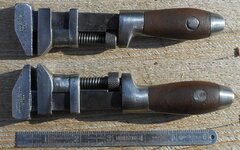
It would appear that my recently acquired Coe's 6-inch adjustable is the more common variety. Not sure what the PO might have done, but the original finish seems to have been "enhanced" somewhat:
I haven't figured out how to post these as thumbnails.
It would appear that my recently acquired Coe's 6-inch adjustable is the more common variety. Not sure what the PO might have done, but the original finish seems to have been "enhanced" somewhat:
I haven't figured out how to post these as thumbnails.
Private Lugnutz
Well-known member
Use only the [@Attach files] button below the text box.
EDIT: Not the little icon between the chain link and the smilie that looks like a mountains landscape with a sun above it (when you hover it shows [Insert image (Ctrl+P)]). Use that button when you want to insert a photo inside the text box where your cursor is placed.
EDIT: Not the little icon between the chain link and the smilie that looks like a mountains landscape with a sun above it (when you hover it shows [Insert image (Ctrl+P)]). Use that button when you want to insert a photo inside the text box where your cursor is placed.
Last edited:
Private Lugnutz
Well-known member
I meant to get back to this...It would appear that my recently acquired Coe's 6-inch adjustable is the more common variety.
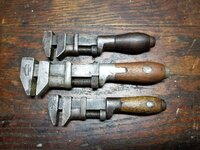
In my limited (meaning, I could be wrong and I am quite willing to be corrected by someone better read-up on the subject…) understanding, yes, the final “Knife-Handle” wrenches (two wooden slabs forming the handle around a uniform solid bar that is one with the ferrule), all of which were made after 1900, are the most common, then the early L & A.G. Coes and L. Coes wrenches, with a uniform piece of wood as a handle, before they started experimenting with ways to fix the early issues. The re-united Coes Wrench Co. 1891/1895 patented “tongues” wrench was one of those ‘tweeners. Believe it or not, they were trying to braze and weld things together before they hit on the single forged bar and ferrule.
Here are some photos to illustrate the evolution.
Note that there were multiple patents in between the solid handles and the “tongues” and several patents between the “tongues” and the D32,656 (May 15, 1900) patent they would market as the “Knife-Handle.” Not all of them were put into production wrenches. But I don’t know what an exhaustive product timeline, from wrench 1 in 1841 to wrench n in 1927 (before being bought out by B&C/Billings) would look like. As I said, one could (and many do) specialize in just Coes wrenches the way some collectors specialize in planes and never come up for any other kind of air.
Attachments


four.cycle
Well-known member
Wow.... I had no idea they had more flavors than Baskin & Robbins.
I only own that one Coe's unit, because it seemed to fit within the scope of a genre of wrench I started collecting.
Your post makes me wonder if somebody out there actually has all the different versions?
I only own that one Coe's unit, because it seemed to fit within the scope of a genre of wrench I started collecting.
Your post makes me wonder if somebody out there actually has all the different versions?
Private Lugnutz
Well-known member
By the way, after a quick inventory, it turns out I misspoke when I used the old ‘one hand’ accounting adage.
I have a grand total of six (6) monkey (carriage, bar-screw, etc) wrenches. So, I need two hands.
These five...

That’s the three Coes included in the previous post, for an early, mid, and late example, a c. 1901 all-steel handle Coes, and all the way on the left, a Collins. That one will always have a good historical story attached to it. It is an example of a famous and failed lawsuit against Coes. You can see and read more about it in posts #5 and #7 on a GJ thread linked here, but the upshot is that the patent (50,364, granted October 10, 1865) and the renewal (RE 5,294, granted February 25, 1873) marked on this wrench were actually voided by the USPTO in 1889!
The sixth is the H.D. Smith in the middle of this display.
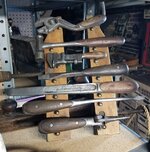
I have a grand total of six (6) monkey (carriage, bar-screw, etc) wrenches. So, I need two hands.
These five...
That’s the three Coes included in the previous post, for an early, mid, and late example, a c. 1901 all-steel handle Coes, and all the way on the left, a Collins. That one will always have a good historical story attached to it. It is an example of a famous and failed lawsuit against Coes. You can see and read more about it in posts #5 and #7 on a GJ thread linked here, but the upshot is that the patent (50,364, granted October 10, 1865) and the renewal (RE 5,294, granted February 25, 1873) marked on this wrench were actually voided by the USPTO in 1889!
The sixth is the H.D. Smith in the middle of this display.
Oldtuleguy
Well-known member
- Joined
- Nov 4, 2017
- Messages
- 10,476


Private Lugnutz
Well-known member
I would bet on it, or close. The Davistown Museum often refers to a guy named Herb Page who seems to be one of the most renowned experts. If he hasn't already literally 'written a book' about his collection, I have seen mentions of him saying it was in the works.Your post makes me wonder if somebody out there actually has all the different versions?
And then there's the guy in post #11. Of the 6,000 Coes wrenches in his collection, you'd have to think he had the x number of unique variants they ever made!

Because you're in need of some distraction, and because this is just the kind of bibliographically well-documented but entertaining rabbit hole I know you love to go down, I will leave you with an absolutely wonderful article on "Monkey Wrench" history and etymology, linked here.
AntiqueBen
Well-known member
- Joined
- Aug 4, 2021
- Messages
- 1,442
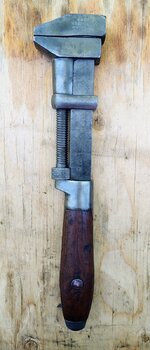
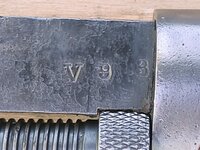
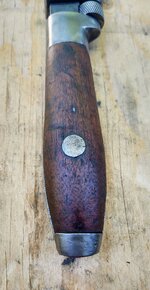
Here is a Coes 15" monkey wrench I just cleaned up a little. It is marked with a V93 on the body & the lower jaw. Could this indicate 1893?? I've always liked Coes. Seems to be built like a tank.
Attachments
-
 IMG_20220710_191751709~2.jpg266.2 KB · Views: 25
 -
 IMG_20220710_191804265~2.jpg260.8 KB · Views: 26
 -
 IMG_20220710_191831330.jpg223.3 KB · Views: 23
 -
 IMG_20220710_191820430.jpg276.6 KB · Views: 22
 -
 IMG_20220710_191846464~2.jpg271.5 KB · Views: 21
 -
 IMG_20220710_191934773.jpg173 KB · Views: 20
 -
 IMG_20220710_192251553_HDR~2.jpg263.7 KB · Views: 33
AntiqueBen
Well-known member
- Joined
- Aug 4, 2021
- Messages
- 1,442


d42jeep
Well-known member
Nice group!
Here is my most recent Coes find. It came from a Nevada garage sale last month. The evaporust dried out the handle but I treated it with some boiled linseed oil and it came out okay.


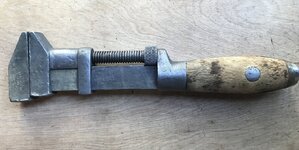

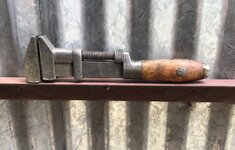
Here is my most recent Coes find. It came from a Nevada garage sale last month. The evaporust dried out the handle but I treated it with some boiled linseed oil and it came out okay.
crguy
Well-known member
One more example of why not to use Evaporust.Nice group!
Here is my most recent Coes find. It came from a Nevada garage sale last month. The evaporust dried out the handle but I treated it with some boiled linseed oil and it came out okay.
d42jeep
Well-known member
I suspect that your dislike of the use of evaporust is a minority view on this forum.
-Don
-Don
crguy
Well-known member
That may be, but I can always hope that as the people that like it become more "advanced and experienced collectors" they will come to agree with me.I suspect that your dislike of the use of evaporust is a minority view on this forum.
-Don
AntiqueBen
Well-known member
- Joined
- Aug 4, 2021
- Messages
- 1,442
To be honest, I've never used it. I've heard positive & negative reviews about it. My cleaning process works good for me, so I don't use it.
crguy
Well-known member
With the quality of the tools you show, it would be a mistake to use Evaporust on them.To be honest, I've never used it. I've heard positive & negative reviews about it. My cleaning process works good for me, so I don't use it.
AntiqueBen
Well-known member
- Joined
- Aug 4, 2021
- Messages
- 1,442
I like to keep the original integrity of all the tools I clean. I don't like to make them new & shiny again. I like to see their age & history. Taking them to a belt sander to get a mirror finish takes all of that away. A simple wire wheel on the bench grinder, some 3-1 oil & boiled linseed oil on the handles....and your good to go.
d42jeep
Well-known member
This particular monkey wrench was so rusted that I was unable to read the markings, hence the use of evaporust. Generally I try to keep the handles out of the evaporust but this particular wrench was rusty right to the bottom of the handle. I generally try to avoid using the wire wheel on my grinder unless there is no other choice. My comment on a particular member being negative about the use of evaporust was in no way directed at you, rather at a member whose post has been deleted.
-Don
-Don
d42jeep
Well-known member
I added a new Coes monkey wrench to the collection today at a Tahoe yard sale. It is by far my largest monkey wrench measuring around 21” long.


-Don
After a little cleanup


-Don
After a little cleanup
Last edited: