

You are using an out of date browser. It may not display this or other websites correctly.
You should upgrade or use an alternative browser.
You should upgrade or use an alternative browser.
common air quick connect (plug) styles
- Thread starter The Cobbler
- Start date
Beerhippie
Well-known member
That, and the fact that there's no advantage to any other style--with the possible exception of the high-flow ones.There's nothing better than hearing "because we're always done it this way"
mike93lx
ALLIANCE MEMBER
I absolutely get not changing at this pointThat, and the fact that there's no advantage to any other style--with the possible exception of the high-flow ones.
To me the biggest advantage to sticking with the M style is because it's so readily available and what so many tools come with.
Years ago I thought I'd go with the universal ends and slowly switch to L but that never happened and over time I stopped borrowing tools that had that end or the people I knew who used it gradually moved to the M ones themselves for their own home use.
If I was regularely borrowing other people's tools that had other ends I'd make sure one of my hoses had a universal end on it.
Years ago I thought I'd go with the universal ends and slowly switch to L but that never happened and over time I stopped borrowing tools that had that end or the people I knew who used it gradually moved to the M ones themselves for their own home use.
If I was regularely borrowing other people's tools that had other ends I'd make sure one of my hoses had a universal end on it.
Schurkey
Well-known member
Almost certainly "Industrial Interchange" which in the Milton world is the "M" design.What is the interface that comes on an air tool purchased at Home Depot? That's the one I want to standardize on.
Whats wrong with M?
EXACTLY right. It's bad enough if you have a two-stage compressor that can be regulated DOWN to a stable ~130-ish psi at the exit of the regulator. When using a single-stage compressor that has ~120-ish psi MAX, and drops from there, it's really-common to wind up working your air tool with 100 psi in the tank, but due to restrictions in the hose (too small diameter) and restrictions at the quick-couplers, the tool is only getting 60--70 psi when it's running. Air tools are rated for power and speed at 90 psi; what they don't say is that is 90 psi with the tool RUNNING; and that's gonna take way more than that "in the compressor air tank" and relatively free-flowing hoses/couplers.Not enough flow for hungry tools.
I haven't used them--or even knew about 'em until reading this thread. I have used Milton "V" coupler bodies; and disliked them due to the very high effort needed to insert the coupler plug.This. 5 in 1 couplers with Type V fittings. Done.
Thus my previous recommendation for the Prevost "PrevoS1" "Euro High Flow" coupler bodies--the plugs are fairly easy to insert; and they don't shoot out of the coupler body when disconnected.
If those 5-in-one bodies have an easy insertion force, I might have to pick one up.
There was a guy on this site from Duluth, MN who was promoting his own couplers/coupler plugs. They were expensive but seemed to be well-designed and thought-out. High flow, easy insertion, and so forth. But I haven't tried his system.
Here is a video I made testing various plugs (including the Stedlin system I believe you're referring to) at some common pressure and flow numbers.Almost certainly "Industrial Interchange" which in the Milton world is the "M" design.
EXACTLY right. It's bad enough if you have a two-stage compressor that can be regulated DOWN to a stable ~130-ish psi at the exit of the regulator. When using a single-stage compressor that has ~120-ish psi MAX, and drops from there, it's really-common to wind up working your air tool with 100 psi in the tank, but due to restrictions in the hose (too small diameter) and restrictions at the quick-couplers, the tool is only getting 60--70 psi when it's running. Air tools are rated for power and speed at 90 psi; what they don't say is that is 90 psi with the tool RUNNING; and that's gonna take way more than that "in the compressor air tank" and relatively free-flowing hoses/couplers.
I haven't used them--or even knew about 'em until reading this thread. I have used Milton "V" coupler bodies; and disliked them due to the very high effort needed to insert the coupler plug.
Thus my previous recommendation for the Prevost "PrevoS1" "Euro High Flow" coupler bodies--the plugs are fairly easy to insert; and they don't shoot out of the coupler body when disconnected.
If those 5-in-one bodies have an easy insertion force, I might have to pick one up.
There was a guy on this site from Duluth, MN who was promoting his own couplers/coupler plugs. They were expensive but seemed to be well-designed and thought-out. High flow, easy insertion, and so forth. But I haven't tried his system.
Here is another video testing the Milton universal coupler vs the Prevost High-Flow coupler (flow).
Here is an insertion force test including the Stedlin, the Milton, and the Prevost.
Here is a series of tests using much higher pressure and flow conditions.
Schurkey
Well-known member
Yes, I was thinking of the Stedlin system, but couldn't remember the name.Here is a video I made testing various plugs (including the Stedlin system I believe you're referring to) at some common pressure and flow numbers.
Given the substantial similarity of all the items tested, I suspect--but am unable to prove--that "something else" in the test system was the real restriction, not the couplers/plugs.
Both tests used the same (high-flow) coupler plug, with a difference in the coupler bodies. The Prevost was marginally better than the Milton Universal.Here is another video testing the Milton universal coupler vs the Prevost High-Flow coupler (flow).
A more-telling comparison for "most" users would be to test a V/Euro high flow coupler set vs. an Industrial Interchange set. Perhaps the Prevost coupler and V plug against a standard, non-universal Milton M coupler and plug.
My experience was Milton V coupler (not Milton "Universal" coupler) vs. Prevost coupler, the Prevost had MUCH lower insertion force. Since "my" comparison is different from yours, I can't dispute your findings...but they surprise me. I expected the Prevost to have lower insertion force. Note that in my world--which requires a huge length of hose for most operations--I run my regulated pressure (static pressure) at ~135 psi, which will require higher coupler plug insertion force.Here is an insertion force test including the Stedlin, the Milton, and the Prevost.
That's more what I expected to see. Thanks especially for this test.Here is a series of tests using much higher pressure and flow conditions.
Short summary: Couplers and plugs ARE important in terms of not "choking" the air supply to the air tool. Higher flow translates into less pressure drop, and air tools work based on inlet pressure. Aside from flow potential, which affects tool "power" and/or speed, there are other factors that might affect operation such as insertion force, overall durability, noise when inserting or releasing coupler plugs, and retention of the coupler plug during the "pressure-down" phase of disconnecting the plug.
But the hose diameter and length (system plumbing) is even more important; shorter hoses and larger-diameter hoses are preferred. This could also apply to the metal or plastic "shop air" plumbing if the hose isn't connected directly to the tank or regulator.
Last edited:
Schurkey
Well-known member
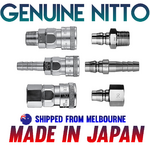
Here in Australia there's two types which are used, Nitto or Ryco. Nitto being the most common currently but it used to be Ryco. New tools come with Nitto.
Nitto:
Ryco type:
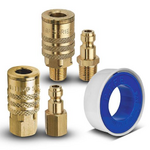
Ryco is--maybe--the same as the Tru-Flate design (Milton "T")
I was wondering that.Ryco is--maybe--the same as the Tru-Flate design (Milton "T")
OP
looks like a possibility. the knurling on the coupler looks to be the same strategic locations tooRyco is--maybe--the same as the Tru-Flate design (Milton "T")
OP
or not . here is a pic of a Milton T couplerlooks like a possibility. the knurling on the coupler looks to be the same strategic locations too

Schurkey
Well-known member
The external appearance of the coupler body is unimportant. The shape including diameter of the coupler plug is.
OP
I totally get that, however different manufactures tend often to replicate looks of the OEM
The external appearance of the coupler body is unimportant. The shape including diameter of the coupler plug is.
OP
That would be good, it would solve my curiosity. It's not the first time that I've thought they are probably a copy of a design from the USA.@Jack_K have some T plugs as well, just not handy. I could measure them if you wanted to compare
LopezBart
Well-known member
“The good thing about standards is that there are so many to choose from.”
Hohn
Well-known member
My Prevo S1 is quite difficult to insert, using genuine type V Milton *******.Almost certainly "Industrial Interchange" which in the Milton world is the "M" design.
EXACTLY right. It's bad enough if you have a two-stage compressor that can be regulated DOWN to a stable ~130-ish psi at the exit of the regulator. When using a single-stage compressor that has ~120-ish psi MAX, and drops from there, it's really-common to wind up working your air tool with 100 psi in the tank, but due to restrictions in the hose (too small diameter) and restrictions at the quick-couplers, the tool is only getting 60--70 psi when it's running. Air tools are rated for power and speed at 90 psi; what they don't say is that is 90 psi with the tool RUNNING; and that's gonna take way more than that "in the compressor air tank" and relatively free-flowing hoses/couplers.
I haven't used them--or even knew about 'em until reading this thread. I have used Milton "V" coupler bodies; and disliked them due to the very high effort needed to insert the coupler plug.
Thus my previous recommendation for the Prevost "PrevoS1" "Euro High Flow" coupler bodies--the plugs are fairly easy to insert; and they don't shoot out of the coupler body when disconnected.
If those 5-in-one bodies have an easy insertion force, I might have to pick one up.
There was a guy on this site from Duluth, MN who was promoting his own couplers/coupler plugs. They were expensive but seemed to be well-designed and thought-out. High flow, easy insertion, and so forth. But I haven't tried his system.
That’s why I prefer the two stage couplers where you don’t have to insert against pressure.
Indeed, I believe I mentioned in the video that I introduced an arbitrary restriction in the form of a ball valve to simulate a "real world" usage scenario (100ish psi at 30ish cfm). I think part of the purpose of that particular video was to illustrate that there isn't really a big difference in plugs used at these relatively low, but relatively common pressures and flow rates.Given the substantial similarity of all the items tested, I suspect--but am unable to prove--that "something else" in the test system was the real restriction, not the couplers/plugs.
Here is a link to a video where I tested the air consumption of 4 very common air tools at their advertised maximum pressures (about 90 psi dynamic pressure) The highest consuming among them didn't even quite hit 30 cfm, so I think the (not so arbitrary) restriction of the ball valve in the other video is a good model.
The other video you saw with a VERY high consumption tool on an unregulated line shows that the couplers/plugs do make a bigger difference at those much higher pressures and flow rates.
On the topic of pressure drop, here is a link to a Playlist of short videos testing the pressure drop across several combinations of couplers and plugs. Unfortunately, I was using a rotameter with a max of 20 cfm, so the measured pressured drop was not substantial until I started introducing some really poorly performing fittings (cheap block swivels, etc). I've been meaning to go back and retest at higher flow rates.Higher flow translates into less pressure drop, and air tools work based on inlet pressure.