To avoid these ads, REGISTER NOW!

Compact Fluorescent vs Tubes

a3tripod

Well-known member
Joined
Dec 30, 2008
Messages
89
First, let me say that I've thoroughly enjoyed lurking in these forums. You guys have amazing homes/garages, and the community seems really genuine and thoughtful. I'll do my best to contribute in the same fashion.

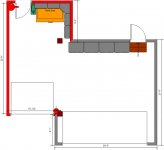
I'm in the early stages of planning my garage finish for our home. It's a 3-car garage where the 2-car section is slightly forward of the single, third bay.

I use my garage for wood working as well as your typical grease monkey pursuits. A bright garage is important to me, but so is the overall fit and finish of my space. I don't like clutter, and I prefer to have everything as functional as possible without sacrificing too much sharp/simple/clean design.

So, my original though was to use either 4' or 8' T8 type fluorescent fixtures or recessed cans with CFLs and reflectors to help spread the light. Any ideas? My guess is that the CFLs will not be as effective as T8s, but I wonder if it's just a matter of installing more cans to make up the difference? I've heard ppl suggest a 1.5 watts per square foot. Does that still apply you think? Attached is a very preliminary design...
Thanks for the ideas guys!
 

Attachments

  • Garage_plan1.jpg
    Garage_plan1.jpg
    70.9 KB · Views: 85
To avoid these ads, REGISTER NOW!

LoneGunman

Well-known member
Joined
Mar 27, 2007
Messages
2,081
Location
The Gunshine state
I really dislike cans in a garage unless you are going to add a whole bunch of them, I think you'd be much better off with 4' T8 fixtures. Looking at your drawing I'd put in 18 -22 cans or there about.
 
OP
A

a3tripod

Well-known member
Joined
Dec 30, 2008
Messages
89
I think with 18-22 cans, it might look a little ridiculous, don't you? If the consensus from everyone here is to stay away from CFLs, I was thinking 10, 4' T8 fixtures would do the trick? 4 in the single bay, 6 in the double. Would i need 2-bulb or 4-bulb? Are tube fixtures easily recessed into the drywall for a flush fit? sorry for all the questions. I'll be sure to provide lots of before and after shots (spring is the go-live date for my project).
 

LoneGunman

Well-known member
Joined
Mar 27, 2007
Messages
2,081
Location
The Gunshine state
I don't think it would look bad at all, you may be able to get away with 16-20, but I'd say that's a bare minimum. Once you start figuring out where your bench/benches are going to go you'd want lights directly over them, they add up quick.

I'd go with the 4 lamp T8s, and put them on a minimum of two switches so if you are working in only one area you could shut down some of the others. I think 10 4 lamp T8 fixtures would be pretty good. Can't help on the recessed, maybe try a search, I have seen someone on here post about how they did theirs. Recessed T8 fixtures is something I have not run into at work so I don't know whats available.
 

Torque1st

MEMBER EMERITUS
Joined
Sep 14, 2008
Messages
5,668
Location
KC Metro, Kansas
I would run tubes. From my experience the CF's are damaged when installed in a live socket. So if you replace that burned out CF when the rest of the lights are on... They arc and spark when screwed in and never do work correctly afterward and have a very short life.
 
OP
A

a3tripod

Well-known member
Joined
Dec 30, 2008
Messages
89
Actually the cans don't look too bad! Here's a quick and dirty design with cans. Note that my table saw is on wheels (Its the cast iron Ridgid TS3650). also, i figure having cans directly above the cabinets would be a bit of a waste. Lastly, i realize that my garage doors when open will hide some of the cans, but I live in IA, and usually work with the doors closed (our winters are long :thumbup:).

Oh, insofar as changing a dead one...don't they last like a zillion years? I doubt I'll have to worry about that (changing a bulb) anytime soon.

Garage_plan_cans.jpg
 
Last edited:

Torque1st

MEMBER EMERITUS
Joined
Sep 14, 2008
Messages
5,668
Location
KC Metro, Kansas
...Oh, insofar as changing a dead one...don't they last like a zillion years? I doubt I'll have to worry about that (changing a bulb) anytime soon.
Some last well, some don't. Out of a package of 5 one or two may fail in a month or so. Others last a long time but not even remotely like a zillion years. I have been using them for over 5 years in my house and not one of them has lasted more than 3 years. I date each bulb when installed and when they die. So far they do not do much better for life than any of the incandescents did in the same applications, -some have done far worse.

GE bulbs seem to do ~OK. The n:vision bulbs sold at Home Depot and other places are complete ****. The so called "warranties" the bulbs carry is essentially worthless. You spend more on postage than a decent replacement bulb costs. Besides who keeps receipts for specific bulbs? The thermal printed receipts go blank in a short time anyway.
 

ddawg16

Well-known member
Joined
Jul 11, 2008
Messages
21,005
Location
S. California
Ya know, a3 might have a good idea.

I'm building my garage right now....and my plan up to this point was to install recessed 4' 2 bulb fixtures.....my floor joists are on 12" centers and with the blocking, I don't have space for anything else. I'm looking at having to use about 8-9 fixtures....at about $50/fixture...that is almost $500.

Last night I picked up some 6" cans.....less than $7 each. I'm installing them in overhang at the front of the garage....I plan to use the 30W CFL Flood....puts out a lot of light.

The way I see it...no ballasts to replace.
Easier to install.
More flexible location placement

I need to do a output comparison to see how many it would take to = a 4' tube.
 
OP
A

a3tripod

Well-known member
Joined
Dec 30, 2008
Messages
89
Ok, so maybe not a zillion years, but from my experience I haven't had to change a CFL (indoor only tho) ever. I'll have to buy my bulbs from Costco then ;) won't need a receipt to exchange them =D.

Seriously tho, thanks for the feedback. I really want to do this right.
 
OP
A

a3tripod

Well-known member
Joined
Dec 30, 2008
Messages
89
Ya know, a3 might have a good idea.

I'm building my garage right now....and my plan up to this point was to install recessed 4' 2 bulb fixtures.....my floor joists are on 12" centers and with the blocking, I don't have space for anything else. I'm looking at having to use about 8-9 fixtures....at about $50/fixture...that is almost $500.

I need to do a output comparison to see how many it would take to = a 4' tube.

This was my line of thinking as well. I can get a contractors pack of cans (5qty) for $25. no clue on the price of flood CFLs, but I'm sure it would run much cheaper than tube fixtures and bulbs. Plus i prefer a clean look if i can get it. Let me know if you come up with a decent analysis of CFL to tube ratios.
 

LoneGunman

Well-known member
Joined
Mar 27, 2007
Messages
2,081
Location
The Gunshine state
I like that can layout alot, that's pretty much how I got to the 18-20 number. What did you use to draw that out? If you go with the can definately go with a minimum of two switches.
 

nissan_crawler

Well-known member
Joined
Jan 12, 2008
Messages
9,638
Location
Wichita, KS
Keep in mind some cans aren't rated for insulation. Personally, I freaking hate cfl's. I bought six kinds to try in my house, threw every one of them in the garbage, and put the old halogens back in.

I'm putting 9 4' 2 bulb t8's in the 24x24 garage.
 

Torque1st

MEMBER EMERITUS
Joined
Sep 14, 2008
Messages
5,668
Location
KC Metro, Kansas
Keep in mind some cans aren't rated for insulation. Personally, I freaking hate cfl's. I bought six kinds to try in my house, threw every one of them in the garbage, and put the old halogens back in.

I'm putting 9 4' 2 bulb t8's in the 24x24 garage.

That nuke power plant we have must zap CFLs. :lol_hitti
 

Kevin54

MEMBER EMERITUS
Joined
Jan 12, 2005
Messages
29,341
Location
Urbana, Ohio
Keep in mind some cans aren't rated for insulation. Personally, I freaking hate cfl's. I bought six kinds to try in my house, threw every one of them in the garbage, and put the old halogens back in.

I'm putting 9 4' 2 bulb t8's in the 24x24 garage.


I don't like them in the house because they don't seem to put out enough light. So we pulled ours also and put incadescents back in. At work we have a bank of CFL's that have three tubes that are "U" shaped. The cement them into the base with a ceramic compound. These are the type that replace a standard light bulb. We replace these lights on the average of every 6 months. From the heat of the light, they will dislodge out of the base and hang by the wires. You can't get it through their heads that it would be cheaper to run incadescents at a few cents apiecs and a little more on electricity, than running a CFL that is better on electricity but expensive to put in and replace every 6-8 months. What I do like though is that I have a traffic light in the garage. A standard low wattage incadescent bulb will only last a short time in it due to being on 24/7 and heat buildup. The CFL's that replaced them with have been in there probably 7 months now and going strong.
 

tdkkart

Well-known member
Joined
Jun 17, 2006
Messages
6,887
Location
Eastern Iowa
Our house is full of CFLs, I don't like 'em. If they're in a cool location they take too long to warm up and put out useable light, and some of them are wierd colors.

2 problems with recessed fixtures.
I'd suggest doing some tests to show yourself how much useable light you lose when you recess a bulb. Recessed fixtures or solid sided shades lose a considerable percentage of the light output. Output that you're paying for.
You're gonna have shadowed areas that you can't work in, you will fight it everytime you try to do something. You can put stuff on wheels and move it under a light when needed, but it's a PIA, and why should you have to when you could have had decent light in the first place, light that you're already paying for.

Also, you're in Iowa, same as me. You know as well as I do that one of the first things we have to think about is the cost to heat our shops during our cold winters. The first consideration in heating is to create a well sealed envelope, and especially in the ceiling.
Considering that most recessed fixtures(and certainly not the $5ea variety) are not rated for direct insulation contact, each one of those fixtures is a hole in your envelope.
A 6" diameter fixture is 28.26sq/in, x 20 fixtures is 565sq/in, 4 square feet.
Would you dream of cutting a 2ft square hole in the ceiling and leave it uncovered?? I doubt it. Fixtures rated for direct insulation contact are not cheap, and their still not as good as a solid ceiling.

Yes they look cool, but other than asthetics, recessed cans are a joke as far as useable light is concerned. 2nd only to cheap heat, good lighting is the first thing we need to consider in a useable shop space.
 
OP
A

a3tripod

Well-known member
Joined
Dec 30, 2008
Messages
89
I like that can layout alot, that's pretty much how I got to the 18-20 number. What did you use to draw that out? If you go with the can definately go with a minimum of two switches.


I'm using Visio and the tools related to home plans. My wife made the same point...probably a switch for the single bay, and another for the double.
 
OP
A

a3tripod

Well-known member
Joined
Dec 30, 2008
Messages
89
Keep in mind some cans aren't rated for insulation. Personally, I freaking hate cfl's. I bought six kinds to try in my house, threw every one of them in the garbage, and put the old halogens back in.

I'm putting 9 4' 2 bulb t8's in the 24x24 garage.


these cans are able to be in direct contact with the insulation. thanks for the heads up. :thumbup:
 
OP
A

a3tripod

Well-known member
Joined
Dec 30, 2008
Messages
89
2 problems with recessed fixtures.
I'd suggest doing some tests to show yourself how much useable light you lose when you recess a bulb. Recessed fixtures or solid sided shades lose a considerable percentage of the light output. Output that you're paying for.
You're gonna have shadowed areas that you can't work in, you will fight it everytime you try to do something. You can put stuff on wheels and move it under a light when needed, but it's a PIA, and why should you have to when you could have had decent light in the first place, light that you're already paying for.

This is what I'm trying to minimze with whatever the setup is that I choose. I'm also prepared to accept some level of shadowing. Let's face it, I'm not using my garage as a paint booth where ample lighting is critical. My typical under-car endeavors are brake jobs, oil changes, and sometimes suspension work. to date, with the 2 incandescent bulbs I currently have, light hasn't been a serious problem. But I do want more, and done well/cost effective.

Also, you're in Iowa, same as me. You know as well as I do that one of the first things we have to think about is the cost to heat our shops during our cold winters. The first consideration in heating is to create a well sealed envelope, and especially in the ceiling.
Considering that most recessed fixtures(and certainly not the $5ea variety) are not rated for direct insulation contact, each one of those fixtures is a hole in your envelope.
A 6" diameter fixture is 28.26sq/in, x 20 fixtures is 565sq/in, 4 square feet.
Would you dream of cutting a 2ft square hole in the ceiling and leave it uncovered?? I doubt it. Fixtures rated for direct insulation contact are not cheap, and their still not as good as a solid ceiling.

that's a good point. I didn't really think about the effect of punching holes into the ceiling and what that might do to the room above. the single bay has nothing above it whereas my master bathroom and walk-in closet is over the double bay. As it is, I'm not convinced the entire ceiling in the garage is insulated, as out tile floor in the bathroom is freezing cold, and sometimes our water pipes freeze. Part of my reason for wanting to finish the garage is due to the fact that I need to pull a lot of drywall down to figure out what the deal is with our pipes. i'll have o give the recessed cans more thought. As I mentioned before, these cans are made to be indirect contact with insulation (and these CFLs don't get hot. I wonder if I can somehow seal them better once they installed??

Generally, when its around 0'F outside, our garage is around 30-33 degrees. the exterior construction is 2x6 with brick facing. Part of my endeavor is to better seal the garage doors, and check to see if they are insulated doors (no idea how to do that). i've also considered using that spray in insulation (icynene is a brand name i think) to earn a higher R value in the walls and ceiling. any idea if this meets fire codes??

thanks for the thoughts and opinions guys. Keep them coming. It's clear i have more to think about here (which is why we plan right?!?)
 
Last edited:

Torque1st

MEMBER EMERITUS
Joined
Sep 14, 2008
Messages
5,668
Location
KC Metro, Kansas
I don't like them in the house because they don't seem to put out enough light. So we pulled ours also and put incadescents back in. At work we have a bank of CFL's that have three tubes that are "U" shaped. The cement them into the base with a ceramic compound. These are the type that replace a standard light bulb. We replace these lights on the average of every 6 months. From the heat of the light, they will dislodge out of the base and hang by the wires. You can't get it through their heads that it would be cheaper to run incadescents at a few cents apiecs and a little more on electricity, than running a CFL that is better on electricity but expensive to put in and replace every 6-8 months. What I do like though is that I have a traffic light in the garage. A standard low wattage incadescent bulb will only last a short time in it due to being on 24/7 and heat buildup. The CFL's that replaced them with have been in there probably 7 months now and going strong.
Check the paperwork etc but some of the CFL's are not to be installed Base UP due to heat generation. I have one like you describe. It is currently installed base up but it is never ON more than 30 minutes at a time so it is still working. A similar one installed in a different application did puke it's guts and I found out why when I read the warnings on the replacement.

The CFLs do take some time to warm up to full output but they seem to be making improvements to the designs. I just live with it or put in a higher powered bulb.
 

VHF

Well-known member
Joined
Oct 27, 2008
Messages
420
Location
NW Wisconsin
There are recessed cans with built in electronic ballasts that take a florescent bulb with a 4-pin base, which comes in 13W, 18W, and 26W. Some cans take two 13W bulbs for a total of 26W with light output comparable to a 100W incandescent bulb. These are frequently used in upscale office/retail space/conference centers (and residential applications in California due to strict energy codes.) The interior of these cans is usually polished, so most of the light gets reflected downwards and bounces out of the fixture at various angles to light up a wide area of floor space under the fixture.

These cans are more expensive because the fixture includes the electronic ballast and because they are of commercial quality. Not sure if the big boxes stores carry any or not; might need to find an electrical supply house or buy on-line. The light output, light quality, and bulb longevity would be much better than using a screw-in CFL in a standard recessed can. (Note that if the recessed can is designed to have a downward facing PAR (parabolic reflector) floodlight/spotlight bulb, when using a screw-in CFL you would not get all the light out of the fixture as there is nothing in the upper part of the can to reflect the light downwards.)

These commercial-style recesed florescent cans could be the answer if the price doesn't end up being prohibitive. I believe they come in both IC-rated and non-IC-rated just like regular recessed lighting cans.
 
To avoid these ads, REGISTER NOW!
OP
A

a3tripod

Well-known member
Joined
Dec 30, 2008
Messages
89
I'm not trying to beat a dead horse, but I was looking at some CFL reflectors that are rated for high heat applications, and they have an output similar to 120watt incandescent. I was thinking the fact that they are PAR38 floods/reflectors they would fill the can nicely and there wouldn't be much light getting trapped in the can. They are Feit brand, and produce a 2700K color @ 1300 lumens rated for 8000 hrs. GE also makes some that seem comparable, but they are a 90 watt equivalent with a longer life rating.

Also, I contacted local Icynene contractors who advised I should build a box with a small air gap to enclose each can and any water lines in the walls/ceiling. Reasons are two fold. First, to prevent the insulation from penetrating the can and messing things up. Second, it eliminates leaks of cold or hot air into the adjacent rooms while still allowing warmth from the adjacent room to prevent water line freeze. Seems Icynene runs $1.90 ft2 installed. Since my walls are already R-19 batting I will probably just make sure its still in good shape only use the Icynene in the ceiling. Icynene is the walls would only be R-20, but it would be R-36 in the ceiling, which is where i need it most.
 
Last edited:

troy

Well-known member
Joined
Mar 12, 2006
Messages
57
Location
MN
I have a similar sized three stall garage, maybe a little bit smaller. I went with 12 cans, and used the reflector 23W (120w equivalent) flood style light with the clear glass. I originally started with 150W regular bulbs, but they were getting too hot. Like output is pretty comparable.

I like the looks and the light is adequate. With that many lights (18-20)I don't think it will be shadowy. You may want additional lighting over the work benches as that is where I have the most need with my set up.

They are still cans and will not be as bright as standard T8 strip lights. I went with the cans, because they were free to me, but I'd likely go with strip lights in a working garage if I do it again. A show only garage is a different story.

Hope that helps.
 

buening

Well-known member
Joined
Dec 17, 2007
Messages
1,338
Location
Decatur, IL
Menards has 4 can lights for $25 and they are rated for contact with insulation. Unsure of the quality of them though. Just a heads up ;)
 

ddawg16

Well-known member
Joined
Jul 11, 2008
Messages
21,005
Location
S. California
Guys...I did a post a couple of days ago showing a comparison of CFL outputs vs tubes vs incandescent...

Info on CFL's

I'm going to be going with the 6" cans in my 20' x 25' garage for several reasons:

1. I have a second floor so the ceiling that I'm putting the cans in will not be insulated.
2. The only 2tube 4' light I have been able to find is about $50 and is does NOT use the newer T8's.....I can buy about 8 cans for the price of one recessed 4' fixture.
3. I already have a few of the 30W PAR lamps (equiv to about 150W output) and I'm quite happy with the light.
4. The layout of my garage lends itself to using the cans. I can put them where my main work centers are. I also have areas that are not well suited to a long tube....like the area around the garage door. When it is up, any lights above it are going to just wasting electrons. Because of the way my floor joists run, I can get a recessed light in front of the garage door...but I can get a few of the cans. I live in CA...so my garage door stays up a lot.....that is, once I get it back in.
5. The ballast in the light in the attic of the garage is going out....I'm getting real tired of changing them out. Unscrewing a light bulb is a lot less effort.

FYI...based on a lot of research I have done on the internet, it would appear that Sylvania CFL's tend to be the best of the bunch.

I have some of the miniture CFL's in sconces in a couple rooms in the house. The fixtures are 2 buld setups...I 'did' have one CFL and one incand....the incand have since burned out so now it's only CFL.

I love the CFL's......my wife and kids have yet to learn how to turn off lights....so I am replacing any burned out incand with a CFL. I'm just not having the issues that some guys have complained about.

BTW....my average electric bill is about $45/month. That's with 2 adults and 3 kids.
 
OP
A

a3tripod

Well-known member
Joined
Dec 30, 2008
Messages
89
Menards has 4 can lights for $25 and they are rated for contact with insulation. Unsure of the quality of them though. Just a heads up ;)


Thomas Lighting or something like that? I've used those before in basements and have no complaints. Used them for a drop ceiling as well as a drywall ceiling without issues.

Thanks for the heads up. Probably should buy them now...even if i don't use them for the garage, I can always use them for our basement that we have yet to finish. Or I can always return them.
 

rinny_tin_tin

Well-known member
Joined
Dec 20, 2008
Messages
636
Location
Northern Virginia
Screw both fluorescents and CFLs. Use LEDs

....service life of 50,000+ hours (about 6 years) @24/7
---80% greater efficiency than CFLs (much lower elek bill)
--Insensitive to shock
--no Mercury and other HazMat disposal concerns.

Yes - first cost a bit more than CFLs/Fluorescents, but on year payback - and practically free follow on.


http://www.creells.com/LR24.htm
 
OP
A

a3tripod

Well-known member
Joined
Dec 30, 2008
Messages
89
I have a similar sized three stall garage, maybe a little bit smaller. I went with 12 cans, and used the reflector 23W (120w equivalent) flood style light with the clear glass. I originally started with 150W regular bulbs, but they were getting too hot. Like output is pretty comparable.

I like the looks and the light is adequate. With that many lights (18-20)I don't think it will be shadowy. You may want additional lighting over the work benches as that is where I have the most need with my set up.

They are still cans and will not be as bright as standard T8 strip lights. I went with the cans, because they were free to me, but I'd likely go with strip lights in a working garage if I do it again. A show only garage is a different story.

Hope that helps.

That's reassuring thanks. It sounds like 20 cans may be plenty bright enough then. I was planning on putting under cabinet lights in above the workbenches. A very helpful tip that I've read (and learned) from many of you throughout TGJ. :thumbup:
 

kbs2244

Well-known member
Joined
Nov 11, 2006
Messages
14,065
I just seems to me that a "flood light can" is a self contradiction.
I have yet to see on where the light spread out at all.
 
OP
A

a3tripod

Well-known member
Joined
Dec 30, 2008
Messages
89
Screw both fluorescents and CFLs. Use LEDs

....service life of 50,000+ hours (about 6 years) @24/7
---80% greater efficiency than CFLs (much lower elek bill)
--Insensitive to shock
--no Mercury and other HazMat disposal concerns.

Yes - first cost a bit more than CFLs/Fluorescents, but on year payback - and practically free follow on.


http://www.creells.com/LR24.htm

I've always loved the idea of LEDs, and I am sensitive to the fact that the CFLs contain mercury. In fact I've read the EPA guidelines for disposal of CFLs and fluorescent tubes.

I found a couple local distributors, and will look into the the cost/logistics of going LED. Thanks for the suggestion.
 
OP
A

a3tripod

Well-known member
Joined
Dec 30, 2008
Messages
89
It seems Cree's website isn't accurate, as none of the "where to buy" locations have a clue what or who Cree is, and they don't have any LED lighting solutions for anything of this scale.
 

rinny_tin_tin

Well-known member
Joined
Dec 20, 2008
Messages
636
Location
Northern Virginia
I've always loved the idea of LEDs, and I am sensitive to the fact that the CFLs contain mercury. In fact I've read the EPA guidelines for disposal of CFLs and fluorescent tubes.

I found a couple local distributors, and will look into the the cost/logistics of going LED. Thanks for the suggestion.

Please let me (us) know what you find out. I saw a great presentation iat ASCE/AEI in Denver this past September,and it sounds like LEDS can do much to get us out of this energy mess. The Hg in CFLs is really not much less than corresponding tubes, but the CFL manufacturers are adding the "less power needed, thus less Hg emission" into their calcs. LEDs are the way!
 

ddawg16

Well-known member
Joined
Jul 11, 2008
Messages
21,005
Location
S. California
Screw both fluorescents and CFLs. Use LEDs

....service life of 50,000+ hours (about 6 years) @24/7
---80% greater efficiency than CFLs (much lower elek bill)
--Insensitive to shock
--no Mercury and other HazMat disposal concerns.

Not totally accurate in regards to efficiency. LED's on average have about the same effeciency as CFL's. See below.

Yes, they last longer...are more rugged...and no Mercury...that is assuming none is used during the manuf process....

The amount of Mercury in CFL's is extremely low in comparison to other things....and as pointed out in one article, the amount of Mercury put into the air to generate the power to light a light bulb is about 4 times more than what is in a CFL.

When you roll the cost of an LED into the total overall cost (bulb cost + oper cost), CFL's still have an advantage.

LED's are right now where CFL's were about 10 years ago....give LED's about 5-10 more years and it's won't be a hard decision at all.

Right now LED's are best suited for hard to reach areas and special applications.

Luminous Efficay

This is from Wikipedia...go down towards the bottom of the page to see the chart.
 

rinny_tin_tin

Well-known member
Joined
Dec 20, 2008
Messages
636
Location
Northern Virginia
It seems Cree's website isn't accurate, as none of the "where to buy" locations have a clue what or who Cree is, and they don't have any LED lighting solutions for anything of this scale.

There are some problems with their web site. I met their agent in Denver -
Try this number and try and get a live person. They are publicly traded as CREE and are on GSA schedule - so no bogus

Cree, Inc.
919-313-5300
 

rinny_tin_tin

Well-known member
Joined
Dec 20, 2008
Messages
636
Location
Northern Virginia
Not totally accurate in regards to efficiency. LED's on average have about the same effeciency as CFL's. See below.

Yes, they last longer...are more rugged...and no Mercury...that is assuming none is used during the manuf process....

The amount of Mercury in CFL's is extremely low in comparison to other things....and as pointed out in one article, the amount of Mercury put into the air to generate the power to light a light bulb is about 4 times more than what is in a CFL.

When you roll the cost of an LED into the total overall cost (bulb cost + oper cost), CFL's still have an advantage.

LED's are right now where CFL's were about 10 years ago....give LED's about 5-10 more years and it's won't be a hard decision at all.

Right now LED's are best suited for hard to reach areas and special applications.

Luminous Efficay

This is from Wikipedia...go down towards the bottom of the page to see the chart.

"LED's on average have about the same effeciency as CFL's. See below."

Sorry - have to disagree - Wiki is hardly authoritative. DOE is tasked in major LED rollout project as we speak. Figures for LED efficiencies given visible useful light ranges from 45% to 90% in contrast to CFLs. Also - can't dim CFL's practically while LEDs don't care and linear efficiency throughout range of output. LED color also adjustable - CFL-Not
 

ddawg16

Well-known member
Joined
Jul 11, 2008
Messages
21,005
Location
S. California
Sorry, but I have to disagree with your "Sorry - have to disagree"....at least in regards to stated efficiencies.

Yes, Wikipedia has to sometimes be held at arms length on some of the content.....but unless you can cite an exact referece, any claims you make have to also be held at arms length.

I've done some more searching and I'm not seeing the data to support the "45% to 90%" effeciency over CFL's.

You are not totally correct in regards to dimming....you can get dimable CFL's.

I disagree with the point on color. Just like CFL's, LED's have issues replicating the same color range as incandescents....and like CFL's, a lot of progress has been made. Mose of the white LED's tend to have a blue hue to them.

And then there is the issue of light direction....I have been looking at using some LED's in certain applications and one of the issues is the very directional nature of the light....the LED that I have in my duty flashlight works great....but using an LED to light a room still has issues.

As I stated in the previous post, I 'think' LED's are where CFL's are now. I have no doubt that they will over take CFL's in the near future. I think it is best to let the technology evolve before I make significant purchases.

It's kinda like the Flat Panel TV issue....the first ones were expensive and didn't last long....now look at them. I don't need to be the first one of the block to have one. (I think E-Tek has a post that touches on that subject a bit).

One last and very important point....this is a friendly and imformative exchange of ideas and views....in no way am I implying anything about your knowledge or experience.....so to that end...:beer:
 

rinny_tin_tin

Well-known member
Joined
Dec 20, 2008
Messages
636
Location
Northern Virginia
Sorry, but I have to disagree with your "Sorry - have to disagree"....at least in regards to stated efficiencies.

Yes, Wikipedia has to sometimes be held at arms length on some of the content.....but unless you can cite an exact referece, any claims you make have to also be held at arms length.

I've done some more searching and I'm not seeing the data to support the "45% to 90%" effeciency over CFL's.

You are not totally correct in regards to dimming....you can get dimable CFL's.

I disagree with the point on color. Just like CFL's, LED's have issues replicating the same color range as incandescents....and like CFL's, a lot of progress has been made. Mose of the white LED's tend to have a blue hue to them.

And then there is the issue of light direction....I have been looking at using some LED's in certain applications and one of the issues is the very directional nature of the light....the LED that I have in my duty flashlight works great....but using an LED to light a room still has issues.

As I stated in the previous post, I 'think' LED's are where CFL's are now. I have no doubt that they will over take CFL's in the near future. I think it is best to let the technology evolve before I make significant purchases.

It's kinda like the Flat Panel TV issue....the first ones were expensive and didn't last long....now look at them. I don't need to be the first one of the block to have one. (I think E-Tek has a post that touches on that subject a bit).

One last and very important point....this is a friendly and imformative exchange of ideas and views....in no way am I implying anything about your knowledge or experience.....so to that end...:beer:

I'll get you a link to the paper published by ASCE/AEI this Summer.

However:

Go buy a CFL dimmer and let me know:
a)How many you found;
b) $$ what it cost you;
c) how you like it; and,
d) range of dimming.

CFL = Fluor in regards to color. That is *limited* choice of one or another

However, a single LED fixture can be programmed to exhibit most all color choices and combinations, particualrly in response to chnagin environment (say incoming daylight v. night, versus one application versus another.)

PWM methods make this possible in LEDs - not the case with CFLs.

I believe as does DOE - LEDS have arrived - or - LEDs are to CFLs as CFLs are to incandescents.

I'll hunt for the paper and get back to you
 

buening

Well-known member
Joined
Dec 17, 2007
Messages
1,338
Location
Decatur, IL
rinny, what has been your experience with the directionality of LED lighting. My experience has been with automotive lighting as well as drop lights, and LED lighting doesn't "fill" areas. There are ways to project the beams, like inverted cone LEDs, so that the beam isn't straight out the end of the LED. My experience is that it takes a ton of LEDs to get a decent amount of "fill" light and typically they take up 3-4 times the space as what a standard bulb does. I have no experience with household LED lighting though. I'm more curious than anything, definitely no expert!

Hopefully these aren't the standard for LED light bulb prices!

http://greenhome.huddler.com/products/earthled-cl-5-led
http://www.besthomeledlighting.com/product/SP80B-120-E27-10W-W
 
Last edited:

ddawg16

Well-known member
Joined
Jul 11, 2008
Messages
21,005
Location
S. California
I typed "cfl dimmer" into Google.....
This was first in the list. Lots more choices as well.

a)How many you found; Several pages on the internet and I know HD has them.
b) $$ what it cost you; $10.32 on the Internet...not sure of HD's price
c) how you like it; and, In-laws use them...they are fine
d) range of dimming. First one I found was 100-10%

We only have one dimmable light in our house...ceiling fan...not a good use for CFL's due to vibration...LED's would be good but there is that issue of light direction....

For reference I found THIS site that sells LED lights. A 120 lum bulb cost about $25....go to the bottom of the page and read the note regarding the use of dimmers.

But I would like to read the paper.....

Time for another :beer:.
 
OP
A

a3tripod

Well-known member
Joined
Dec 30, 2008
Messages
89
One thing that needs to be considered when people try to make comparisons regarding energy efficiency, initial cost, and ROI is how often something is used. While on paper it might be meaningful that X is more efficient than y (and we are talking about efficient bulbs to begin with right?), it may take more years to achieve ROI than the homeowner might live in the house.

Honestly, If i averaged it out, I might use my garage a couple hours/week and even less so in the winter months. i expect once the kids get a little older and I can spend more time in the garage and take up projects again, but for now it may as well be a show room. CFLs + cans are going to cost me $200 whereas LED (I'm guessing) are going to cost considerably more.

Anyway, good conversation guys. My goal is to explore reasonable options...and LED may as well get a strong look, despite my initial ideas.
 
To avoid these ads, REGISTER NOW!
Top Bottom