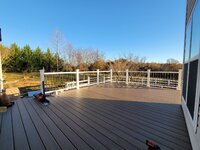
Nope. Not the way I did it...
First, definitely design/plan out your deck so everything fits the way it should, with the proper gapping in between boards. For your last board, plan out how much overhang you want to have on the last board. I think I did something like 1/2" or 1" as mentioned above.
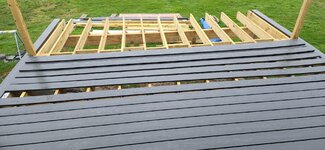
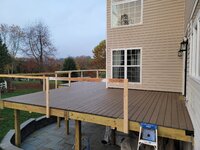
Then when building, I put in the first two boards which were part of the mitered picture frame, and then installed every successive board in the middle, making sure that your end cuts (length cuts) are square to where they need to be, and obviously the right length.
What I found out is that no matter how tight you try to place all the boards and clips (so they meet exactly the 1/8" gap or whatever your clip may be), sometimes you might be off just a hair, say like 1/32". Sometimes it's human error on installing the clip or screw, or sometimes it's just how the wood reacts (for example, if you suddenly hit a small knot and your screw deviates just slightly). Well, when you add up all those deviations, you realize that your deck doesn't exactly fit your frame exactly to the T as you designed it. This is where having a little bit of hidden flexibility in the overhang of your last board is where you can hide the excess.
Note, because of these slight deviations, you want to make sure that you don't go too far off linear and you suddenly have a bunch of curved boards, and it gets much worse (much more curved) the more boards you put down. Make sure you keep everything aligned and straight...
So when I got to the end, I put in my last two 45 deg mitered boards and whatever excess deviation on the last board was just now part of the overhang on the frame. Now that all the parallel boards are in, measure for your mitered side boards and install.
Remember that by building from one side to the other and then building out the sides of the picture frame, you can maximize the usage of the clips (which are pretty much hidden) and minimize the use of screws on the face of the board. Make sure you purchase a bag of plugs for all of the screws you do end up needing to use on the face. TAKE THE TIME to sort out every single plug into groups - I separated them into no grain line, 1 grain line, and 2 grain lines. Then when installing the plugs into the boards, try to match not only the direction of the grain but the number of grain lines in that area. If you take the extra 10 seconds, you can really do a good job of hiding all of the face-screws.
Perhaps the pros have a better way to make everything fit perfect (doing the picture frame first), but IMO construction does not have the precision of a machine shop.