To avoid these ads, REGISTER NOW!

Composite decking picture framing

dustink

Member
Joined
Feb 16, 2014
Messages
6
I am attempting to frame a timbertech composite deck. I am trying to design the frame so that it will support the picture framed boards along the perimeter.

All the instructions and videos I have seen show the picture frame boards being mitered and installed first, and then the infill boards being installed one at a time and then ‘magically’ the last infill board fits perfectly without having to rip it to width.

How to I design the width of my deck so that last board will fit perfectly within the gap in the picture frame? Are these composite boards so perfect that I can measure to a specific width and know that the last board will just fit without having to rip it to width?
 
To avoid these ads, REGISTER NOW!

rayra

Well-known member
Joined
Dec 1, 2014
Messages
4,724
Location
Escaped from Los Angeles
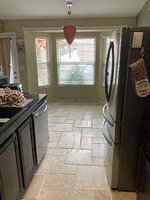
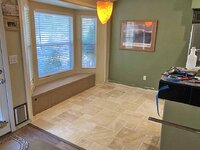
It isn't 'magic'. It's usually a lot of pre-planning. Say your deck boards are 5.5"W + 1/8" gap, so your spacing of your "picture frame" (facias) is some multiple of 5-5/8" plus an additional 1/8". No "magic" to it.

Presuming you have gaps between the deck boards and you've sized your picture frame span correctly to accommodate those gaps, if it then still didn't work our you would need to fudge the spacing a little bit to make it work out. Before fixing the deck boards in place.

Similar with masonry / brick / tile laying or any other repeating pattern effort, you plan your dimensioning beforehand. And you dry fit before you commit, to make sure things will work out.
 

Attachments

  • sparta kitchen tile layout - Oct19 mod.jpg
    sparta kitchen tile layout - Oct19 mod.jpg
    48.1 KB · Views: 123
  • sparta kitchen tiling 34 gung ho.jpg
    sparta kitchen tiling 34 gung ho.jpg
    62.1 KB · Views: 86
  • sparta kitchen tiling 35 dinette tiling done.jpg
    sparta kitchen tiling 35 dinette tiling done.jpg
    85.6 KB · Views: 84
  • deckcompleted1-100617.jpg
    deckcompleted1-100617.jpg
    28.4 KB · Views: 116

harleybear66

Well-known member
Joined
Jun 28, 2016
Messages
45
Location
south central connecticut
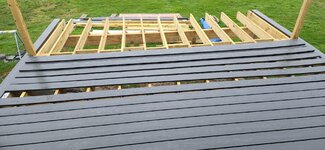
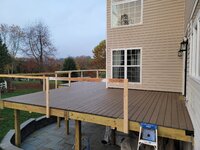
maybe pictures will help. i built this long skinny deck and two very small ones last summer for a good clients son. i build a few for his other son a few years ago. i am a commercial carpentry contractor but sometimes take on other projects to change it up a little and also to stay working in town.
ripping composite decking will not look good. first step is to decide your overhang, i use one inch. that being said a set of double joists will need to be added at the ends. you will never catch both edge board and field boards on a single because a spacer screw clip is needed in between. the clip does not hold the end of the field boards so one side is cut off. tin snips will work. cut and miter your picture frame boards first and hand tack them with regular finish nails for now, screw the outside edges off later on. you then work back toward the house. full board on the outside. your framing must be figured out ahead of time. or you can leave the joists long, tack your end deck boards, run 3/4 of the field decking, then finish your framing.

few tips.
its easier to grow your courses than to shrink them.
check your courses in a several places every few boards.
check your courses from where your going not where you came from.
its easier to install your posts before decking-you can get in there easier.
one sided planks are available but i never saw them at any big box stores.
 

Attachments

  • IMG_0812.jpg
    IMG_0812.jpg
    1.2 MB · Views: 132
  • IMG_0588.jpg
    IMG_0588.jpg
    781.2 KB · Views: 128

firebirdparts

Well-known member
Joined
Jun 8, 2016
Messages
10,584
Location
Kingsport, TN
You leave space between them, so just figure out X number of boards in your picture frame and then X+1 spaces and add it up. make your picture frame that size. Then when you install them, KEEP TRACK off where you are and adjust those gaps a little as you go to make it work out. Getting them supported around the picture frame is more of a problem than the dimensions.

The gaps make the dimensioning kinda easy.
 

Viper98912

Well-known member
Joined
Oct 20, 2012
Messages
1,124
Location
GA
Nope. Not the way I did it...

First, definitely design/plan out your deck so everything fits the way it should, with the proper gapping in between boards. For your last board, plan out how much overhang you want to have on the last board. I think I did something like 1/2" or 1" as mentioned above.

Then when building, I put in the first two boards which were part of the mitered picture frame, and then installed every successive board in the middle, making sure that your end cuts (length cuts) are square to where they need to be, and obviously the right length.

What I found out is that no matter how tight you try to place all the boards and clips (so they meet exactly the 1/8" gap or whatever your clip may be), sometimes you might be off just a hair, say like 1/32". Sometimes it's human error on installing the clip or screw, or sometimes it's just how the wood reacts (for example, if you suddenly hit a small knot and your screw deviates just slightly). Well, when you add up all those deviations, you realize that your deck doesn't exactly fit your frame exactly to the T as you designed it. This is where having a little bit of hidden flexibility in the overhang of your last board is where you can hide the excess.

Note, because of these slight deviations, you want to make sure that you don't go too far off linear and you suddenly have a bunch of curved boards, and it gets much worse (much more curved) the more boards you put down. Make sure you keep everything aligned and straight...

So when I got to the end, I put in my last two 45 deg mitered boards and whatever excess deviation on the last board was just now part of the overhang on the frame. Now that all the parallel boards are in, measure for your mitered side boards and install.

Remember that by building from one side to the other and then building out the sides of the picture frame, you can maximize the usage of the clips (which are pretty much hidden) and minimize the use of screws on the face of the board. Make sure you purchase a bag of plugs for all of the screws you do end up needing to use on the face. TAKE THE TIME to sort out every single plug into groups - I separated them into no grain line, 1 grain line, and 2 grain lines. Then when installing the plugs into the boards, try to match not only the direction of the grain but the number of grain lines in that area. If you take the extra 10 seconds, you can really do a good job of hiding all of the face-screws.

Perhaps the pros have a better way to make everything fit perfect (doing the picture frame first), but IMO construction does not have the precision of a machine shop.
 
Last edited:

cgrutt

Well-known member
Joined
Mar 4, 2016
Messages
8,182
Two issues first is getting measurements correct and keeping boards consistent to measured expectations as you go. Second problem, which is larger IMO is making sure frame is square to house. Less of a problem with engineered products but also have to deal with warped boards as you're tacking them down. I typically run boards from outside in and make up any difference at house/structure way less noticeable than at outer edge of deck. You can make up small differences with spacing as you run closer to structure. Any remaining differences can be made at structure, including the innermost picture frame boards if necessary.
 

Hank11

Well-known member
Joined
Aug 19, 2019
Messages
1,139
Location
Tennessee
If you have a large flat surface, you can lay the boards down spaced or pushed together as you wish and measure the width. If not space for the whole deck, lay down 10, 15, 20 boards and measure to get a better estimate of how they lay up.
 

cgrutt

Well-known member
Joined
Mar 4, 2016
Messages
8,182
Also mitering the picture frame is good because it hides exposed endgrain, which generally needs to be painted unless you're using solid composite.
 

PelicanPines

ALLIANCE MEMBER
Joined
Apr 30, 2014
Messages
38,104
Location
New Jersey, USA, Earth, My own reality
I've built a few decks and have picture framed the last two.. or three. Yea... follow what @rayra said above.

I also like to use a roundover bit to ease the edge of ALL cut ends. To me it looks more finished. So any board that its ripped or **** jointed would get the cut length routed with a roundover to MATCH the existing board roundover along the sides of the boards. It's also helpful if you have to rip .. say 1/2" off one board to make it fit ... nobody will notice it was ripped given the roundover.
 

nadogail

Well-known member
Joined
Jan 23, 2009
Messages
31,910
Location
Coronado, CA
Follow the Rule of the Seven P’s “Proper Prior Planning Precludes Piss Poor Performance “

You can be assured that those beautiful DIY projects in the magazines were not done on the fly without rehearsals and retakes.
 
OP
D

dustink

Member
Joined
Feb 16, 2014
Messages
6
I've built a few decks and have picture framed the last two.. or three. Yea... follow what @rayra said above.

I also like to use a roundover bit to ease the edge of ALL cut ends. To me it looks more finished. So any board that its ripped or **** jointed would get the cut length routed with a roundover to MATCH the existing board roundover along the sides of the boards. It's also helpful if you have to rip .. say 1/2" off one board to make it fit ... nobody will notice it was ripped given the roundover.
Oh that is an interesting idea! The round over is what makes the composite boards look “out of place” if they are ripped or cut, because all the composite boards have a round over. So when there is one board that has a very square cut on it, it looks out of place.

Thank you for that idea! I’m going try rounding over on some scrap material and see if I can make it look right with this composite stuff
 
OP
D

dustink

Member
Joined
Feb 16, 2014
Messages
6
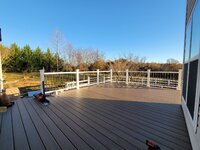
Here's a few pics i did a couple years ago with Timber Tech... good product.

20200806_191925.jpg

20200806_191849.jpg

20200806_191915.jpg

20200806_191908.jpg

Owner did railings at later date.
Wow! That is beautiful!

Thank you for the inspiration! How was your experience with timbertech? Would you recommend it over the other choices like trex?
 

PelicanPines

ALLIANCE MEMBER
Joined
Apr 30, 2014
Messages
38,104
Location
New Jersey, USA, Earth, My own reality
Oh that is an interesting idea! The round over is what makes the composite boards look “out of place” if they are ripped or cut, because all the composite boards have a round over. So when there is one board that has a very square cut on it, it looks out of place.

Thank you for that idea! I’m going try rounding over on some scrap material and see if I can make it look right with this composite stuff
Pick the right round over radius too...

Wish I had pictures... one platform I built under a step out... I went crazy and camfered the outside edge... to remove the round over... many many oh **** that's cool.
 

Zeke

Well-known member
Joined
Aug 13, 2009
Messages
17,176
Location
Long Beach CA, the sewer by the sea.
I've done this with tile, a border and a field. I found that expanding the calculated measurement allowed me to 'adjust' as I was nearing the center point. Good to layout the work "dry" first so that you get a feel for how it's going to come together. I my case I was wanting 1/4' joints for sanded grout. In 20 rows of tile a few thousandths made a difference. Spacers and jigs help along with using a tape.
 

cgrutt

Well-known member
Joined
Mar 4, 2016
Messages
8,182
Wow! That is beautiful!

Thank you for the inspiration! How was your experience with timbertech? Would you recommend it over the other choices like trex?
It was good, easy to work with. Believe they have 3 or 4 different lines this was mid-grade. Composite, capped on 4 sides. The only thing I don't like about it is it gets very hot. The top grade is solid pvc with no wood fibers stays much cooler, is solid color throughout, longer warranty but very expensive. Believe timber tech and trex are about same cost wise and product lines. I'd use either one again.
 
To avoid these ads, REGISTER NOW!

CraigStu

Well-known member
Joined
May 22, 2014
Messages
4,013
Location
Blacksburg, Va
I just did our front porch w/o picture framing. But thinking about the rear deck for the fall or next spring. Was thinking to picture frame that but didn't realize you picture frame against the house also. Dang that requires a LOT of planning. On mine the deck and porch were built and then the vinyl siding done so the decking goes under the J trim at bottom of the siding. That was nice as I only had to rip about 6ft where there is a bumpout for the front door. So my ripped edge is hidden by the siding.
 

cgrutt

Well-known member
Joined
Mar 4, 2016
Messages
8,182
I just did our front porch w/o picture framing. But thinking about the rear deck for the fall or next spring. Was thinking to picture frame that but didn't realize you picture frame against the house also. Dang that requires a LOT of planning. On mine the deck and porch were built and then the vinyl siding done so the decking goes under the J trim at bottom of the siding. That was nice as I only had to rip about 6ft where there is a bumpout for the front door. So my ripped edge is hidden by the siding.
Don't need to run picture frame along house if you don't want to and you don't need to use different colors. In pics posted above it's how customer (his wife, actually lol) wanted it. No special framing needed along house as long as joists are running perpendicular to it. Sides need some additional blocking for the picture frame.
 

mepstein

Well-known member
Joined
Sep 17, 2010
Messages
1,281
I just did a picture framed deck with trex but I did not run the picture frame along the house. I mocked it up that way and then decided I just wanted it on three sides. Since the railing only runs over the picture framed sides, it all looks really good.
 

mark198

Active member
Joined
Jan 13, 2012
Messages
29
A round over is a great finishing touch after a board is ripped but make sure the product you choose supports it. Some products are capped with a different material and a round over would expose the inside of the board.
 

firebirdparts

Well-known member
Joined
Jun 8, 2016
Messages
10,584
Location
Kingsport, TN
That's a good point and it's nice here to decide where your posts are going to "hit" that picture frame and make it advantgeous to you. So in my case, the inside edge of the rail posts is flush with the inside of the picture frame. The first space starts at that post (4 by 4's). So you need a 2x outboard of your rail in that case to hold up the picture frame. 3.5" plus 1.5" equals 5" and the boards are bigger than that, so that gives you a little overhang of the floor surface beyond the framing if you like that. If you were using 6 by 6 posts you'd need it to look different.

P.S. Basic trex you can't round it over as Mark said. I used the color they stock at lowes and my picture frame is a contrasting color. The picture frame boards, I grooved them on one side and used groove hardware on one side.
 

Wolley

Well-known member
Joined
Jun 24, 2022
Messages
420
Location
Maine
I would add up the number of board widths and gaps to get the size deck you want. If it's a basic rectangle, leave the joists a little long and install a temporary rim joist and sides of the picture frame. Install all the field deck boards then you can use the actual picture boards to layout and Mark the joists where they need to be cut to come out perfect.
 

arrowhead

Well-known member
Joined
Dec 11, 2008
Messages
681
Location
Stillwater, NY
I'm no carpenter so consider that in my suggestion. When I framed the deck, I left the joists long and just put up the header temporarily. I started at the house and decked all the way across until I got a couple of boards from the end. Only then did I cut the joists and permanently mount the last header. That way any error is built in and didn't have to rip any boards.
 

arrowhead

Well-known member
Joined
Dec 11, 2008
Messages
681
Location
Stillwater, NY
That's a good point and it's nice here to decide where your posts are going to "hit" that picture frame and make it advantgeous to you. So in my case, the inside edge of the rail posts is flush with the inside of the picture frame. The first space starts at that post (4 by 4's). So you need a 2x outboard of your rail in that case to hold up the picture frame. 3.5" plus 1.5" equals 5" and the boards are bigger than that, so that gives you a little overhang of the floor surface beyond the framing if you like that. If you were using 6 by 6 posts you'd need it to look different.

P.S. Basic trex you can't round it over as Mark said. I used the color they stock at lowes and my picture frame is a contrasting color. The picture frame boards, I grooved them on one side and used groove hardware on one side.
Yup, it's a lot of extra material but you need that extra joist on the perimeter to support the picture frame.

look up dr decks on youtube, lot of great info there
 

richnc

New member
Joined
Dec 14, 2024
Messages
2
I'm no carpenter so consider that in my suggestion. When I framed the deck, I left the joists long and just put up the header temporarily. I started at the house and decked all the way across until I got a couple of boards from the end. Only then did I cut the joists and permanently mount the last header. That way any error is built in and didn't have to rip any boards.
Did you picture frame yours? I'm leaving my joists long and working from the house side out, but that means installing one side of the picture frame first. I'd like to miter the corners of the picture frame but I don't want to freehand them. Any ideas?
 

arrowhead

Well-known member
Joined
Dec 11, 2008
Messages
681
Location
Stillwater, NY
Did you picture frame yours? I'm leaving my joists long and working from the house side out, but that means installing one side of the picture frame first. I'd like to miter the corners of the picture frame but I don't want to freehand them. Any ideas?
Yes, I did picture frame with mitered corners so I laid out the two perimeter boards temporarily until I knew where the last board would go across before I cut them.

1734362112230.jpeg
 

545_days

Well-known member
Joined
Oct 30, 2016
Messages
577
Location
Texas
I've done this with tile, a border and a field. I found that expanding the calculated measurement allowed me to 'adjust' as I was nearing the center point. Good to layout the work "dry" first so that you get a feel for how it's going to come together. I my case I was wanting 1/4' joints for sanded grout. In 20 rows of tile a few thousandths made a difference. Spacers and jigs help along with using a tape.
I was about to make a similar post. As with tile careful measurement is key. Also, if you are forced to deal with an out of square deck for some reason such as spanning between two existing buildings, you can carefully spread the difference across all the gaps on one end and make up a significant difference in width. A 32nd difference in the gap along a length of a 10' + long deck will be invisible to the naked eye
 

richnc

New member
Joined
Dec 14, 2024
Messages
2
Yes, I did picture frame with mitered corners so I laid out the two perimeter boards temporarily until I knew where the last board would go across before I cut them.

1734362112230.jpeg
Thanks! That helps. I might use some 1x4's or something temporarily so I don't have to screw thru expensive composite and then remove it.
 
To avoid these ads, REGISTER NOW!
Top Bottom