To avoid these ads, REGISTER NOW!

Compressed Air Hardware - What to Choose?

moparfreak

Well-known member
Joined
Jan 24, 2005
Messages
853
Location
Milwaukee, WI
So I am in the latter stages of planning out my compressed air system to plumb up to my compressor. For a couple years now I've lived with a simple system dragging a hose right out of the compressor to the various areas of the shop, and now I'd like to get it installed onto the walls and accessible to all the areas of the shop conveniently.

The biggest thing I've got as a question mark is figuring out what type of compressed air plumbing/hardware I should include, and where. There's coalescing filters, dryers, lubricators, oil removers, water removers, regulators, gauges, etc. It's where most of the money can get spent on these systems. What type of stuff is best used where?

As far as my plan goes, I plan to have a few different types of drops:

- General use workbench drops for general work. Expect this type of use to be nailers, blow guns, die grinders, zip saw, general small hand work. These drops would probably include a coiled hose and a relatively low-buck pressure regulator w/ gauge such as this one:

https://www.menards.com/main/tools-...6-c-12917.htm?tid=1084071434130140913&ipos=50

- Automotive bay drop, this would use more of the higher flow type tools used on car restoration & metal work, so impact guns, air ratchets, air hammers, grinders, sanders. I'm thinking maybe an oiler would be good for this drop, as those are the type of tools that need consistent lubricaton?

- Drop for small sand blasting cabinet, and also light painting such as airbrushes or HVLP. I'm thinking this is where a dryer and filter would be best, such as this one?

http://www.eastwood.com/rockwood-3-8-npt-2-stage-air-filter-dryer-system.html

I could put the filter / dryer in at the beginning near the compressor but then moisture that builds in the lines wouldn't be treated. Just not sure what is best practice here.
 
To avoid these ads, REGISTER NOW!

EOC_Jason

Well-known member
Joined
Jun 25, 2012
Messages
11,388
Location
Bentonville, AR
Dryer's are most effective at the end of the run because that gives the air the longest time to cool down while running through your pipes... Having one at the beginning though wouldn't hurt, and it would also help remove some of the moisture that would otherwise go through the lines and might build up in certain spots that you wouldn't want.

Unless you are really going to be using a lot of air tools all day every day I'm not a fan of the stationary oilers. Either a small in-line oiler, or just put a couple drops of oil in your tool at the end of the day like most people.
 
OP
M

moparfreak

Well-known member
Joined
Jan 24, 2005
Messages
853
Location
Milwaukee, WI
Took the advice here and did some searching on different types of hardware, especially drying. Wow, a lot of different information and approaches.

As far as moisture removal, originally I was planning on doing a couple up/down loops w/ drain valves in the bottom to get some of the moisture out, but now I'm also considering using a Hayden cooler plumbed up against the fan to do the same job. I've got a 3 hp 60 gal IR SS compressor, so I figured a Hayden 1240 would do the job and certainly priced reasonably.

https://www.amazon.com/dp/B000HE8VQ4/?tag=atomicindus08-20

I'd be doing it essentially using this method:


I figure using the aftercooler would negate the need to add extra piping loops which saves me some wall space. Then I'd put dessicant filters over by the drops that I really wanted extra protection on.

Makes sense?
 

sberry

Banned
Joined
Jun 18, 2005
Messages
35,747
Location
Brethren, Michigan
Depends on the shop, size etc. The trick is making less do more vs adding every fitting you can think of. Skip the oiler and those coil things. A couple hose reels and maybe a fixed whip drop serve most places, lots of guys here make it with 1 reel and a filter regulator.
 
OP
M

moparfreak

Well-known member
Joined
Jan 24, 2005
Messages
853
Location
Milwaukee, WI
My shop is long narrow and somewhat winding, especially considering it's got 3 cars and lots of tools to block the flow of things from end to end, so one hose (which is what I have set up now & been using for a couple years) really isn't my endgame here. I plan to put a fixed reel at each end for flexibility to go outside the front or back, then put a few drops near the areas I work the most.

y4m6WO26zLuHNHrPSR6lobX-ptpFEN3MBvRvXtPujXOPzYqR6YOVVPGzmIAOLP8KdpfRiW8CgMb3etRtjXctOSyW6EmIdNW_zdVxZ4cggWLMezLG-_0HQgkQszn7qgGSR9xjigE9XF5azbHeIolb0NhaYL7yfrQhAAhiPRN1qcDHJImyGLfEcXXP9qYDI10qRYUMnPnKk1uJHPkgUayqoTZdw


For the very large air consumers I have a larger ID fitting drop right out of the tank for now.

y4mmvYJsWInFrrMrMn4kBwrn1sPaG9Wmmpq6w3flkYO94xfL9WpxmNRMD3UzzQvAU4Jfw0rjuh1HEl2cJ6ZwpQwaowcPcN8UvhwVrzgKtWK8c5LnsrUkM9xEF62ccZOzLwS6Lg0tw1HtwnNWSEBzcvrEAUsCgLXiVBcK0ULwOxSKIVGlxsmC48hCZr-2RVwvt2-ixHI5Pq8tG0JlXLzlJDt6A
 
To avoid these ads, REGISTER NOW!

Lelandwelds

Well-known member
Joined
Sep 6, 2017
Messages
2,443
Location
Central Texas

Milton V are hard to beat.

Many people ( I include myself) get too hung up on every aspect of shop air. Every system works ( it is a law of physics after all) but some need a bit more hands on attention. Air systems can survive a shocking amount of neglect and abuse.

But, the nice systems are a joy to use and painless to service. They can provide 20, 40 years or more of drama free service. They can also do it for less cash outlay than the crappy poorly maintained systems.
 
OP
M

moparfreak

Well-known member
Joined
Jan 24, 2005
Messages
853
Location
Milwaukee, WI
Mopar - What are those connectors at the bottom & side of the tree?

The fitting on the RH of the "cross" is just a mesh muffler w/ valve, so if I wan to bleed the system off safely w/o projectiles or too loud I can use that.

The fitting on the LH side of the "cross" is a standard coupler, I use it connected to my one blue hose at the moment, and drag it to wherever in the shop I need it.

The fitting on the bottom of the "cross" is a large ID SS industrial high flow valve, got it from my SFIL he has access to that kind of stuff. Plan is to use it to feed the main trunk that goes up on the wall, I forget exactly what spec it is, though I'll take a closer look and see if I can put more information out on it. At the moment I don't use it much it's plugged waiting for me to re-plumb the system up permanently.
 

sberry

Banned
Joined
Jun 18, 2005
Messages
35,747
Location
Brethren, Michigan
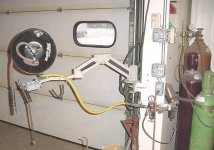
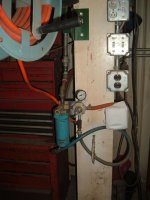
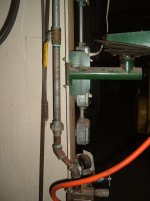
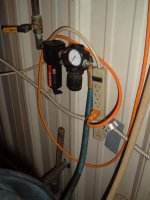
I had an audit by an engineer and he remarked about the air. There are really no "hydrants" so to speak. No sections of hot hose to be disconnected and moved. The only user connection is at the end of the hose to the tool. The hoses are screwed to the regulators and fixed like the reels, a user can't disconnect sections of charged hose and doesn't need to move them. I have a couple extra fixed whips along with reels, a couple are convenience because I can and it helps the layout as well as provides overlap but in reality could cover 6000 sq ft and outside aprons with 3 reels if I had to without much inconvenience.
One of the first systems I had was more complicated, during a remodel actually removed more than added and simplified a little. Get the basics right, leave a method to add if needed, run as much as practical off of a reg/filter. You don't need one for every drop. I have a couple feet single reels and one feeds 4 , 2 whips on the hoist, another real and a feed to the paint booth. A plus is that when a tool is moved in that section it's running at the same pressure no matter what hose it comes from.
Last pic is a revision with new line on the incoming, note a couple of them do not have trip legs, the filter is the catch all but this system is so try it doesn't need them.
My files are a bit messed up, I add a couple pics. Not all have drips but do have a service valve ahead of filter/reg.
 

Attachments

  • air reggie.jpg
    air reggie.jpg
    133.2 KB · Views: 56
  • air reg combo.jpg
    air reg combo.jpg
    142 KB · Views: 55
  • air hose reel.JPG
    air hose reel.JPG
    33.7 KB · Views: 62
  • air 2.jpg
    air 2.jpg
    136.7 KB · Views: 58
  • air 3.jpg
    air 3.jpg
    137 KB · Views: 49
  • air 4.jpg
    air 4.jpg
    137 KB · Views: 51
Last edited:

cvairwerks

Well-known member
Joined
Aug 12, 2016
Messages
7,226
Location
Within hearing distance of Texas Motor Speedway
Forget adding an oiler, as anything downstream of that point will have oil in it, and that includes any hose you ever connect there. Best thing is to individually oil each tool per the manufacturers recommendation. The only thing that should ever have an oiler, is a large, permanently mounted tool that needs constant oiling. The oiler should be installed on the tool itself and downstream of any non permanent air connection.
 

ford33

Well-known member
Joined
Feb 26, 2011
Messages
2,118
Location
Chicago, IL. USA
Suggest you keep your pneumatic system simple. A central ceiling mounted hose reel and a coupler or two near the bench is likely all you need initially. You can add more if needed later.

As mentioned earlier, no need for an oiler. They exist to provide lubrication to valve and cylinders used on industrial machinery. Just add a few drops of oil to your hand tools. You don't want oil in your compressed air system piping and hoses.

I would slope the air pipe lines to a low point and then put in a shut-off valve. Open the value to drain any water that collects in the piping.

One other suggestion you may not have thought of is to plumb a coupling on the outside of the garage near where you park cars or near the yard. It is convenient to use it to fill your car tires or blow the dirt or leaves off the patio or inflate pool toys. I also use my yard coupling to blow out the water in my lawn irrigation sprinkler piping in the fall.
 

Blue XJ

Well-known member
Joined
Dec 10, 2012
Messages
414
Location
Washington, Michigan
For the plumbing part of it, I would recommend Rapid Air. I am using their 1/2" kit. All of the fittings are 3/8" NPT except where the QD's go, those are 1/4". It's very easy to run, and you get 100 feet of hose, with 3 manifolds for under $100.
 

jfrey123

Well-known member
Joined
May 22, 2016
Messages
76
Location
Sparks, NV
You might consider going with universal air chucks on your drops. Kind of annoying to have to swap the tool connectors if you borrow a buddy's tool and it has the opposite fitting as all your hoses.
 

Lelandwelds

Well-known member
Joined
Sep 6, 2017
Messages
2,443
Location
Central Texas
For the plumbing part of it, I would recommend Rapid Air. I am using their 1/2" kit. All of the fittings are 3/8" NPT except where the QD's go, those are 1/4". It's very easy to run, and you get 100 feet of hose, with 3 manifolds for under $100.

I am not as big a fan of nylon.( I have had leaks).

I would prefer PEX or PE-AL-PE . Or copper. Or black pipe (if you have a threader) (In that order.)

Welding gas fill plants use 360 alloy brass pipe. Process piping is 300 series stainless. Almost all underground pipe is now PE.
 
To avoid these ads, REGISTER NOW!
Top Bottom