To avoid these ads, REGISTER NOW!

Compressed Air Lines - Pressure Loss

smithlabs

New member
Joined
Feb 21, 2024
Messages
3
Hi all,

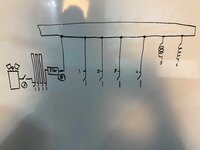
I've just installed a fixed copper air run for my home workshop and am trying to debug the cause of losing pressure over time. Attached is a schematic and here are a few additional specs:

* Total network is 200ft 3/4" copper including 4 drip legs and a handmade aftercooler
* Drip legs and drops in aftercooler are reduced and use 1/2" ball valves, 8 valves in total
* System includes two 25' retractable hoses, 3/8" ID
* Hose reels have fixed connections, 7 other access points are female quick connects

I have given the entire system about 6 baths in soapy water - I found a few leaks in threaded connections and have repaired them, and I'm now out of places to check. I'm still losing about 15 PSI over a period of 12 hours. That said, my first question is: Should I expect my air lines to hold nearly ideal pressure or should will even a tight system have some loss?

I'd be glad to share my debug steps and photos if helpful. Thanks for your thoughts.
 

Attachments

  • Air System.jpg
    Air System.jpg
    99.6 KB · Views: 163
To avoid these ads, REGISTER NOW!
OP
S

smithlabs

New member
Joined
Feb 21, 2024
Messages
3
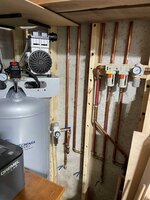
Hi Eric, I do. There are two nodes that I have been controlling as part of the debug - see nodes A and B in the previous schematic. With (A) closed, the tank including first valve holds pressure with no leaks. With (A) open and (B) closed I saw some leaking and fixed a few spots - I am retesting this now.

Attaching a photo as well.
 

Attachments

  • Air System 2.jpg
    Air System 2.jpg
    276 KB · Views: 164
OP
S

smithlabs

New member
Joined
Feb 21, 2024
Messages
3
I'd thought of temp change - my assumption is that cooling would most affect pressure local to the tank and any sagging would be equally visible with the inline valve closed.

If this is faulty logic, would it be enough to explain a 15 PSI drop? Note it continues to drop over time rather than reaching steady state at ambient.
 

ColoradoMech

Active member
Joined
Feb 12, 2023
Messages
43
Location
Denver Colorado
I'd thought of temp change - my assumption is that cooling would most affect pressure local to the tank and any sagging would be equally visible with the inline valve closed.

If this is faulty logic, would it be enough to explain a 15 PSI drop? Note it continues to drop over time rather than reaching steady state at ambient.
If it continues to drop then there is a leak. My compressor will drop a solid 7 psi if i fill it from empty to full and let the tank cool for a few hours but then remains steady at 128psi or so until use. If it constantly loses pressure after sitting for half a day then it has a leak and its not normal. Id investigate the air drains on the air dryer system. Try plugging the drain lines and seeing if that helps. Air systems are suppose to be 100% tight with no loss other than due to temperature change.
 

TurnipTruck

Well-known member
Joined
Aug 28, 2005
Messages
1,552
Location
Southcentral Alaska
Until I added a second air hose reel, my screwed-pipe system would hold pressure for months.
Some of the leaks I have found over the years are valve stem packings and quickconnect Orings.
Sometimes a leak is bad enough to blow away the soapy water without making bubbles, and you can’t get enough soap in the valve ports to make a bubble so you submerge the valve in a cup of water.
 

GrayFlattop

Well-known member
Joined
Jan 18, 2018
Messages
1,039
Location
Chicago
Regulators and filter/regulators can frequently be a source of leaks. Harder to check than pipe fittings, but if you have a valve in "front" of them, then it's easier to isolate. Valve stem packing and the o-ring for the bowls are good places to look.
 

GrayFlattop

Well-known member
Joined
Jan 18, 2018
Messages
1,039
Location
Chicago
Are you checking the ends of the valves with soap as well?

System looks great, btw!
Good point - also - check the ball valves. There is a packing nut on the valve stem that may need a little snugging.

And yes - it looks good. Far nicer than my Black Iron piping.
 

vwpieces

Well-known member
Joined
Apr 28, 2020
Messages
5,925
Location
Hills, PA
Am I seeing 1/2 in 90 out of compressor? Yet I think it looks like 3/4 used for the runs after that?
I know unrelated to the Leak but have to ask... Why?
 

nadogail

Well-known member
Joined
Jan 23, 2009
Messages
31,916
Location
Coronado, CA
Pressure drops indicate either a leak or a reduction in temperature.
Small drops or leaks in most systems are of little or no consequence.
An "Old Timer" once told me that "the only hydraulic systems that won't leak are those that are out of oil".
A little leak may not hurt, unless it is a hazard; in which case it needs to be found and fixed.
 

thammel

Well-known member
Joined
Oct 3, 2005
Messages
2,239
Location
Maryland
I did a copper line system also. I had numerous leaks also to start.....just about all of them were at threaded joints. I have a lot of drops, drip legs and used good supply house valves (Apollo brand). I used leak detection via soapy solution and rector seal better bubble. Now I essentially never have any pressure drop. All that soldering really got my skill back up!!
 

larry4406

Well-known member
Joined
Jan 27, 2006
Messages
19,066
Location
Northern Virginia
Do a hydro test on the system as if it were domestic water supply.

Connect a water line to your copper pipes. Fill the line with water. Make sure the ends are hard capped and hose reals not involved. Apply over pressure to the system (100-120 psi).

Watch for water leaks.
 

GrayFlattop

Well-known member
Joined
Jan 18, 2018
Messages
1,039
Location
Chicago
Makinf compressed air is quite expensive, so fixing leaks can save a lot of money
One place I worked had a rather extensive compressed air piping system. Literally miles of black iron pipe, hundreds and hundreds of valves, filters, as well as hundreds of cylinders and solenoids. It took one compressor running fully loaded - just to keep up with the leaks. At least it was one of the smaller compressors - 150 H.P...

VERY costly, but in the case of the OP, a 15 PSI drop - should only be addressed if he has the time to debug, IMO.
 

mike93lx

ALLIANCE MEMBER
Joined
Dec 9, 2013
Messages
37,408
Location
Richmond, VA
One place I worked had a rather extensive compressed air piping system. Literally miles of black iron pipe, hundreds and hundreds of valves, filters, as well as hundreds of cylinders and solenoids. It took one compressor running fully loaded - just to keep up with the leaks. At least it was one of the smaller compressors - 150 H.P...

VERY costly, but in the case of the OP, a 15 PSI drop - should only be addressed if he has the time to debug, IMO.
For me, either having the compressor kick off at night or need to run whenever I want some air would bug me enough to chase it down. I'd hate to put in all that work for plumbing and have to turn off the valve at the compressor after every use
 
To avoid these ads, REGISTER NOW!

zmotorsports

ALLIANCE MEMBER
Joined
Oct 20, 2009
Messages
21,333
Location
Northern Utah
One place I worked had a rather extensive compressed air piping system. Literally miles of black iron pipe, hundreds and hundreds of valves, filters, as well as hundreds of cylinders and solenoids. It took one compressor running fully loaded - just to keep up with the leaks. At least it was one of the smaller compressors - 150 H.P...

VERY costly, but in the case of the OP, a 15 PSI drop - should only be addressed if he has the time to debug, IMO.


Agreed. We have thousands of feet of compressed air lines at work and multiple air compressors and do our best to control leaks through normal preventive maintenance tasks and routine inspections. Leaks are expensive in an industrial environment and worthwhile to control and minimize. However, I have yet to see a 100% tight air system in a shop that has more than a couple of connections. I'm not saying it's impossible, just nearly, and you have to ask what the ROI is as far as time spent vs. reward. Piping is not nearly as difficult to control compared to connections, couplers, hoses and especially those pivot points for moving connections.

My last home shop of 25+ years had very, very slow leaks show up over the years as I continued to add more and longer runs on. It wasn't through the soldered connections per se, but all of the threaded couplers, hoses, pivot points on the hose reels, etc. where a small amount will escape undetected. I got in the habit of just closing the ball valve right off the tank each night as I closed up and the next day when I walked into the shop and opened the ball valve, there would be a slight amount of air escape from the tank to fill the lines, nothing too much to worry about and by closing the ball valve it wasn't allowing the pressure switch to activate and therefore kick the compressor on.

In my new shop I have about 6 times the linear feet of air lines combined with 4 times the amount of wall drops and ceiling drops. Each drop also going to a dual coupler manifold and although I'm confident my air lines are relatively tight, I still close the ball valve off each night and kill the compressor power. The next afternoon when opening up the shop and turning the compressor on and opening the ball valve I still get a slight transfer of air from the tank to the lines with about a 8-10 PSI drop. Not enough to worry about but a small amount and sometimes it is enough to immediately kick the compressor on and sometimes not. It depends on where in the normal operating range the tank pressure was at the night before when I shut everything down. If it was near the cut-out pressure then it won't drop enough to activate the pressure switch when opening the ball valve. However, if the tank pressure was nearer to the cut-in pressure of the switch, then the compressor will start upon opening the ball valve.
 

PoorUB

Well-known member
Joined
Mar 29, 2021
Messages
11,622
Location
Fargo, ND
The over night 15 PSI drop would bug me, but stuff like that just does!
I had a shop a few years ago with multiple drops. I found quick couplers leaking, even the make ends worn, or not in spec and replaced them too. I threaded the air hoses right to drops in well used spots to avoid the QD at the wall. I got it down so I could shut off the compressor Saturday noon and if might have been done 4 PSI Monday morning. To me that was acceptable as if the compressor was left on it might run once in 4 or 5 days.

My current system is stupid simple. One drop with a 50 foot hose reel in the middle of the shop. It is just me and I don't see a reason to run hard lines all over. I have been gone for a week, come out to the shop and turn on the air compressor and it doesn't run. The first time that happened I went and looked to see if there was air in the tank and something had failed so the compressor wasn't running! I have a new QD on the end of the hose. I had some cheap imported QD's, the males too, that fit the Milton QD, but leaked ever so slightly. They got tossed. When I come in in the morning, flip on the compressor and it runs, I get looking for leaks!
 

cvairwerks

Well-known member
Joined
Aug 12, 2016
Messages
7,196
Location
Within hearing distance of Texas Motor Speedway
We used to have a monster air system at work.....probably close to 100 miles of everything from 1/4" to 12" piping and tubing, and several tanks that looked like rail cars on end for storage. With more than a dozen huge single cylinder compressors feeding the system, and it under heavy use 24/7, any minor leaks were ignored. We had a 2" line with a major leak that was let go until we got to a holiday where the main air feed for it could be shut down. Takes a long time to blow down 2 miles of 12" air line!
 

PoorUB

Well-known member
Joined
Mar 29, 2021
Messages
11,622
Location
Fargo, ND
We used to have a monster air system at work.....probably close to 100 miles of everything from 1/4" to 12" piping and tubing, and several tanks that looked like rail cars on end for storage. With more than a dozen huge single cylinder compressors feeding the system, and it under heavy use 24/7, any minor leaks were ignored. We had a 2" line with a major leak that was let go until we got to a holiday where the main air feed for it could be shut down. Takes a long time to blow down 2 miles of 12" air line!
Not many of us have to deal with that at home!

I worked at a shop and we worked a four day, 10 hour a day week. My boss asked me if I wold work Friday. He got a threader and Friday we went to it and repaired the worst of the leaks. Before we started you could walk through the shop with everything shut off and hear air leaks. When we got done we still had some minor leaks, but we could not hear any. We went through and soaped every fitting and tagged the large one with red tape, and the minor ones with yellow tape, thinking if we had to cut into the air lines to add drops at a later date we would fix that small leak. We feel we had found most of them and there were a couple tiny ones we didn't bother with. We had the one day to tackle the job so we just went after the big leaks.

Some of the machines had leaks and we made note of them and fixed then while doing maintenance.
 

fitter30

Well-known member
Joined
Jun 23, 2019
Messages
2,966
Location
Peace Valley,mo
You can also loose air through the compressor valves. Pull the air cleaner put some soap bubbles on your hand put it over the threaded opening.
 

zmotorsports

ALLIANCE MEMBER
Joined
Oct 20, 2009
Messages
21,333
Location
Northern Utah
Not many of us have to deal with that at home!

I worked at a shop and we worked a four day, 10 hour a day week. My boss asked me if I wold work Friday. He got a threader and Friday we went to it and repaired the worst of the leaks. Before we started you could walk through the shop with everything shut off and hear air leaks. When we got done we still had some minor leaks, but we could not hear any. We went through and soaped every fitting and tagged the large one with red tape, and the minor ones with yellow tape, thinking if we had to cut into the air lines to add drops at a later date we would fix that small leak. We feel we had found most of them and there were a couple tiny ones we didn't bother with. We had the one day to tackle the job so we just went after the big leaks.

Some of the machines had leaks and we made note of them and fixed then while doing maintenance.

Agreed and for a simple system as you stated it can easily be found and corrected and I wouldn't tolerate either.

For a larger system this is many times not worth the time as once one small leak is found and repaired another will show up, or one created while taking apart the one you went to fix. It comes down to how large a system and what you can live with so it's rather subjective.

In my shop I can walk in with nothing running, deathly quiet and not hear a single leak. However, I still lose roughly 8-10 PSI in a 24-hour period. Granted some of that could be temperature fluctuation, but I am certain some of it is leaks with as much piping that I have around the entire perimeter and the 10+ air drops with all of the corresponding connection points and couplers. The ones I am most suspect of are the hose reels. In my last shop I think in 25 years I resealed the swivel fitting on my one hose real about 3 times. So far with my much better quality Reelcraft hose reels in my new shop and only 7 years old, I haven't had to reseal the swivel fittings, yet.
 

GrayFlattop

Well-known member
Joined
Jan 18, 2018
Messages
1,039
Location
Chicago
Agreed. We have thousands of feet of compressed air lines at work and multiple air compressors and do our best to control leaks through normal preventive maintenance tasks and routine inspections. Leaks are expensive in an industrial environment and worthwhile to control and minimize. However, I have yet to see a 100% tight air system in a shop that has more than a couple of connections. I'm not saying it's impossible, just nearly, and you have to ask what the ROI is as far as time spent vs. reward. Piping is not nearly as difficult to control compared to connections, couplers, hoses and especially those pivot points for moving connections.

My last home shop of 25+ years had very, very slow leaks show up over the years as I continued to add more and longer runs on. It wasn't through the soldered connections per se, but all of the threaded couplers, hoses, pivot points on the hose reels, etc. where a small amount will escape undetected. I got in the habit of just closing the ball valve right off the tank each night as I closed up and the next day when I walked into the shop and opened the ball valve, there would be a slight amount of air escape from the tank to fill the lines, nothing too much to worry about and by closing the ball valve it wasn't allowing the pressure switch to activate and therefore kick the compressor on.

In my new shop I have about 6 times the linear feet of air lines combined with 4 times the amount of wall drops and ceiling drops. Each drop also going to a dual coupler manifold and although I'm confident my air lines are relatively tight, I still close the ball valve off each night and kill the compressor power. The next afternoon when opening up the shop and turning the compressor on and opening the ball valve I still get a slight transfer of air from the tank to the lines with about a 8-10 PSI drop. Not enough to worry about but a small amount and sometimes it is enough to immediately kick the compressor on and sometimes not. It depends on where in the normal operating range the tank pressure was at the night before when I shut everything down. If it was near the cut-out pressure then it won't drop enough to activate the pressure switch when opening the ball valve. However, if the tank pressure was nearer to the cut-in pressure of the switch, then the compressor will start upon opening the ball valve.
For a long time, we had two maintenance guys coming in on Sundays EXCLUSIVELY for the purpose of eradicating air leaks as they were "easier" to detect when production equipment was not running. That got old real fast - and was never-ending. We are moving toward solenoid shut-off valves to equipment that closes the valve for any equipment not in use at the time. But that is slow going.

The upside is that our electric utility LOVES us.
 

zmotorsports

ALLIANCE MEMBER
Joined
Oct 20, 2009
Messages
21,333
Location
Northern Utah
For a long time, we had two maintenance guys coming in on Sundays EXCLUSIVELY for the purpose of eradicating air leaks as they were "easier" to detect when production equipment was not running. That got old real fast - and was never-ending. We are moving toward solenoid shut-off valves to equipment that closes the valve for any equipment not in use at the time. But that is slow going.

The upside is that our electric utility LOVES us.

Agreed. We did much the same thing about ten years ago. We added solenoids to those pieces of equipment that were highly suspect let lesser usage. What we found is while the plan is A+, the real world scenario is average at a C. Results were similar to what I mentioned in my last post about fixing one leak point and possibly creating another of equal, less or worse leak. We found that by cutting the supply line feeding a piece of equipment that we now doubled our potential leak points by cutting in a solenoid valve. Not all leaked but over time some fittings began leaking, sometimes caused by the vibrations of the machine or just the operations floor/environment.


I will say that when it comes to air leaks on our coach however, I am extremely **** about finding those. I hate hearing my auxiliary compressor kick on in the middle of the night when the wife and I are sleeping to compensate for a listing coach. I have been known to spend many hours under the chassis with a bottle of soapy water tracking down suspected leak points and fixing. I love it when we can roll into a campground, level up and not have the air system compensate for 5+ days. We've sat around friend's coaches during happy hour and visiting and heard their auxiliary compressors kick on multiple times in several hours and it didn't seem to bother them. Drove me bonkers though. :bounce:
 

bdbecker

ALLIANCE MEMBER
Joined
Nov 18, 2015
Messages
5,551
Location
Iowa
...I have been gone for a week, come out to the shop and turn on the air compressor and it doesn't run. The first time that happened I went and looked to see if there was air in the tank and something had failed so the compressor wasn't running!...

Ha! I did the exact same thing when I replaced my compressor a few years ago! Just like you, I'd been away from the shop for awhile. My heart sank when I flipped the switch and nothing happened. Poked around for a few minutes trying to figure out what was wrong. Once I realized that the system still had pressure and that my connections just weren't leaking for a change, I felt a little silly, but was also relieved.
 

cvairwerks

Well-known member
Joined
Aug 12, 2016
Messages
7,196
Location
Within hearing distance of Texas Motor Speedway
If you are chasing tiny leaks, this is what we use on the oxygen systems on our aircraft. Very thin fluid and will show extremely tiny leaks quite easily. It's not real cheap, but well worth it to us, as we are not allowed any leakage on the O2 systems.


ZRX61

Well-known member
Joined
Aug 15, 2006
Messages
28,716
Location
Solar Blight Valley, SoCal
I worked one place where we didn't have much in the way of leaks, but we had a lot of water spraying out of tools. I decided to go open the drain on the 80gal tank the first time I got water (the first time I used the system). Got about 50gal of water out of it. Turns out none of the employees had ever drained the tank & the boss thought such matters where beneath his pay grade.
I lasted about 3 months & pushed my toolbox out the door one lunch time.
 

johninct

Well-known member
Joined
Dec 21, 2010
Messages
2,593
Did you buy your threaded fittings from a good quality plumbing supply house or a big box? I feel there is a difference. My system probably leaks too over weeks, but if it does, it is so insignificant that I never notice it. Get rid of your regulators, use high flow good quality couplers.
 

Firebrick43

Well-known member
Joined
May 12, 2015
Messages
13,998
Location
West central Indiana
The plant I worked at had 40 acres under roof and nearly all the hand power tools were air. You could find an air drop within 20-25 feet anywhere but electrical outlets may take a 75 or longer extension cord.

Anyway they started hiring a company to use a electronic ear that could locate leaks. An apprentice would follow them around and tag/document the leaks and we would work the list off on weekends.

After two or three months I was talking to the plant energy czar and he stated that we were saving 10k a month on electricity from the leaks we fixed.
 

Yargnoj

New member
Joined
Feb 23, 2024
Messages
1
I'd thought of temp change - my assumption is that cooling would most affect pressure local to the tank and any sagging would be equally visible with the inline valve closed.

If this is faulty logic, would it be enough to explain a 15 PSI drop? Note it continues to drop over time rather than reaching steady state at ambient.
Yes you will see a significant pressure drop and 15 psi is not out of the question for compressing air and letting it sit. This does not mean that you don't have leaks, but I did a quick calculation using the ideal gas law (Charles' variation) and it shows the following:

P_1/T_1=P_2/T_2
125psi / 85°F = P_2 / 75°F
P_2 = 110.3°F
(Note that 85°F is used because a 10°F temperature increase from the heat of compression seems reasonable, probably even a little low)

Based on that, should you compress your air and let your system cool off a bit (like like valving it off and letting it sit for 12 hours), it would not be unreasonable to see your tank/line pressure to drop 15psi or even more. Have you tried closing the main trunk valve and isolating how much this affects your tank pressure?

Also, similar to this:
Try sliding a balloon over the QD's. If it blows up then the QD is leaking.
you can build yourself a QD pressure gauge and isolate the root valves to test pressure over time as well. I won't lie, I have a strange problem, I have more parts for this kind of problem laying around than I do balloons so it'd probably take more effort to go find a balloon XD.
 

larry_g

Well-known member
Joined
Apr 28, 2007
Messages
16,872
Location
oregon
you can build yourself a QD pressure gauge and isolate the root valves to test pressure over time as well. I won't lie, I have a strange problem, I have more parts for this kind of problem laying around than I do balloons so it'd probably take more effort to go find a balloon XD.
If you put a plug into the QD how does that inform you if the QD is leaking? That only would tell you if the piping system that is feeding that QD is leaking and not pinpoint a particular QD. By inserting a plug into a QD you cause different sealing surfaces to come into play.

lg
no neat sig line
 

Moss

Well-known member
Joined
Dec 21, 2013
Messages
148
Location
Ontario Canada
I had a leak like that I couldn't find for some time and it was in the back of the regulator there was a plug or a screw (can't remember exactly but I think it was a plug in back for another gauge etc.) that was just not tightened/sealed all the way from the factory.
 

Sumboodie

Well-known member
Joined
Mar 20, 2021
Messages
10,660
Location
AK
I go in shops daily to fill bulk oil. I can't think of any that don't have audible air leaks.

One is bad enough on the lube pumps (run off air) that i shut the valves off so I can even hear myself think.

Not important to fix till it's broke I guess.

I'd consider 15psi in a day not bad at all. The compressor would only run maybe everything 4-5 days.
 

thammel

Well-known member
Joined
Oct 3, 2005
Messages
2,239
Location
Maryland
Amazing. I guess I lucked out in that I don't have any leaks. Holds pressure tight. I did get a good Cox wheel. But it did take me a while - probably a week or more to get rid of a few leaks.
 
Last edited:
To avoid these ads, REGISTER NOW!
Top Bottom