To avoid these ads, REGISTER NOW!

Compressed Air System Design

jkesselr

Well-known member
Joined
Mar 16, 2016
Messages
373
Hey guys,

I am working on designing my air compressor system and need some advice. I do various things in my shop, including paint and auto repair. I have paint at one end of the shop and auto repair at the other. I am looking at replacing my IR T30 80gal 7.5HP with a similar Emax unit in the 80-120 gallon range. I anticipate somewhere in the neighborhood of 600-800 feet of 3/4" pex-al-pex running around the shop. The compressor will be near the paint end of the shop and roughly 120 feet from the auto repair side of the shop. The question is: do I need a second reservoir tank at the auto repair end of the building? I am sure it would be ideal, I am just curious if it is necessary to keep tools fed with enough volume and pressure. If so, can I get away with just installing a second 60-80 gallon compressor tank (minus compressor)? Thoughts?
 
To avoid these ads, REGISTER NOW!

DAWrench

Well-known member
Joined
Jan 7, 2023
Messages
158
Location
Central AR
I added a small 20 gallon tank on the far end of my shop away from the compressor. Only about 50' from the compressor. I feel like it helps with my impact for shorts bursts but my air piping is very basic and probably undersized. I am sure someone smarter than me will have an answer but it wouldn't think a second big tank would necessary and might even be counter productive
 
OP
J

jkesselr

Well-known member
Joined
Mar 16, 2016
Messages
373
I added a small 20 gallon tank on the far end of my shop away from the compressor. Only about 50' from the compressor. I feel like it helps with my impact for shorts bursts but my air piping is very basic and probably undersized. I am sure someone smarter than me will have an answer but it wouldn't think a second big tank would necessary and might even be counter productive
Thanks DA, I appreciate the feedback. Maybe a smaller second reservoir might be more helpful than an additional large tank.
 

GeoBruin

Well-known member
Joined
May 5, 2018
Messages
3,732
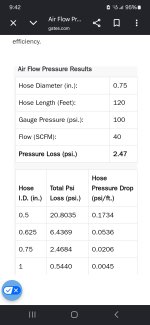
I just plugged your numbers into the Gates air pressure drop calculator. Assuming you are running unregulated at a max tank pressure of 175 PSI, using a tool that consumes 40 cfm, you'll only see 1.5 psi drop at the end of your 120 foot run. Obviously it will drop more with an air hose hooked up, but that would happen anyway.

Doesn't seem like much benefit to adding a tank to me. Even at a more typical shop pressure of 100 psi, you'll only see about a 2.5 psi drop.
 

Attachments

  • Screenshot_20260529_213457_Chrome.jpg
    Screenshot_20260529_213457_Chrome.jpg
    279.6 KB · Views: 14
  • Screenshot_20260529_214214_Chrome.jpg
    Screenshot_20260529_214214_Chrome.jpg
    299.6 KB · Views: 14

mariom2019

Member
Joined
Mar 4, 2019
Messages
5
Location
miami
Honestly, with a 7.5HP Emax and an 80 to 120-gallon main tank, you’ve already got a massive amount of volume at the source.
With 3/4" PEX-AL-PEX, your main restriction over that 120-foot run to the auto side isn't going to be total volume, it's going to be friction loss during high-flow spikes (like running a heavy 3/4" or 1" impact or a sandblaster).
You definitely don't need another massive 80-gallon tank down there—that's just extra volume for the compressor to pump up initially and more places for condensation to trap. If you find your high-draw tools starving for a second during initial trigger pulls, just plumb in a small 10 to 20-gallon receiver tank right at the auto work station. It acts like a local capacitor, supplying that instant hit of air right where you need it while the main line catches up.
Keep it simple first. Run your 3/4" loop, see how the tools perform, and only add a small local tank if you notice a pressure drop when hitting the trigger.
 

72Anthony

Well-known member
Joined
May 22, 2010
Messages
294
Location
Houston, TX
If it's a single man shop, I think you'll be fine, unless you are running un-attended machines like a CNC plasma that needs continuous air, while doing other work.

As others said, run a loop to allow flow from both sides, and some valves to allow isolation to parts of the system.

All that being said, I'd install a tee with a cap or vavle at the far side of the shop in case you ever wanted to plumb in an additional tank or even a standby/secondary compressor as a back up. Some members here are able to pickup incredible deals on the secondhand market.
 

FTG-05

Well-known member
Joined
Oct 11, 2012
Messages
1,517
Location
TN
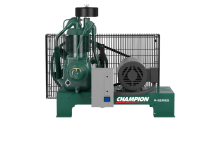
Used compressor tanks are cheap:

IMG_20180427_151947119_HDR (Large).jpg

I got this 120 IR tank for $200 maybe.

Sharp eyes will note the 3/8" line plumbed in parallel to the 3/4" Rapidair line.
 

Chipm

Well-known member
Joined
Mar 10, 2020
Messages
422
Location
Georgia
Scaling this idea up a bit, If one were to run two compressors, how would you set that up? Would one have a higher kick-on point? Would they need check valves?
 

FullRaceMerc

Well-known member
Joined
Jan 9, 2015
Messages
3,830
Location
SoCal (SGV)
We have 2 at the shop. Yes, we stagger their start pressures so only 1 runs unless the demand is high. We don't use additional check valves.

Most of the time only 1 is needed. Number 2 has been shut off for years. We originally had times where we ran both, but with the current equipment & crew size 1 is plenty. We're plumbed in a fashion where the 2nd tank can be used for added volume, or turned off so the single tank is all that has to be filled. The 2nd tank is almost always off.

Having the second compressor was handy when the primary bit the dust. Turn the valves, throw the right switches, & keep running while taking our time to determine if it was repair or replacement time.
 
OP
J

jkesselr

Well-known member
Joined
Mar 16, 2016
Messages
373
I just plugged your numbers into the Gates air pressure drop calculator. Assuming you are running unregulated at a max tank pressure of 175 PSI, using a tool that consumes 40 cfm, you'll only see 1.5 psi drop at the end of your 120 foot run. Obviously it will drop more with an air hose hooked up, but that would happen anyway.

Doesn't seem like much benefit to adding a tank to me. Even at a more typical shop pressure of 100 psi, you'll only see about a 2.5 psi drop.
Thank you for running the numbers. I agree, based on this, it doesn't seem significant enough to worry about. The compressor runs to a max tank pressure of 175. Even at the farthest reaches, if I rot really carried away, a particular connection point might be 210 feet, which would only be a 2.7 psi drop. Seems like I need to spend my time focused on other concerns.

Thanks!
 
OP
J

jkesselr

Well-known member
Joined
Mar 16, 2016
Messages
373
Instead of a trunk line down the center with several branches, I think it's better to run a loop around the shop with drops as needed. That way any point along the way is fed from both sides of the loop.
I hadn't really thought about that, but I suppose it is a possibility.
 
OP
J

jkesselr

Well-known member
Joined
Mar 16, 2016
Messages
373
Honestly, with a 7.5HP Emax and an 80 to 120-gallon main tank, you’ve already got a massive amount of volume at the source.
With 3/4" PEX-AL-PEX, your main restriction over that 120-foot run to the auto side isn't going to be total volume, it's going to be friction loss during high-flow spikes (like running a heavy 3/4" or 1" impact or a sandblaster).
You definitely don't need another massive 80-gallon tank down there—that's just extra volume for the compressor to pump up initially and more places for condensation to trap. If you find your high-draw tools starving for a second during initial trigger pulls, just plumb in a small 10 to 20-gallon receiver tank right at the auto work station. It acts like a local capacitor, supplying that instant hit of air right where you need it while the main line catches up.
Keep it simple first. Run your 3/4" loop, see how the tools perform, and only add a small local tank if you notice a pressure drop when hitting the trigger.
This makes a lot of sense to me. I am hoping to land the blaster closer to the compressor, maybe 40-50 feet or so. I am seeing a few suggestions for running a loop, instead of a trunk line. I guess I really need to think about that being a better option.
 
OP
J

jkesselr

Well-known member
Joined
Mar 16, 2016
Messages
373
If it's a single man shop, I think you'll be fine, unless you are running un-attended machines like a CNC plasma that needs continuous air, while doing other work.

As others said, run a loop to allow flow from both sides, and some valves to allow isolation to parts of the system.

All that being said, I'd install a tee with a cap or vavle at the far side of the shop in case you ever wanted to plumb in an additional tank or even a standby/secondary compressor as a back up. Some members here are able to pickup incredible deals on the secondhand market.
Yeah, it's just me and a few buddies from time to time. I could imagine a time where one of us is using an impact, another using the plasma cutter and a third using a blast cabinet, but that would be a very rare occasion.
 
To avoid these ads, REGISTER NOW!

Hohn

Well-known member
Joined
Aug 25, 2016
Messages
2,614
Location
Diesel Central, Indiana
I just plugged your numbers into the Gates air pressure drop calculator. Assuming you are running unregulated at a max tank pressure of 175 PSI, using a tool that consumes 40 cfm, you'll only see 1.5 psi drop at the end of your 120 foot run. Obviously it will drop more with an air hose hooked up, but that would happen anyway.

Doesn't seem like much benefit to adding a tank to me. Even at a more typical shop pressure of 100 psi, you'll only see about a 2.5 psi drop.
I think rather than running a buffer tank, most people would be better served running a service loop in their shop. This has two advantages that I see. First, it cuts the flow in half along any one run of plumbing, which halves line losses. Second, it makes every drop on the run balanced with every other other parallel drop.

IN other words, anything pulling air at any point on the loop drops pressure evenly across all other parallel drops.
Especially with many of the PEX/AL/PEX kits being so affordable now, I think it makes a lot more sense to run a loop than just a linear run with drops.

It might allow you to even drop down a pipe size and have an overall more cost effective system for the performance level, depending on the linear distance involved.
 

Chipm

Well-known member
Joined
Mar 10, 2020
Messages
422
Location
Georgia
This is a good thread. I am planning a long skinny building, so a trunk line would cost half of what a loop does.

What about dryers? At what point do we need one of those for typical auto repair use? For just me, I've gotten by with a vapor separator on the regulator, but if we step up to a handful of users does a dryer make sense?
 

Shoreline_

Well-known member
Joined
Aug 1, 2022
Messages
961
Location
Springfield, MA
Your cfm lowers at higher pressure for given hp. A 40 cfm compressor which is about 10hp @ 90 psi (I think it's actually 38 cfm). At 175 psi it's less. Just keep that in mind. If you're gonna sandblast I highly recommend an air dryer at those cfm.
 
OP
J

jkesselr

Well-known member
Joined
Mar 16, 2016
Messages
373
Your cfm lowers at higher pressure for given hp. A 40 cfm compressor which is about 10hp @ 90 psi (I think it's actually 38 cfm). At 175 psi it's less. Just keep that in mind. If you're gonna sandblast I highly recommend an air dryer at those cfm.
Thank you for the heads up. The compressors I am looking at are 31 or 38 CFM at 100 psi. How does that impact the discussion above?

Also, I have a large refrigerated air dryer.
 

Shoreline_

Well-known member
Joined
Aug 1, 2022
Messages
961
Location
Springfield, MA
Thank you for the heads up. The compressors I am looking at are 31 or 38 CFM at 100 psi. How does that impact the discussion above?

Also, I have a large refrigerated air dryer.
It only affects if you plan on not having a little extra capacity in your pump. Some customers size their stuff right on the edge of their needed volume. In the real world 7.5hp should be about 28 cfm at 90 pounds. So with sandblasting go for the biggest hp your circuit can handle because storage won't make a difference.
 
OP
J

jkesselr

Well-known member
Joined
Mar 16, 2016
Messages
373
It only affects if you plan on not having a little extra capacity in your pump. Some customers size their stuff right on the edge of their needed volume. In the real world 7.5hp should be about 28 cfm at 90 pounds. So with sandblasting go for the biggest hp your circuit can handle because storage won't make a difference.
Okay, good to know. So, if I understand you correctly, if I am blasting I won't see any material difference between a 7.5 hp 80 gallon unit and a 7.5 hp 120 gallon unit. Conversely, I would be better off with a 10hp 80 gallon unit, than a 7.5 hp 120 gallon unit?
 

Shoreline_

Well-known member
Joined
Aug 1, 2022
Messages
961
Location
Springfield, MA
Yes because it will run non stop anyways so why pay for extra storage. At a certain point you will hit equilibrium where the air leaving the tank is as much as the air being pumped into it and at that point it doesn't even matter the size of the tank. Our sandblasting shops customers have small reservoirs compared to the size of the machine. They are basically to smoothen out the vfd command. Anyways If you can find a pump with continuous run option that would be even better. It'll have head unloaders.
 
OP
J

jkesselr

Well-known member
Joined
Mar 16, 2016
Messages
373
Yes because it will run non stop anyways so why pay for extra storage. At a certain point you will hit equilibrium where the air leaving the tank is as much as the air being pumped into it and at that point it doesn't even matter the size of the tank. Our sandblasting shops customers have small reservoirs compared to the size of the machine. They are basically to smoothen out the vfd command. Anyways If you can find a pump with continuous run option that would be even better. It'll have head unloaders.

It sounds like you know your ****. Given that this is a 1 man weekend hobby shop (maybe 3 man when have a couple buddies over), can you recommend a compressor of those I am looking at? I presently have an old (1980s) IR T-30 80 gallon with a 7.5hp motor. I am looking to replace it with one of the Eaton Emax units in either 80 or 120 gallon and with a 7.5 hp motor or more. I only have single-phase power and am only replacing the IR due to its age (I am scared of an old tank) and noise level.
 

Shoreline_

Well-known member
Joined
Aug 1, 2022
Messages
961
Location
Springfield, MA
Hey thanks Ive only been around this stuff professionally for 2 years but I have a great teacher and hes been doing it for a job since 1992 (Its my dad lol)

Those 80s T-30s are great units as long as you keep oil in them. If you're not sandblasting what is your average air consumption? Like what are you using the air for?
 
To avoid these ads, REGISTER NOW!
Top Bottom