To avoid these ads, REGISTER NOW!

Compressed Air System Questions

AtlasRearden

Well-known member
Joined
Feb 8, 2021
Messages
63
Location
Southern California
Wondering if there are any compressed air experts out there that can offer some guidance.

Before my house was drywalled, I installed 1/2" type L copper pipe in the walls down to my basement where I'm putting a 230v 5 hp Puma (TE-5040V) with magnetic starter. I have 230v running into the garage where there will be a switch on the wall.

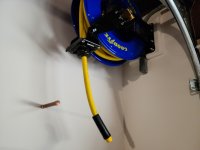
Here's my copper pipe sticking out of the wall in the garage:
20210319_AirLineStub_1000.jpg

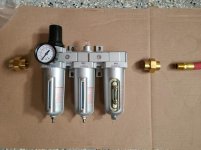
My plan is to run the copper line from where I have it stubbed out to a mounting block on the wall that will hold the regulator set that I have:
20210319_Regulator_1000.jpg

As you can see, I have two brass couplers. Here's a close up of the couplers:
20210319_CouplerDetail_1000.jpg

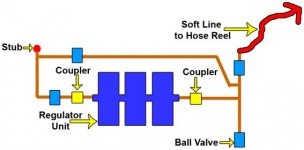
My plan is to mount the regulator unit between those two couplers so it could later be removed for service/replacement if needed. From there, I would take a soft line up to my hose reel seen in the first pic. I would also have a small drop under the reel with a ball valve to release the pressure, catch any backflowed moisture, or whatever. Here's a rudimentary diagram:
Diagram.jpg

A few questions:
1. Does this seem like a reasonable approach?
2. Are there any preferred types of ball valves to be used for compressed air? Any brands better than others (I prefer made in U.S.A. wherever possible).
3. I was planning to solder male copper threads onto my pipe wherever there's a ball valve and then get female threaded brass ball valves. Is this the best practice?
 
To avoid these ads, REGISTER NOW!

nadogail

Well-known member
Joined
Jan 23, 2009
Messages
31,916
Location
Coronado, CA
IMHO, I would add Quarter Turn ball valves to shut off the supply to the moisture separator and to the flex line to the hose reel.

I am far from being an expert on any subject, but I have some experience maintaining and repairing Fluid Flow Systems.
 
OP
A

AtlasRearden

Well-known member
Joined
Feb 8, 2021
Messages
63
Location
Southern California
IMHO, I would add Quarter Turn ball valves to shut off the supply to the moisture separator and to the flex line to the hose reel.

I am far from being an expert on any subject, but I have some experience maintaining and repairing Fluid Flow Systems.

Thanks--probably a good idea. At the very least, there doesn't seem to be any downside to making that addition.
 

Kaizen

Well-known member
Joined
Jan 9, 2015
Messages
6,946
Location
New England
Think I’d put a flex line from the stub. Protect it from any stress that it might have as if it cracks you’re in trouble.
Imo 1/2 will be a little limiting to air flow on a 5 hp. If you find this maybe add a storage tank in garage.


Sent from my iPhone using Tapatalk
 

infinkc

Well-known member
Joined
Jan 19, 2012
Messages
862
Not sure if you have a need for un-regulated air, but I always have one connection before the regulators I use a lot for blowing things off at full pressure so I don’t have to mess with the regulator.
 
OP
A

AtlasRearden

Well-known member
Joined
Feb 8, 2021
Messages
63
Location
Southern California
Think I’d put a flex line from the stub. Protect it from any stress that it might have as if it cracks you’re in trouble.
I guess I was thinking the regulator is fixed and solidly mounted, so it shouldn't put any stress on that area. Still, not a bad idea. Although, I haven't seen any flex line that's short enough. The shortest I see in 1/2" flex air hose is like 3 feet, which would be a bit cumbersome in that spot.

Imo 1/2 will be a little limiting to air flow on a 5 hp. If you find this maybe add a storage tank in garage.
Interesting observation. In all honesty, the system is probably a bit overkill for my needs, but I'm having fun with it and wanted the headroom. I guess I can see how it goes and address in the future if needed.

Not sure if you have a need for un-regulated air, but I always have one connection before the regulators I use a lot for blowing things off at full pressure so I don’t have to mess with the regulator.
Good point, and I had previously thought about this and glad you mentioned it because it reminds me and confirms that this would be an easy and useful addition.

Thanks for for all the helpful feedback from everyone.
 

matt_i

Well-known member
Joined
Mar 14, 2008
Messages
10,725
Location
SE Michigan
A few questions:
1. Does this seem like a reasonable approach?
2. Are there any preferred types of ball valves to be used for compressed air? Any brands better than others (I prefer made in U.S.A. wherever possible).
3. I was planning to solder male copper threads onto my pipe wherever there's a ball valve and then get female threaded brass ball valves. Is this the best practice?


My personal preference is yellow handled "full port" Apollo Conbraco ball valves. (I typically shop at Supply House). I would avoid the white-handled versions of all manufacturers (that denote lead-free-potable-water) for air systems. They seem built to a lesser standard as cheap price point used to hold residential construction costs down. I always put in threaded male NPT fittings and a union to integrate a ball valve. This is extra work and extra cost, but if the valve ever leaks, the repair is a relatively fast job. I've struggled in the past with getting sweat-solder valves to seal perfectly tight and I always thought the high heat was to blame. I might have held this view for so long now that technology and modern materials have surpassed my curmudgeonly beliefs. If you've spent time with copper then you know what a pain it is when water won't drain from a part of the system you're working on. The threaded fittings remove all doubt about who's the boss when trying to remove the valve.

Double check your 3-element air prep and make sure you don't have a lubricator in there. For years and years I keep hearing "FRL" unit = filter, regulator, lubricator...and really you don't ever want that lubricator unless you have a dedicated line going to a full mechanical tool like an impact wrench used day in and day out. Perfectly acceptable to have 2 stages of filtration, however.

If you want drier air you should supplement the cyclonic filter with a coalescing filter (fancy way of saying a specialized element) and the last stage is a dessicant dryer if you intend to paint.
 

Norcal

Well-known member
Joined
Mar 16, 2008
Messages
13,752
My personal preference is yellow handled "full port" Apollo Conbraco ball valves. (I typically shop at Supply House). I would avoid the white-handled versions of all manufacturers (that denote lead-free-potable-water) for air systems. They seem built to a lesser standard as cheap price point used to hold residential construction costs down. I always put in threaded male NPT fittings and a union to integrate a ball valve. This is extra work and extra cost, but if the valve ever leaks, the repair is a relatively fast job. I've struggled in the past with getting sweat-solder valves to seal perfectly tight and I always thought the high heat was to blame. I might have held this view for so long now that technology and modern materials have surpassed my curmudgeonly beliefs. If you've spent time with copper then you know what a pain it is when water won't drain from a part of the system you're working on. The threaded fittings remove all doubt about who's the boss when trying to remove the valve.

Double check your 3-element air prep and make sure you don't have a lubricator in there. For years and years I keep hearing "FRL" unit = filter, regulator, lubricator...and really you don't ever want that lubricator unless you have a dedicated line going to a full mechanical tool like an impact wrench used day in and day out. Perfectly acceptable to have 2 stages of filtration, however.

If you want drier air you should supplement the cyclonic filter with a coalescing filter (fancy way of saying a specialized element) and the last stage is a dessicant dryer if you intend to paint.

My valve of choice is also Apollo, & the OP's photos are showing a filter/regulator/lubricator, having a inline lubricator is a great way to contaminate the air hoses so that using them could cause fish eye in paint finishes.
 
OP
A

AtlasRearden

Well-known member
Joined
Feb 8, 2021
Messages
63
Location
Southern California
My personal preference is yellow handled "full port" Apollo Conbraco ball valves. (I typically shop at Supply House). I would avoid the white-handled versions of all manufacturers (that denote lead-free-potable-water) for air systems. They seem built to a lesser standard as cheap price point used to hold residential construction costs down. I always put in threaded male NPT fittings and a union to integrate a ball valve. This is extra work and extra cost, but if the valve ever leaks, the repair is a relatively fast job. I've struggled in the past with getting sweat-solder valves to seal perfectly tight and I always thought the high heat was to blame. I might have held this view for so long now that technology and modern materials have surpassed my curmudgeonly beliefs. If you've spent time with copper then you know what a pain it is when water won't drain from a part of the system you're working on. The threaded fittings remove all doubt about who's the boss when trying to remove the valve.

Thanks for the tips. Yes, I ended up sourcing a grab bag of Apollo Full Port ball valves off of Ebay. They even have the stainless balls in them. Are the unions you're talking about the same as the ones I have in my original pic? I looked all over for those, and when I finally found them, they are very large and bulky and weren't cheap. But I figured they would work fine for making the regulator unit removable. If I added a bunch for every ball valve, it would get pretty nuts. But maybe you're talking about a more compact solution.

Double check your 3-element air prep and make sure you don't have a lubricator in there. For years and years I keep hearing "FRL" unit = filter, regulator, lubricator...and really you don't ever want that lubricator unless you have a dedicated line going to a full mechanical tool like an impact wrench used day in and day out. Perfectly acceptable to have 2 stages of filtration, however.

the OP's photos are showing a filter/regulator/lubricator

The regulator in my picture is actually a 2-stage filter and a desiccant air dryer. There is no lubrication stage. First stage is designed to remove most liquid and solid particles, Second stage is a coalescing filter that supposedly removes 99.9% of oil vapor particles (wherever that might come from), and the third stage is a dessicant dryer. It's overkill for me, but that's fine. I specifically made sure to avoid lubrication, since I have no need for that, and would just plan on adding oil directly to the tool if needed.

Regarding unregulated air, would a design like this make sense? Would there be any problem with back-pressure on the regulator when opening the valves to bypass the regulator?
Diagram2.jpg
 

Firebrick43

Well-known member
Joined
May 12, 2015
Messages
13,998
Location
West central Indiana
Hello Henry,

There shouldn’t be problems with the regulator with back pressure. They are a normally open device so it shouldn’t cause any issues.

I recommend Apollo as well or Dahl if you want small twist *****.

I would not recommend threaded valves with fittings, just solder directly. Just more work and two more possible leak paths.
 
Last edited:
To avoid these ads, REGISTER NOW!

LDO

Member
Joined
May 13, 2014
Messages
18
Wondering if there are any compressed air experts out there that can offer some guidance.

Before my house was drywalled, I installed 1/2" type L copper pipe in the walls down to my basement where I'm putting a 230v 5 hp Puma (TE-5040V) with magnetic starter. I have 230v running into the garage where there will be a switch on the wall.

Here's my copper pipe sticking out of the wall in the garage:
20210319_AirLineStub_1000.jpg

My plan is to run the copper line from where I have it stubbed out to a mounting block on the wall that will hold the regulator set that I have:
20210319_Regulator_1000.jpg

As you can see, I have two brass couplers. Here's a close up of the couplers:
20210319_CouplerDetail_1000.jpg

My plan is to mount the regulator unit between those two couplers so it could later be removed for service/replacement if needed. From there, I would take a soft line up to my hose reel seen in the first pic. I would also have a small drop under the reel with a ball valve to release the pressure, catch any backflowed moisture, or whatever. Here's a rudimentary diagram:
Diagram.jpg

A few questions:
1. Does this seem like a reasonable approach?
2. Are there any preferred types of ball valves to be used for compressed air? Any brands better than others (I prefer made in U.S.A. wherever possible).
3. I was planning to solder male copper threads onto my pipe wherever there's a ball valve and then get female threaded brass ball valves. Is this the best practice?


I am in the process of plumbing my new shop/compressor. Champion 7.5HP. May I ask the brand of drying setup you have and where a fella might acquire something like that?
thank you.
 

matt_i

Well-known member
Joined
Mar 14, 2008
Messages
10,725
Location
SE Michigan
Imo I think you are making a couple of mistakes.

1. place your vertical drip leg right below your stub-out. Moisture collects in the lowest point naturally and so no help to have it after the filtration units. Place it in the location it can be of the most assistance.

2. I would skip the bypass. If you are worried about prematurely contaminating the dessicant prior to actually needing to paint something, you can try one of two things. Dessicants can be "baked out" in an electric oven around 200F. Or simply pull the dessicant cartridge out and store it in a ziploc bag until you need it. No harm running air thru an empty housing.
 

Jswain

Well-known member
Joined
Apr 26, 2013
Messages
2,455
Location
Calgary, AB
Your drawing is pretty good but I would add a second drop & ball valve prior to the filter setup just like you have after, and i would change the position of the ball valve on the top right to the right side of the discharge coupler. This would make it possible to continue to use your bypass if you are working on a project ie: painting and for some reason/failure it's not desirable to stop

The bypass I would make a flex hose with more length then needed and then if you ever upgrade/replace/add filters it's one less thing to mess with
 

PoorUB

Well-known member
Joined
Mar 29, 2021
Messages
11,622
Location
Fargo, ND
Imo 1/2 will be a little limiting to air flow on a 5 hp. If you find this maybe add a storage tank in garage.


Sent from my iPhone using Tapatalk

100 feet of 1/2" will flow roughly 15 CFM, and I assume he has much less than that in length, so it might flow 20 CFM. More than enough air for a home shop, unless you have some ridiculous sized air tools, and also right on par for a 5 HP compressor.

Also, what does the size of the compressor do with line sizing? Wouldn't you size it to supply the highest consumption tool? After all, you can run a large CFM tool from a too small compressor for a short time, or a small CFM compressor with a large tank capacity.

I have a 5 HP, 2 stage Curtis everything piped in 1/2" and zero complaints.
 

mytimeyet

Well-known member
Joined
Apr 27, 2010
Messages
128
Location
Micanopy, FL
No one has mentioned your electrical hookup. From the description I read you are running 240V from the basement to a switch in the garage and back again? An AC contactor with a remote switch would make for a much shorter run of heavy cable $$.
 

PoorUB

Well-known member
Joined
Mar 29, 2021
Messages
11,622
Location
Fargo, ND
He said it had a magnetic starter. Pretty sure the switch will break the circuit on the pressure switch side. at least that is how I would do it.

Actually, I kept forgetting to shut my compressor off. Years ago I came home after being out of town for a couple days and when I got into the garage I could hear air hissing and the compressor running. The diaphragm ruptured on the pressure switch and it kept running. Not sure how long it had been running, but the pump was smoking it was so hot! After that I ran a wire from the shop lights and put a relay in that breaks the pressure switch circuit. Shut off the lights, no compressor.
 

Kaizen

Well-known member
Joined
Jan 9, 2015
Messages
6,946
Location
New England
100 feet of 1/2" will flow roughly 15 CFM, and I assume he has much less than that in length, so it might flow 20 CFM. More than enough air for a home shop, unless you have some ridiculous sized air tools, and also right on par for a 5 HP compressor.

Also, what does the size of the compressor do with line sizing? Wouldn't you size it to supply the highest consumption tool? After all, you can run a large CFM tool from a too small compressor for a short time, or a small CFM compressor with a large tank capacity.

I have a 5 HP, 2 stage Curtis everything piped in 1/2" and zero complaints.


He buried half inch pipe in concrete. He is now limited to the size no matter what.
On a new system it’s not much more to do 3/4 so why not? Remember all the 90s and such knock down air flow


Sent from my iPhone using Tapatalk
 

Jeff Ivers

Well-known member
Joined
Apr 9, 2010
Messages
2,555
Location
Oklahoma
There are many different ways to set up compressed air systems and the "right way" is very dependent on the intended use. If you defined your planned usage, I missed it. I am guessing you have no more than 10 feet of copper line between the compressor and the stub out place where you have indicated you plan to put the regulator/separator. If you plan to do media blasting or painting, your air will end up having a lot of moisture in it with the indicated setup as the air will not have enough time to cool and lose the moisture content. All the research I did before setting up my system indicated at least 25' between the compressor and the water separator. Some people install air coolers instead. In my shop, the air goes from the compressor through an oil/water separator, then 45' of .75 inch Maxair line and then through a water separator before going into any tools. The first separator does a great job of extracting oil, but almost all the water does not get separated till the second separator.
 

PoorUB

Well-known member
Joined
Mar 29, 2021
Messages
11,622
Location
Fargo, ND
He buried half inch pipe in concrete. He is now limited to the size no matter what.
On a new system it’s not much more to do 3/4 so why not? Remember all the 90s and such knock down air flow


Sent from my iPhone using Tapatalk

I probably would have run 3/4" too, at least where the pipe would not be accessible, but the 1/2" is probably adequate.

Again, it is such a short run, I doubt he will have issues.
 
To avoid these ads, REGISTER NOW!
Top Bottom