Outlawmws
Well-known member
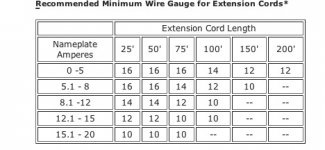
Both. Any conductor is also a resistor. Ever had an extension cord or power cord feel hot after use? A sure danger sign...

This was my first day using my CAT-6310. Seemed to work ok to get a few bolts removed. I was initially very happy.
1) When I returned after dinner and tried to remove another bolt, the gun did not have enough power. Bolt would not turn. So, I was waiting for it to refill itself once the impact wrench used up the air. I walked over to it and noticed a faint wisp of electrical smoke coming from the air filter vents. The motor was also pretty hot, considering it had not refilled the tank in some time.
The PSI was under 60 at this point, yet it was not pumping. So, I then drained all the air from the tank, and flipped the power to on, and it did nothing. Shouldn't it immediately start pumping? I think I flipped it on and off a few times. Eventually, it started pumping. Is this normal?
2) I have a bright DeWalt work lamp plugged into the same socket. 2 hot bulbs. I notice the light will sporadically go dim. Then it will suddenly become very bright. During this time, the CAT has not begun refilling. Does it vary its power draw even when just sitting there, not pumping? Is the CAT causing this?
3) Also, the CAT will sometimes “sneeze” or “cough” It sounds like it’s starting back up, but just does a “hiccup” instead. It’s like a false start when its about to refill?? Is that normal?
I'm with xj31. That compressor way too small and underpowered. An impact gun uses a lot of air and must have a constant 90 psi or greater going to the gun at all times.
Yes, when plugged into the wall, it recharges immediately at 90PSI. I will try out a 10G 50ft cord. If it immediate cranks on at 90PSI, cna I assume it's got adequate power?
A bit of light reading if you are interested:
http://ecatalog.weg.net/files/wegnet/WEG-specification-of-electric-motors-50039409-manual-english.pdf
Ok, so resistance of the cord is what drops the voltage (or "pressure") The cord is absorbing some of the power, and therefore there is less "pressure". Is that the right idea?
Now, with the lower voltage, and b/c W=VxA that means either the amps have to increase, or the watts have to decrease. It sounds like the watts of the appliance always stays the same? Harris said above that the amps will rise. What does this mean? How does the current or flow increase? By heat dissipation out of the wires in the motor or does the extension cord heat up?
Just curious, who is that manual targeted for? Electrical engineers? I am fairly certain the typical residential electrician is not able to read that caliber of technical documentation.
Just curious, who is that manual targeted for? Electrical engineers?
You just need an interest and a willingness to learn.

Ok, so resistance of the cord is what drops the voltage (or "pressure") The cord is absorbing some of the power, and therefore there is less "pressure". Is that the right idea?
Now, with the lower voltage, and b/c W=VxA that means either the amps have to increase, or the watts have to decrease. It sounds like the watts of the appliance always stays the same? Harris said above that the amps will rise. What does this mean? How does the current or flow increase? By heat dissipation out of the wires in the motor or does the extension cord heat up?
I had the same problem with a craftsman oil-less. I'm not sure of the model number, but I will get it & post it here.
It would start no problem with no tank pressure, but it would blow a breaker when the tank was full. 20 amp breaker didnt help the situation .It was brand new , but I got it at a misguided freight sale and obviously no warranty. What I ended up doing was adding a cold start unloader valve, another name is unloader assist valve available on ebay & other places.
Tie it into the pump discharge line( before the tank check valve) what it does is bleed off some of the air until the pressure reaches about 10 PSI, then the valve closes . that gives the motor lots of time to get up to full run before it has to deal with pressure on the pump. Cost was about $4 and a brass tee was $2 .
see the part here http://www.aircompressorservicekits.com/Cold-Start-Unloader-Valve-25.html
If I get ambitious I will take a few pic of my set up & post here if I can..
any questions I would be glad to answer.
See attachment. Typically, all of these fittings would be 1/4" NPT (national pipe thread).
Remove hose. Remove brass elbow. Install "street tee". Install male-to-male coupling. Re-install hose. Install unloader assist valve. All threads require teflon pipe tape at least 3 full wraps.
eBay !
Thanks!
Theoldwizard1 is one hell of a good fella with all his help.
I will order this unloader valve for $4
Street T costs $7
Male to Male 1/4 for $3
Total cost $14/delivered.
There you go. Telling the world I'm a nice guy ! How am I going to keep up my reputation as a grumpy old man !!!