To avoid these ads, REGISTER NOW!

Compressor acting funny. First day using it. Is this normal?

Outlawmws

Well-known member
Joined
Aug 9, 2011
Messages
39,201
Location
The Badlands
Both. Any conductor is also a resistor. Ever had an extension cord or power cord feel hot after use? A sure danger sign...
 
To avoid these ads, REGISTER NOW!

N.I.

Well-known member
Joined
Aug 24, 2012
Messages
332
Location
Northern Ireland
This was my first day using my CAT-6310. Seemed to work ok to get a few bolts removed. I was initially very happy.

1) When I returned after dinner and tried to remove another bolt, the gun did not have enough power. Bolt would not turn. So, I was waiting for it to refill itself once the impact wrench used up the air. I walked over to it and noticed a faint wisp of electrical smoke coming from the air filter vents. The motor was also pretty hot, considering it had not refilled the tank in some time.

The PSI was under 60 at this point, yet it was not pumping. So, I then drained all the air from the tank, and flipped the power to on, and it did nothing. Shouldn't it immediately start pumping? I think I flipped it on and off a few times. Eventually, it started pumping. Is this normal?

2) I have a bright DeWalt work lamp plugged into the same socket. 2 hot bulbs. I notice the light will sporadically go dim. Then it will suddenly become very bright. During this time, the CAT has not begun refilling. Does it vary its power draw even when just sitting there, not pumping? Is the CAT causing this?

3) Also, the CAT will sometimes “sneeze” or “cough” It sounds like it’s starting back up, but just does a “hiccup” instead. It’s like a false start when its about to refill?? Is that normal?

When a motor dims lights at start up, it means it is drawing a lot of power. If a motor fails to start and the lights continue to dim, NEVER just stand and watch it. Always knock it off and find out the cause. This is how you burn out a motor.

As others have said, it is probably just your extension cords. Plug in in direct to the wall socket and if it cures your problems, then happy days. You just need a heavier extension.

If not, it will probably be an issue with the check valve and decompression components. The motors fitted to cheap compressors are pure tripe and just don't have the startup torque required for normal operation. They decompress the cylinders to give the cheap motors are 'running start'. If the compressor doesn't decompress, the motor won't have the torque to start it. Your compressor is new, so this is unlikely.

The hiccup you mentioned is the compressor turning over once or twice and then the motor stalling. The pressure builds up in the cylinders after a couple of cycles, the load on the motor increases, but the motor runs out of momentum/ torque and just stalls.


I wouldn't worry about a couple of overheats since the thermal kicked in, but you shouldn't keep doing this or you will wreck it.
 
OP
G

GoodEnough

Banned
Joined
Sep 22, 2013
Messages
488
Yes, when plugged into the wall, it recharges immediately at 90PSI. I will try out a 10G 50ft cord. If it immediate cranks on at 90PSI, cna I assume it's got adequate power?

NI, I didn't make the connection b/w the dimming lights and the compressor, b/c the latter was not on. If it dimmed while the thing was pumping away, it would have been more obvious. Now I understand that it was drawing power and burning itself out b/c it was unable to start!
 

theoldwizard1

Well-known member
Joined
Feb 22, 2011
Messages
43,142
Location
SE MI
I'm with xj31. That compressor way too small and underpowered. An impact gun uses a lot of air and must have a constant 90 psi or greater going to the gun at all times.

I call ******** ! For running an impact to remove a few lug nuts, its fine ! Worst case is he will have to wait a few seconds after a couple of lug nuts.
 

theoldwizard1

Well-known member
Joined
Feb 22, 2011
Messages
43,142
Location
SE MI
Yes, when plugged into the wall, it recharges immediately at 90PSI. I will try out a 10G 50ft cord. If it immediate cranks on at 90PSI, cna I assume it's got adequate power?

Let it cycle a few times (bleed the tank down until it should kick in) and see if it restarts okay. If it restarts after 5-6 times, you are probably good.

Do you know what else is on that circuit ? Can you turn everything else off ? It is likely you only have 14 gauge wire on a 15A circuit to that plug. Your 10 gauge cord will help, but if there is other items on that circuit they will NOT help. Any residence built in the last 10-20 years has a 20A dedicated circuit (no other loads permitted on that circuit) in the bathroom and on the kitchen counter top. 100' of 10 gauge from one of those dedicate plugs might be better than what you have now.

Also, longer hose is better than longer extension cords. And a lot cheaper ! If you don't have a second hose already, buy one. Someday you will need it !

In general, you should turn off/unplug your portable compressor if you are away from it for more than about 30 minutes. Drain the tank daily.
 
Last edited:

jakemac

Well-known member
Joined
May 21, 2013
Messages
9,035
Location
New England
Let me see if I can simplify it.
Your water pipes have a preset pressure setting. If you stand in a hot shower and someone flushes the toilet, the pressure in the shower drops.

It all comes down to supply and demand. There is a preset supply that can handle a certain amount of demand. If you demand more, then the supply is reduced.

Ok, so resistance of the cord is what drops the voltage (or "pressure") The cord is absorbing some of the power, and therefore there is less "pressure". Is that the right idea?

Now, with the lower voltage, and b/c W=VxA that means either the amps have to increase, or the watts have to decrease. It sounds like the watts of the appliance always stays the same? Harris said above that the amps will rise. What does this mean? How does the current or flow increase? By heat dissipation out of the wires in the motor or does the extension cord heat up?

It ALL heats up. If the wires are too small of a gauge, in the X-cord or the walls, they could combust and start a fire. At some point, your electrical breaker should have tripped. Since it didn't, I can only guess that either the wires in the wall are 12ga, or the breaker is defective.

A point about your worklight. I'm guessing that each bulb in the light is a 500 watt halogen. That would mean that with both lamps on, you are drawing an additional 1000 watts from the worklight. Not something I'd recommend running on a 100' 16ga extension cord.

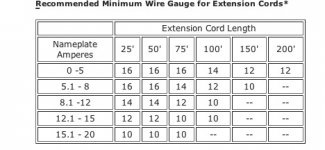
The package that the cord came in (assuming that you still have it) should have a chart on it with recommended cord lengths and power ratings. If not, then here is a simple chart.

.
 

Attachments

  • Capture.jpg
    Capture.jpg
    35.5 KB · Views: 12
Last edited:

Outlawmws

Well-known member
Joined
Aug 9, 2011
Messages
39,201
Location
The Badlands
Just curious, who is that manual targeted for? Electrical engineers? I am fairly certain the typical residential electrician is not able to read that caliber of technical documentation.

Two things: there is no such thing as a "Typical residential electrician" some may do that for a living, some may work on industrial settings, but all of them get the same basic training.

I'm neither an electrician, nor an EE but I could follow 90% of that book, and more if I dug in...
 
Last edited:

N.I.

Well-known member
Joined
Aug 24, 2012
Messages
332
Location
Northern Ireland
As Outlaw said, you don't need to be anyone special to understand it.

You just need an interest and a will to learn.

In the real world you sink or swim. It is nearly impossible to get an Electrician when you need him. Personally I never really liked the electrical side of things but learn what I can out of necessity.

I find that the manufacturer comprehensive manuals are the best way to learn. They generally give you everything you need to know and you get the facts from the source instead of relying on opinion and gossip.
 
To avoid these ads, REGISTER NOW!

Davefr

Well-known member
Joined
Jan 7, 2010
Messages
11,823
Location
OR
Ok, so resistance of the cord is what drops the voltage (or "pressure") The cord is absorbing some of the power, and therefore there is less "pressure". Is that the right idea?

Yes, the cord is a resistor. So is your home's internal wiring. So is the plug and receptacle along with the compressor's own cord/wiring.

Normally these values are low but they're also cumulative and can add up to be significant. And ohms law tells us that resistance X amps will be voltage drop in these resistive components. AND amps drawn by a motor during startup are very high. (that leaves less voltage for the motor at a time where it needs it the most)

Now, with the lower voltage, and b/c W=VxA that means either the amps have to increase, or the watts have to decrease. It sounds like the watts of the appliance always stays the same? Harris said above that the amps will rise. What does this mean? How does the current or flow increase? By heat dissipation out of the wires in the motor or does the extension cord heat up?

Inductions motors that aren't turning consume very large amperage. (way more then when they're running). Once the motor comes up to speed, amps will decrease to approx. to the nameplate running current. This value is much much lower then locked rotor amps. (ie startup amps). The reason is that inductance from the spinning motor comes into play and impedes the flow of amps.
 

monkeyspanners

Well-known member
Joined
May 28, 2013
Messages
419
Location
Oxford, UK
When a motor starts it can draw between 4 and maybe 10 times its normal running amps depending on the design and loading of the motor. Often this amperage is displayed on the data plate.
If it doesn't start, either due to mechanical failure, failure of the starting device (relay, capacitor etc) it will sit there humming and pulling locked rotor amps till something gives. If you are lucky it will be a fuse or an internal motor safety device, if not it will soon get hot enough to melt the insulation on the windings and then its new motor time.


Not my best vid but it shows how the amps jump once the broken con rod jams the motor, normal run current for this is around 7-8 amps, notice how it jumps to over 30amps in the seized condition.

 
OP
G

GoodEnough

Banned
Joined
Sep 22, 2013
Messages
488
Just to update this thread for future readers, in addition to the above resolutions (plug directly into wall or use a 10GA cord that is short.... I ended ordering a cold start unloader valve for $15. Details below:

I had the same problem with a craftsman oil-less. I'm not sure of the model number, but I will get it & post it here.
It would start no problem with no tank pressure, but it would blow a breaker when the tank was full. 20 amp breaker didnt help the situation .It was brand new , but I got it at a misguided freight sale and obviously no warranty. What I ended up doing was adding a cold start unloader valve, another name is unloader assist valve available on ebay & other places.
Tie it into the pump discharge line( before the tank check valve) what it does is bleed off some of the air until the pressure reaches about 10 PSI, then the valve closes . that gives the motor lots of time to get up to full run before it has to deal with pressure on the pump. Cost was about $4 and a brass tee was $2 .

see the part here http://www.aircompressorservicekits.com/Cold-Start-Unloader-Valve-25.html

If I get ambitious I will take a few pic of my set up & post here if I can..

any questions I would be glad to answer.

See attachment. Typically, all of these fittings would be 1/4" NPT (national pipe thread).

Remove hose. Remove brass elbow. Install "street tee". Install male-to-male coupling. Re-install hose. Install unloader assist valve. All threads require teflon pipe tape at least 3 full wraps.


eBay !

Thanks!
Theoldwizard1 is one hell of a good fella with all his help.

I will order this unloader valve for $4

Street T costs $7

Male to Male 1/4 for $3

Total cost $14/delivered.
 

theoldwizard1

Well-known member
Joined
Feb 22, 2011
Messages
43,142
Location
SE MI
There you go. Telling the world I'm a nice guy ! How am I going to keep up my reputation as a grumpy old man !!!
 
OP
G

GoodEnough

Banned
Joined
Sep 22, 2013
Messages
488
I used the compressor today, and I still used my 16AWG 50ft extension cord.
However, I didn't use the 2nd extension cord like the last time.
I also did not have the 500W lights going.

The motor was able to start up each time it needed to.
No more false start hiccups like last time.

I am still going to get the 10AWG for 50 feet,
and install the unloader assist valve

But I think I can get away with this for the time being.
 

Pumpman1968

Well-known member
Joined
Oct 21, 2012
Messages
1,520
Location
Upstate, NY
Please, Sir, buy the heavier cord. Many fires have been started by "It'll be fine for now".

Not only are you risking damage to the motor, you are taking the risk of overheating and damaging the insulation of that cord.........which can start a fire!

<a href="http://s1008.photobucket.com/user/pumpman342001/media/Burned-Out-Extension-Cord_zps7b4ad759.jpg.html" target="_blank"><img src="http://i1008.photobucket.com/albums/af207/pumpman342001/Burned-Out-Extension-Cord_zps7b4ad759.jpg" border="0" alt="cord photo Burned-Out-Extension-Cord_zps7b4ad759.jpg"/></a>
 
Last edited:
To avoid these ads, REGISTER NOW!
Top Bottom