To avoid these ads, REGISTER NOW!

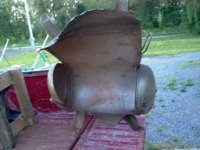
Compressor dropped during move, now junk?

Mooky

Well-known member
Joined
Jul 6, 2014
Messages
257
Location
PA
Not sure where you inferred that a pneumatic test was proposed. That type of testing is allowed by the various ASME test codes, but at a reduced pressure (typically 1.1 X MAWP). Many companies prohibit those tests regardless, due to the significant risk involved. There was a recent explosion during a pneumatic test in a Chinese natural gas plant:

http://www.tedpelling.com/news/Pneumatic Shanghai LNG Terminal.pdf

The Wikipedia description is somewhat generic, but captures the general definition of a hydro test. The specific pressure limits have changed, the manufacture date of the equipment determines which revision of the code is used. Piping, boilers, pressure vessels and their respective Section/Division determines the test pressures. The specific ASME Sections define the testing requirements:

http://www.asme.org/wwwasmeorg/medi...Standards/New Releases/ASME-BPVC-Brochure.pdf


A good synopsis of the testing is found here (Actual ASME codes aren't readily to the public). Note that new versus existing or repair/alteration tests are somewhat different:

http://www-group.slac.stanford.edu/esh/eshmanual/references/pressureProcedTest.pdf

Your low pressure heating boilers are governed by Section I, whereas the compressor tank in question is a Section VIII unfired pressure vessel
 
To avoid these ads, REGISTER NOW!

nehog

Well-known member
Joined
Jan 2, 2010
Messages
7,935
Location
Jaffrey, NH
Started my career working in an ASME Section 8 Pressure Vessel Shop... I might know a little about hydrostatic testing.

ASME:

http://mtm-inc.com/reduce_project_risk/asme_code_section_viii_pressure_tests/

Wikepedia:

Hydrostatic tests are conducted under the constraints of either the industry's or the customer's specifications, or may be required by law. The vessel is filled with a nearly incompressible liquid - usually water or oil - pressurized to test pressure, and examined for leaks or permanent changes in shape. Red or fluorescent dyes may be added to the water to make leaks easier to see. The test pressure is always considerably higher than the operating pressure to give a factor of safety. This factor of safety is typically 166.66%, 143% or 150% of the designed working pressure, depending on the regulations that apply.


;)

PugetDude said:
a gauge, and another compressor

Then why did you recommend 'another compressor?' :dunno:
 

Robby321

Well-known member
Joined
Jan 22, 2015
Messages
607
Location
Olympia, WA
OK..let this thread die off. Seems many here who been around the block 4/5/6 decades (6 me and worked decades Reynolds Metals as Maintenance Machinist) would not give it another thought. And this.."Can you say shrapnel?". BS. I'm a Nam Vet and I can show ya "shrapnel". The MOST that tank would do with 120PSI find a weak spot out, and let the air out. Its not some "bomb". But seems the new "Safety Nazis? are paranoid. And no harm meant here any but I remember when ya bought SIMPLE "Desk Light", that ya pull out the box and plugged in Didn't NEED directions as "plug it in" Last one I bought had SEVEN WARNING STICKERS, as a plastic cap over the plug prongs, and "directions in 4 languages? Has the world got THAT STUPID?

On the OP's Q. Up to you. Use it (like I would and zero thought it) or buy new. What makes you happy and content.

Anyway..ya all have a great New Year. ENJOY the life we have and use your own judgement of what is right, or wrong. Only YOU can make that decision.
 
Last edited:

DekeT

Well-known member
Joined
Aug 12, 2011
Messages
2,234
Location
USA
I do hydro testing as part of my job. I would fail that tank on a visual and would not allow it to even be tested on my job site. You will not find anyone qualified to test it that will touch it.

Thank you for posting a knowledgeable, professional point of view instead the backyard soda bottle, put a bead on it, 120psi ain't nothing nonsense.
 

DekeT

Well-known member
Joined
Aug 12, 2011
Messages
2,234
Location
USA
This is a no brainer.
Get some paint. Contrasting, if possible.
Paint:
SHOULD HAVE RESTRAINED THIS LOAD
On the side of it.
Then cut it up so you can read the words forever and make a nice baby smoker.
Then go get a new tank.
Here endeth the lesson...

That's great. You are the one person who refused to get distracted. A lesson in itself.
 
To avoid these ads, REGISTER NOW!

52wrench

Well-known member
Joined
Dec 20, 2015
Messages
69
Location
western NYS, land of taxes
Nah, 120 psi is nothing, throw a bead on her. LOL
 

Attachments

  • r1959.jpg
    r1959.jpg
    17.4 KB · Views: 138
  • air_tank_7.jpg
    air_tank_7.jpg
    10.8 KB · Views: 141
  • exploded air compressor - note the extensive corrosion.jpg
    exploded air compressor - note the extensive corrosion.jpg
    72.8 KB · Views: 143

All

Well-known member
Joined
Mar 28, 2013
Messages
606
All of those horizontal tanks in the photos above ruptured on their respective low points, where water settled and corroded the bottoms, thinning the metal beyond it's capacity to resist pressure.

The problem with buying a new "cheap" 80 gallon air compressor just to get the new tank, and tossing or selling the import pump and motor, is the fact that the tank itself on the newer compressors is thinner material to start off with.

For example, on my 2000 era 80 gallon vertical ASME code welded air receiver that has a MAWP of 200 psi, the shell thickness is .184", and the head caps are .149". By contrast, an old Saylor Beale tank from 1950 might be .250" thick (based on some of the past postings by GJ members of their old compressor finds), and conversely, some of the newest import compressors might only have a shell thickness of .098".

The thinner the material when new, the shorter the lifespan of the tank, and the less tolerant the tank will be to corrosion, pressure cycles, and something else that hasn't been mentioned yet... cold temperatures... which can embrittle thinner metal, reducing the modulus of elasticity to a sudden kaboom.

So rather than spend $800 on an entire "cheap" compressor, I'd be more inclined to spend that $800 on just a new tank alone a la carte, from a source where I could shop for say, a 250 psi MAWP rating, not because I need that high of a pressure rating, but because I would want the thicker metal that comes with that pressure rating, to increase the safety factor and longevity of the tank.
 
OP
D

davejo

Well-known member
Joined
Oct 29, 2015
Messages
277
Location
(VA)
Well I went ahead and bought the used compressor that supposedly needed a new motor. I was by myself so I got to unload it the way I wanted to this time:

20160107_171237_zpsx7o6rbyp.jpg


Intention was to strip off the hardware from my scraped up compressor to replace the stuff on the fixer upper. Of course I had to tinker with it and found that its actually a running unit. nice little upgrade if its usable.

I did pull out my endoscope to look inside and its rusty in there but I have no point of reference to compare it to. Its a 2004 tank with an automatic drain on the bottom. Has anybody here actually looked inside their own tank?
 

Strouty

Well-known member
Joined
Mar 21, 2010
Messages
38,211
Location
Southern Maine
I looked into mine and it scared the **** out of me. Then I tested the tank with an ultrasonic gauge and it was way above current specs for thickness based on tank size. I pulled a few gallons of rust out of the tank. This was a 200 gallon horizontal tank made in the 1980s. I am going to use the tank, but I went through a lot of back and forth before seeing that the tank is thick enough even with the thinner areas.

http://www.garagejournal.com/forum/showthread.php?t=298362
 
OP
D

davejo

Well-known member
Joined
Oct 29, 2015
Messages
277
Location
(VA)
well, Its been over a year now and the old tank still sits in the yard, awaiting a new chapter in life.

The Ingersol compressor I bought for its' tank lasted about 6 months before the motor finally gave up.

I found another compressor with a good motor and bad pump so I revived the Ingersol. Ergo, I have yet another 80 gallon tank consuming floor space. I'd like to determine if it is junk as well.

1. Visual inspection plug removal.
I have read that one method is to heat the actual plug until glowing, then loosen it. Others say heat around the fitting its screwed into. Any danger in applying heat to an "empty" vessel?

2. ASME certification tag questions.
The thickness listed on the tag has been described both as the actual thickness of the tank and the minimum allowed thickness of the tank on GJ. Any clarification?

3. Thickness measurement.
If the tag doesn't list minimum thickness, how is it calculated? The only ASME chart I find says bare minimum on any vessel is 3/16 which is thicker than what is listed on the tags of all my tanks. I.E. all my tanks were built too thin.

http://www.engineersedge.com/materi...ssel_required_shell_thickness_chart_13162.htm

Anybody have a different chart?
 

Charlie51

Well-known member
Joined
Nov 1, 2015
Messages
224
Location
Bolingbrook, Illinois, USA and Michigan's Upper Pe
Thanks for this thread. I'm heading out today to get a replacement for my 42 year old Sears compressor. There's a pinhole leak in the bottom of the tank and the posts here put its replacement on high priority. Pressure vessels are nothing to screw around with (Don't fix a pinhole with a PK screw!) Tanks again!
 
To avoid these ads, REGISTER NOW!
Top Bottom