To avoid these ads, REGISTER NOW!

Compressor Hard Wire

Norcal

Well-known member
Joined
Mar 16, 2008
Messages
13,752
I hooked up a 200A 120/208 3Ø receptacle of theirs once and as I remember the cost was ~$400.00 - 1990's prices (Plug not included)

A safety switch, or A/C pullout disco, the pullout disco only being $10-15, certainly will be more reasonable, I have a used combo starter on mine, one of only 2, I have ever seen in a single phase model.
 
To avoid these ads, REGISTER NOW!

Terry D

Well-known member
Joined
Mar 25, 2015
Messages
2,202
Location
St. Louis, MO.
Thanks Wylies, I've seen those pin plug and receptacles before. Never even dreamed using one for a compressor, but at that cost, I'm hardwiring
 

marinusdees

Well-known member
Joined
Oct 30, 2012
Messages
1,325
Location
Edgewood, Washington
You only need 2 conductor plus grnd NM-b. 10/3 NM-b is 3 conductor plus ground

As pointed out by exranger06, #10 NM-b is too small

As to what wire to use from the wall to the compressor, #10 THWN is fine in FMC. Or you may be able to find a premade whip at the store.

Also, if the compressor is more than 50' from and not within sight of the breaker panel, you will need a local disconnect.


yes because of inflated numbers. This is why one must check the motor nameplate. The OPs motor however, IS a 5HP rated motor so he must size the wire based on NEC FLC table amps of 28a.


:+1: This


actually they do.

heres one rated for 250v and 5HP. you wont like the price though ($200-$300+)

https://www.hubbell.com/hubbell/en/...e/IEC-Devices/HBL330P6W/p/159377?PN=HBL330P6W

https://hubbellcdn.com/literature/Wiring_WLBP005.pdf


you can't compare the 2. Thats a false equivalency. The wires on listed equipment have been tested in a lab, they aren't ran inside the walls of a building next to flammable materials and they often have a higher temperature rating (105° instead of 75° or 60°).


exranger06 already explained the wire sizing requirements for motor circuits. #10/x NM-b is too small for 5HP

As to the breaker sizing, you can use a breaker rated up to 250% of the FLC table amps. But a 30a breaker may very well work and not nuisance trip.


Umm, what? :headscrat I've seen numerous 5HP nameplates and they all have an FLA between 20-23a. The NEC FLC table lists 5HP as 28a and thats what the wire must be sized by NOT the nameplate FLA.
James Watt defined a horsepower as 748 watts.
 

pmiranda

Well-known member
Joined
Jul 15, 2008
Messages
1,504
Location
Austin, TX
Anyone have their compressor on any sort of electronic switch? I'm thinking it'd be nice to disable it automatically at night and while away.
 

sberry

Banned
Joined
Jun 18, 2005
Messages
35,747
Location
Brethren, Michigan
Anyone have their compressor on any sort of electronic switch? I'm thinking it'd be nice to disable it automatically at night and while away.

We should find something to show for this. What would be really good is a solo no I'd after the service valve and simply shut the air off. No leak, no run and that would isolate any connected equipment. Simply shut the service valve is as good as any.
 

u2slow

Well-known member
Joined
Nov 20, 2011
Messages
3,583
Location
BC
Anyone have their compressor on any sort of electronic switch? I'm thinking it'd be nice to disable it automatically at night and while away.

Turn off the compressor breaker when you leave the shop?
 

Dave88LX

Well-known member
Joined
Nov 25, 2006
Messages
664
Location
York, PA
NEC Article 430 deals with motor circuits, and is the section to use to determine wire size and breaker size. Table 430.248 says that a single phase 230V motor that's 5 HP has a full locked rotor current (FLC) of 28 A. You need to size the wire to 125% of that. So whichever wire you use needs to have an ampacity of 35 A. If you go back to Article 310 and table 310.16, you'll find that #10 Romex has an ampacity of 30A (60 degree column), so it's too small. #8 Romex has an ampacity of 40 A. You use the 75 degree column for THHN, so #10 THHN has an ampacity of 35 A.

I'm more confused than when I started. I thought pretty much everyone here was running 10/2 Romex on a 30A breaker for a 240V 5 HP air compressor. I guess I was mistaken.

I looked at #8 Romex at Home Depot when I was there today. It's like 5-6 strands per cable vs solid wire like 10/12/14. Does this still work with a regular QO 240V dual-pole breaker like this? (Assuming this is the one I'd be using for my SquareD QO box): https://www.homedepot.com/p/Square-D-QO-40-Amp-2-Pole-Circuit-Breaker-QO240CP/100075398 (35A or 40A)

I (think) I want to avoid running conduit through the basement if possible.

Also, how does wire temperature ratings come into play?
 
Last edited:

wyliesdiesels

Well-known member
Joined
Aug 14, 2012
Messages
19,983
Location
Modesto, CA
I'm more confused than when I started. I thought pretty much everyone here was running 10/2 Romex on a 30A breaker for a 240V 5 HP air compressor. I guess I was mistaken.

I looked at #8 Romex at Home Depot when I was there today. It's like 5-6 strands per cable vs solid wire like 10/12/14. Does this still work with a regular QO 240V dual-pole breaker like this? (Assuming this is the one I'd be using for my SquareD QO box): https://www.homedepot.com/p/Square-D-QO-40-Amp-2-Pole-Circuit-Breaker-QO240CP/100075398

I (think) I want to avoid running conduit through the basement if possible.

Also, how does wire temperature ratings come into play?

yes you can terminate stranded wire on a breaker.

NM-b is limited to 60° c ampacity this is why you have to use #8 NM-b for 35a ampacity wire requirement. THWN is 75° c ampacity so #10 can be used.
 

Dave88LX

Well-known member
Joined
Nov 25, 2006
Messages
664
Location
York, PA
yes you can terminate stranded wire on a breaker.

NM-b is limited to 60° c ampacity this is why you have to use #8 NM-b for 35a ampacity wire requirement. THWN is 75° c ampacity so #10 can be used.
I guess I am confused on what determines the requirement for 60°, 75°, 90° etc.?

I read this, and just get lost.

https://www.menards.com/main/electr...nd-wire/147-1802a3/p-1474478926969-c-6441.htm

NM-B may be used for both exposed and concealed work in normally dry locations at temperatures not to exceed 90°C with ampacity limited to that for 60°C conductors as specified in the National Electrical Code®
 

sberry

Banned
Joined
Jun 18, 2005
Messages
35,747
Location
Brethren, Michigan
A lot of them certainly run from 30 just dandy. Many simply figure, 22 or 23 and 125% and install it. The longer I do this the more I assume I am wrong and the code is right. I had a Bud with a heavier Sears, about 3 ft of wire to a 30 breaker and never tripped but once when something went wrong with the start circuit and he used it a lot. I don't recall if it had an oil change, might have but tightened the belt once or twice.
He paid 400 for it from a garage down the street had to have a better one. Looked like new when he got it. They bought a 3K one, did the same work. Went in there a couple years after he died, still had air in it, full.
 

sberry

Banned
Joined
Jun 18, 2005
Messages
35,747
Location
Brethren, Michigan
My pressure washer came 30 plug and cord, had a molded cord, all it said was 30A circuit. Has a heavy 22A motor with a 5 hp tag on it. Big heavy plug.
 

mxdev

Well-known member
Joined
Aug 28, 2019
Messages
97
Location
SW Ontario
Anyone have their compressor on any sort of electronic switch? I'm thinking it'd be nice to disable it automatically at night and while away.

That's how I have mine setup. I built an enclosure with a low power switch and 240V LED that shows the compressor is on.

If the switch is on, and the pressure switch gets tripped, it activates the relay for the compressor.

Although, it was primarily that I wanted an overload for the motor, and didn't want to use a cheap pressure switch rated for 3HP welding itself on and unable to shut off.
 

wyliesdiesels

Well-known member
Joined
Aug 14, 2012
Messages
19,983
Location
Modesto, CA
I guess I am confused on what determines the requirement for 60°, 75°, 90° etc.?

There's several different temperature specs at play here.

For ampacity under normal ambient temperatures, NM-b is limited to the 60° c ampacities column in table 310.15(B)(16). THWN can use the 75° c ampacities column and this is due to the 75° c temperature rating of breakers and lugs. The 90° c ampacity column is ONLY for derating of THWN conductors in regards to number of bundled conductors and ambient temperature. There are several tables that tell us how to derate the 90° c ampacity based on # of conductors and ambient temperature. However, the final amp rating on the breaker cannot be more than the 75° c ampacity rating.

I read this, and just get lost.

https://www.menards.com/main/electr...nd-wire/147-1802a3/p-1474478926969-c-6441.htm

NM-B may be used for both exposed and concealed work in normally dry locations at temperatures not to exceed 90°C with ampacity limited to that for 60°C conductors as specified in the National Electrical Code®

Not sure what's confusing there.

The 90°C is referring to the ambient temperature. the 60°C is referring to the ampacity rating of the wire.
 

sberry

Banned
Joined
Jun 18, 2005
Messages
35,747
Location
Brethren, Michigan
Probably as many wired with 10 cable as the right way. They havnt come out with PSA and warnings its pretty moot. I wonder what the real statistical risk is using a 10 vs an 8, does it ever actually even out to the cost of the wire.
I just saw an owner 12/2 to a dryer on a 20/ didn't trip for a long time.
 
Last edited:
To avoid these ads, REGISTER NOW!

sberry

Banned
Joined
Jun 18, 2005
Messages
35,747
Location
Brethren, Michigan
How long would it take to save lost watts on starts etc from a bigger wire if the guy was to run an hour or 2 a week. I wonder how much safer it is?
 

cosmopedro

Well-known member
Joined
Mar 21, 2016
Messages
122
Location
Southwest VT
They do make them.


From what I have seen, the folks on this forum do not want to spend the higher cost on properly rated receps/cord ends, and choose to hardwire instead.


Agreed... very high voltage/amperage systems exist in aircraft hangars with plugs like you’re describing, but those folks TYPICALLY know better than to plug/unplug when the possibility of an energized connection is possible!

Good way to give your wife a life insurance payout.


Sent from my iPhone using The Garage Journal mobile app
 

Dave88LX

Well-known member
Joined
Nov 25, 2006
Messages
664
Location
York, PA
This a great video from Mike Holt that I found it extremely useful in understanding the temperature ratings of the wiring.

The main take-away is that you use the 60° C column of the the table for equipment under 100A, unless the equipment specifically says it is rated for 75°, AND the termination the other end of the circuit is also rated 75°. Even if you are using THHN etc. (since it is under 100A).

Conductor Sizing Based on Terminal Rating


The video is from 2014, but the principles are still valid.
 

wyliesdiesels

Well-known member
Joined
Aug 14, 2012
Messages
19,983
Location
Modesto, CA
This a great video from Mike Holt that I found it extremely useful in understanding the temperature ratings of the wiring.

The main take-away is that you use the 60° C column of the the table for equipment under 100A, unless the equipment specifically says it is rated for 75°, AND the termination the other end of the circuit is also rated 75°. Even if you are using THHN etc. (since it is under 100A).

Conductor Sizing Based on Terminal Rating


The video is from 2014, but the principles are still valid.

Almost all terminations are rated 75°C. I've actually NEVER seen anything rated 60°C....
 

cvairwerks

Well-known member
Joined
Aug 12, 2016
Messages
7,184
Location
Within hearing distance of Texas Motor Speedway
Agreed... very high voltage/amperage systems exist in aircraft hangars with plugs like you’re describing, but those folks TYPICALLY know better than to plug/unplug when the possibility of an energized connection is possible!

Good way to give your wife a life insurance payout.


Sent from my iPhone using The Garage Journal mobile app

We've had a few dumb bunnies try to make or break connections with the disconnects on. Got real exciting when one guy found a miswired piece of equipment. Everything we run on 480 uses plugs like these:

https://www.galco.com/buy/Crouse-Hinds/APL20468
 

Dave88LX

Well-known member
Joined
Nov 25, 2006
Messages
664
Location
York, PA
Almost all terminations are rated 75°C. I've actually NEVER seen anything rated 60°C....

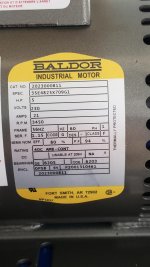
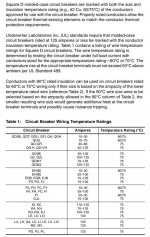
Not sure, and remember I'm trying to learn, not be argumentative. Where's the temp rating on this breaker and my motor?

Screenshot_20200418-100002_Drive.jpg


20200416_132150.jpg


Doing some more searching I did find this.

Screenshot_20200418-101243_Drive.jpg
 
Last edited:

Terry D

Well-known member
Joined
Mar 25, 2015
Messages
2,202
Location
St. Louis, MO.
Not sure, and remember I'm trying to learn, not be argumentative. Where's the temp rating on this breaker and my motor?

Screenshot_20200418-100002_Drive.jpg


20200416_132150.jpg


Doing some more searching I did find this.

Screenshot_20200418-101243_Drive.jpg

I know it can be confusing. The last document pretty much explains it. Your breaker is 75 degrees, I don't believe the motor has a temp rating, but the disconnect does. Everything now is mostly 75 degree as already said. I do believe they make 90 degree equipment, but it is not common. the 90 degree column is basically for derating ampacity calculations.

You have to look at the weakest link. Even though you have a 90 degree conductor but only 75 degree terminations on the breaker and disconnect, you cant run more amps through it than what the 75 degree column says.

NM-b has to be sized per the 60 degree column per the NEC, even though the conductors are rated at 90 degrees. So no matter what the termination ratings are, you have to use the 60 degree column for ampacity. The 90 degree rating is just for calculation purposes.

I do have a question of my own, do wirenuts have a temperature rating
 
Last edited:

Dave88LX

Well-known member
Joined
Nov 25, 2006
Messages
664
Location
York, PA
I re-read through this thread a couple times after going through the charts and some videos, and it's making a lot more sense.

The place I still have a little confusion is breaker sizing. 250% of 28A is a 70A breaker...but I "hear" a 55A is adequate. (I also hear most people are running a 30-35A breaker...but cost is moot, I want what is right).
 
OP
J

Jagmandave

Well-known member
Joined
Nov 6, 2011
Messages
6,299
Location
Overland Park, Ks.
It sounds like what's being discussed here are industrial settings, not residential?

Industrial settings where usage is almost constant rather than infrequent, like it is in my shop? Like sberry says, if I'm using mine hard, it may run 10-20 minutes a day, and that's on weekends. I base that on the approx 1-2 min runtime to recharge the tank - I only have mine set to 135psi as nothing I run uses that much air - just the occasional blowgun or impact wrench. I know that running it up to it's max rating means it runs longer but less frequently, but I'm just using this for an example of real world use in MY shop.

At some point I plan to use it for a sandblasting cabinet, but when that happens it will be mounted permanently and hard wired...and it will run quite a bit more than it does now, but still nothing like in an industrial setting.

In the meantime, as a temporary measure mine is plugged into an A/C socket on a less than 30 ft run of #10 on a 30 amp breaker, and it seems to work fine. Neither the wire or the plug gets even warm to the touch, nor the breaker.

As to the possibility of an arc flash - it's just me and the wife - the chances that she would even try to unplug it is zero - but she does know where the breaker is.
 
Last edited:

sberry

Banned
Joined
Jun 18, 2005
Messages
35,747
Location
Brethren, Michigan
I re-read through this thread a couple times after going through the charts and some videos, and it's making a lot more sense.

The place I still have a little confusion is breaker sizing. 250% of 28A is a 70A breaker...but I "hear" a 55A is adequate. (I also hear most people are running a 30-35A breaker...but cost is moot, I want what is right).
250 is the max allowable for 2 reasons, 1 could be that it tends to trip and the other is it could tolerate 2 units on 1 circuit,,,, but,,,,,,,,,,,,,,,, the 70 assumes you use the correct wire. Which would be 8. 10 is only rated to 60A for short circuit and its not a great idea to over breaker and under wire. Itscommon to use the smallest breaker that operates it or similar, a 10 thhn and a 40 is a tailor made circuit for these although I have seen them tripping up 30
This is a bit hypothetical,, but when its under wir3ed the wire needs tobe protected for thermal. A lot of that is done thru load calculation not from a breaker. Old monster welders are often under wired but when its done they also need to be under breaker. The minimum wire size cant be double derated and if the machine has the potential to overheat the wire then it needs additional protection.
 

u2slow

Well-known member
Joined
Nov 20, 2011
Messages
3,583
Location
BC
Probably as many wired with 10 cable as the right way. They havnt come out with PSA and warnings its pretty moot. I wonder what the real statistical risk is using a 10 vs an 8, does it ever actually even out to the cost of the wire.

Its is not a risk when the 5hp motor only has a 20-22A FLA.

The NEC wants the 5hp circuit wired for a 28A FLA motor.

Other (non-NEC) jurisdictions wire the circuit per nameplate data.
 

wyliesdiesels

Well-known member
Joined
Aug 14, 2012
Messages
19,983
Location
Modesto, CA
It sounds like what's being discussed here are industrial settings, not residential?

Industrial settings where usage is almost constant rather than infrequent, like it is in my shop? Like sberry says, if I'm using mine hard, it may run 10-20 minutes a day, and that's on weekends. I base that on the approx 1-2 min runtime to recharge the tank - I only have mine set to 135psi as nothing I run uses that much air - just the occasional blowgun or impact wrench. I know that running it up to it's max rating means it runs longer but less frequently, but I'm just using this for an example of real world use in MY shop.

At some point I plan to use it for a sandblasting cabinet, but when that happens it will be mounted permanently and hard wired...and it will run quite a bit more than it does now, but still nothing like in an industrial setting.

In the meantime, as a temporary measure mine is plugged into an A/C socket on a less than 30 ft run of #10 on a 30 amp breaker, and it seems to work fine. Neither the wire or the plug gets even warm to the touch, nor the breaker.

As to the possibility of an arc flash - it's just me and the wife - the chances that she would even try to unplug it is zero - but she does know where the breaker is.

nope there is no designation for usage environment such as industrial vs residential. all motor circuits get wired with the same parameters.
 

Terry D

Well-known member
Joined
Mar 25, 2015
Messages
2,202
Location
St. Louis, MO.
I re-read through this thread a couple times after going through the charts and some videos, and it's making a lot more sense.

The place I still have a little confusion is breaker sizing. 250% of 28A is a 70A breaker...but I "hear" a 55A is adequate. (I also hear most people are running a 30-35A breaker...but cost is moot, I want what is right).

The NEC allows you to size a circuit breaker up to 250% of the FLC of a motor. That doesn't mean you have to install a 70 amp for yours right of the bat.

When full voltage is applied to start a motor, it is at a stand still condition, and can draw up to 6 to 7 times, sometimes more, the FLA to start it spinning. This is called Lock rotor current. This only happens for a split second.

The NEC allows you to oversize the breaker compared to the wire to prevent nuisance tripping from start up. In this case, you are sizing the breaker to the motor load, not the conductor. You will rarely, if ever need the 70 amp. Like said, a 40 amp breaker should be fine and it might also run fine on a 30 amp.

So if your looking at find out what exact size breaker to install. You can try a 30 amp and if you get nuisance tripping, bump it up to a 40 amp. I personally would just install a 40 amp
 
Last edited:

Dave88LX

Well-known member
Joined
Nov 25, 2006
Messages
664
Location
York, PA
The NEC allows you to size a circuit breaker up to 250% of the FLC of a motor. That doesn't mean you have to install a 70 amp for yours right of the bat.

When full voltage is applied to start a motor, it is at a stand still condition, and can draw up to 6 to 7 times, sometimes more, the FLA to start it spinning. This is called Lock rotor current. This only happens for a split second.

The NEC allows you to oversize the breaker compared to the wire to prevent nuisance tripping from start up. In this case, you are sizing the breaker to the motor load, not the conductor. You will rarely, if ever need the 70 amp. Like said, a 40 amp breaker should be fine and it might also run fine on a 30 amp.

So if your looking at find out what exact size breaker to install. You can try a 30 amp and if you get nuisance tripping, bump it up to a 40 amp. I personally would just install a 40 amp
Thanks again for everyone's patience with the posts...all makes sense now.
 

Dave88LX

Well-known member
Joined
Nov 25, 2006
Messages
664
Location
York, PA
Damn. I wish I could temporarily run this off my dryer outlet until I get a subpanel and proper wiring out in the garage.
 

Bert_

Well-known member
Joined
Dec 24, 2016
Messages
9,697
Location
NW Iowa
Damn. I wish I could temporarily run this off my dryer outlet until I get a subpanel and proper wiring out in the garage.

So do it. Doesn't mean it's right but it's not going to burn your house down. It's not like you plai to leave it like that.

I generally stay out of the discussions about motors and plugs because I wire 5-10hp motors with 50A plugs all the time.
 
OP
J

Jagmandave

Well-known member
Joined
Nov 6, 2011
Messages
6,299
Location
Overland Park, Ks.
And a 30 amp 480 3 phase circuit is a different beast than a 30 amp 240V single phase.

yes, both can kill you but I think the 3 phase is worse.
 

Dave88LX

Well-known member
Joined
Nov 25, 2006
Messages
664
Location
York, PA
The dryer outlet is like, 10 feet from where the compressor is sitting in the garage. Easy to run something temporary to use the compressor for the time being. Getting a subpanel to the garage or the compressor into the basement is a whole project onto its own.

If the consensus is that "it's not exactly right, but it will work for now without killing anyone", then I will do it for the interim.
 
To avoid these ads, REGISTER NOW!
Top Bottom