To avoid these ads, REGISTER NOW!

Compressor pressure regulators

PT Doc

Well-known member
Joined
Nov 12, 2010
Messages
3,197
I have read a bunch on regulators in past threads and have a few questions since the more I thought I know, the more I realize that I am more confused.

1-Regulator question: A 3/8" regulator flows ~120 cfm. Why would I need to get a 1/2" or 3/4" regulator? My compressor's ouput is 17+ cfm out of the factory 3/4" valve.

2-Air lines: Many would say that since my compressor has a 3/4" output valve, I should plumb the airline with 3/4" piping or at least 1/2" so as not to create a restriction. But even the 3/8" regulator puts out 6x more cfm than my compressor can. Why would I want to spend more money to plumb my line with larger diameter piping.

3-CFM and max pressure of regulators: Looking at Parker, Wilkerson, IR and other brands carried my MSC and Grainger, I have noticed the following: a 3/4" regulator with a max PSI >175 (my compressor max's out at this) will likely have an output of 125 psi to 150 psi. I found a Speedaire unit that is Max 200psi but it is around $100. A harbor freight $5 unit has a max PSI of 200. What the hell is going on? I guess I could just plumb the lines (after getting a better understanding from #2 above) and just get 3 of the HF units. I'd like to have a few output lines: 40, 90 and 120 psi. I just can't spend $100 per regulator though. What are some cost effective solutions?

Thanks in advance for the responses.
 
Last edited:
To avoid these ads, REGISTER NOW!

bmxr4life87

Well-known member
Joined
Mar 21, 2009
Messages
872
Location
Bixby Oklahoma
Why not regulate down to 120 right off your tank then use a small regulator with quick connects to further regulate down to 90 or 40 when you need?
 

W-Cummins

Well-known member
Joined
Jan 9, 2006
Messages
1,641
Location
Iowa
I have read a bunch on regulators in past threads and have a few questions since the more I thought I know, the more I realize that I am more confused.

1-Regulator question: A 3/8" regulator flows ~120 cfm. Why would I need to get a 1/2" or 3/4" regulator? My compressor's ouput is 17+ cfm out of the factory 3/4" valve.

You can use the 3/8" regulator, it will work just fine, and it will flow many times the output of you compressor.

PT Doc said:
2-Air lines: Many would say that since my compressor has a 3/4" output valve, I should plumb the airline with 3/4" piping or at least 1/2" so as not to create a restriction. But even the 3/8" regulator puts out 6x more cfm than my compressor can. Why would I want to spend more money to plumb my line with larger diameter piping.

In one word DISTANCE
As you can see from the ratings of the regulators even the 3/8" stuff flows a lot of air!
But it does it over a short distance,in the case of a regulator, only a few inches. As you start to increase the length of the restriction its effect on the flow and pressure drop can start to become a factor in your choice.

PT Doc said:
3-CFM and max pressure of regulators: Looking at Parker, Wilkerson, IR and other brands carried my MSC and Grainger, I have noticed the following: a 3/4" regulator with a max PSI >175 (my compressor max's out at this) will likely have an output of 125 psi to 150 psi. I found a Speedaire unit that is Max 200psi but it is around $100. A harbor freight $5 unit has a max PSI of 200. What the hell is going on? I guess I could just plumb the lines (after getting a better understanding from #2 above) and just get 3 of the HF units. I'd like to have a few output lines: 40, 90 and 120 psi. I just can't spend $100 per regulator though. What are some cost effective solutions?

Thanks in advance for the responses.

You need the FIRST regulator in your system to be rated to the max pressure that you intend to run the compressor. So if your going to run your tank @ 175 psi you need to have a regulator that can take that input pressure. There is really no good reason to run your lines at that high of pressure so that regulators output will be less than the 175 max ie. 125-150psi.
On my system I intend to run my compressor at 150 psi. You will also find that a lot of other air compressor accessories ( filters, driers, oilers) are not rated at more than 150psi. Then I will regulate it down to say 130psi for the lines ( more than an adequate pressure) and at the point of use I will install another filter regulator to supply the end use pressure of under 120psi as needed.
This will allow me to run more cost effective filters and regulators at the end points, and still have plenty of pressure as needed.

William...
 
Last edited:
OP
P

PT Doc

Well-known member
Joined
Nov 12, 2010
Messages
3,197
Why not regulate down to 120 right off your tank then use a small regulator with quick connects to further regulate down to 90 or 40 when you need?

I could regulate it down close to the tank. But it would make sense to have a flexible line that connects to rigid piping. Here I could regulate down to 120 like you say but I need to get a regulator that will handle the 175 max PSI pressure. I find it weird that there are so few expensive regulators that can handle 175 max psi but that a $5 Harbor Freight regulator can do 200 psi.
 

Charles (in GA)

Well-known member
Joined
Jan 11, 2006
Messages
12,489
Location
50 mi south of Atlanta
As William noted, the reasons for using larger lines are the distances involved. Engineers have charts that will give you the drop in flow over a certain distance for a specific ID of pipe. You could run a 3/8 line 5 ft and get good air flow, run it a half mile, and not get much out of the end of it. Surface friction inside the pipes are part of the problem, so you are much better to oversize by some amount and not have flow issues, than to undersize it and have problems the first time you install a blast cabinet on the opposite side of the shop from the compressor.

For an education in filters and how they work, good cutaways and descriptions, etc, go to this link.

http://www.wilkersoncorp.com/9EM-TK-190/9EM-Intro-Technical.pdf

Especially read page 29 of 30 for the list of oils and chemicals that will attack polycarbonate filter bowls.

Table of Contents page allows you to drill down thru everything Wilkerson offers.

http://www.wilkersoncorp.com/9EM-TK-190/9EM-TOC.pdf

Wilkerson is very good quality and lots of it is found on Ebay for reasonable prices.

Charles
 
Last edited:

soob

Well-known member
Joined
Jul 11, 2011
Messages
551
The pressure also falls off suddenly when you start drawing air, right?
 
To avoid these ads, REGISTER NOW!

z28snksknr

Well-known member
Joined
Jul 8, 2009
Messages
1,827
Location
Turnersville, NJ
The pressure also falls off suddenly when you start drawing air, right?

Not if your plumbing is sized correctly and you have a good regulator.

Charles

It's not that simple. A regulator is trying to maintain a pressure directly downstream of the diaphragm / disc that opens to allow flow. So if you have the regulator set at 100 psi, the reg. opens to allow enough flow from the high pressure side of the unit to the low pressure side so that the regulator senses 100 psi. The pressure needs to drop below 100 psi before the regulator will crack open and allow flow, and it will only open enough to maintain your set pressure.

The pressure seen at the point of use will be less than 100 psi otherwise there is no driving force for movement of air (flow). As far as the regulator's flow capacity (the large CFM numbers you posted), that is the regulator's flow capacity when there is a maximum pressure difference between the high side and the low side. Essentially, it is the air flow rate measured when the upstream pressure is at the valve's max rated pressure, and there is no loss downstream of the valve (open to the atmosphere or some other controlled "test pressure"). This requires the regulator to be completely wide open and flowing it's maximum capacity. It is NOT the flow rate of the regulator when you have it running through a 50' hose, several fittings, and a tool, while maintaining a static pressure in the line.

The ideal regulator would be one that uses the pressure at the point of use (the tool) and maintains an upstream pressure so that the tool receives the intended air pressure required for the task. This would be considered a remote sensing or "pilot operated" regulator but they are impractical for use in a garage setting, so the next best thing would be a regulator that was as close to the point of use as possible, high flow / low restriction fittings, and a regulator set pressure that is set with appropriate margin above what is desired at the tool to accomodate for the losses in the system.

You can accomplish this with even a cheap regulator if you just measure the inlet pressure to the tool you are using while in use and adjust the set pressure on the regulator until you achieve the desired pressure at the tool. If you do it this way, the regulator's flow and setpoint become irrelevant as long as the reg is not choking the flow in the system. Staging several regulators may be desireable to not exceed any individual tool's max pressure.
 
OP
P

PT Doc

Well-known member
Joined
Nov 12, 2010
Messages
3,197
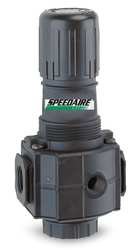
Sounds like a good 3/4" regulator is needed. Speedaire has one that seems like it would do the job: 4ZM23

Regulator, NPT 3/4 Inch, Maximum Flow 100 CFM, Maximum Pressure 300 PSI, Maximum Temperature 175 Degrees Fahrenheit, Adjustment Range 5-150 PSI, Bowl/Adjustment Knob Type Non Rising Knob, Height 6.67 Inches, Width 3.15 Inches, Prefilter/Gauge Stock Number 1X762

This needs a gauge but Grainger and MSC intown should have everything that I need.

I will also look at the Wilkerson line more closely. Thanks
 

Attachments

  • Speedaire_Regulator-4ZM22_AS01.JPG
    Speedaire_Regulator-4ZM22_AS01.JPG
    3.5 KB · Views: 18
OP
P

PT Doc

Well-known member
Joined
Nov 12, 2010
Messages
3,197
If I wanted to have an inline filter would it be better to have the filter first the the regulator so that the regulator is protected from moisture?

Does a regulator/filter stacked combination unit have air go into the reg or filter first? If its the reg than I would want to get them separate so that the reg does not have unneeded moisture going through it.
 

W-Cummins

Well-known member
Joined
Jan 9, 2006
Messages
1,641
Location
Iowa
I could regulate it down close to the tank. But it would make sense to have a flexible line that connects to rigid piping. Here I could regulate down to 120 like you say but I need to get a regulator that will handle the 175 max PSI pressure. I find it weird that there are so few expensive regulators that can handle 175 max psi but that a $5 Harbor Freight regulator can do 200 psi.

Well I don't know about that, I just looked through Wilkerson's catalog and all of their stand alone regulators are rated at least 250psi and most are rated @ 300psi

Sounds like a good 3/4" regulator is needed. Speedaire has one that seems like it would do the job: 4ZM23
I will also look at the Wilkerson line more closely. Thanks

Sounds like you just want to use a 3/4" regulator :)

The 3/4" regulator ( as pointed out above) operates like all regulators do and its pressure will drop off on use. Its pressure/flow chart just drops off further to the right. Also as pointed out above you should adjust the regulator to provide the pressure you need at the tool if it's important that you have an exact pressure for proper operation ie. spray painting.
I run small regulators right on the spray guns that don't have built in pressure gauges on them. For non critical applications I just tweak the pressure some. With 50' of 3/8 hose, I dial in an addtional 9-15psi more at the regulator the hose is plugged into. That takes care of the regulator drop and the line loss from the hose. I guess I could make a gauge on a "T" with a female quick disconnect on one side, and a male plug on the other, so I could snap it inline to check the pressure at the tools. Its just never been enough of a problem to prompt action so far!

If I wanted to have an inline filter would it be better to have the filter first the the regulator so that the regulator is protected from moisture?


Does a regulator/filter stacked combination unit have air go into the reg or filter first? If its the reg than I would want to get them separate so that the reg does not have unneeded moisture going through it.

All of the one piece filter/reg units I have seen the air goes to the filter section before the regulator section. This is another problem with the high pressure input, filters are normally not rated at higher pressures unless they have $$ metal bowls. Also some, even with metal bowls are rated at lower pressures depending how you configure them.

IMG_0584.jpg


My large m32 filters are rated a 300psi. but if you want to run the differential pressure gauges on them it's only 150psi max.

William...
 
Last edited:

Greatbear

Well-known member
Joined
Jan 17, 2008
Messages
1,702
Location
Columbia/Fulton, MD
While many regulators are rated for large CFM, some of them do so at the expense of tight regulation. The small-bodied regulators are the worst for this. A larger diaphragm and valve generally translates into a more sensitive unit.
 

dwm

Well-known member
Joined
Aug 28, 2010
Messages
861
Location
Southeast Michigan
If I wanted to have an inline filter would it be better to have the filter first the the regulator so that the regulator is protected from moisture?

Does a regulator/filter stacked combination unit have air go into the reg or filter first? If its the reg than I would want to get them separate so that the reg does not have unneeded moisture going through it.

Every manufacturer's documentation I've seen recommends a filter upstream of the regulator. Milton, IR, others. The filter protects the regulator's passages, and from what I've read over the years, many filters are not happy with something upstream that might cause a big pressure drop. For primary filtering and regulation, I've always set mine up this way. I'm talking about a reasonably high-flow coalescing filter.

The combo units are called 'FRL' because that's the order they should be in: filter, regulator, lubricator.

I avoid polycarbonate bowls. Metal bowls cost more, but have fewer problems with cold temperature swings and of course accidental impacts ("s**t happens" scenarios).

Secondary point-of-use filtering and regulation... do what you need to do for the task at hand. If you plan on painting or powdercoating but want a lubricator for other tools, the spray paths need to be separated upstream of the lubricator so there's no chance of lubricator oil contaminating your spray gun's air path.
 
To avoid these ads, REGISTER NOW!
Top Bottom