To avoid these ads, REGISTER NOW!

Compressor safety. What can be done?

shooting4life

Well-known member
Joined
Nov 19, 2012
Messages
334
How do you test the PRV? The only way to truly test one is to bring the pressure above the trip point and confirm it opens. Pulling the relief valve ring is not a test, if that's what you're doing. I don't know how you would pressurize the system to those levels to properly test.

As far as all the concerns about tanks exploding, I'm with the apparently small minority that have said this safety threat is so low I wouldn't even think once about it, nevermind twice. There are SOOOO many other things FAR more dangerous and worthy of addressing than the minute chance of a compressor exploding. As was already mentioned, you're statiscally way more apt to be killed driving to the store to buy parts to fix this hazard, than having the hazard harm you. Doesn't make sense to me :dunno:

From what I have read, the PRV fails by it getting stuck, by pulling the little ring it makes sure that it is not stuck. You would also be able to tell if you have a problem if your tank is at full PSI and it takes a good amount of force to move the PRV. When I pull the ring it hardly takes any pull to open the valve, not scientific but works.

But like you and others have said, I am not really worried about my tank exploding. With basic maintenance (draining the water and testing the PVR) the tank should last forever.
 
To avoid these ads, REGISTER NOW!

dlcwent

Member Emeritus
Joined
Feb 24, 2014
Messages
8,427
Location
coastal maine
Do any of you guys have a drain valve like they do on trucks with air breaks? It makes it really easy to drain it everyday.Keeps the water out at least. And is there any problem you might know of by using this type of drain?
 

shooting4life

Well-known member
Joined
Nov 19, 2012
Messages
334
Do any of you guys have a drain valve like they do on trucks with air breaks? It makes it really easy to drain it everyday.Keeps the water out at least. And is there any problem you might know of by using this type of drain?

I don't know what type of drain valve they have on trucks air breaks, but I installed a 90 and about 8 inches of 1/4 pipe to a ball valve which then has a hose attached to the end so I can put the hose out he garage door and open the valve and the water goes outside. I usually do not have much water as I am in a pretty dry area.

The other benefit to doing this is that the water sits in the replaceable pipe instead of the bottom of the tank.
 

efncrx

Well-known member
Joined
Mar 5, 2014
Messages
99
Location
Cold, MN
My compressor is a huge 150 gal horizontal, I have no idea of the age probably mid 80s huge cast iron piston. Never once have I worried about it. Now the high speed tools I'm using are a different story. I would worry more (for good reason) a cheaply balanced die grinder flying apart in my hand. I always turn the breaker off when I'm not in the garage, the tank remains full and I drain it often.
 
Last edited:

Nick Danger

Well-known member
Joined
May 7, 2013
Messages
4,244
Location
Albuquerque
I'm curious about the guys in earthquake country. In California, it's code to strap the water heater to the wall, so it doesn't tip over and explode. Do people also strap their vertical compressor tanks to the wall?
 

Durka

Well-known member
Joined
Mar 20, 2014
Messages
341
Location
Howell, MI
I'm curious about the guys in earthquake country. In California, it's code to strap the water heater to the wall, so it doesn't tip over and explode. Do people also strap their vertical compressor tanks to the wall?

I'm not sure about Cali, but here you set them on some half cork/half rubber pads and lag bolt every leg stand into the concrete.
 

Fixnair

Well-known member
Joined
Jan 5, 2013
Messages
476
Location
Sapulpa OK
Seismic restraints are the law in commercial applications. Not enforced though and not required unless you employ others.
 

rlitman

Well-known member
Joined
Oct 18, 2010
Messages
24,591
Location
Long Island
how do you know this?


Anecdotal evidence that tanks are not blowing up every day, when most are in service for many decades.
As I said, prove this wrong. Or at least find evidence of a single compressor fatigue failure. I'd be satisfied with pictures of a tank that failed at the motor mount welds on the top (where fatigue would be worst due to motor vibration).
Sorry, it just don't happen.
 
Last edited:

owenst7

Well-known member
Joined
Oct 19, 2011
Messages
632
Location
Anchorage/Reno
Anecdotal evidence that tanks are not blowing up every day, when most are in service for many decades.
As I said, prove this wrong. Or at least find evidence of a single compressor fatigue failure. I'd be satisfied with pictures of a tank that failed at the motor mount welds on the top (where fatigue would be worst due to motor vibration).
Sorry, it just don't happen.

I didn't say you were wrong. I simply asked you to back up your claim scientifically, since fatigue is a scientific discussion. I simply said I would be reluctant to make a claim that it wasn't relevant, because I don't have enough information to know that. You appear to know more than me, so I would love it if you would educate me further.
 
Last edited:

Steve in Louisiana

MEMBER EMERITUS
Joined
Aug 9, 2012
Messages
76
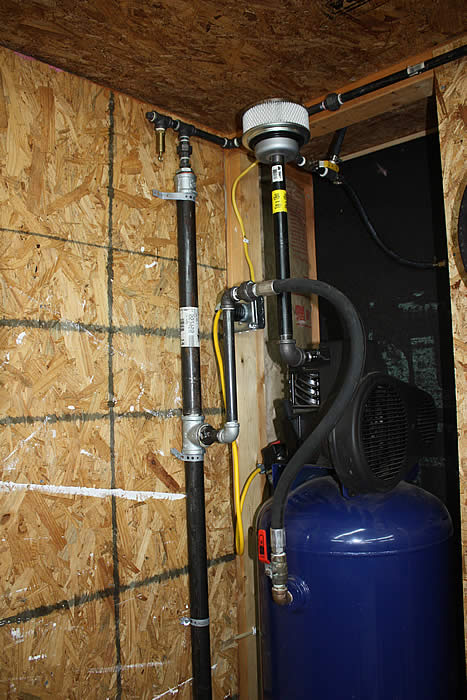
Right off the top of my dryer column I have a 175 PSI pop off. Gold thing on the left hand leg.
Air7.jpg

Do you find the filter arrangement you have reduces the noise generated by the compressor?

Steve
 

ASimmons

Member
Joined
Mar 7, 2014
Messages
7
Location
Hueytown, Alabama
make sure there is no leaking in the piping that link back to the air compressor, don't put anything flammable around the compressor, and make sure the shut-off switch is working properly. When the air compressor cuts on when it drops to an "x" osi number, test the shut -off switch and make sure the compressor cuts off and doesn't come back on when not in use.

I can remember a friend of mine that had a dewalt air compressor that kept running and wouldn't shut off and it blew the whole roof off his garage next to his home. VERY DANGEROUS...Lucky the home didn't completely blow.
 
Last edited:

DIC

Well-known member
Joined
Aug 2, 2009
Messages
698
I always get nervous airing up those portable air tanks.... :Twitch:
 

Fyrme

Well-known member
Joined
Nov 28, 2012
Messages
2,231
Location
Green country, Oklahoma
I am so on the fence right now with the compressor thing. Maybe it is because I am now searching for my third tank. My first one started leaking last year it was a horizontal 80gal that was 40 years old. I found a 1990's Craftsman vertical 60gal complete for $150. The guy assured me it was drained regularly. However the 2" plug was NOT coming out to inspect it. I took his word and went down the road. I spent hours removing the small pump and motor and modifying the mounting plate to fit my big pump and motor. 3 months later, it got a leak in the bottom.
I am obviously having reservations about buying another used tank. But I can't afford a $1500 new compressor either. My 5hp 230V Baldor motor and cast iron 16SCFM pump still work like a champ. So I'd like to just buy a new tank. But they are $600. Piece of mind? IDK, I'll probably just worry about my motor or pump dieing after I dropped a bunch of coin on a tank.

The one thing I think EVERYONE should consider for compressor safety is to move it outside. I don't care if it is a 10gal or 100gal. Get it out of your work area!!!! I mean seriously, lets say it does blow up at some point. If it was outside under a 'dog house' in a non-populated area, the most it would do is damage your house or shop. That is what insurance is for if it does major damage. Missing limbs are not replaceable, and unless you have one hell-of-a disability insurance plan, you're screwed
financially. As far as I'm concerned, moving it outside is the best safety measurement any one can take. Even more so than draining it everyday.
 

DekeT

Well-known member
Joined
Aug 12, 2011
Messages
2,234
Location
USA
This post has been up for a few hours and no one has even hinted at it...

Thisis why you use the forbidden PVC pipe...... Path of least resistance!

Ok not a solution but as with a few of the other posts I see this as the least likely thing in my barn that will hurt me. Taking myself out of the equation as that is the most dangerous tool in my garage I am more fearful of the paint and cleaners I have inflicted on my 45 year old soul as well as the fumes from welding. I know I am not alone when I say many, not all, of us do not wear any type of breathing mask when welding?

:+1: The most dangerous tool in the garage is me. :lol_hitti So true.
Yes, many folks just did not know of the potential dangers. Now that you know I hope you take precautions.
 

DekeT

Well-known member
Joined
Aug 12, 2011
Messages
2,234
Location
USA
The garage journal, being one the most active areas of its kind on the net, should be a leader in emphasizing the safety of its members. I would hope the well being and health of the participants is a high priority of the posters here. Enough of the "I did something dumb for years and it did not hurt me, so it won't hurt you.". That is just wrong advice.

It would not hurt (pun intended) to have a section of its own on safety.
 

b-body-bob

Well-known member
Joined
Oct 10, 2011
Messages
1,621
Location
Almost Heaven
I always turn the breaker off when I'm not in the garage, the tank remains full and I drain it often.

Same here except I installed a disconnect switch with my latest used compressor so I don't have to use the breaker as a switch.

I always get nervous airing up those portable air tanks.... :Twitch:

That's two of us, and it's not just the filling. There's something about one that just seems unsafe in any situation. I think it's because the steel doesn't seem much thicker than sheetmetal, and it's light enough if you somehow knocked the bung off it, it'd take off like a rocket.
 

Kev442

Well-known member
Joined
Jan 15, 2009
Messages
5,386
Location
Wi
All one needs to do is look to tire safety cages to see what would be safer. I've considered wrapping with chain link fence, but my exposed compressor is only 6 years old.

My older compressor is under the staircase far from where I normally am working. I leave it pressurized, but switched off.
 

Durka

Well-known member
Joined
Mar 20, 2014
Messages
341
Location
Howell, MI
I am so on the fence right now with the compressor thing. Maybe it is because I am now searching for my third tank. My first one started leaking last year it was a horizontal 80gal that was 40 years old. I found a 1990's Craftsman vertical 60gal complete for $150. The guy assured me it was drained regularly. However the 2" plug was NOT coming out to inspect it. I took his word and went down the road.

Someone just posted about a slue of Snap On scratch and dent tanks for sale. Nothing wrong with them except a scratch or little dent. It was on this site. I hit the link and sure enough, they had a 60 or 80 gal upright in the picture.

Yea, it wasn't more than a couple days ago. :thumbup:
 

b-body-bob

Well-known member
Joined
Oct 10, 2011
Messages
1,621
Location
Almost Heaven
Someone just posted about a slue of Snap On scratch and dent tanks for sale. Nothing wrong with them except a scratch or little dent. It was on this site. I hit the link and sure enough, they had a 60 or 80 gal upright in the picture.

Yea, it wasn't more than a couple days ago. :thumbup:

I remember it was on the Detroit Craigslist.
 
To avoid these ads, REGISTER NOW!

beakie

Well-known member
Joined
Feb 21, 2014
Messages
492
Location
Ontario, Canada
I am curious why there are so many worried about "what if" my compressor blows up, just because it happens once in every 1million sold?

This isn't a common occurrance, and under normal circumstances they pose no abnormal risks.

Hiding them outside, in metal rooms, sonic testing them... I'd suggest not reading/watching the news or you won't want to venture outside for fear of... everything.

Has the cause of the exploding tank been determined? I doubt it was rust, so nothing to worry about there. If PRV valves are old, replace them, cheap n simple piece of mind... heck install 2 if it's that big of a deal.
 

Fyrme

Well-known member
Joined
Nov 28, 2012
Messages
2,231
Location
Green country, Oklahoma
It's because of the seriousness of when they do. Just like people that are afraid to fly. It doesn't happen enough to warrant worrying but the ramifications if it does in fact crash.....
 

6768rogues

Banned
Joined
Nov 28, 2007
Messages
4,524
Location
Western NY
If you look at aircraft....it's not really the number of flying hours that does them in...but rather the 'cycles'.....each take off and landing.....and resulting change in pressure. The real wear and tear on aircraft is the pressure/depressurization....(excluding war birds)
If they build airplanes with the materials used in air compressor tanks, they would never get off the ground.
 

dwm

Well-known member
Joined
Aug 28, 2010
Messages
861
Location
Southeast Michigan
Most air compressor explosions are from the ignition of oil mist, carbon deposits, etc. That's been the case for as long as we've had oil-lubricated air compressors.

If you're worried about an explosion, the receiver should not be your top priority. Lower the flash point and/or increase the outlet temperature... kaboom.

I'd hazard a guess that one of the primary causes of oil-lubricated compressor explosions at home (i.e. compressors not on a scheduled maintenance/test schedule) is the lack of pump maintenance.

I remember reading here years ago of someone who hadn't changed the oil in his splash-lubricated air compressor in many years. Don't be this person. Read your manual and follow it. I change mine once every 6 months (IR All Season Select and IR air filters in my case) since I like having fresh lubricant before the winter and before the summer. Cheap insurance.
 

LG63

Well-known member
Joined
Sep 7, 2012
Messages
1,003
Most air compressor explosions are from the ignition of oil mist, carbon deposits, etc. That's been the case for as long as we've had oil-lubricated air compressors.

Interesting observation but wouldn't it take a spark somewhere within the compressor/tank to kick this off? There's the pressure switch arc but it's external.
 

Davefr

Well-known member
Joined
Jan 7, 2010
Messages
11,822
Location
OR
Most air compressor explosions are from the ignition of oil mist, carbon deposits, etc. That's been the case for as long as we've had oil-lubricated air compressors.

If you're worried about an explosion, the receiver should not be your top priority. Lower the flash point and/or increase the outlet temperature... kaboom.

I'd hazard a guess that one of the primary causes of oil-lubricated compressor explosions at home (i.e. compressors not on a scheduled maintenance/test schedule) is the lack of pump maintenance.

I remember reading here years ago of someone who hadn't changed the oil in his splash-lubricated air compressor in many years. Don't be this person. Read your manual and follow it. I change mine once every 6 months (IR All Season Select and IR air filters in my case) since I like having fresh lubricant before the winter and before the summer. Cheap insurance.


Please explain better.

I don't see how more frequent oil changes/filters would eliminate the source of fuel and ignition resulting in an explosion.

I guess a total lack of lubrication would create blow by from badly worn rings and the lack of oil could cause the pump's output temp to rise. Is that what your theory is??
 

coykiam

Active member
Joined
Mar 6, 2014
Messages
37
My 7 year old 20 Gal 6HP Porter Cable manual suggested to drain the tank regularly. How often is regularly?

I only use it 3-4 times a year when I'm rotating my tires or blowing my sprinklers and have drained it after each use. Is this a bad thing? I rarely use the compressor. :dunno:
 

dwm

Well-known member
Joined
Aug 28, 2010
Messages
861
Location
Southeast Michigan
No time to explain myself, but here are some links. This is a longstanding well-known cause of compressor explosions. All you need is fuel (oil mist, carbon deposits, dust, etc.), air and a heat source. All three are present, obviously.

Keeping your oil fresh reduces heat and carbon deposits and helps keep the flash point high. Keeping your air filter clean reduces heat and using the correct one reduces the odds of sucking in particles that may spark or provide fuel. Lack of maintenance here will lead to dirty/leaky valves, blow-by etc. that will increase the amount of flammables that leave the pump and accumulate in and outside the pump.

Keep your compressor well-maintained upstream of the receiver and it should run trouble-free for many years. Doesn't hurt to inspect the insides of the plumbing between the pump and the receiver once in a while. And don't use flammables/combustibles to clean it!

http://ncsp.tamu.edu/reports/WorkCover/Alerts.htm

http://wiki.nasa.gov/oxygen-fire-in...-Air-Compressor-Fires-NASA-WSTF-Mid-1980s.pdf

http://voices.yahoo.com/explosive-air-careful-air-compressor-1629593.html?cat=6

http://www.tpub.com/engine3/en33-75.htm
 

DenisG

Well-known member
Joined
Jul 14, 2013
Messages
1,278
Location
Milwaukee
No time to explain myself, but here are some links. This is a longstanding well-known cause of compressor explosions. All you need is fuel (oil mist, carbon deposits, dust, etc.), air and a heat source. All three are present, obviously.

Keeping your oil fresh reduces heat and carbon deposits and helps keep the flash point high. Keeping your air filter clean reduces heat and using the correct one reduces the odds of sucking in particles that may spark or provide fuel. Lack of maintenance here will lead to dirty/leaky valves, blow-by etc. that will increase the amount of flammables that leave the pump and accumulate in and outside the pump.

Keep your compressor well-maintained upstream of the receiver and it should run trouble-free for many years. Doesn't hurt to inspect the insides of the plumbing between the pump and the receiver once in a while. And don't use flammables/combustibles to clean it!

http://ncsp.tamu.edu/reports/WorkCover/Alerts.htm

http://wiki.nasa.gov/oxygen-fire-in...-Air-Compressor-Fires-NASA-WSTF-Mid-1980s.pdf

http://voices.yahoo.com/explosive-air-careful-air-compressor-1629593.html?cat=6

http://www.tpub.com/engine3/en33-75.htm

Do you know the flashpoint of SAE30 oil?
 

RABRods

Well-known member
Joined
Nov 5, 2011
Messages
110
Location
SE, Michigan
Someone just posted about a slue of Snap On scratch and dent tanks for sale. Nothing wrong with them except a scratch or little dent. It was on this site. I hit the link and sure enough, they had a 60 or 80 gal upright in the picture.

Yea, it wasn't more than a couple days ago. :thumbup:

That was me and here is the link, the guy is located in Detroit. As of Monday he had 22 80 gallon tanks. They seemed to be in good shape from talking to him.

http://detroit.craigslist.org/wyn/tld/4318672369.html
 

Davefr

Well-known member
Joined
Jan 7, 2010
Messages
11,822
Location
OR
No time to explain myself, but here are some links. This is a longstanding well-known cause of compressor explosions. All you need is fuel (oil mist, carbon deposits, dust, etc.), air and a heat source. All three are present, obviously.

Keeping your oil fresh reduces heat and carbon deposits and helps keep the flash point high. Keeping your air filter clean reduces heat and using the correct one reduces the odds of sucking in particles that may spark or provide fuel. Lack of maintenance here will lead to dirty/leaky valves, blow-by etc. that will increase the amount of flammables that leave the pump and accumulate in and outside the pump.

Keep your compressor well-maintained upstream of the receiver and it should run trouble-free for many years. Doesn't hurt to inspect the insides of the plumbing between the pump and the receiver once in a while. And don't use flammables/combustibles to clean it!

http://ncsp.tamu.edu/reports/WorkCover/Alerts.htm

http://wiki.nasa.gov/oxygen-fire-in...-Air-Compressor-Fires-NASA-WSTF-Mid-1980s.pdf

http://voices.yahoo.com/explosive-air-careful-air-compressor-1629593.html?cat=6

http://www.tpub.com/engine3/en33-75.htm

Thanks for the links! This is very interesting info. and has given me a new appreciation for what can happen.
 

dwm

Well-known member
Joined
Aug 28, 2010
Messages
861
Location
Southeast Michigan
Do you know the flashpoint of SAE30 oil?

Off the top of my head, a typical synthetic is 220C to 230C. Haven't used non-synthetic in decades so I'd have to look it up. But I've been told it gets tricky when you have to account for mechanical vaporization, pressures, diesel effect and contaminants.

Some countries have regulations on air compressor outlet temperatures to reduce the likelihood of explosions in compressed air systems. I don't know the numbers, but somewhere in the neighborhood of 140C seems to ring a bell from when a former employer had some decommissioned for high outlet temperatures. That was in Germany, I don't know what OSHA has to say, if anything. That should be well below flash temperature, but I'm sure there's a basis for the number... the Germans aren't known for under-engineering.

My rudimentary understanding is that long-term, lack of pump maintenance creates a vicious circle. Heat causes carbon buildup. Carbon buildup creates more heat. Most of us aren't running our compressors at high duty cycles day in and day out, but that can be good or bad. I suppose the totally paranoid homeowner could stick with oil-free units, but we all know their limitations (CFM) and drawbacks (noise being one of the primary ones).
 

DenisG

Well-known member
Joined
Jul 14, 2013
Messages
1,278
Location
Milwaukee
Off the top of my head, a typical synthetic is 220C to 230C. Haven't used non-synthetic in decades so I'd have to look it up. But I've been told it gets tricky when you have to account for mechanical vaporization, pressures, diesel effect and contaminants.

Some countries have regulations on air compressor outlet temperatures to reduce the likelihood of explosions in compressed air systems. I don't know the numbers, but somewhere in the neighborhood of 140C seems to ring a bell from when a former employer had some decommissioned for high outlet temperatures. That was in Germany, I don't know what OSHA has to say, if anything. That should be well below flash temperature, but I'm sure there's a basis for the number... the Germans aren't known for under-engineering.

My rudimentary understanding is that long-term, lack of pump maintenance creates a vicious circle. Heat causes carbon buildup. Carbon buildup creates more heat. Most of us aren't running our compressors at high duty cycles day in and day out, but that can be good or bad. I suppose the totally paranoid homeowner could stick with oil-free units, but we all know their limitations (CFM) and drawbacks (noise being one of the primary ones).

I did a critical reading from the first link that you provided (above):

http://ncsp.tamu.edu/reports/WorkCover/Alerts.htm

Text from link: (my comments in red and are directed at the author of the article)

Recently an air receiver of a compact air compressor unit exploded in a panel-beating workshop, narrowly missing an employee and causing material damage.

Compressors of this type are commonly used in smaller businesses, like automotive repairers, for spray painting, vehicle hoisting and other applications.

Although there was corrosion on the inside surface of the cylinder, the explosion was probably due to poor maintenance of the air supply line. (Conclusion does not mention removing and cleaning the air supply line to prevent future explosions. No accident report, failure analysis, or details mentioned. No discussion of how the conclusion was reached or if the investigator of the accident was a professional or recognized authority.)
How can an air receiver tank explode?
During operation, deposits of lubricating oil tend to build up in the line supplying compressed air from the compressor cylinder to the air receiver. (If this is the case, why don’t manufacturers install oil or condensing traps preventing oil from entering the receiver?) As the diameter of the supply line decreases, the already high temperature of the compressed air rises further to a point where it is possible for the contaminant to ignite. (Evidence, citations, sources???)
Sparks are then carried into the air receiver where oil from the compressor, which is often present as a mixture with air in the air receiver, burns explosively. (If this is the case, then why don’t manufacturers install internal spark arrestors? Should I put backflow preventers on my compressed air lines to prevent combustible gases from igniting and blowing up my air compressor receiver? Nonsense!) As the pressure relief valve is not designed for such an event, rupture of the air receiver vessel is likely to occur. (Why bother with safety valves then? Sandbag bunker, maybe?) In other air compressor accidents, static electricity sparks have also been identified as a source of fires and explosions. (Huh, where??? Internal static electricity in all metal vessels?!?)
Prevention measures
To avoid such incidents and damage, all air compressor equipment should be maintained in a safe operational condition and be regularly inspected. To prevent excessive fouling of compressed air supply lines, only the grade of oil recommended by the manufacturer/supplier should be used in the compressor. (Why didn’t you say that the wrong type of lubricating oil was the cause of the explosion before?)

Sorry, but there’s nothing here but a scattershot theory backed with conjecture and supposition. If an air compressor is making combustible gases from its lubricating oil, no one should be using one.


I did read your other links and I can post my comments if you wish.
 
Last edited:

dwm

Well-known member
Joined
Aug 28, 2010
Messages
861
Location
Southeast Michigan
There are many documented cases of these types of explosions. Including those with laboratory analysis revealing the products of combustion. Most of the seminal studies are not easy to find on the Internet because many of the studies were done more than 50 years ago and the results used to update documents like the Navy's "Maintenance and Operation of Air Compressor Plants". The Navy started including cautions in the early 1900's (you can find the same cautions in copies of the Journal of the American Naval Science Engineers pre-1920). You can probably dig up some of the more seminal work in this area at your local university's engineering library. Some of it was commissioned by the Navy in the middle of the 20th century and from memory, into the 1970's.

And yes, moving fluids, dust, etc. through a pipe can and does create static electricity. That's not what I'd typically be worried about unless my piping was PVC. :) All of the products I work on have to pass ESD testing though, and humans are modelled as a 100 pico cap charged at up to 35 kV. Low energy, but that potential can jump a pretty good distance in not-so-obvious paths. We don't see most ESD discharges in their entirety with our eyes, but the cameras catch them. I can't rule out static electricity as a source of ignition of a combustible; it's not uncommon.

Oil-lubricated air compressors have always created potentially combustible gases. Just like a zillion other things in our homes. Heck, we humans create combustible gases. :) Over the 100+ years we've been using compressed air, several have died from diesel effect ignition of oil and carbonaceous material when opening a valve into a previously unpressurized dead end. Most of us don't think twice about whipping open an air valve into our piping. Of course not; how many of us have studied thermodynamics and considered what happens when you very rapidly pressurize air?

Obviously there are other causes of receiver breaches. And they can be violent (and maiming or fatal if you're nearby!). But I assume those reading GJ have learned to keep water/oil condensate from accumulating in their receiver, to not shove their compressor in a location where cooling will suffer dramatically, aren't using 20+ year old tanks, non-ASME tanks from foreign lands, etc. without understanding the risks. But I could be wrong and have no problem admitting so. I suppose that's part of the reason for this thread.

Air compressor explosions in homes are relatively rare, but they do happen. But a LOT more of us are injured or killed in automobile accidents and we keep on driving. Which is not to say we should be careless, and I'm not suggesting we ignore our receivers. I just made the assumption that those of us reading GJ are already taking care of our receivers and it's the other parts (with documented catastrophes) that are probably not receiving attention.
 
To avoid these ads, REGISTER NOW!
Top Bottom