MythBusters has done a couple shows featuring exploding water heaters. They made a mock up of a two story house with the water heater downstairs. Took off and capped the relief valve and *******. Can't remember how much pressure they ran it up to. Damn thing blew through floor joists, floor, ceiling, rafters, roof decking, and shot way, way up in the air.


You are using an out of date browser. It may not display this or other websites correctly.
You should upgrade or use an alternative browser.
You should upgrade or use an alternative browser.
Compressor tank explosion
- Thread starter royesses
- Start date
MN4x4
Well-known member
So I have a question about draining the tanks daily. I really want to understand this, and I am NOT trying to start anything. Here's what I don't get...
I realize that draining the tank will purge any accumulated water from the tank, but won't it also leave behind a WET bare metal surface that's now exposed to air? I was taught that's a guaranteed formula for making rust?!
Just so I'm clear, I agree with purging your tank on a somewhat regular basis. I'm just questioning the wisdom of doing it daily, or wondering what the optimum schedule is? Can someone tell me (or point me to a paper I can read up on) why a daily purge is really a good idea?
I want to be as safe as I can be - I'm an EMT and don't want to end up as an example for any future students - but I guess it's just counter-intuitive to me...?
I realize that draining the tank will purge any accumulated water from the tank, but won't it also leave behind a WET bare metal surface that's now exposed to air? I was taught that's a guaranteed formula for making rust?!
Just so I'm clear, I agree with purging your tank on a somewhat regular basis. I'm just questioning the wisdom of doing it daily, or wondering what the optimum schedule is? Can someone tell me (or point me to a paper I can read up on) why a daily purge is really a good idea?
I want to be as safe as I can be - I'm an EMT and don't want to end up as an example for any future students - but I guess it's just counter-intuitive to me...?
arent all the new tanks made in china now? thin metal + untreated shell = ticking time bomb?
Doesn't matter where it is made, all pressure vessel must meet some ASME (or other) pressure vessel standard.
Just so I'm clear, I agree with purging your tank on a somewhat regular basis. I'm just questioning the wisdom of doing it daily, or wondering what the optimum schedule is?
I think that depends on how often and how hard you use your compressor. I use mine sporadically. If I use it for a few day, I will drain it more often and get some water each time even if it isn't much. If I haven't used it in several weeks there's no reason to drain it often because after the first few times, I'm not getting hardly any water at all.
I guess I'd say drain it often enough that you aren't getting much water at all when you open the valve.
Doesn't matter where it is made, all pressure vessel must meet some ASME (or other) pressure vessel standard.
You are talking about the country that put antifreeze in dog food, lead exceeding Fed rules in children's toys, that ignores international copyright laws?
What I did not understand in the referenced thread was the guy who pressure tested his tank to an indicated 150PSI with a hand held pump. Because it did not catistrophically failed, it never would? Stupid, Stupid people. Pressure vessels can and do fail.
Last edited:
littletoes
Well-known member
You can buy/install auto-drain valves. Some don't need electricity, some do.
The ones that don't take electricity, work like a float operated steam trap. The auto-blows that take 110, have timers on them, you can adjust to blow-off at intervals that fit your schedule.
AND you can pipe the durn things outside so they don't spook you every time they go off! Hate them damn things......spook me every time.
The ones that don't take electricity, work like a float operated steam trap. The auto-blows that take 110, have timers on them, you can adjust to blow-off at intervals that fit your schedule.
AND you can pipe the durn things outside so they don't spook you every time they go off! Hate them damn things......spook me every time.
Hoss356
Well-known member
You are talking about the country that put antifreeze in dog food, lead exceeding Fed rules in children's toys, that ignores international copyright laws?
What I did not understand in the referenced thread was the guy who pressure tested his tank to an indicated 150PSI with a hand held pump. Because it catistrophically failed, it never would? Stupid, Stupid people. Pressure vessels can and do fail.
Hydo testing small cylinders at low pressure only requires an expanded metal cage around it, is done frequently with hand pumps and is safe. Generally speaking most LP cylinders have a service pressure and a test pressure substantially than the service but will take quite a bit more pressure to reach their failure point. Small cylinders that do reach failure point are generally uneventful.
Eg: A 5lb Fire extinguisher can have a service pressure of 195psi, a test pressure of 585psi and would likely reach it's failure point around 1100-1200 psi with a loud "pop" and a squirt of water.
Of course most fire extinguishers are free from moisture and corrosion inside. With steel tanks the best way to check for corrosion is always a visual but with a ball peen hammer you can do a quick check by rapping on the outside and listening for the "ring", when you hit the tank it shoud have a sharp ring to it and not a dull thud that would suggest some corrosion or rust.
I highly recommend that anyone that has an older compressor like this one replace or reduce the pressure switch to 125 from 135/155. This is NOT going to keep a bad tank from possibly exploding, but it will reduce the possible tragic results somewhat. I personally think 155 psi on a 35-40 year old tank is pretty scary.
So I have a question about draining the tanks daily. I really want to understand this, and I am NOT trying to start anything. Here's what I don't get...
I realize that draining the tank will purge any accumulated water from the tank, but won't it also leave behind a WET bare metal surface that's now exposed to air? I was taught that's a guaranteed formula for making rust?!
Just so I'm clear, I agree with purging your tank on a somewhat regular basis. I'm just questioning the wisdom of doing it daily, or wondering what the optimum schedule is? Can someone tell me (or point me to a paper I can read up on) why a daily purge is really a good idea?
If you allow a decent purge through the drain valve, the air pressure will essentially blow out the moisture. Chances are your compressor runs daily, so on a daily basis it's contaminating the reservoir tank with moisture. Daily or per-shift draining of compressor tanks were requirements in industrial facilities for almost a century, until auto-drain devices came into play. Additionally, if some moisture was to be left on metal surfaces, chances are it would be limited to the ball valve or drain piping. Which would be apparent as the rust accumulated, and if it started to fail would likely lead only to a leak versus an outright explosion of the pressure vessel. As well as easily being repairable with some new piping and a valve.
i wonder if someone welded the leg back on that tank............
I was waiting for this. In fact, I only looked at this thread to see how long before someone made reference to that.

Can someone explain this thing about leg being welded back on?
Did it fail because of a bad weld?
acamato
Well-known member
I highly recommend that anyone that has an older compressor like this one replace or reduce the pressure switch to 125 from 135/155. This is NOT going to keep a bad tank from possibly exploding, but it will reduce the possible tragic results somewhat. I personally think 155 psi on a 35-40 year old tank is pretty scary.
I put 2250 PSI in my steel SCUBA tanks that were made in the 60's. You can find steel welding gas tanks that were made in the early 1900's that are still in service. The big difference is that these tanks/vessles are required, by the DOT, to be hydrostatically tested to a pressure of 5/3 the operating pressure every 5 years. Part of a hydro is a visual inspection on the inside and outside of the vessel.
Air compressor tank are not required to be hydroed because thay are not regulated by the DOT.
Chris Adams
Well-known member
- Joined
- Oct 21, 2007
- Messages
- 2,117
I highly recommend that anyone that has an older compressor like this one replace or reduce the pressure switch to 125 from 135/155. This is NOT going to keep a bad tank from possibly exploding, but it will reduce the possible tragic results somewhat. I personally think 155 psi on a 35-40 year old tank is pretty scary.
You know, scary is right, but then how many of those tanks had that high of a pressure?
ALL the old tanks I ever saw were low pressure. First time I saw a 150 rated compressor for homeowners was in the 90's and the first time I saw a 175 was much more recent. Those old tanks were mostly 120 and 125.
I bought one in 1988 new, a CH 2 horsepower 20 gallon and I got it because it was the only small compressor I could find that went to 135.
I looked a lot of places.
I think people 'retrofit' a lot of really wrong things to old tanks.
I've had guys ask me to increase their tanks by 20-50 lbs because I do hobby compressor work.
I point at the '150' max, or '125' max on the side of their old tanks and they try to argue with me...
Their cousin's uncle's brother-in-law's best friend had one of those to 300 lbs...
Hoss356
Well-known member
Acamoto, looks like someone know's what they're talking about. I've tested tanks from the 50's that put out better numbers than 5yo stuff. When it comes to high pressure cylinders not all are created equal, some are just built like tanks, have been stored correctly and have seen enough use to where they come back from 9000psi with zero permanent expansion at the end of the test.
relief valve question.... just because it blows air when you pull the ring on top doesnt mean it will pop at the correct pressure does it? at work we routinely hydro relief valves in lube oil, r.o. systems, etc... we pump them up to pressure w/ water. would it hurt the relief valve on my air compressor to hydro it w/ water at work? just asking because of air system and water on relief valve... i am merely a helper when it comes to hydros, i just help the pipefitter.
You know, scary is right, but then how many of those tanks had that high of a pressure?
ALL the old tanks I ever saw were low pressure. First time I saw a 150 rated compressor for homeowners was in the 90's and the first time I saw a 175 was much more recent. Those old tanks were mostly 120 and 125.
You're not looking very hard. Most old tanks from the 50s and 60s meant for service on the farm, in the shop, or any other commercial application, had a working pressure of at least 150-200PSI.
I have had 3 of the below built in random locations around the country but all essentially the same design. I scouped each up within the same 6 months. One i scrapped not because it was bad but because i didnt need it. It was older dated 1948. I have this one and another, both in service. I would trust them LONG before any new thing. These old tanks make the new stuff look like aluminum soda cans in comparison. I took a picture so you could read it for yourself. ~55 Gal capacity by the way so its not tiny either

oh and the manufacturer is still in business

http://www.pressedsteel.com/
Last edited:
klhitman
Well-known member
that makes me wonder as i sit right here next to mine. wonder if i should bleed it off when i am done using it????
DHS
Well-known member
You know, scary is right, but then how many of those tanks had that high of a pressure?
ALL the old tanks I ever saw were low pressure. First time I saw a 150 rated compressor for homeowners was in the 90's and the first time I saw a 175 was much more recent. Those old tanks were mostly 120 and 125.
I bought one in 1988 new, a CH 2 horsepower 20 gallon and I got it because it was the only small compressor I could find that went to 135.
I looked a lot of places.
I think people 'retrofit' a lot of really wrong things to old tanks.
I've had guys ask me to increase their tanks by 20-50 lbs because I do hobby compressor work.
I point at the '150' max, or '125' max on the side of their old tanks and they try to argue with me...
Their cousin's uncle's brother-in-law's best friend had one of those to 300 lbs...
They have been around for a long time. I have the second compressor in this pic.

I kinda spooks me because the ends are rolled around the end caps and looks to be brazed together.
millwrightjesse
Well-known member
I had a brand new semi truck rupture the wet tank driving down the road between the explosion and he spring brakes locking up it was a scary experience
Chris Adams
Well-known member
- Joined
- Oct 21, 2007
- Messages
- 2,117
For those tempted to test their hot water tank safety valve, have a replacement handy.
If you haven't tested it in a long time (1 year or longer) the chances increase that it will not re-seat properly and leak.
Boy, ain't that the truth. Testing one that hasn't been tested in awhile will almost guarantee a new one is needed.
On a side note; One of mine started weeping.
I replaced it. Still weeping.
Replaced the water pressure regulator to the house. Still weeping.
Had to plumb in an expansion tank.
Now it doesn't weep and I am not going to test it...
Chris Adams
Well-known member
- Joined
- Oct 21, 2007
- Messages
- 2,117
You're not looking very hard. Most old tanks from the 50s and 60s meant for service on the farm, in the shop, or any other commercial application, had a working pressure of at least 150-200PSI.
I have had 3 of the below built in random locations around the country but all essentially the same design. I scouped each up within the same 6 months. One i scrapped not because it was bad but because i didnt need it. It was older dated 1948. I have this one and another, both in service. I would trust them LONG before any new thing. These old tanks make the new stuff look like aluminum soda cans in comparison. I took a picture so you could read it for yourself. ~55 Gal capacity by the way so its not tiny either

oh and the manufacturer is still in business
http://www.pressedsteel.com/
Um not really a lot of farms in the center of LA
 .
.I did say "homeowners" tanks.
The places I looked were all the big five hardware chains like HD, Lowes. Sears retail outlets, about a dozen, they couldn't even order higher pressure, dozens of small tool shops.
I had big tanks in the 70's that ran at higher pressure. But I wasn't going to bring home a 150 gallon tank from a gas station.
Smaller tanks, like in the explosion, are what I was talking about.
Believe it on not, virtually no one in the suburbs or city had a 60 gallon commercial in their garage till after the 80's.
Think about trying to find a huge tool box in 1980. There weren't any.
Or a cell phone in 1985...
Or a pocket calculator in 1970.
Homeowners and hobbyist didn't use the big stuff back in the day, and again, I have never seen an old small tank rated for those pressures.
bradweingartner
Well-known member
- Joined
- Sep 30, 2009
- Messages
- 149
I recently aquired a handful of old compressor tanks. Does anybody have any ideas for a testing procedure?
I've already visually inspected the tanks inside and out, not new anymore but thats pretty subjective. I was considering filling them with water, and pumping them up to 300-330psi (from a distance!). That's ~5/3 of Working Pressure on the 175 and 200psi WP tanks I have. It would give me peace of mind but I don't know if that's the appropriate procedure or if somebody has additional input.
I had considered measuring the tank in a few key dimensions before and after the test as well to check for yielding. I would love to follow published guidelines.
I have a 60gal, 80gal and 120gal tank I'd like to test. Two of them are heavy duty American made tanks that were made when men were men and steel was cheap. The other 60gal tank might be an import, I haven't looked that closely at it...
Thoughts?
Perhaps this is darwin award material. No way I can submerge the tanks, so no way to measure displacement due to expansion.
I've already visually inspected the tanks inside and out, not new anymore but thats pretty subjective. I was considering filling them with water, and pumping them up to 300-330psi (from a distance!). That's ~5/3 of Working Pressure on the 175 and 200psi WP tanks I have. It would give me peace of mind but I don't know if that's the appropriate procedure or if somebody has additional input.
I had considered measuring the tank in a few key dimensions before and after the test as well to check for yielding. I would love to follow published guidelines.
I have a 60gal, 80gal and 120gal tank I'd like to test. Two of them are heavy duty American made tanks that were made when men were men and steel was cheap. The other 60gal tank might be an import, I haven't looked that closely at it...
Thoughts?
Perhaps this is darwin award material. No way I can submerge the tanks, so no way to measure displacement due to expansion.
Last edited:
Packard V8
Well-known member
Cheap and easy to test them yourself. Do a search and you'll find how to do it with a hand grease gun and a gauge.
jack vines
jack vines
bradweingartner
Well-known member
- Joined
- Sep 30, 2009
- Messages
- 149
I appreciate the input but I was looking for something a bit more balanced towards the ASTM Pressure Testing procedure for a compressed air tanks.
Milton Shaw
Well-known member
- Joined
- Feb 11, 2011
- Messages
- 4,868
To hydro test a tank, remove pressure switch and pop off valve, fill tank with water and then pump to a pressure at least a hundred pounds over the working pressure of the tank. You can use a pressure washer for the pressure source hook the hose to the tank and when the tank is full and water is running out the top of the tank slowly close off a valve on that top outlet with a t below the tank with a high pressure gauge. doesn't take much restriction to start getting the pressure gauge to move. As the pressure washer will reach 2500 or what ever its relief valve is you can fracture almost any air tank if you do a full restriction on it's output, so slowly close the valve and watch the pressure. 250 to 300 lbs pressure reached should insure the air tank is good for compressor use.
Alchymist
Well-known member
Just last week I ran my newly acquired old tank up to 240 lbs as a test. Course it was filled as full as I could get it with H2O. 240 was the max my regulator would go, so I guess it will be safe at 100PSI. Tag says max working pressure was 165. Just curious about the 5/3 test pressure though. Seems like 2 or 2.5 X working pressure should be the guide, but what do I know. If I could have gotten 300 on the regulator, that's where I would have stopped. 
northernborn99
Banned
WOW, about all i can say
welder4956
Well-known member
Just last week I ran my newly acquired old tank up to 240 lbs as a test. Course it was filled as full as I could get it with H2O. 240 was the max my regulator would go, so I guess it will be safe at 100PSI. Tag says max working pressure was 165. Just curious about the 5/3 test pressure though. Seems like 2 or 2.5 X working pressure should be the guide, but what do I know. If I could have gotten 300 on the regulator, that's where I would have stopped.
The design of compressor tanks in the U.S. and Canada is typically to ASME Section VIII Div. 1 pressure vessel code. The "U" symbol inside a cloverleaf on the nameplate indicates all ASME requirements have been met by the manufacturer. The hydrostatic (water) test pressure required by ASME is 1.5 times the design pressure (or maximum allowable working pressure - MAWP). The design safety factor is 3.5 on a new tank with no corrosion. An old tank that has thinned due to corrosion will have lost some of that safety factor and not be capable of a 2 or 2.5 times hydro. A 1.5 times MAWP hydro would be about as high as you should go on an old tank to make sure it is safe and to keep from damaging the tank. Even a tank rupture with water is going to be very violent if you were up next to it when it happened, say to look at a pinhole leak or open the drain. Definitely do NOT attempt a 1.5 or higher pressure test with air only!!! Be safe guys.
Alchymist
Well-known member
The design of compressor tanks in the U.S. and Canada is typically to ASME Section VIII Div. 1 pressure vessel code. The "U" symbol inside a cloverleaf on the nameplate indicates all ASME requirements have been met by the manufacturer. The hydrostatic (water) test pressure required by ASME is 1.5 times the design pressure (or maximum allowable working pressure - MAWP). The design safety factor is 3.5 on a new tank with no corrosion. An old tank that has thinned due to corrosion will have lost some of that safety factor and not be capable of a 2 or 2.5 times hydro. A 1.5 times MAWP hydro would be about as high as you should go on an old tank to make sure it is safe and to keep from damaging the tank. Even a tank rupture with water is going to be very violent if you were up next to it when it happened, say to look at a pinhole leak or open the drain. Definitely do NOT attempt a 1.5 or higher pressure test with air only!!! Be safe guys.
It's that part that worries me - if I can hydro to 2X desired working pressure, I'd feel a lot safer than at 1.5X. I don't expect a used tank to be self healing, so it can only go downhill in use, hence the extra safety factor. If it springs a leak at 2X WP, then I didn't want to use it anyway!
kams1973
ALLIANCE MEMBER
This tank explosion was caused by a pressure switch with the contacts stuck in the closed position and a safety relief valve which was also stuck closed. Just a reminder to check your relief valves on a regular basis. Note....the orange in the pics is a Saylor Beall 705 air compressor pump, and NO this was not my set up.
Attachments


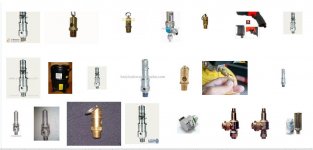
Pull it open. Does it purge?
Pull on what to open? Do you have a pic showing this?
Last edited:
Alchymist
Well-known member
Pull on what to open? Do you have a pic showing this?
Take your pick:
Attachments
roadlizard7
New member
The design of compressor tanks in the U.S. and Canada is typically to ASME Section VIII Div. 1 pressure vessel code. The "U" symbol inside a cloverleaf on the nameplate indicates all ASME requirements have been met by the manufacturer. The hydrostatic (water) test pressure required by ASME is 1.5 times the design pressure (or maximum allowable working pressure - MAWP). The design safety factor is 3.5 on a new tank with no corrosion. An old tank that has thinned due to corrosion will have lost some of that safety factor and not be capable of a 2 or 2.5 times hydro. A 1.5 times MAWP hydro would be about as high as you should go on an old tank to make sure it is safe and to keep from damaging the tank. Even a tank rupture with water is going to be very violent if you were up next to it when it happened, say to look at a pinhole leak or open the drain. Definitely do NOT attempt a 1.5 or higher pressure test with air only!!! Be safe guys.
This is correct. Virtually all tanks made these days, whether made in China or the USA have to be designed, inspected, and tested according to ASME Code. Almost everything found these days is a 200 PSI design tank with an ASME mandated corrosion allowance. Corrosion allowance is required to be greater on tanks for non-lube compressors, since lubricated compressors typically have some oil carryover, which helps protect the inside of the tank from corrosion.
I put 2250 PSI in my steel SCUBA tanks that were made in the 60's. You can find steel welding gas tanks that were made in the early 1900's that are still in service. The big difference is that these tanks/vessles are required, by the DOT, to be hydrostatically tested to a pressure of 5/3 the operating pressure every 5 years. Part of a hydro is a visual inspection on the inside and outside of the vessel.
Air compressor tank are not required to be hydroed because thay are not regulated by the DOT.
They're also visually inspected every year.
I'd actually use a steel 72 and still outlast students with AL80's at 3000psi. Plus its less weight I have to use.
I'm looking at getting an older compressor. have to remember to take a hammer.
Professur
Well-known member
I just talk to the guy that fills my welding tank ... he'll happily hydro test anything up to 500 gallons. He regularly does 100lbs propane tanks, so my 16g compressor tank is nothing. For a few bucks more, he tests out the safeties and switches too. I just drop it off with him every 2 years for an afternoon, and get it back knowing it's good for a while yet. He offers to coat the interior with some elastomer every time, but I've not bothered with it ...
GoodoleBoy
Well-known member
- Joined
- Mar 2, 2008
- Messages
- 252
I am sure that damage will buff right on out.
Whooooooooly ****.
Did you see the last post in that thread though with the Cast Pump?
Man o man...A life was lost in this Cast Pump Detonation. RIP

May as well post the pics up for people to see here also...


JohnFreeman
Well-known member
you are talking about the country that put antifreeze in dog food, lead exceeding fed rules in children's toys, that ignores international copyright laws?
.
+1000