To avoid these ads, REGISTER NOW!

Concrete contractor offering two options for reinforcement, thoughts?

Joined
Apr 24, 2020
Messages
21
Location
next to the house
So I've read so much on this topic, I feel like I've actually gone backwards in my ability to make a decision (the internet can be an awful place for the indecisive). Any input is appreciated.

Getting a pad put into my post frame, going to be a 6" in-floor radiant job. 2" foam, fiber reinforced, sawed at every post (roughly 8' squares). Originally this guy spec'd 1/2" rebar, which I was fine with, and actually preferred. Upon asking the density he would be using, he said their standard is that you'd see 3 bars in a 10' section (3 in one direction, so 3 across, 3 vertical). I was expecting a tighter layout, but it would obviously start adding up fast. He offered doing an industrial mesh instead if I prefer (panels instead of rolled), which has me thinking maybe I'd feel better with that. Question is, am I over-reacting to the layout he's proposing with rebar? ~3' squares* feels big to me, but I'm new at this. I know reinforcement won't stop cracking, that it's only there to prevent it from pulling apart/heaving up giant lips, so no need to beat me up there. :)

Contractor has been in business a long time and has great reviews, so I don't feel like I'm getting a skeevy sales job here, just feeling people out for their experiences.


*I suppose 3' assumes equal layout within the 10', if he means one on each side and one down the middle, that's suddenly 5' squares
 
To avoid these ads, REGISTER NOW!

infinkc

Well-known member
Joined
Jan 19, 2012
Messages
862
Sounds like a nice floor you are doing. If it were me, id just pay the extra for the rebar to do like a 2x2 grid. Cost cant be that much more and you would be much happier knowing it was done.
 

ncornilsen

Active member
Joined
Mar 3, 2022
Messages
27
Location
Roseburg OR
I am a licensed engineer but am not offering this advice in my professional capacity, and recommend you hire an engineer to assess the project in it's entirety and prescribe a re-enforcement plan.

Rebar on effectively 3'3" centers with fiber re-enforced concrete is probably fine for typical floor loading. If you didn't have fiber having the rebar 18"OC would be more appropriate.

In the former case, you're relying on the rebar to hold the various 8'x8' "Tiles" of concrete aligned with eachother, where the fiber will keep those 8' tiles crack free within themselves. 18 rebar will not hurt anything though.

In the latter case, the rebar on 18' centers is doing both.

May I also second the comment above - "Compaction, Compaction, Compaction!"
 

Half-fast eddie

Well-known member
Joined
Jul 10, 2021
Messages
1,479
Location
Virginia
And do you realize that the joints need to be sawn or troweled as soon as the concrete can support the machine? Next day can be too late. You might consider using zip-strips rather than sawing.
 

wssix99

Well-known member
Joined
Mar 2, 2011
Messages
5,153
Location
Chicago, IL
I know reinforcement won't stop cracking, that it's only there to prevent it from pulling apart/heaving up giant lips, so no need to beat me up there. :)

*I suppose 3' assumes equal layout within the 10', if he means one on each side and one down the middle, that's suddenly 5' squares

Engineering-wise, rebar vs. mesh doesn't really matter. The physics of the slab only care about the steel area ratio, which is the ratio of steel to concrete in the cross section. If you take the cross section of wire cross your 8' section and its greater than the cross section of the number of 1/2" rebar you would have in the same section, then you would have more reinforcement.

Things that matter - getting the reinforcement in the middle of the slab. Having the reinforcement on proper chairs, etc. (Not pieces of cinder block or rubble.)

Cutting the floor at 8' squares is very conservative. The rebar you are talking about isn't much, but with your control joints cut so close, you don't really need reinforcement at all.

My biggest worry for you would be if you plan on installing a lift. If you will be bolting a lift down to the floor, you will need to keep the posts away from all the control joints, like any other crack. With so many control joints, that might be a challenge.
 

BigLeagueSmoes

Well-known member
Joined
Feb 10, 2022
Messages
314
Location
Central IL
compaction, compaction, compaction.
:+1:

While having some formal education in engineering and construction management I can't say I can speak on the engineering specifics of rebar spacing or rebar vs. reinforcing mesh for this type of application without looking closer at a plan set or talking with a licensed engineer or the designer. I will say, however, when installing radiant heat in concrete I would always want to error on the side of over constructing because repairing concrete issues with radiant flooring in the future can get very expensive very fast. Obviously like you said, closer spacing >> more materials >> more dollars spent. Only you can decide if you can afford extra $$ and if you want to spend the extra $$. Based on your perception of the contractor being trustworthy, I would say whatever he recommends as the strongest/most robust option, go with that. One last thought... in the world of concrete and foundations, the pleasure of getting a lower price will fade quickly, but the pain of lower quality design/work will last forever.
 

mcbane

Well-known member
Joined
Jul 23, 2017
Messages
794
Location
California
The rebar you described is less than 1/2 the ACI minimum steel ratio for temperature and shrinkage control. It wont appreciably affect either strength or formation of cracks. If you aren't prepared to use at least minimum steel, IMHO there is no point in adding rebar and you can save some time and money by omitting the rebar. The fiber should help with crack control.
 
OP
P
Joined
Apr 24, 2020
Messages
21
Location
next to the house
Sounds like a nice floor you are doing. If it were me, id just pay the extra for the rebar to do like a 2x2 grid.

I suppose I could ask for the upcharge at 2', when I originally asked for clarification, I mentioned having seen other jobs at 1'. He advised I probably didn't want to use quite that much steel, and then offered the mesh option if I wanted that tight of spacing. I'm kind of stretching my budget to meet this guy's bid to begin with, seems to be a recurring theme. lol

compaction, compaction, compaction.

I almost have no business getting concrete in the first place with my paranoia of it shifting/cracking. To that end, I've done about as best I think I can compaction-wise. The pad was prepped with road base gravel last spring, then compacted with a 2-drum vibratory roller. It sat all summer undisturbed, taking several heavy rains. After they completed the build and twisting up the top layer with their equipment, I had it re-leveled with a track loader and ran one of those large reversible walk-behind plate compactors over it (the 700lb+ type, a neighbor just happened to have in his garage for some reason). Didn't get so far as a jumping jack or anything, but it's a gravel pad on gravel substrate -we're lucky to have lots of natural gravel here.

Rebar on effectively 3'3" centers with fiber re-enforced concrete is probably fine for typical floor loading. If you didn't have fiber having the rebar 18"OC would be more appropriate.

In the former case, you're relying on the rebar to hold the various 8'x8' "Tiles" of concrete aligned with eachother, where the fiber will keep those 8' tiles crack free within themselves. 18 rebar will not hurt anything though.

In the latter case, the rebar on 18' centers is doing both.

May I also second the comment above - "Compaction, Compaction, Compaction!"

When you refer to standard floor loading, I work on vintage woodworking and metalworking machinery, so it will be seeing some heavier items, including mills, lathes and large bandsaws.. Not sure if that's considered standard or high load... I don't plan on running large farm equipment in here, but a lift may show up down the road.

And do you realize that the joints need to be sawn or troweled as soon as the concrete can support the machine? Next day can be too late. You might consider using zip-strips rather than sawing.

This is one of those areas where I feel I just have to watch what the contractor does (within reason). I know how much they love the owner standing over them telling them how to do their job. Trying to find that balance. I've taken the tack of not caring about their feelings/I have to live with this thing before, but it's not a fun experience for anyone. On the topic of zip strips, my father in law has them and they didn't seem to accomplish much. I'll do some more reading, but I thought opinions were relatively low.

Things that matter - getting the reinforcement in the middle of the slab. Having the reinforcement on proper chairs, etc. (Not pieces of cinder block or rubble.)

Cutting the floor at 8' squares is very conservative. The rebar you are talking about isn't much, but with your control joints cut so close, you don't really need reinforcement at all.

My biggest worry for you would be if you plan on installing a lift. If you will be bolting a lift down to the floor, you will need to keep the posts away from all the control joints, like any other crack. With so many control joints, that might be a challenge.

Around here it sounds like there's very few contractors that use pump trucks or conveyors for smaller jobs like this (36'x48'). They all use buggies to move the concrete in and lift the reinforcement as they go. So at best it sounds like it should be pulled up, at worst it will be on top of the pex (which is still kind of 'up', but obviously less than ideal).

Very good point on the joints/potential lift locations for the future... I'll have to go look around and see what kind of problem this might cause.

Obviously like you said, closer spacing >> more materials >> more dollars spent. Only you can decide if you can afford extra $$ and if you want to spend the extra $$. Based on your perception of the contractor being trustworthy, I would say whatever he recommends as the strongest/most robust option, go with that. One last thought... in the world of concrete and foundations, the pleasure of getting a lower price will fade quickly, but the pain of lower quality design/work will last forever.

Agreed on the price thing. This is actually my most expensive bid by a few thousand dollars. Their reputation and a fairly comprehensive write-up of the job gives me some confidence (or at least hope) that I'm paying for a better job. I hope so, because I'm putting off other parts of the project to pay for it..


Thanks for the replies everyone!
 
OP
P
Joined
Apr 24, 2020
Messages
21
Location
next to the house
The rebar you described is less than 1/2 the ACI minimum steel ratio for temperature and shrinkage control. It wont appreciably affect either strength or formation of cracks. If you aren't prepared to use at least minimum steel, IMHO there is no point in adding rebar and you can save some time and money by omitting the rebar. The fiber should help with crack control.

Well, that's good info as well.. would wire mesh bring things back into line, or is that a relative waste as well? I feel like I need something in there.
 

racecougar

Well-known member
Joined
Jan 26, 2021
Messages
4,971
Location
Missouri
Around here it sounds like there's very few contractors that use pump trucks or conveyors for smaller jobs like this (36'x48'). They all use buggies to move the concrete in and lift the reinforcement as they go. So at best it sounds like it should be pulled up, at worst it will be on top of the pex (which is still kind of 'up', but obviously less than ideal).
That's pretty typical. Hopefully you're able to take that day off work to watch the pour. That will provide you with the peace of mind that you were able to see the contractor pulling up the rebar, or you'll be there to "remind" the contractor to do so.
 

MerlinsBeard

Well-known member
Joined
Mar 27, 2020
Messages
396
Location
MD
Whatever you decide, the most important thing is to be there for the pour. You don't have to get in their way, but you get one shot at it and if you see something, you have a chance to address it before it's set in stone.
 

NUTTSGT

Super Moderator
Staff member
Joined
Sep 14, 2009
Messages
50,849
Location
Northern Central Ohio
Sounds like you have the base already done, compacted, sat for some time and compacted again. I'd say that's one of the most important things checked off.
 

pl_silverado

Well-known member
Joined
Jul 1, 2005
Messages
2,033
Location
West Bradford, PA
I laid my own rebar, #4 - 12" grids with double around the perimeter, and poured 4000psi with fiber, 7-8" thick... every 3 feet, i wouldn't even bother putting it in personally, just go with fiber. Bundle of rebar cost me i think $600-700, cheap insurance.
 

JWILLIE1977

Well-known member
Joined
Jan 8, 2020
Messages
142
Location
WNY
Things that matter - getting the reinforcement in the middle of the slab. Having the reinforcement on proper chairs, etc. (Not pieces of cinder block or rubble.)
This.

The rebar you described is less than 1/2 the ACI minimum steel ratio for temperature and shrinkage control. It wont appreciably affect either strength or formation of cracks.
And this.

If you move forward with the "fibers". Be sure that the fiber is added by the ready mix concrete company, in the dosage prescribed by the fiber manufacturer.
 

Mr onetwo

Well-known member
Joined
Apr 6, 2011
Messages
2,001
Location
Coastal Maine
call me old fashioned....#4 rebar 12" OC on chairs...4000lb concrete 6" thick...infloor tubing stapled down to the foam . You will never have any problems with this formula
 
To avoid these ads, REGISTER NOW!

Bondo

Well-known member
Joined
Dec 22, 2007
Messages
2,549
Location
Greenfield, Maine
So I've read so much on this topic, I feel like I've actually gone backwards in my ability to make a decision (the internet can be an awful place for the indecisive). Any input is appreciated.

Getting a pad put into my post frame, going to be a 6" in-floor radiant job. 2" foam, fiber reinforced, sawed at every post (roughly 8' squares). Originally this guy spec'd 1/2" rebar, which I was fine with, and actually preferred. Upon asking the density he would be using, he said their standard is that you'd see 3 bars in a 10' section (3 in one direction, so 3 across, 3 vertical). I was expecting a tighter layout, but it would obviously start adding up fast. He offered doing an industrial mesh instead if I prefer (panels instead of rolled), which has me thinking maybe I'd feel better with that. Question is, am I over-reacting to the layout he's proposing with rebar? ~3' squares* feels big to me, but I'm new at this. I know reinforcement won't stop cracking, that it's only there to prevent it from pulling apart/heaving up giant lips, so no need to beat me up there. :)

Contractor has been in business a long time and has great reviews, so I don't feel like I'm getting a skeevy sales job here, just feeling people out for their experiences.


*I suppose 3' assumes equal layout within the 10', if he means one on each side and one down the middle, that's suddenly 5' squares
Ayuh,..... I like the sheet mesh, with less rebar, especially for tying down the pex for the radiant heatin',....
 

ConCretin

Well-known member
Joined
Jan 20, 2011
Messages
3,378
Location
Central Maine
I'm not sure what 'industrial' mesh is but assuming it's something like 6x6/2.9x2.9, I'd probably opt for that over widely spaced #4 bar. In either case, make sure it's properly supported before the placement.

Base, reinforcing, etc. are important but if I had to pick one thing to focus on, it would be controlling water. More slab failures are caused by excessive mix water than everything else combined. Give my Guide to Floor Slabs in the link below a read for some additional thoughts.

Congrats and good luck with your project.
 
Last edited:

rayra

Well-known member
Joined
Dec 1, 2014
Messages
4,724
Location
Escaped from Los Angeles
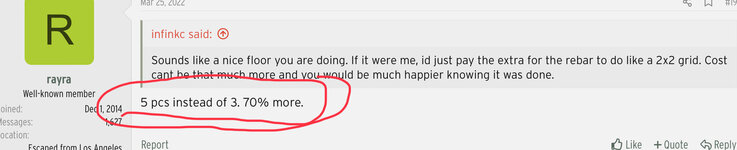
Wait … you need to buy 5 pcs of rebar instead of 3 pieces? Yes it’s 70% more, but in real dollars it’s pennies.
You bought any rebar lately? Building metals are all well into inflationary pricing.
Rebar, simpson brackets, wire reinforcement panels, it's all up 200-500% over the last 10yrs.
 

walrus

Well-known member
Joined
Nov 12, 2008
Messages
11,672
Location
Maine
You bought any rebar lately? Building metals are all well into inflationary pricing.
Rebar, simpson brackets, wire reinforcement panels, it's all up 200-500% over the last 10yrs.
You will have a hard time sourcing mesh also. Not sure why but its hard to find in Maine right now
 

mcbane

Well-known member
Joined
Jul 23, 2017
Messages
794
Location
California
You bought any rebar lately? Building metals are all well into inflationary pricing.
Rebar, simpson brackets, wire reinforcement panels, it's all up 200-500% over the last 10yrs.
I just checked pricing at wcrebar.com. By the ton, grade 60 domestic mfg rebar is still $950 per one ton bundle, vs $900 back in 2019. California prices btw.

The biggest difference in the market is that there is evidently no more ChiCom rebar (used to be $700/ton in 2019), probably because shipped cost are making that impractical.

So if the big box store is boosting prices 200-500% they are manipulating the price.
 

Half-fast eddie

Well-known member
Joined
Jul 10, 2021
Messages
1,479
Location
Virginia
You bought any rebar lately? Building metals are all well into inflationary pricing.
Rebar, simpson brackets, wire reinforcement panels, it's all up 200-500% over the last 10yrs.
You missed the point. Yes rebar price is up. Yes you are buying 70% more rebar. But you’re buying TWO additional pieces of rebar. The additional cost will be minimal … and the cost to redo the slab from not having TWO more pieces of rebar could be excessive. A whole new thread.

Just for fun ... what is the total cost of the slab … round numbers. And how much more is TWO pieces of rebar?
 

rayra

Well-known member
Joined
Dec 1, 2014
Messages
4,724
Location
Escaped from Los Angeles
You missed the point. Yes rebar price is up. Yes you are buying 70% more rebar. But you’re buying TWO additional pieces of rebar. The additional cost will be minimal … and the cost to redo the slab from not having TWO more pieces of rebar could be excessive. A whole new thread.

Just for fun ... what is the total cost of the slab … round numbers. And how much more is TWO pieces of rebar?


I'm sure YOU missed the point, not I. It's two more RUNS of rebar per 10' of span. IN both axes. 70% more for the whole project. I'm not sure where you get that silly '2 additional pieces' garbage from.
 

theoldwizard1

Well-known member
Joined
Feb 22, 2011
Messages
43,072
Location
SE MI
I'm not sure what 'industrial' mesh is but assuming it's something like 6x6/2.9x2.9, I'd probably opt for that over widely spaced #4 bar. In either case, make sure it's properly supported before the placement.
LL would is a pro. Take his advice !!

Unless you are planning on parking heavy equipment on your slab, I concur. Mesh is adequate.
 
OP
P
Joined
Apr 24, 2020
Messages
21
Location
next to the house
Thanks for the feedback everyone. Checking back in as things are moving along...

I'm not sure what 'industrial' mesh is but assuming it's something like 6x6/2.9x2.9, I'd probably opt for that over widely spaced #4 bar. In either case, make sure it's properly supported before the placement.

Base, reinforcing, etc. are important but if I had to pick one thing to focus on, it would be controlling water. More slab failures are caused by excessive mix water than everything else combined. Give my Guide to Floor Slabs in the link below a read for some additional thoughts.

Congrats and good luck with your project.

Thanks, I've read your guide a few times now, it's been a great help. So what say you about 2' spacing of #4 vs mesh?

Water is the next big neurosis I've been cultivating. Unfortunately, it's one of those topics I don't feel that I have a ton of power over. So much of the cement's lifecycle is out of my view, it seems like anything could happen, from water being added in transit to a signal to the driver from the far end of the chute as it's coming down. I feel like all I can do is let out a HEY!! if someone starts squirting the pad during finishing, but at that point the horse has already left the barn.

Just for fun ... what is the total cost of the slab … round numbers. And how much more is TWO pieces of rebar?

Well, it's not a clean answer, as the building has couple outside components included (apron, etc). Let's just say in round numbers that the whole project (6-bag, 6" main pad, fiber, low chert, cut and sealed) is about $20K and those two pieces add about 8%.
 
Last edited:

Half-fast eddie

Well-known member
Joined
Jul 10, 2021
Messages
1,479
Location
Virginia
Well, it's not a clean answer, as the building has couple outside components included (apron, etc). Let's just say in round numbers that the whole project (6-bag, 6" main pad, fiber, low chert, cut and sealed) is about $20K and those two pieces add about 8%.
Two pieces of rebar adds $1600?

Water in the mix. It leaves the batch plant with the proper ratio of water/cement/aggregate. The drver isn't going to add any water on his own. The finisher is going to look in the truck, pronounce it too dry, and tell the driver to add a 50 gallons. All you need to do is tell the driver you want it the way it was batched.
 

K'ledgeBldr

Well-known member
Joined
Aug 22, 2011
Messages
1,925
Location
Johns Creek, GA
Water is the next big neurosis I've been cultivating. Unfortunately, it's one of those topics I don't feel that I have a ton of power over. So much of the cement's lifecycle is out of my view, it seems like anything could happen, from water being added in transit to a signal to the driver from the far end of the chute as it's coming down. I feel like all I can do is let out a HEY!! if someone starts squirting the pad during finishing, but at that point the horse has already left the barn.
The batch is the batch for a certain slump.
Water goes on the bare ground- not in the concrete. Contractors will usually want to add water for work-ability.
 

brownbagg

Well-known member
Joined
Mar 20, 2006
Messages
5,208
three variable, they all do diferent jobs
rebar, weld wire fabric, fiber

welded wire fabric and fiber are for stress cracks in the first 48 hours, after that, they do nothing
rebar is for load factors, it does nothing till a load is applied. like weight

you can place a slab on compacted soil with no rebar or welded wire, and it does nothing till a load is applied, when a load, even the curing of concrete, is applied, the concrete will curl, when this happens it cracks. so you need some rubber bands.

when it starts to curl the so called rubber band will pull bacjk and counter act the bending, that would be rebar, you can bend rebar but pulling rebar is more diffucult 60,000 pounds diffulcult, this going be confusing bare with me.

so when the truck parks on the slab, the slab wants to move in a curl. the force is on the end of the rebar, concrete curl, pull on rebar, one reason both ways bars are placed. rebar are for load factors, they do not do the job as fiber and welded wire mesh

when concrete begins to cure, first couple hours, its pulls in multi directions, that why it always cracks on a corner, welded wire mesh and finer counter acts this in first 48 hours after that the concrete has built enough strength to hold its self

curing compounds blankets, water reducers and even fly ash will slow down the curing, reduce heat and it will control the cracking. old days we kept a slab underwater for 28 days

finisher water, that when you let a high school drop out dope head control your $120 a yard 3000 psi concrete into a 1400psi that crack like crazy

there only two ways to screw of concrete 1) concrete driver 2) concrete finisher, keep both away from the water valve, and the concrete be good.

if the person not writing the check to the concrete company, he cant play with the valve

so on a typical 4 inch slab, 3000 psi concrete, just to park a car, you dont need wire, rebar to hold together on a compacted base
 
OP
P
Joined
Apr 24, 2020
Messages
21
Location
next to the house
When it comes to the shrinkage part of the conversation, it seems like pouring around posts is generally a bad plan, that one should instead board that off so you're just putting down a slab with 4 flat sides.. I'll have to go do some reading to what people normally do and possibly add some lumber here.
 

brownbagg

Well-known member
Joined
Mar 20, 2006
Messages
5,208
put a five gallon bucket around the post, after the slab is hard a couple weels, pull the bucket and fill with grout. If you block out the slab with wood, it will crack on a corner
 

ConCretin

Well-known member
Joined
Jan 20, 2011
Messages
3,378
Location
Central Maine
So what say you about 2' spacing of #4 vs mesh?

Water is the next big neurosis I've been cultivating. Unfortunately, it's one of those topics I don't feel that I have a ton of power over. So much of the cement's lifecycle is out of my view, it seems like anything could happen, from water being added in transit to a signal to the driver from the far end of the chute as it's coming down. I feel like all I can do is let out a HEY!! if someone starts squirting the pad during finishing, but at that point the horse has already left the barn.
The primary advantage of rebar over mesh is it's rigidity, which helps keep it off the ground and allows you to space out the supports a bit.

With regard to mix water, one option would be to use a mid range water reducer to get the slump into the 5-6" range. It might cost a couple bucks more but it would provide a workable mix without adding too much water. Keeping them from applying water to the slab to assist in finishing usually requires careful monitoring.
 
To avoid these ads, REGISTER NOW!
Top Bottom