To avoid these ads, REGISTER NOW!

Concrete failure during 2 Post Lift install

Joined
Sep 4, 2015
Messages
23
***UPDATE***

Hey all,

So I talked to the owner of the company about what happened. To make a long story short, he came back out with the same 2 installers and installed another anchor in the same area that failed.

This time making sure to blow out any and all debris in the hole.

We dropped the anchor in again, and it went right to the bottom. (I verified with a Powers engineer that this is typical when using a brand new drill bit)

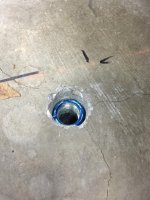
It took around 10 good hammer blows to easily set the anchor. Verified by the blue paint on the top of the anchor being removed.

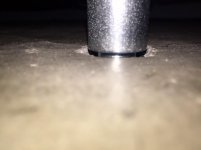
And the result? No cracks!

The owner agreed the reason the anchors did not set all the way was because of the dust from drilling left in the hole. When they did not fully set, the installers hammered harder and harder on them until the concrete failed.

So he said they will do a pad for me at that spot for free. I wish the installers would have been less half-assed and more detail oriented. I hired them for their expertise in lift installations and not just for manual labor.

Anyways, I could have been working on my track car, but instead now I get to wait for concrete to dry. Yay

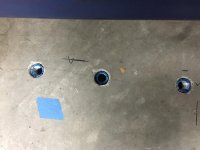
(Uploaded a new picture showing the new anchor and no cracks connecting to either of the holes next to it)


original post
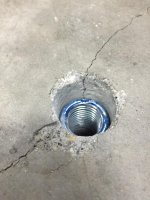
During install of my 2 post lift today, I observed cracking that propagated from each of the anchor holes while the Power's 3/4 anchors were being set. (using the proper setting tool)

It took a lot of hard hits and the installers were still not able to seat the setting tool against the top of the anchor to remove the blue paint (per instructions included with the anchors).

A test hole was drilled prior to the install and they drilled 6 inches deep and did not get through the slab. The previous owner told me it was 8 inches thick.

The installers said they could not continue the install and that I would need footers to be poured.

:sad:

I am quite surprised to find out that the concrete was not 3000psi rated?? For an 8 inch thick slab of concrete in the garage?? House was built in 1997.

Please post your thoughts on the concrete.


**One point of major concern is: How close can I pour a footer to the side wall of the garage?

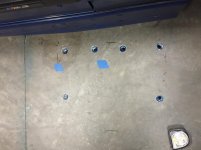
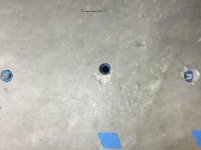
As you can see in the picture, I had the base plate about 3 inches away from the wall. This gave me 3.5 feet of space to work on that side of the car, which I thought was enough. It also allowed me to park another car in the garage with the lift in place. Is it possible to pour the footer right next to the wall?
 

Attachments

  • 9.jpg
    9.jpg
    141.7 KB · Views: 742
  • 6.jpg
    6.jpg
    140.9 KB · Views: 733
  • 8.jpg
    8.jpg
    143.6 KB · Views: 632
  • 7.jpg
    7.jpg
    141.9 KB · Views: 644
  • 10.jpg
    10.jpg
    140.2 KB · Views: 704
  • 3.jpg
    3.jpg
    99.9 KB · Views: 598
  • IMG_2865.jpg
    IMG_2865.jpg
    142.3 KB · Views: 189
Last edited:
To avoid these ads, REGISTER NOW!

OccupantRJ

Well-known member
Joined
May 15, 2009
Messages
11,131
Location
Eastern North Carolina
I am usually a frugal guy, and I have millwright experience, but with what is going to be supported in that multi-cracked area, in this case I would pour new footer areas for the lift. I would think you could pour footers as close as a cut through the concrete could be made or chipped out next to the wall. Those fractures will come to no good, and will only get worse.
 

larry4406

Well-known member
Joined
Jan 27, 2006
Messages
19,336
Location
Northern Virginia
Not sure what type of slab and foundation wall construction you have. When you break out your floor for repair you may encounter the footing for the foundation wall. You can locally excavate under the wall footing (a process called underpinning) so as to increase your footing depth for the lift. Your new lift footing will be flush to the slab surface and the wall.
 

brickG-man

Well-known member
Joined
Jul 31, 2011
Messages
134
Location
Chicagoland
How do you know that the concrete was not 3000 psi? Did they test a piece? I suspect that being so close to the wall (end of the slab) is what made it crack. Cut it out and pour a nice deep footing with a very compacted base. My suggestion would be since it's so close to the edge to over-cut it. It won't be that much work once you get started on it.
 

matt_i

Well-known member
Joined
Mar 14, 2008
Messages
10,728
Location
SE Michigan
I'm thoroughly amazed those "flush floor" anchors are allowable to hold down a vehicle lift. In my opinion, they are the weakest expansion anchor*. And, if they had big hammers out like a sledgehammer, next to an already cracked area on a corner (the saw cut has a crack all the way thru it likely) with no rebar inside (never will know until you saw cut) it would lead to exactly that.

Had you confirmed thickness and set epoxy anchors you would probably now be hoisting cars. I can see why they aren't popular with "professional" installers as they have to be set, then the epoxy has to cure, before the nuts are torqued requiring a return visit.

When you pour a new pad-base, make sure you pin it with rebar to the cut-sides of the existing slab, as also not to interfere with the projected stud locations.

Personally, I'd be very mad at the installers if they tried to pull some low-budget stuff like that on me, ruining my concrete floor in the process and leading to hundreds of $ in rework....but...I also would not have hired installers in the first place.


* the one crowning feature of a "flush floor anchor" in my opinion is that if one has something like a shop area where one needs to be OSHA compliant and bolt down equipment, yet can't be cutting off wedge anchor studs every time a piece of equipment needs to be moved for a special project, or accessed from the back for repairs, then one would install just that. If its a permanent install, wedge-stud-anchors for light duty, epoxy anchors for something undergoing high forces or vibration.

The wedge-stud anchors, while presumably reusable under a temporary relocation scenario, are a complete PITA when it comes to rigging heavy machinery on and off the studs, armed with a forklift as a prime rigging tool. The studs get bent, threads smooshed over, and each one has to be caution-taped as its one of the most egregious trip hazards known. However, with flush floor anchors, machines slide around, slide them back into position, retighten the bolts.
 
Last edited:

Astro-t

Well-known member
Joined
Jan 5, 2010
Messages
55
Location
Pennsylvania
You should cut out concrete for footings! That cracking could result in a injury! I see they used drop in anchors? Most lift installs I notice they use thunder stud anchors! I have seen drop in anchors pull out!
 

Astro-t

Well-known member
Joined
Jan 5, 2010
Messages
55
Location
Pennsylvania
That blue paint is used to hold the wedge inside the anchor! I have used drop in anchors were the wedge inside was missing or flipped upside down, making the anchor not set!
 
OP
A
Joined
Sep 4, 2015
Messages
23
How do you know that the concrete was not 3000 psi? Did they test a piece? I suspect that being so close to the wall (end of the slab) is what made it crack. Cut it out and pour a nice deep footing with a very compacted base. My suggestion would be since it's so close to the edge to over-cut it. It won't be that much work once you get started on it.

I assumed since it cracked between all the holes that it was not strong enough. And actually, they installed the anchors in the holes that were in the middle of the garage first. They didnt even finish drilling the holes near the wall after they saw the first set of holes form a crack between them.


I'm thoroughly amazed those "flush floor" anchors are allowable to hold down a vehicle lift. In my opinion, they are the weakest expansion anchor*. And, if they had big hammers out like a sledgehammer, next to an already cracked area on a corner (the saw cut has a crack all the way thru it likely) with no rebar inside (never will know until you saw cut) it would lead to exactly that.

Had you confirmed thickness and set epoxy anchors you would probably now be hoisting cars. I can see why they aren't popular with "professional" installers as they have to be set, then the epoxy has to cure, before the nuts are torqued requiring a return visit.

When you pour a new pad-base, make sure you pin it with rebar to the cut-sides of the existing slab, as also not to interfere with the projected stud locations.

Personally, I'd be very mad at the installers if they tried to pull some low-budget stuff like that on me, ruining my concrete floor in the process and leading to hundreds of $ in rework....but...I also would not have hired installers in the first place.


* the one crowning feature of a "flush floor anchor" in my opinion is that if one has something like a shop area where one needs to be OSHA compliant and bolt down equipment, yet can't be cutting off wedge anchor studs every time a piece of equipment needs to be moved for a special project, or accessed from the back for repairs, then one would install just that. If its a permanent install, wedge-stud-anchors for light duty, epoxy anchors for something undergoing high forces or vibration.

The wedge-stud anchors, while presumably reusable under a temporary relocation scenario, are a complete PITA when it comes to rigging heavy machinery on and off the studs, armed with a forklift as a prime rigging tool. The studs get bent, threads smooshed over, and each one has to be caution-taped as its one of the most egregious trip hazards known. However, with flush floor anchors, machines slide around, slide them back into position, retighten the bolts.

They were using a hand held mini-sledge. The Power's anchors are what shipped with the lift that I bought.

I have been thinking "what if" I used epoxy anchors also. Because the cracks didn't form when the holes were drilled. They formed when setting the anchors.

But then I think that if the concrete cracked from just trying to set an anchor, wouldn't it crack even more with the weight of a vehicle on the lift?

There are no cracks between the holes at the post location near the wall. All the holes arent even drilled yet. Would it be safe to use epoxy anchors for the post near the wall in the existing concrete? And then pour one footer at the other post location (the one that cracked)?
 

ozyborn

Well-known member
Joined
Apr 26, 2011
Messages
686
Mark, cut, remove, pour footings. problem solved. I did not even try on my floor. I just poured footings and part of installing the lift.
 

jonjon1

Well-known member
Joined
Mar 11, 2015
Messages
1,036
I have to agree with the guys here, I know it sounds like a pita to do, but its not that bad, rent a saw, cut the floor, dig it all out, pound the snot out of it, pour it nice and level, smooth it over and try again, you will be happy with the outcome, its a days work, and you dont have to worry after that, no cars dropping on your head, lol...

Where are you located?
 

LS6 Tommy

Well-known member
Joined
Dec 27, 2013
Messages
26,162
Location
Northern NJ
I may be WAY off here, but I've set literally hundreds of wedge type anchors. Never had the hammering process crack anything...

Tommy
 

Daedalus

Well-known member
Joined
Sep 28, 2009
Messages
6,023
I hope the installers already considered this, but do the anchors' locations meet the manufacturer's minimum edge distance and spacing requirements? For example, a WejIt 3/4" power drop anchor has a min distance of 5 1/4 inches to the nearest slab edge and between anchors.
 

T_R

Well-known member
Joined
Jul 2, 2015
Messages
902
Location
Maine
I may be WAY off here, but I've set literally hundreds of wedge type anchors. Never had the hammering process crack anything...

Tommy

That was my thought. I've watched probably 10 lifts installed over the years so figure 100 anchors and have never seen a floor crack.

Seems more like installer error to me.
 

krandrew

Member
Joined
Feb 18, 2015
Messages
8
Location
Edmonton Ab
My guess is that the slab is missing rebar + also has a very low strength. A drop in anchor should never cause something like that.
 
OP
A
Joined
Sep 4, 2015
Messages
23
I have to agree with the guys here, I know it sounds like a pita to do, but its not that bad, rent a saw, cut the floor, dig it all out, pound the snot out of it, pour it nice and level, smooth it over and try again, you will be happy with the outcome, its a days work, and you dont have to worry after that, no cars dropping on your head, lol...

Where are you located?

Im in socal, near LA.


Are those threaded inserts only about 1in long? Can't really tell from the pics.

The inserts are the Powers brand anchors that take a 3/4 bolt and they are 3 inches long.


I may be WAY off here, but I've set literally hundreds of wedge type anchors. Never had the hammering process crack anything...

Tommy

Have you ever had the setting tool not come in contact with the top of the anchor and remove the blue paint?


I hope the installers already considered this, but do the anchors' locations meet the manufacturer's minimum edge distance and spacing requirements? For example, a WejIt 3/4" power drop anchor has a min distance of 5 1/4 inches to the nearest slab edge and between anchors.

The anchors were not supplied by the installers. They were shipped with the lift that I ordered from National Auto Tools. It is the Triumph C7000 and I bought it after reading good reviews from this forum.


That was my thought. I've watched probably 10 lifts installed over the years so figure 100 anchors and have never seen a floor crack.

Seems more like installer error to me.

What kind of installer error would lead to this failure? All they did was drill the holes using the base plate as a template. Then they dropped in the anchors and set them. The cracks showed up when they were setting the anchors. Do you think they hammered too hard on the anchors to set them?


My guess is that the slab is missing rebar + also has a very low strength. A drop in anchor should never cause something like that.

The previous owner of the house who was also the builder told me it was 8 inch thick concrete with rebar. I really don't get why he would pour an 8 inch thick slab and not use 3000+psi concrete.


Its unfortunate that this happened. It bums me out because I was all set to use the lift this holiday weekend. I wanted to install it myself but since I havent installed a lift before, I figured I should trust someone with experience (I hired a company called Airdraulics and they do the lift installs at large dealerships). So much for that...
 

T_R

Well-known member
Joined
Jul 2, 2015
Messages
902
Location
Maine
What kind of installer error would lead to this failure? All they did was drill the holes using the base plate as a template. Then they dropped in the anchors and set them. The cracks showed up when they were setting the anchors. Do you think they hammered too hard on the anchors to set them?

Yes I think they beat on them too hard and too much. perhaps they didn't drill a large enough hole?

Why did they continue after cracking the first one? They should have stopped at that point where the floor was still savable with epoxy anchors.
 

182RG

Well-known member
Joined
Sep 26, 2015
Messages
74
Yes I think they beat on them too hard and too much. perhaps they didn't drill a large enough hole?


^ This ^ Seems like an obvious question, but did they drill a hole large enough? Did they vacuum it out? Was it deep enough? Did they follow Powers specs for install? For homeowner, perm install, I would have used wedge anchors. I've used 3/4 concrete anchors before, and never had to use a sledge hammer?


Sent from my iPad using Tapatalk
 
Last edited:

tcianci

Well-known member
Joined
Feb 7, 2009
Messages
4,242
Location
Walpole, Ma
To the OP,
Now that you have a great deal of everyone else's experience and all kinds of opinions and precious little good information, you have hereby been bestowed the Garage Journal Useless Answer Award. This award gives you the authority to approach the manufacturer of the product in question and get useful, factual information for your situation.
 

182RG

Well-known member
Joined
Sep 26, 2015
Messages
74
It took a lot of hard hits and the installers were still not able to seat the setting tool against the top of the anchor to remove the blue paint (per instructions included with the anchors).


Should have been a 1" hole.


Sent from my iPad using Tapatalk
 
To avoid these ads, REGISTER NOW!

myredracer

Well-known member
Joined
Nov 1, 2015
Messages
557
Location
Langley, BC
If it were me at this point, I would go talk to a structural engineer and get a proper answer and recommendation. Too much at stake and too much guessing.
 

Daedalus

Well-known member
Joined
Sep 28, 2009
Messages
6,023
The anchors were not supplied by the installers. They were shipped with the lift that I ordered from National Auto Tools. It is the Triumph C7000 and I bought it after reading good reviews from this forum.

That doesn't answer the question. The anchor manufacturer specifies requirements for placement of the anchors relative to one another, and relative to the edge of the slab. Hopefully the hole pattern in the baseplate does not violate these requirements. The anchors begin to lose capability if less than 9-1/2" apart, and under no circumstances are they to be less than 5" apart. Moreover, the lift manufacturer did not dictate the location of the lift right next to the edge of the slab, and clearly that distance does not meet the minimum 6-1/2" required.

If the installer allowed you to place the lift that close to the edge of the slab, they obviously aren't very familiar with the anchors being installed. I can only wonder what other details or nuances they may have missed.

Specs are here.
 
OP
A
Joined
Sep 4, 2015
Messages
23
Yes I think they beat on them too hard and too much. perhaps they didn't drill a large enough hole?

Why did they continue after cracking the first one? They should have stopped at that point where the floor was still savable with epoxy anchors.


^ This ^ Seems like an obvious question, but did they drill a hole large enough? Did they vacuum it out? Was it deep enough? Did they follow Powers specs for install? For homeowner, perm install, I would have used wedge anchors. I've used 3/4 concrete anchors before, and never had to use a sledge hammer?


Sent from my iPad using Tapatalk

They drilled a 1 inch hole which is what the instructions called for. They had a brand new drill bit and they did vacuum out the hole.


By wedge anchors, what do you mean? The type that have a threaded rod sticking out of the floor?

I wanted to be able to remove one post and move it out of the way if I ever needed open floor space to work.
 

boobag

Well-known member
Joined
Aug 15, 2010
Messages
397
what kind of anchors are these? i find it hard that they could crack the floor.
 

AJ1978

Well-known member
Joined
Apr 27, 2010
Messages
239
Location
Jamestown, PA
Looking at this whole install I am trying to figure out why a said 2 post lift would be that close to the wall to begin with. I am not trying to slam anyone but if the post is that close how will you work on anything. Something obviously went wrong but where and why?
 

LS6 Tommy

Well-known member
Joined
Dec 27, 2013
Messages
26,162
Location
Northern NJ
Have you ever had the setting tool not come in contact with the top of the anchor and remove the blue paint?

Nope. I followed the directions and everything went as planned. Every single time. That being said, I don't have the expertise to pass judgement on the mason that poured the floor or the guys who set the anchors. Maybe the holes were too deep? IDK...

Tommy
 
Last edited:

Slowgsr

Well-known member
Joined
Nov 14, 2014
Messages
610
Location
Southern ontario
I use those anchors overhead to hang transformers and lighting Not my favourite but never had one fail

I bet it cracked because it was too close to the edge, too much pounding stressed the slab. I haven't seen anything less then 3000psi come out of a cement truck. Should have used a different anchor style.

Saw cut, break and pour some footings. Pin into the existing slab. Use different anchors or better yet template and place anchor bolts in the pour. That's what I do for light pole installations. Careful measuring
 

joes169

Well-known member
Joined
Sep 19, 2011
Messages
663
Location
WI
It sounds real easy for everyone to type "saw cut & repour",, but you're not going to go down to the local homeowner's rental store to get a saw for this if it really is 8" thick. You're going to need a 24" walk behind saw, not ann everyday occurance at rental yards. I'd try to get a bid on saing & removal from a company that only saws concrete.

As for the strength, if it was ordered as 3000 psi, I wouldn't be one bit surprised if it's actually closer to 2000 psi in strength in actuallity.......
 

krandrew

Member
Joined
Feb 18, 2015
Messages
8
Location
Edmonton Ab
We can speculate all day so if you want a path going forward, I would recommend this:

1) Core the slab and send the core to a concrete testing facility to get the in-situ strength of your slab
2) At the same time, you can scan the slab to see if there is in fact rebar in it and get a rough idea of the spacing. You might see a piece of rebar or mesh in the actual core from step 1.
3) Discuss the options with a qualified engineer after getting the results from the testing

The engineer can tell you what size of slab to cut out & repour with a certain strength concrete. It would also involve installing some rebar around the anchor locations to prevent cracking and doweling with rebar into the existing slab to tie them together.

You can order concrete to have 3000+ psi strength within 3-4 days.

I wouldn't bother corresponding with the manufacturer on this issue. The issue is related to the concrete slab more then anything. When you tighten wedge anchors, similar forces to a drop-in anchor are trying to spread the concrete apart. Likely the same issues would have came up with any expansion type anchor. The edge distance is a small factor, considering the crack doesn't even propagate to the closest hole from the edge.
 

duanesz

Well-known member
Joined
Mar 20, 2009
Messages
58
Location
S.E. Michigan
During install of my 2 post lift today, I observed cracking that propagated from each of the anchor holes while the Power's 3/4 anchors were being set. (using the proper setting tool)


It took a lot of hard hits and the installers were still not able to seat the setting tool against the top of the anchor to remove the blue paint (per instructions included with the anchors).


A test hole was drilled prior to the install and they drilled 6 inches deep and did not get through the slab. The previous owner told me it was 8 inches thick.


The installers said they could not continue the install and that I would need footers to be poured.


:sad:


I am quite surprised to find out that the concrete was not 3000psi rated?? For an 8 inch thick slab of concrete in the garage?? House was built in 1997.


Please post your thoughts on the concrete.


**One point of major concern is: How close can I pour a footer to the side wall of the garage?


As you can see in the picture, I had the base plate about 3 inches away from the wall. This gave me 3.5 feet of space to work on that side of the car, which I thought was enough. It also allowed me to park another car in the garage with the lift in place. Is it possible to pour the footer right next to the wall?


I'm a millwright and have installed thousands of anchors of all types. Only time we ever have cracking issues is to close to edge or to saw cut lines. I'm surprised they put that one post so close to saw cut. The lift I'm getting says right in insulation instructions not to install post closer than 1 foot from any crack expansion joint or saw cut. Also if they had to beat on anchor so hard to set it the bit on drill was worn out. Every time we start having a hard time driving in anchors we get a new bit and they drive down no problem in next hole.


Sent from my iPhone using Tapatalk
 

pmiranda

Well-known member
Joined
Jul 15, 2008
Messages
1,504
Location
Austin, TX
I'm surprised they put that one post so close to saw cut. The lift I'm getting says right in insulation instructions not to install post closer than 1 foot from any crack expansion joint or saw cut.

This. I thought 1 foot was a pretty common rule of thumb. :dunno:
 
OP
A
Joined
Sep 4, 2015
Messages
23
ABOUT THE POST BEING TOO CLOSE THE THE WALL:

I want to make this more clear to everyone:

The holes you see in the picture that have the crack running between them ARE IN THE MIDDLE OF THE GARAGE.

If you look at the picture near the wall, only two 1 inch holes are drilled. They did not even attempt to install the anchors in the holes next to the wall after the first set of holes developed a crack.

So lets leave out the fact that the post may have been too close to the wall. Because those are not the holes that failed. Maybe they would have failed also if the anchors were installed. But they were not installed in those holes so it has nothing to do with the concrete cracking.
 
OP
A
Joined
Sep 4, 2015
Messages
23
That doesn't answer the question. The anchor manufacturer specifies requirements for placement of the anchors relative to one another, and relative to the edge of the slab. Hopefully the hole pattern in the baseplate does not violate these requirements. The anchors begin to lose capability if less than 9-1/2" apart, and under no circumstances are they to be less than 5" apart. Moreover, the lift manufacturer did not dictate the location of the lift right next to the edge of the slab, and clearly that distance does not meet the minimum 6-1/2" required.

If the installer allowed you to place the lift that close to the edge of the slab, they obviously aren't very familiar with the anchors being installed. I can only wonder what other details or nuances they may have missed.

Specs are here.


I just measured the spacing of the holes on the lift post itself. There are 6 holes and 2 of them are 4.75 inches center to center. The others are all more than 5 inches away from each other.

No one ever mentioned this in the threads about the Triumph C7000 from NAT. Seems very stupid to ship anchors with a lift that do not match up with the requirements properly.
 
OP
A
Joined
Sep 4, 2015
Messages
23
Called the pro's and they undersized the holes, that *****.

I don't think they undersized the holes... Maybe oversize? Or not deep enough.

The instructions state to tap the anchor flush with the surface if necessary.

After they drilled the holes, the anchors dropped in and went right to the bottom of the hole.
 

coldh2o

Well-known member
Joined
May 21, 2013
Messages
1,428
Location
Ontario, Canada
I don't think they undersized the holes... Maybe oversize? Or not deep enough.

The instructions state to tap the anchor flush with the surface if necessary.

After they drilled the holes, the anchors dropped in and went right to the bottom of the hole.

Oversize and too deep then? Why were they banging on them if they dropped right in, and what were they hitting them with?
 

duanesz

Well-known member
Joined
Mar 20, 2009
Messages
58
Location
S.E. Michigan
Those anchors use a set tool. When you drive tool into anchor it sets the wedge. Then when you tighten anchor it fully sets it.


Sent from my iPhone using Tapatalk
 
OP
A
Joined
Sep 4, 2015
Messages
23
Oversize and too deep then? Why were they banging on them if they dropped right in, and what were they hitting them with?

Those anchors use a set tool. When you drive tool into anchor it sets the wedge. Then when you tighten anchor it fully sets it.


Sent from my iPhone using Tapatalk


Correct. They were hammering on the setting tool. The tool needs to seat against the top surface of the anchor. With repeated blows, it was not moving down at all and did not come in contact with the anchor.

I believe that the hole was drilled too shallow. But Im not sure. Wondering if anyone has experience with trying to set an anchor in a hole that is not deep enough. Did you find it would not set completely?
 
To avoid these ads, REGISTER NOW!
Top Bottom