To avoid these ads, REGISTER NOW!

Concrete Slab Questions

Model A Fan

Well-known member
Joined
Dec 1, 2011
Messages
1,220
Location
NW Washington
I'm going to be prepping for a concrete slab in my driveway. I have finally gotten tired of having to crawl in the gravel and am going to pay for one to be poured.

I'm going to go with a slab that is 22'x25'x6" deep. I want to be able to roll my projects out into the driveway without having to worry about the gravel making them tip over or difficult to roll. I am also planning on doing some of the prep-work myself to save money. A buddy will be helping me with the concrete laying and finishing, and probably the frames if I can get him to offer his advice.

The plan is to reinforce it with rebar so it is tough and strong. I was wondering if there were any "additions" to the concrete slab anyone would make. Some people put a pit for their garage or a lift is built in. Are there "additions" to the slab anyone would recommend?

Any comments or advice for laying this project down? I am going to hire a guy with an excavator to come and do the digging portion.

I am planning on him digging approximately 8" deep so I can compact gravel underneath to the depth of 6" for the concrete. He said he'd be able to knock out that amount of space in about three hours or so at the cost of $300.

I'm paying my buddy about $250 for his help finishing and pouring.

Any framing advice?

Thanks! :beer::dunno::D
 
To avoid these ads, REGISTER NOW!

Dick in Wisconsin

Well-known member
Joined
Mar 3, 2012
Messages
3,048
Location
Shawano, Wisconsin
I'm wondering if it makes sense to put something like 6mil poly under an outdoor concrete slab so that vehicles parked on the slab won't get inundated with all the moisture that could wick up through the concrete and rust the frame.
 

chrism0107

Well-known member
Joined
Jun 4, 2012
Messages
252
if you are planning a pit you might want to check with your home insurance on any cost or other issues that could or would affect a decision to add it. and also county or city code that might apply.
 
OP
M

Model A Fan

Well-known member
Joined
Dec 1, 2011
Messages
1,220
Location
NW Washington
I think I may have been misunderstood.

I am planning a 22'x25'x6" slab right in front of my garage (level with the garage floor so they touch). I want to be able to roll projects out into the driveway so I have a clean, level workspace to work on. I hate walking in the gravel, inadvertently kicking it into my garage, not being able to roll things with casters on the drive way or pick engines out of cars.

I'm not putting a pit in, I was just wondering if there would be features you could think to incorporate into a new cement driveway. Nothing will stay on the driveway long term, perhaps overnight if it is dry and summertime.
 

oilslick

Well-known member
Joined
Feb 19, 2011
Messages
1,925
Location
Central illinois
Put lots of steel in it, not mesh. Don't add water to the truck, have plenty of help placing it and at least two who know whats going on is my advice. Never hurts too have somewhere to go with extra crete if you order too much.
 

brownbagg

Well-known member
Joined
Mar 20, 2006
Messages
5,208
I'm wondering if it makes sense to put something like 6mil poly under an outdoor concrete slab so that vehicles parked on the slab won't get inundated with all the moisture that could wick up through the concrete and rust the frame.

ok, never heard that one before, going save that quote
 
Last edited:

BADSIX

Well-known member
Joined
Nov 30, 2010
Messages
895
Location
oregon coast
Put lots of steel in it, not mesh. Don't add water to the truck, have plenty of help placing it and at least two who know whats going on is my advice. Never hurts too have somewhere to go with extra crete if you order too much.

THIS and two times on the extra help!
Jay D.
 

Cyberbear

Well-known member
Joined
Nov 23, 2013
Messages
1,524
Location
California
Make certain to use at least a six bag mix on the concrete, #3 rebar at 12" o/c, and be sure you have someone, or two, that knows how to properly finish the concrete surface for smoothness and level as much as possible, if not, definitely hire a pro.
 

ms fowler

Well-known member
Joined
Jun 27, 2012
Messages
450
Location
Littlestown, PA _ 6 miles south of Gettysburg
I would tell the concrete company what I was doing, and listen to their advice on the mix design. I would also tell them that we are amateurs at placing concrete, and probably want it a little wet so that we can get it placed and leveled more easily. They can design a mix with a high slump--say 6" that will be as strong as you need. Just do not order a "standard" 3500 PSI mix that is designed for a 3"-4" slump and add extra water.
Remember, the concrete company wants happy customers. It is to their benefit to provide you with a mix that you can place and that will be durable. It may cost a couple of bucks more than the "standard" mix--and some "friend" will be sure to point out that you were a sucker to pay extra--- but in the end, you want a good slab.
 

Bluedodge

Well-known member
Joined
Jun 22, 2015
Messages
1,995
Location
Michigan (not the Detroit part)
I'd be tempted to drop a recessed chain/hitch point in the floor for the rare occasions when you need to winch or come-a-long something into position.

Indoors is no problem. In the driveway? Not sure how to keep it dry and rust free over time.
 

wssix99

Well-known member
Joined
Mar 2, 2011
Messages
5,160
Location
Chicago, IL
I am also planning on doing some of the prep-work myself to save money. A buddy will be helping me with the concrete laying and finishing, and probably the frames if I can get him to offer his advice.

If you are going to take responsibility for this whole project, I highly recommend getting this book and reading it:
- http://members.cement.org/EBiz55/ProductCatalog/Product.aspx?ID=281

If you want this thing to last, knowing about producing a quality product and finish will be key. You will probably also learn some things your buddy doesn't know! :) You may even find a local library with this book. Most Universities with technical offerings will have it on the shelf, as well.


The plan is to reinforce it with rebar so it is tough and strong.

Rebar will do nothing for you with regard to making the the driveway tough or strong. Rebar works that way in concrete columns and beams (in buildings) but not in typical slabs. In slabs, like the one you are talking about, rebar would be used just like wire mesh - to control cracking. Even if you use rebar, you will still need your saw cut joints spaced every 10-12 feet. The rebar is just extra insurance (expensive insurance, at that) that cracks won't happen outside of those cracks.

Typically, rebar is not used in driveways (like it is inside garages/buildings) due to the diminishing returns on its payback. A driveway is really overkill (for heavy rebar usage) unless you have an area where cosmetic cracking would be tragic for some reason.

Better to invest extra money in a better/thicker compacted base - that will give you strength and durability.

You'll should still use some mesh or light rebar for some extra crack control - but nothing like bars spaced every 12". If you are doing this yourself, using rebar over mesh may make things a lot easier for you to manage, so there could be some benefit/upside there.


I was wondering if there were any "additions" to the concrete slab anyone would make. Some people put a pit for their garage or a lift is built in. Are there "additions" to the slab anyone would recommend?

Not for an outdoor slab. You could consider clear sealer, but that would be it. There are even reasons not to do this. Invest in a great base, do the saw cuts right, and finish it well - then you'll end up with a quality product.


I am planning on him digging approximately 8" deep so I can compact gravel underneath to the depth of 6" for the concrete. He said he'd be able to knock out that amount of space in about three hours or so at the cost of $300.

Does this mean you are planning for a 2" gravel base?
 
Last edited:

wssix99

Well-known member
Joined
Mar 2, 2011
Messages
5,160
Location
Chicago, IL
I'm wondering if it makes sense to put something like 6mil poly under an outdoor concrete slab so that vehicles parked on the slab won't get inundated with all the moisture that could wick up through the concrete and rust the frame.

Outdoor slabs should not have a vapor barrier. Lakeroadster recently put out a great thread on this: http://www.garagejournal.com/forum/showthread.php?t=322454&highlight=vapor+

^ Post 16 in the thread above has a great flow chart for this. Vapor barriers are only needed to keep water out of buildings post-construction. They also create problems for the slab when curing, so it's best not to use them unless they are absolutely required.
 

ddawg16

Well-known member
Joined
Jul 11, 2008
Messages
21,005
Location
S. California
Highways do use rebar.....I see it all the time in LA.....and it's really big rebar.

A compacted based is one of the best things you can do to insure a strong driveway.

If it was me, I think I'd be also doing a footer around the sides....6" down (below bottom of the slab)...at least 6" wide. This will help to strengthen the sides in the event something heavy drives off the edge.

I'd also be using #4, not #3 rebar.

I'd also be drilling holes into the existing skirt of the garage and putting in dowel pins (short pieces of rebar). This will lock the two slabs together and prevent that lip you get when one tries to move up or down.
 

Falcon67

Well-known member
Joined
Jun 11, 2009
Messages
18,371
Location
Merkel, TX
Get some local advice because what works "here" may not work "there". You can usually find some specs at a planning department web site of a large city near by with similar soil conditions. I'd tell you here mesh and 4" with no footer is a standard driveway - short, long, wide, etc - with saw cuts and they last nearly forever with a decent base. We have mildly expansive clay and our house foundations sit right on the ground. Where you are may be a totally different deal. If I put a pad (yours is a pad, not what we'd call a "driveway") in front of my shop I' do a base of road rock (fines, packs almost like concrete after wetting) with a small footer maybe 8x8, 3/8 bar 24" OC and 4" thick. I can park our race trailer in the house driveway (4" no footer) and that box weighs 9000 lbs. No issues.

Also, around here there is no such thing as a crack-free slab or driveway. We even have a good crack in the sidewalk leading into the house. They all crack in some form, base, footer size and the bars or mesh keep the pieces in the same spot. The slab next door is 50x60, 24" footers, 6" nominal, pro poured and finished - has all kinds of cracks mostly small.
 
Last edited:

sberry

Banned
Joined
Jun 18, 2005
Messages
35,747
Location
Brethren, Michigan
Why dig it out and put it all back? If this is hard packed drive it is as good a base as it gets. See how hard it is to hand excavate to 4 to 4 1/2 inches. Some steel is good, I tend to use 1/2 bar, around the outside and every 18 inches or so, closer if you feel like tossing extra money at it. This isn't frozen ice climate I don't believe, if it wasn't would skip any cuts on a slab that size.
I might even make the finished end or bulkhead moveable, size it at the end. Can drive right in it, float the last of the rods in if I had to but 25 ft wouldn't be hard to reach.
Re read post 9 also.
 
Last edited:

sberry

Banned
Joined
Jun 18, 2005
Messages
35,747
Location
Brethren, Michigan
I am going to disagree with a lot of study and research here. Learning is a good thing but can add a lot of confusion, follow some of the simple instructions.
There was already the assumption that this needed to be 6 inches and it went from there,,,, again if its friendly at the supplier (read post 9) chat them up a minute, they will certainly sell more mud but also will recommend common practice.
There must be a shateload of DIY tutorials on small pours.
 
Last edited:

Dick in Wisconsin

Well-known member
Joined
Mar 3, 2012
Messages
3,048
Location
Shawano, Wisconsin
Whether you trowel in the expansion joints or cut them in, think about being able to use the joints/cuts down the road for lining things up.

Will you work on a car in the middle of the garage? If so, align the joints/cuts so that they are an inch or so outside of the tires (presuming the vehicle is in the middle of the garage) for what you usually work on. That way you can drop a vehicle on the new slab, align it with the joints/cuts and know you can easily move it into the garage an easily center the vehicle. When you push a vehicle out of the garage ... you'll easily follow the joints/cuts out and back in again ... easily centering it.

If you cut the joints, while you have the saw there ... put some cuts in the garage floor to line with the cuts on the slab for easy alignment.

I didn't do this on my new 1000sf shop and wish I would have!
 

pmiranda

Well-known member
Joined
Jul 15, 2008
Messages
1,504
Location
Austin, TX
I'm wondering if it makes sense to put something like 6mil poly under an outdoor concrete slab...

No... it's outdoors...

What slope will it have? Think about where you want water to run off to.
The most luxury thing I can think of for it would be a radiant heat loop to melt off the snow and ice so it's easier or unnecessary to shovel it off.
 

j p smith

Well-known member
Joined
May 22, 2013
Messages
1,213
Location
Glendale, Arizona
Looks like a lot of good advise, the one thing I can add is the doweling, new slab to the existing slab. Easy to do and you will be glad you did later on when the slab does not shift and end up higher that the existing floor
 

pmiranda

Well-known member
Joined
Jul 15, 2008
Messages
1,504
Location
Austin, TX
The doweling could go both ways... if you really need to roll in and out of the garage without having a gap or dip (I think that's a big reason for this project), then you want to do the dowels and make sure the prep is really solid under the driveway.
A typical driveway will have a gap and be free to move independent of the garage so it can be done with cheaper prep. And a typical driveway (like mine) will move up and down an inch over the year. If I tried to pin it to the garage foundation it would crack in a week and be a disaster.

So, make sure the folks helping you with the work understand your intentions.
 
To avoid these ads, REGISTER NOW!

Hilltopmasonry

Well-known member
Joined
Oct 12, 2015
Messages
2,167
Make sure your friend knows what he is doing. If so ask him how many people will it take to finish the concrete. If you are short handed you are screwed when you start to lose the concrete or it "sets"

Make sure you pay your helpers enough to make sure they actually show up. This way that will be there when the truck shows up

Rent a plate ******** and pack the hell out of the base...wet it with water and pack it again
 
OP
M

Model A Fan

Well-known member
Joined
Dec 1, 2011
Messages
1,220
Location
NW Washington
Put lots of steel in it, not mesh. Don't add water to the truck, have plenty of help placing it and at least two who know whats going on is my advice. Never hurts too have somewhere to go with extra crete if you order too much.

Why would mesh be worse than rebar? I have seen videos on YouTube by different cement companies where they do wire mesh over the expanse of the driveway.

I would have to think about where I want to put extra concrete.

Make certain to use at least a six bag mix on the concrete, #3 rebar at 12" o/c, and be sure you have someone, or two, that knows how to properly finish the concrete surface for smoothness and level as much as possible, if not, definitely hire a pro.

The friend coming over does concrete for a company in town. He offered to help me out. He said he'd be there to help me pour and finish and he'll be bringing some tools.

I'd be tempted to drop a recessed chain/hitch point in the floor for the rare occasions when you need to winch or come-a-long something into position.

Indoors is no problem. In the driveway? Not sure how to keep it dry and rust free over time
.

I'm doing an entirely outdoors pad. This is merely to be able to roll the projects on to when I'm working on them or in my garage.

If you are going to take responsibility for this whole project, I highly recommend getting this book and reading it:
- http://members.cement.org/EBiz55/ProductCatalog/Product.aspx?ID=281

If you want this thing to last, knowing about producing a quality product and finish will be key. You will probably also learn some things your buddy doesn't know! :) You may even find a local library with this book. Most Universities with technical offerings will have it on the shelf, as well.

Rebar will do nothing for you with regard to making the the driveway tough or strong. Rebar works that way in concrete columns and beams (in buildings) but not in typical slabs. In slabs, like the one you are talking about, rebar would be used just like wire mesh - to control cracking. Even if you use rebar, you will still need your saw cut joints spaced every 10-12 feet. The rebar is just extra insurance (expensive insurance, at that) that cracks won't happen outside of those cracks.

Typically, rebar is not used in driveways (like it is inside garages/buildings) due to the diminishing returns on its payback. A driveway is really overkill (for heavy rebar usage) unless you have an area where cosmetic cracking would be tragic for some reason.

Better to invest extra money in a better/thicker compacted base - that will give you strength and durability.

You'll should still use some mesh or light rebar for some extra crack control - but nothing like bars spaced every 12". If you are doing this yourself, using rebar over mesh may make things a lot easier for you to manage, so there could be some benefit/upside there.

Not for an outdoor slab. You could consider clear sealer, but that would be it. There are even reasons not to do this. Invest in a great base, do the saw cuts right, and finish it well - then you'll end up with a quality product.

Does this mean you are planning for a 2" gravel base
?

I am planning on six inch deep slab and having the excavation guy come in and dig 8" down so I can throw gravel/dirt back in and compact it for a 2" base of compacted material. The driveway is gravel already, so what I am thinking is sift the gravel from the dirt that will be coming up, rent a compacter and then compact the base nice and solid.

Why dig it out and put it all back? If this is hard packed drive it is as good a base as it gets. See how hard it is to hand excavate to 4 to 4 1/2 inches. Some steel is good, I tend to use 1/2 bar, around the outside and every 18 inches or so, closer if you feel like tossing extra money at it. This isn't frozen ice climate I don't believe, if it wasn't would skip any cuts on a slab that size.
I might even make the finished end or bulkhead moveable, size it at the end. Can drive right in it, float the last of the rods in if I had to but 25 ft wouldn't be hard to reach.
Re read post 9 also.

I figure I was going to dig it out so I could do a proper compacting on it with a tamper/compacter. The ground freezes during winter here, so frost heave is a concern.

No... it's outdoors...

What slope will it have? Think about where you want water to run off to.
The most luxury thing I can think of for it would be a radiant heat loop to melt off the snow and ice so it's easier or unnecessary to shovel it off
.

Slope will be approximately 2.5" over the entire length. My friend recommended approximately 1" for every 10" of length.

The doweling could go both ways... if you really need to roll in and out of the garage without having a gap or dip (I think that's a big reason for this project), then you want to do the dowels and make sure the prep is really solid under the driveway.
A typical driveway will have a gap and be free to move independent of the garage so it can be done with cheaper prep. And a typical driveway (like mine) will move up and down an inch over the year. If I tried to pin it to the garage foundation it would crack in a week and be a disaster.

So, make sure the folks helping you with the work understand your intentions
.

I think you're right, if doweled together, it seems like it would then cause the two to shift when frozen and thawing causing cracking or potential twisting.

Make sure your friend knows what he is doing. If so ask him how many people will it take to finish the concrete. If you are short handed you are screwed when you start to lose the concrete or it "sets"

Make sure you pay your helpers enough to make sure they actually show up. This way that will be there when the truck shows up

Rent a plate ******** and pack the hell out of the base...wet it with water and pack it again

That's the plan. As for "helpers", I'm going to invite my Dad to help :D, paying my buddy who does this professionally. I think a steak lunch and dinner will be in order.

I would suggest that you saw cut as soon should can walk on the slab.....do not wait until tomorrow.

Cut with a saw? I thought you're supposed to put grooves in with a trowel...:headscrat

I have a week off that I will try to get this done in the first part so I can re-roof my garage during that week as well. The garage needs new shingles, so I am getting a bit eager to finish projects.
 
Last edited:

ssdave

Banned
Joined
Apr 11, 2015
Messages
2,913
Location
Eastern Oregon
With the more information you've given in your last post, here's my recommendations:

1) Excavate at least 12", and put in at least 6 inches of heavily compacted, well graded crushed rock aggregate (gravel). Since you have freeze/thaw issues, it is even more important to have a good base. 2 inches of used/contaminated rock is definitely not enough to do what you need. I would consider going to more rock and less concrete. 4 to 5 inches of concrete is fine, as long as you don't make it 3 1/2 inches to use a 2x4 form. Use a 2x4, but prepare it so you get a minimum of 4 inches. Or, there's nothing wrong with your plan of 6 inch concrete, but you need a minimum of 6 inches of compacted rock under it.

2) Definitely put in reinforcing. Mesh is as good as rebar, as long as you block it up in a positive fashion so that it is in the middle of the slab. Buy a bunch of concrete block, and break them up with a hammer into pieces that you use to wedge up the mesh. DO NOT RELY ON PULLING THE MESH UP AFTER THE CONCRETE IS PLACED. It doesn't work. #3 rebar is quite cheap, usually I use it 18" on center, and tie mesh onto it, and then block the whole thing up 2 inches to fall in the middle of the slab. The rebar and mesh does add some strength, but more importantly, when the concrete cracks (and it will), the reinforcement holds it together so it doesn't displace.

3) DO NOT DOWEL INTO YOUR GARAGE SLAB. If you get a problem occurring in the slab outside, you don't want it to displace and/crack the slab inside. You'd much rather have the slab outside move independently, and hopefully return, than move, break the garage slab up, and then have both of them screwed up and hooked together.

4) Definitely saw cut the joints if you can instead of tooling the joints. If your contractor friend has a correct joint scoring tool, you can use it. But, that works a lot better for sidewalks than it does for slabs. Using a trowel and edger can work, but not well at all. Hard to score deep enough to be effective in making it crack where you want it to, particularly if you have rebar.

5) Do not put a vapor barrier under the slab. Will not serve any useful purpose.

6) Do not rely on a large flat plate compactor to compact your gravel. Wet it thoroughly and use wacker packer/jumping jack type compactor to thoroughly get the gravel compacted.

7) Use air entrained concrete. Specify 5 to 6.5% air entrainment. The concrete company knows how to do that. That will help keep the concrete from spalling after water gets onto the concrete an it freezes. Essentially, the air entrainment leaves some void space that water can expand into when it freezes, so it doesn't break the concrete.

8) Work the surface a minimum to get it smooth enough to finish. I'd finish it with a smooth broom finish, going in the direction of the water flow/slope. If you overfinish the concrete, working up a "cream" and repeatedly troweling that, you create a layer that water gets under, and when it freezes, it spalls off the surface. Overworking also removes the air entrainment, and that increases the spalling potential. For slabs and roads, the minimum you can work the surface and still finish it is the best and most durable surface.

9) Slope the concrete a minimum of 1/8" per foot for a hard troweled, flat finish. 1/4" per foot is preferred if you use a broom finish. Less than that and water will pond on the surface. I'd recommend a broom finish instead of a hard troweled finish, as it will be more durable and less susceptible to spalling in freeze/thaw cycling. Hard troweled will be easier to roll over with a creeper, and will be easier on your knees if you kneel on the slabe. Both have their benefits and detriments. Chose whichever works best for you.
 
Last edited:

wssix99

Well-known member
Joined
Mar 2, 2011
Messages
5,160
Location
Chicago, IL
Highways do use rebar.....I see it all the time in LA.....and it's really big rebar.

You shouldn't. CALTRANS says that reinforced highways are a thing of the past and were only used on a limited basis for high-volume roadways (621.2) http://www.dot.ca.gov/hq/oppd/hdm/pdf/english/chp0620.pdf You may be noticing rebar used on bridge pavements or the doweling that is used between panels. (Figure 621.1)
 

ssdave

Banned
Joined
Apr 11, 2015
Messages
2,913
Location
Eastern Oregon
You shouldn't. CALTRANS says that reinforced highways are a thing of the past and were only used on a limited basis for high-volume roadways (621.2) http://www.dot.ca.gov/hq/oppd/hdm/pdf/english/chp0620.pdf You may be noticing rebar used on bridge pavements or the doweling that is used between panels. (Figure 621.1)

That's always controversial. There's been about 3 reversals in that thinking since the interstates were first built in the 60's. Bottom line is both reinforced and unreinforced have failures. Unreinforced are easier to demo out to replace, and save the cost of the reinforcement. Reinforced arguably perform better, but may not be worth the added cost. So, kind of a hybrid mostly going in now; doweling the joints with smooth dowels, to minimize joint displacement and slab tipping, but no continuous reinforcement through the longitudinal length of the slab, and none transverse. However, in driving across country in the past few years, I've seen several jobs that did have continuous reinforcement. No one standard is universally applied.

And, that's for properly designed highways. The tradoff's in homeowner construction are entirely different than for highways. It's not at all a like comparison.
 

wssix99

Well-known member
Joined
Mar 2, 2011
Messages
5,160
Location
Chicago, IL
I am planning on six inch deep slab and having the excavation guy come in and dig 8" down so I can throw gravel/dirt back in and compact it for a 2" base of compacted material. The driveway is gravel already, so what I am thinking is sift the gravel from the dirt that will be coming up, rent a compacter and then compact the base nice and solid.

If you just end up with 2" of base material, you'd probably be better off (and save money) by trading depth of base for thinner concrete.

You have conflicting advice on this thread, some good advice, some counterproductive advice, etc. so getting a good book is really going to help you filter out the proper things go do. (If a web site gives bad advice, there are no consequences, but a publisher will feel the pain from publishing a bad book.)

I also think that sifting your gravel isn't going to be a fun thing and that if you are going to do the prep yourself, you should plan for a lot more time than a week.
 

wssix99

Well-known member
Joined
Mar 2, 2011
Messages
5,160
Location
Chicago, IL
And, that's for properly designed highways. The tradoff's in homeowner construction are entirely different than for highways. It's not at all a like comparison.

True - that makes heavy reinforcement in a driveway even more of an overkill proposition. The stresses on a pavement (experiencing vehicles at speed, trucks, etc.) are much greater than anything a driveway will ever see.

Particularly here - if the OP invests in 6" concrete and rebar, but doesn't go for a proper base, then it's not going to end up well. The money for the thicker-than-needed concrete and some of the reinforcement would probably be better invested in a thicker base.
 

ssdave

Banned
Joined
Apr 11, 2015
Messages
2,913
Location
Eastern Oregon
True - that makes heavy reinforcement in a driveway even more of an overkill proposition. The stresses on a pavement (experiencing vehicles at speed, trucks, etc.) are much greater than anything a driveway will ever see.

Particularly here - if the OP invests in 6" concrete and rebar, but doesn't go for a proper base, then it's not going to end up well. The money for the thicker-than-needed concrete and some of the reinforcement would probably be better invested in a thicker base.

I agree with your statement about trading off concrete for base. I'd much rather have 4 inches of concrete over 6 inches of correctly graded rock than 6 inches of concrete over 2 inches of salvaged rock.

I do not agree with leaving out reinforcement in a home slab. Why non-reinforced works on pavements is because it is so thick and such high strength, and large aggregate and good quality control, and good base material and good preparation. Because of these things, it doesn't see flexure and displacement.

Reinforcement in a thin slab by a homeowner is insurance against settlement, cracking, freeze/thaw, etc.. It's essentially a low cost trade off for not having the slab structure properly designed, detailed, and monitored for proper installation. Rebar is cheap compared to professional knowledge and oversight.

I see driveway and other slabs all over that show failures that would not have damaged them if they had minimum rebar in them. We're talking about less than $100 difference in a $1000 plus slab that would have doubled the life or more, and made a huge difference in usability. I never see failures that are caused by having rebar in the slab.
 

fastjohnny

Well-known member
Joined
Sep 3, 2011
Messages
261
Location
SW Michigan
No point in excavating 8" to throw 2" back in...

I would go 10-12", crushed run 6-8", then 4" slab with properly installed mesh/rebar, doesn't have to be overkill. Better to spend the money on prep than more concrete.
 
Joined
Feb 24, 2016
Messages
14
Location
Princeton MN
There is a lot of info here. I am a concrete producer so this is what I would do. I would order a 4500 psi exterior mix with at least a 6 inch slump. You could use a 6 bag mix as from my experience they finish better but the company I work for doesn't warranty bag mixes. Don't be afraid to add water to the truck but no more than a gallon or 2 per yard. Since you will be be dealing with freeze/thaw cycles I wouldn't pin your new slab to your garage slab. I personally wouldn't use rebar or wire mesh because unless its epoxy coated it will corrode. I would use a mono filament fiber instead. I would also seal it with a product we call tri-siloxane which helps keep the de-icers that state uses from destroying a slab. But the most important thing is the base you are pouring on.
 

wssix99

Well-known member
Joined
Mar 2, 2011
Messages
5,160
Location
Chicago, IL
Why non-reinforced works on pavements is because it is so thick and such high strength, and large aggregate and good quality control, and good base material and good preparation. Because of these things, it doesn't see flexure and displacement.

Yes, and because driveways don't see the traffic, weight, or speed, a much thinner slab can give an equivalent performance. (With a proper base.)


Reinforcement in a thin slab by a homeowner is insurance against settlement, cracking, freeze/thaw, etc..

Wire mesh or rebar reinforcement in the context it's being discussed here is insurance against visible cracking only. (And as an extension to that, additional stresses imparted by freeze/thawing, expansion/contraction.)

One could add a good bit of reinforcement to the slab to protect against heavy point loads, settlement voids, etc. but that quantity of reinforcement is much more than anyone has suggested here. (ACI 360R gives the equations on how to figure this quantity out.) Coincidentally, the thicker the slab, the greater the reinforcement cross section needs to be, proportionally, to maintain the strength. (So every inch of slab thickness with this strategy is doubly expensive.)


Rebar is cheap compared to professional knowledge and oversight.

This is a very good point that I may not have considered fully. Given that a small (relatively novice) crew will be finishing the slab it could end up with a propensity to crack from related factors.

^ The bit about reducing thickness of the concrete will also help here. The thinner the slab, the better the same amount of reinforcement/$$$ will be able to control any cracking.
 

ssdave

Banned
Joined
Apr 11, 2015
Messages
2,913
Location
Eastern Oregon
That is a good post, although gravel typically needs to be compacted with a plate compactor: http://www.multiquip.com/multiquip/...ow_res_0212_DataId_59525_Version_1.pdf#page=7 (see the table on page 7)

We may have a terminology difference here that isn't making things clear.

In my recommendation, I distinguish a wacker packer from a concrete mans plate compactor. The reference book you linked to does not, they call a jumpingjack or wacker packer a plate compactor.

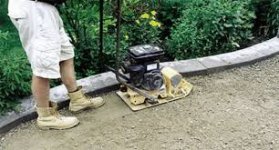
A wacker packer has about 10 times the compacting force of a walk behind plate compactor. It is adequate to compact 6 inches of gravel. A walk behind plate compactor is suitable for final smoothing and prep of an already adequately compacted gravel surface. I have see settlement under flatwork that was compacted only with a plate compactor several times. I have also had nuke densometer tests done on prepped work enough times to show that you CANNOT get adequate compaction with just a walk behind plate compactor. You can with proper moisture and a wacker packer.

Using a walk behind plate compactor is fine to do a nice smooth final finish, just before tying the rebar and getting ready to place the concrete.

Here's some photo's showing the difference.
 

Attachments

  • wacker.jpg
    wacker.jpg
    16.3 KB · Views: 44
  • packer.jpg
    packer.jpg
    13.4 KB · Views: 39

bcradio

Well-known member
Joined
Jan 30, 2012
Messages
6,017
Location
New Mexico
Put lots of steel in it, not mesh. Don't add water to the truck, have plenty of help placing it and at least two who know whats going on is my advice. Never hurts too have somewhere to go with extra crete if you order too much.

Don't worry about adding any steel actually.

Key things to look for are:

- make sure the ground under the slab is evenly compacted. It doesn't have to be super compacted, just evenly compacted
- make sure you have very high quality rock added to the mix with lots of fractured faces on it (not smooth river rock)
- you can get add-ins like fiber, but get entrained air added
- most importantly is to cure the concrete. Cover with plastic for 1 week at least
 
OP
M

Model A Fan

Well-known member
Joined
Dec 1, 2011
Messages
1,220
Location
NW Washington
So, what I think is going to happen (correct me if this is a bad plan) is I will have the excavator dig down about 8" and then back fill with 4" of gravel, compact it with a jumping jack compactor and then wire mesh supported by little pieces of bricks or cement.

Then pour.

Is the jumping jack compactor sufficient for compacting that much gravel all at one time or should I do it in layers a few inches at a time?
 

bcradio

Well-known member
Joined
Jan 30, 2012
Messages
6,017
Location
New Mexico
So, what I think is going to happen (correct me if this is a bad plan) is I will have the excavator dig down about 8" and then back fill with 4" of gravel, compact it with a jumping jack compactor and then wire mesh supported by little pieces of bricks or cement.

Then pour.

Is the jumping jack compactor sufficient for compacting that much gravel all at one time or should I do it in layers a few inches at a time?

Seriously, no need for wire mesh. You or the next owner will thank me later.
 

ssdave

Banned
Joined
Apr 11, 2015
Messages
2,913
Location
Eastern Oregon
So, what I think is going to happen (correct me if this is a bad plan) is I will have the excavator dig down about 8" and then back fill with 4" of gravel, compact it with a jumping jack compactor and then wire mesh supported by little pieces of bricks or cement.

Then pour.

Is the jumping jack compactor sufficient for compacting that much gravel all at one time or should I do it in layers a few inches at a time?

Jumping jack can compact 4 inches easily, if it is wet.

On the reinforcing question: Guys that demo out concrete to replace it, always recommend not putting in mesh or rebar. It makes the concrete hard to demo. My answer to that has been, "you wouldn't have had to demo out and replace this concrete for several more years if it had reinforcement to start with". Their interests are not the same as the homeowners interests. Theirs is minimizing their work and cost, and yours is to have the most usable and long life slab you can get, with secondary factor of cost. Or, if cost is the primary factor, then leave the reinforcing out, and accept the tradeoff of a chance of a slightly shorter life of the slab.

The function of the mesh is not to add strength per se. What it does, is eliminate displacement of the concrete along cracks. In doing so, it can extend the usable life of a concrete slab by several or many years. Often, the concrete is still quite usable for a driving or working surface, but it cracks. Eventually, freeze thaw, water getting into the cracks and softening the subgrade, gophers tunneling under the slab, settlement of old fill under the slab, etc, make the pieces tip and heave, and you get displacement along the cracks. When that happens, it becomes a tripping hazard, or more water gets in and accelerates the degradation, and it becomes time to replace the slab.

When you have have mesh in the slab (or microfiber can also help) the cracks don't displace, and don't open up as easily. You can caulk them to keep out water, and the slab life can be extended by many years. As noted by another poster, increasing the amount of rebar to a correctly designed amount can actually help prevent cracking from happening at all. However, that amount of steel is questionable for use in a thin slab, as the thin slab doesn't realistically make use of the steel due to other factors, cost increases, and removal becomes MUCH harder to accomplish.

Reinforcement mesh or small diameter, thinly placed rebar is, in my opinion, a very good investment in slabs. I'd rather have a little harder removal later, and a little more cost today for a very probable return of a more usable, smoother slab and longer life of the slab.

As also mentioned later, curing the concrete to not let it dry out after placement greatly increases the strength and durability. I'd also recommend putting plastic sheeting over it as soon as you can walk on the surface, and leaving it for at least a week. The condensation moisture trapped under the sheeting may cause a mottled surface on the concrete, but the ultimate durability of the concrete will be much greater, both for wear resistance and for strength.
 

wssix99

Well-known member
Joined
Mar 2, 2011
Messages
5,160
Location
Chicago, IL
We may have a terminology difference here that isn't making things clear.

In my recommendation, I distinguish a wacker packer from a concrete mans plate compactor. The reference book you linked to does not, they call a jumpingjack or wacker packer a plate compactor.

A wacker packer has about 10 times the compacting force of a walk behind plate compactor. It is adequate to compact 6 inches of gravel. A walk behind plate compactor is suitable for final smoothing and prep of an already adequately compacted gravel surface. I have see settlement under flatwork that was compacted only with a plate compactor several times. I have also had nuke densometer tests done on prepped work enough times to show that you CANNOT get adequate compaction with just a walk behind plate compactor. You can with proper moisture and a wacker packer.

Using a walk behind plate compactor is fine to do a nice smooth final finish, just before tying the rebar and getting ready to place the concrete.

Here's some photo's showing the difference.

Whatever they are called:
- The compactor on the left (in your pictures) does have greater force, but it provides dynamic/impact/ramming compaction. This type of force is good for very fine material like clays. It does not do anything for granular/angular material, like crushed stone (or what I call "gravel") - at all. (Except for moving it around.) If you've had compaction success with this type of compactor and gravel, it was likely because the compactor was compressing whatever was beneath the gravel. (That may be a valid method. I've heard of both types of compactors specified for this type of situation.) The exception here would be rounded "gravel" like river rock.

- The compactor on the right (in your pictures) has less dynamic force, but it provides vibration, which is what is required to compact granular/angular material like crushed stone "gravel" or sand. The sharp angles/edges overcome dynamic forces and the material will not compact. The vibration is needed to move it around until the points move around and "settle"/compact into each other.

We may be hung up on what "gravel" actually means because the stone people use can vary differently around the country and in different parts of the world. In the case of the OP, here; (without any pictures of this material) probably the best compactor to use is whatever the professional down the street is using on their job for the same material. :)
 
To avoid these ads, REGISTER NOW!
Top Bottom