Stinger
Well-known member
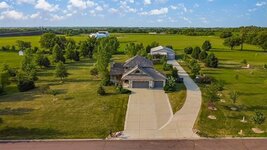
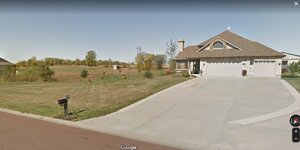
I bought this property last year. It has a large concrete driveway in front of the house (3200 sq ft), and back to the shop (280ft long, 6000 sq ft). Due to the amount of concrete and the insane cost of replacement, I'm wanting to protect it and prevent it from further damage. Everything was poured in 2004 (house) and 2008 (shop).
There are two problems with it currently (the second just showed up this week). The first is at the base of the driveway next to the curb/road. As far as I can tell, it started as spalling and has now basically turned to gravel. This area also becomes a drain during/after rain where water from the yard and under the slab appears to use this area as the path of least resistance to exit to the road (hence the vertical lines on the curb from water always running down it. I have to assume this issue is at least partly to blame for the spalling and destruction of the slab. If this is the case, what can be done to prevent the water from using this area as an exit? Would drilling a drain hole in the curb to prevent it from puddling behind the curb be reasonable? Is there something that can be done under the slab (after the damaged area is cut out) to build a "dam" of sorts to redirect water away from the base of the slab?

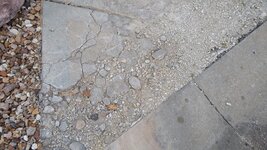
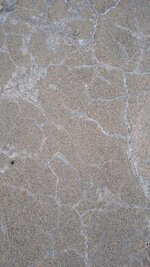
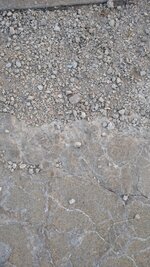
This area is obviously a lost cause in terms saving it and I assume the correct fix is to cut out the bad areas and pour new. The question is, how do I prevent this from happening again? I've seen repairs to areas like this before and it seems like a few years later the same problem is happing just outside of the repair area where the seemingly "good" concrete isn't so good after all. There are certainly very fine cracks around the gravel area (so fine that there is no gap in the crack, it's just visibly lighter colored).
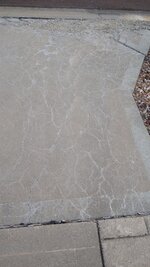
The second issue just popped up after the recent extremely cold stretch. It was single digits here for about a week, we got a few inches of snow that didn't get cleared off the slab due to the extreme cold, and the city used rock salt on the surrounding roads. So once it warmed up and the snow melted, there was some exposure to salt that had been deposited by the vehicles driving from the salted roads to the garage. This new damage took a previously "good condition" slab with some fine cracks (again, no visible gap in crack, just lighter colored than the non-crack area), and caused spalling where the water/salt got into those fine cracks and caused it to expand. There are now areas that I can rub my shoe across and the concrete just turns to powder and a new 1" wide pit appears. These effected areas now appear to hold water (whole driveway is dry except for these fine cracks and spalled area), making me fear that the visible damage is nowhere near what's actually done (and that it's about to get really bad with some more freeze/thaw/salt cycles).
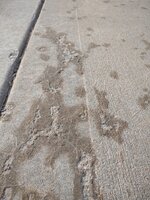
I rinsed the driveway to clear away any salt and then snapped a few pics of it while it was still wet that shows these damaged areas are raised now, and show all of the fine cracks I've mentioned. The other pics show the new damaged areas still being wet 2 days later, plus a better look at this new spalling.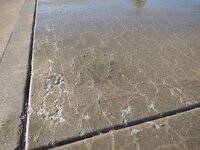



Am I screwed here and this slab is a lost cause or is there a product or products that would allow me to fix/seal this new damage and prevent future water/salt/freeze damage? Thanks for your help.
There are two problems with it currently (the second just showed up this week). The first is at the base of the driveway next to the curb/road. As far as I can tell, it started as spalling and has now basically turned to gravel. This area also becomes a drain during/after rain where water from the yard and under the slab appears to use this area as the path of least resistance to exit to the road (hence the vertical lines on the curb from water always running down it. I have to assume this issue is at least partly to blame for the spalling and destruction of the slab. If this is the case, what can be done to prevent the water from using this area as an exit? Would drilling a drain hole in the curb to prevent it from puddling behind the curb be reasonable? Is there something that can be done under the slab (after the damaged area is cut out) to build a "dam" of sorts to redirect water away from the base of the slab?
This area is obviously a lost cause in terms saving it and I assume the correct fix is to cut out the bad areas and pour new. The question is, how do I prevent this from happening again? I've seen repairs to areas like this before and it seems like a few years later the same problem is happing just outside of the repair area where the seemingly "good" concrete isn't so good after all. There are certainly very fine cracks around the gravel area (so fine that there is no gap in the crack, it's just visibly lighter colored).
The second issue just popped up after the recent extremely cold stretch. It was single digits here for about a week, we got a few inches of snow that didn't get cleared off the slab due to the extreme cold, and the city used rock salt on the surrounding roads. So once it warmed up and the snow melted, there was some exposure to salt that had been deposited by the vehicles driving from the salted roads to the garage. This new damage took a previously "good condition" slab with some fine cracks (again, no visible gap in crack, just lighter colored than the non-crack area), and caused spalling where the water/salt got into those fine cracks and caused it to expand. There are now areas that I can rub my shoe across and the concrete just turns to powder and a new 1" wide pit appears. These effected areas now appear to hold water (whole driveway is dry except for these fine cracks and spalled area), making me fear that the visible damage is nowhere near what's actually done (and that it's about to get really bad with some more freeze/thaw/salt cycles).
I rinsed the driveway to clear away any salt and then snapped a few pics of it while it was still wet that shows these damaged areas are raised now, and show all of the fine cracks I've mentioned. The other pics show the new damaged areas still being wet 2 days later, plus a better look at this new spalling.
Am I screwed here and this slab is a lost cause or is there a product or products that would allow me to fix/seal this new damage and prevent future water/salt/freeze damage? Thanks for your help.