To avoid these ads, REGISTER NOW!

Condensate drain questions

lund

Well-known member
Joined
Nov 2, 2019
Messages
820
Location
Michigan
With the hot, muggy weather in Michigan, my home central AC is working overtime. Naturally the condensate drain is plugged so I need to clean it out. Of course the installers of the owners before me installed it in a way that it cannot be disassembled or blown out without cutting the PVC pipes. I will be modifying it to better deal with this going forward.

But I have a mystery on the present setup that perhaps you more HVAC literate guys can help me with. I may not be understanding how the present system is setup. In the 1st pic below there is a fabbed trap out of 3/4 PVC lengths and elbows that (I think) drains the condensate from the evaporator coil. There was a drain plug that I removed and put a temporary brass ****** to connect a hose leading to a bucket to catch the drain overflow while I sort out my issue and modify it for clean out. I will cut the pvc pipe going into the drain line, clean out the trap, and modify the line (disconnect) where it can be opened more easily in the event of future issues and clean outs. No big deal here. But I was puzzled why no air vent above the trap. I can add one easily enough if it is needed when modifying the system. The drain line below the trap runs to the floor and follows the contour of the blower assembly base before leading into a floor drain (all look ok).

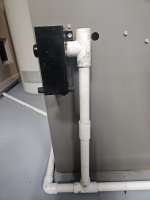
Now my main confusion. There is a black box that I show from the side, front, and back in the 2nd - fourth pics. This box is on the side and mounted *lower* in elevation than the drain in the 1st pic. It connects to a T open at the top with a pipe connecting to the same floor drain line with the PVC trap shown in the first pic. There are two hoses inside that feed into black box within the blower assembly. To the extent I can tell, they appear to go up to the level of the drain pan that the 1st pic drain with trap. There are no electrical connections to this box (not an interlock switch). There are two small lower caps on the black box on the front and back that are labeled clean out that had (clean) water in them when I removed them to check. The PVC T connects to the back side and a fitting on the front appears to be a symmetrical connection to the PVC T that is capped. The two hoses in the blower assembly have water in them.

Have any of you seen this black box or know what it is? Is this a secondary drain and vent? Or is it a primary drain and vent and the one with the PVC elbow trap is some secondary overflow (perhaps both were not working?).

Any recommendations on improving this? It is not made to come apart easy but I can cut the pipes and add some coupling unions at a few locations.

Thanks in advance for the advice. It is surprising how much condensate the AC makes on hot and humid days! So the overflow can quickly become a big problem.
 

Attachments

  • 20260703_092152.jpg
    20260703_092152.jpg
    699.8 KB · Views: 43
  • 20260703_092117.jpg
    20260703_092117.jpg
    580.3 KB · Views: 37
  • 20260703_092056.jpg
    20260703_092056.jpg
    634 KB · Views: 32
  • 20260703_092127.jpg
    20260703_092127.jpg
    608.4 KB · Views: 34
To avoid these ads, REGISTER NOW!
OP
L

lund

Well-known member
Joined
Nov 2, 2019
Messages
820
Location
Michigan
Is this unit just and air handler, or a gas furnace with a AC coil on top?

It is a gas furnace with an AC coil on top. The gas furnace is a 97% efficient model, so I think most of the water vapor condensing from the combustion goes out the large PVC pipe vent outside.

Is it possible that the 2nd drain is something linked to the gas furnace for water condensation that does not make it outside? That might also explain the lower location. I have another house I maintain with a similar high efficiency furnace and it has no auxiliary drain. But the pipe to outside on this one is pretty long (guessing 40' with elbows) and not sloped much, if any. So it might have created a need for some sort of extra drain.
 

bonneyman

Well-known member
Joined
Apr 22, 2010
Messages
8,836
Location
Desert SW
As I recall I read somewhere that a 5 ton unit can make a gallon an hour of condensate during humid times.

I'd recommend the E-Z trap set-up. Install it in place of the glued elbows. The clear U-tube lets you see if it's clogged, and they include a flexible brush to clean out that tube when needed. No disassembly necessary.

 
OP
L

lund

Well-known member
Joined
Nov 2, 2019
Messages
820
Location
Michigan
Is this it?
IMG_0073.jpeg

We don’t need AC up here, but my 95% eff shop furnace and house boiler can each make 4+ gallons/day of condensate when it’s really cold.

Yes! It looks like an exact match.

Thanks, you guys are super with the rapid and on target help.

It is also a Lennox gas furnace + AC. So I think the 2nd drain box is for the furnace. I am still puzzled why that is needed for a 97% efficient gas furnace. My guess is due to the vent pipe being so long and level that all the water may not make it out the exhaust pipe.

I should have realized it could be for that purpose! Seems less mysterious along with the height being lower now too.
 
Last edited:
OP
L

lund

Well-known member
Joined
Nov 2, 2019
Messages
820
Location
Michigan
As I recall I read somewhere that a 5 ton unit can make a gallon an hour of condensate during humid times.

I'd recommend the E-Z trap set-up. Install it in place of the glued elbows. The clear U-tube lets you see if it's clogged, and they include a flexible brush to clean out that tube when needed. No disassembly necessary.


Thanks.

That looks super and makes great sense. I think I will order one or something similar and install. I do not know if I will bother with the interlock though.
 
OP
L

lund

Well-known member
Joined
Nov 2, 2019
Messages
820
Location
Michigan
I think the black box thing is associated with the furnace condensate as its a condensing furnace.

+1 on the clear trap.

Agree. It also fits with the lower elevation and the very long vent pipe for the high efficiency furnace. So it is probably an add on needed for the install location being so far from the exterior vent.
 

bonneyman

Well-known member
Joined
Apr 22, 2010
Messages
8,836
Location
Desert SW
Thanks.

That looks super and makes great sense. I think I will order one or something similar and install. I do not know if I will bother with the interlock though.
Yeah, the interlock shuts off the A/C system if it senses water back up. Very important in attic or above ceiling systems - saves flooded ceilings and $$$ mold removal. But not as necessary for like garage installations.
 

firebirdparts

Well-known member
Joined
Jun 8, 2016
Messages
10,637
Location
Kingsport, TN
To your question about venting the trap, that might be needed sometimes. If the condensate drain is not sloped all the way, it could seal up an air bubble in there, but in general, there is just so little pressure required to blow the seal in both directions, it doesn't really cause a problem. I hope that makes sense. As a fundamentalist, I admit it could seal up, but they still work. The upstream side of the trap is under vacuum all the time when the a/c is running.
 

PoorUB

Well-known member
Joined
Mar 29, 2021
Messages
11,668
Location
Fargo, ND
I am still puzzled why that is needed for a 97% efficient gas furnace.
Most of the condensate in a high efficiency furnace is created in the heat exchanger and drained there, plus any furnace I have installed they want the venting to slope back to the furnace. Any condensate that gets by the drain in the furnace and heads out the venting drains back. The furnace really doesn't, and should not expel much condensate out the exhaust because an ice berg will form at the termination and possible cause problems. I have seen poorly vented furnaces with huge icebergs right below the exhaust.
 

PoorUB

Well-known member
Joined
Mar 29, 2021
Messages
11,668
Location
Fargo, ND
We don’t need AC up here, but my 95% eff shop furnace and house boiler can each make 4+ gallons/day of condensate when it’s really cold.
When I installed my own furnace I did it in January so I was in a hurry to get it running. As soon as the supply duct, gas and power was hooked up I fired it up and had it running, condensate drained into a five gallon bucket. I had to dump it twice that afternoon before I took the time to get the drain finished. I bet it would have easily produced 30 gallons of condensate a day.
 

PoorUB

Well-known member
Joined
Mar 29, 2021
Messages
11,668
Location
Fargo, ND
As I recall I read somewhere that a 5 ton unit can make a gallon an hour of condensate during humid times.
I would say that is reasonable.
I was on a construction site in it was in the 90's and very humid. We were installing the HVAC and were hooking up a 40 ton RTU We were ******* to get it running as it was miserable inside the building. As soon as we got power we fired it up. The unit had two condensate drains and we set a five gallon pail under each. It took twenty minutes to fill each pail, so close to 30 gallons and hour. As soon as we fired it up we could hear guys cheering inside!
 

bonneyman

Well-known member
Joined
Apr 22, 2010
Messages
8,836
Location
Desert SW
I almost thought about rigging up a collection system for my house unit and then using condensate to water house plants and maybe the garden. But never really got around to it.
 

larry4406

Well-known member
Joined
Jan 27, 2006
Messages
19,440
Location
Northern Virginia
As @PoorUB said, if your condensing furnace is installed properly, the flue pipes drain back towards your furnace.

So, if you remove the cover of the furnace, you will see the internal drain connections for this to the black box.

The attached picture is a Lennox Gas 90+ furnace and AC from the day job. Ignore the box (with yellow light peeking thru the ajar cover) above the A-coil drain as that is a sniffer as this is an A2L system (flammable). This is an upright "up-flow" system where the return air comes in at the bottom, then thru the heat exchanger, and continues upward thru the A-coil and then distributed to the home.

At the top (below the sniffer box), is the A-coil drain which goes into the run of a tee, a cap at the top (for maintenance cleaning), trap below, then into a branch of another tee while the upper run of the tee is vented.

You can see the gray fitting on the left side of the furnace, this is where the furnace condensate discharges are connected to the AC condensate. From there it all goes to a floor drain with an air-gap.

Our units are in the basement in a metal pan (no drain) with the float switch (red device).

This unit has 3" PVC combustion air and vent because of the distance. You may likely have 2" if your runs are shorter.
1783102356374.jpeg
 

fitter30

Well-known member
Joined
Jun 23, 2019
Messages
2,989
Location
Peace Valley,mo
Draw through coil needs a trap. Blow through doesn't. Trap offsets the suction of the blower. To shallow will never drain. To deep doesn't matter will still drain. If you want to vent the line has to be after the trap. Vent can be 3/16" - 1/4" hole on the top side of the ell(90°). The trap doesn't have to glued into the male adapter justjpush it in so ou xan take it apart. Don't hook a garden hose up to the higher fitting to flush the coil. Th e water will blow out of the condensate pan run right to the blower.
 
Last edited:
To avoid these ads, REGISTER NOW!

TurnipTruck

Well-known member
Joined
Aug 28, 2005
Messages
1,579
Location
Southcentral Alaska
Most of the condensate in a high efficiency furnace is created in the heat exchanger and drained there, plus any furnace I have installed they want the venting to slope back to the furnace. Any condensate that gets by the drain in the furnace and heads out the venting drains back. The furnace really doesn't, and should not expel much condensate out the exhaust because an ice berg will form at the termination and possible cause problems. I have seen poorly vented furnaces with huge icebergs right below the exhaust.
If you slope the exhaust to the outside, you can get sizable stalagmites. But water out the exhaust is nowhere near the amount of water that condenses and drains from the heater.
IMG_4031.jpeg
 
OP
L

lund

Well-known member
Joined
Nov 2, 2019
Messages
820
Location
Michigan
Most of the condensate in a high efficiency furnace is created in the heat exchanger and drained there, plus any furnace I have installed they want the venting to slope back to the furnace. Any condensate that gets by the drain in the furnace and heads out the venting drains back. The furnace really doesn't, and should not expel much condensate out the exhaust because an ice berg will form at the termination and possible cause problems. I have seen poorly vented furnaces with huge icebergs right below the exhaust.

Thanks.

[Edited below since I realized I was forgetting details of the install on my Cali system (the furnance does have a condensate drain)].

I installed a Rudd (same as Trane but will sell to non-pros) high efficiency gas furnace in Cali. The exhaust pipe is sloped PVC (runs back to furnace). with a drain in the pipe to catch water that condenses in the pipe and runs back toward the furnace. This was very different than my Michigan, high efficiency gas furnace. I never noticed the Cali one draining much water. In retrospect, this was likley due to Cali being much warmer and the exhaust pipe was short. So the water was mostly expelled by the exhaust fan in small droplets that spray out the pipe (rarely gets below freezing there so no ice buildup etc). Never any problems.

But Cali is also not cold. I can see your point on an exterior ice berg up north and likely collecting the condensed water to be a potential ice berg generator on discharge and it is best to drain it out. My Michigan house is bigger and Michigan is cold. So more gas useage and more combustion byproduct water condensate AND the pipe is very long in Michigan to allow even more condensation to run back to the furnace. All this being said, I am puzzled why the designs from the Rudd (Cali; small BTUs) and Lennox (Michigan; large BTU) systems were so different though. Maybe I was installing something (did not realize if so) more appropriate for a warmer climate (Cali barely gets below freezing in brief intervals in the location used). I do not think I mis-installed it (read everything). But this was 16 years ago (and running fine the whole time).
 
Last edited:
OP
L

lund

Well-known member
Joined
Nov 2, 2019
Messages
820
Location
Michigan
Yeah, the interlock shuts off the A/C system if it senses water back up. Very important in attic or above ceiling systems - saves flooded ceilings and $$$ mold removal. But not as necessary for like garage installations.

Thanks. Makes sense. In my case, the furnace is on a basement cement floor with not much prone to water damage nearby and drains etc. So I ordered one without the interlock. I am also not clear how the interlock would interface with the control board (but I assume I can find info on that). But what you say on an interlock makes good sense for other locations where you can get moisture damage more easily. The volume of AC condensate can be high on humid days!
 
OP
L

lund

Well-known member
Joined
Nov 2, 2019
Messages
820
Location
Michigan
To your question about venting the trap, that might be needed sometimes. If the condensate drain is not sloped all the way, it could seal up an air bubble in there, but in general, there is just so little pressure required to blow the seal in both directions, it doesn't really cause a problem. I hope that makes sense. As a fundamentalist, I admit it could seal up, but they still work. The upstream side of the trap is under vacuum all the time when the a/c is running.

Yes. I think that is the case with the AC condensate drain line. The air above should be enough. The main issue is crud growing in the low water flow. The clear trap retrofit mentioned makes good sense so you can realize the problem. In retrospect, I am surprised it lasted as long as it did without me doing any cleanouts.
 
OP
L

lund

Well-known member
Joined
Nov 2, 2019
Messages
820
Location
Michigan
When I installed my own furnace I did it in January so I was in a hurry to get it running. As soon as the supply duct, gas and power was hooked up I fired it up and had it running, condensate drained into a five gallon bucket. I had to dump it twice that afternoon before I took the time to get the drain finished. I bet it would have easily produced 30 gallons of condensate a day.

Makes sense: If the condensate of a furnace drains back it would be a lot just from the basic chemical reactions in burning:

Natural Gas (Hydrocarbon) + Air (with Oxygen) -> burn -> H2O (water in vapor form) + C02 (Carbon Dioxide gas) + other trace quantities.

The water on burning will be in vapor at high temp. But when heat is extracted, it will start to condense in droplets. The water need to go somewhere: expelled out the vent pipe, or collected in a drain. Burn a lot of gas for high heat generation, you will get a lot of water. Water droplets also condense out of cold air. So as some point out here if you expel the high efficiency discharge pipe into cold air you may get a rapid condensation and ice berg forming.

Low efficiency furnaces do not have this problem to the same degree since the water is hot and in vapor form since not so much heat is extracted and it should be able to make it well outside on discharge from a conventional flue pipe (which also gets hot). High efficiency furnaces use PVC discharge pipes since they have a lot of water droplets. Those are usually sloped to drain back into the furnace.
 
OP
L

lund

Well-known member
Joined
Nov 2, 2019
Messages
820
Location
Michigan
Draw through coil needs a trap. Blow through doesn't. Trap offsets the suction of the blower. To shallow will never drain. To deep doesn't matter will still drain. If you want to vent the line has to be after the trap. Vent can be 3/16" - 1/4" hole on the top side of the ell(90°). The trap doesn't have to glued into the male adapter justjpush it in so ou xan take it apart. Don't hook a garden hose up to the higher fitting to flush the coil. Th e water will blow out of the condensate pan run right to the blower.

Thanks. Makes sense. I may add a vent post trap (with a retrofit clear trap that can be easily disassembled for cleaning) to be extra safe when I make the mod.
 

bonneyman

Well-known member
Joined
Apr 22, 2010
Messages
8,836
Location
Desert SW
Thanks. Makes sense. In my case, the furnace is on a basement cement floor with not much prone to water damage nearby and drains etc. So I ordered one without the interlock. I am also not clear how the interlock would interface with the control board (but I assume I can find info on that). But what you say on an interlock makes good sense for other locations where you can get moisture damage more easily. The volume of AC condensate can be high on humid days!
Condensate interlocks (or overfill) switches are usually float operated (or use an electric sensor). They are typically wired in series with the yellow wire from the stat, so when the interlock opens the compressor is shut off - but the indoor fan will run. This shows up as a no-cooling scenario prompting you to check the condensate drain line or pan.
The EASYTRAP I referenced has a in-tube float that acts as the cut-off switch.
 
OP
L

lund

Well-known member
Joined
Nov 2, 2019
Messages
820
Location
Michigan
As @PoorUB said, if your condensing furnace is installed properly, the flue pipes drain back towards your furnace.

So, if you remove the cover of the furnace, you will see the internal drain connections for this to the black box.

The attached picture is a Lennox Gas 90+ furnace and AC from the day job. Ignore the box (with yellow light peeking thru the ajar cover) above the A-coil drain as that is a sniffer as this is an A2L system (flammable). This is an upright "up-flow" system where the return air comes in at the bottom, then thru the heat exchanger, and continues upward thru the A-coil and then distributed to the home.

At the top (below the sniffer box), is the A-coil drain which goes into the run of a tee, a cap at the top (for maintenance cleaning), trap below, then into a branch of another tee while the upper run of the tee is vented.

You can see the gray fitting on the left side of the furnace, this is where the furnace condensate discharges are connected to the AC condensate. From there it all goes to a floor drain with an air-gap.

Our units are in the basement in a metal pan (no drain) with the float switch (red device).

This unit has 3" PVC combustion air and vent because of the distance. You may likely have 2" if your runs are shorter.
1783102356374.jpeg

Thanks! This is very helpful.

I like that you installed a drain pan at the bottom. It is good to have such redundancy in case things go wrong. The only downside of such if that homeowners might let it go a long time if the pan is drained and be oblivious to a problem. But it looks like you have a float switch too. So a lot of redundancy!
 
OP
L

lund

Well-known member
Joined
Nov 2, 2019
Messages
820
Location
Michigan
Condensate interlocks (or overfill) switches are usually float operated (or use an electric sensor). They are typically wired in series with the yellow wire from the stat, so when the interlock opens the compressor is shut off - but the indoor fan will run. This shows up as a no-cooling scenario prompting you to check the condensate drain line or pan.
The EASYTRAP I referenced has a in-tube float that acts as the cut-off switch.

Thanks.

I already have trap without interlock ordered, so I will stick to that. I am down there a lot and notice/follow up problems. So in my case it should be ok. But I agree the interlock is a better way in most cases -- particularly if the damage potential is high.

One additional thing even if one notices the overflow fast, it can be a lot of water and in my case (Lennox furnace + AC), I noticed an internal wiring connector close to where an overflow went. I "fixed" that by repositioning a mollex type connector off the potentially wet surface with some cable ties. But yikes, that is a dumb design to have a connector that might get very wet or submerged on a drain failure. I wonder what the engineer was thinking !! Or maybe that got done in the factory construction to make assembly easy. I notice here I am kind of contradicting my comment on "not needing" an interlock. Maybe I will reorder and change it ...
 
Last edited:
OP
L

lund

Well-known member
Joined
Nov 2, 2019
Messages
820
Location
Michigan
I almost thought about rigging up a collection system for my house unit and then using condensate to water house plants and maybe the garden. But never really got around to it.

If you have a clean system without too much mold etc, I would think AC coil condensate can be collected and used. That might be worthwhile in high water cost areas. I noticed that you are from an arid place though, and the volume of water collected from an AC coil will likely be less due to the dry air (some homes install humidifiers in the system even).

On the condensate from an high efficiency gas furnace: I would be cautious on using it. When natural gas burns in air, you get C02 (vented) + water (vapor that can condense out if cool enough in a high efficiency system) + combustion byproducts. The byproducts might be nasty stuff (hydrocarbons, heavy metals etc) in high enough concentration where you would not want to drink them or give them to plants. You could collect some samples and have it tested if curious or ask with people who might know better. But I would not use it on blind faith. It might superficially look fine though.

Probably a grey water system from the shower and use soaps that are ok for plants would be a good way to go. I was considering that when I lived in Cali near SF. Water cost there can be pretty crazy and seems to go up rapidly in recent years. My tenant there (2 people without kids) were complaining about huge water bills (think $400/mo) and it turns out they just took longish daily showers for primary usage. Just being connected costs ~$100/mo. I had to do some work between tenants needing water for a few days and ended with with about $600 in bills for a few months between tenants (mostly idle time bills). I could have bought mineral water for that price for what I used ... Life in Cali. Great place to live though, IF you can afford it!!
 

larry4406

Well-known member
Joined
Jan 27, 2006
Messages
19,440
Location
Northern Virginia
Thanks! This is very helpful.

I like that you installed a drain pan at the bottom. It is good to have such redundancy in case things go wrong. The only downside of such if that homeowners might let it go a long time if the pan is drained and be oblivious to a problem. But it looks like you have a float switch too. So a lot of redundancy!
No drain to the pan.

It’s a sump to fill up and trip the switch.
 

dcg9381

Well-known member
Joined
Jun 20, 2018
Messages
11,799
Location
Austin, TX
I almost thought about rigging up a collection system for my house unit and then using condensate to water house plants and maybe the garden. But never really got around to it.
I've done this and it worked amazingly well. But I'm primarily cooling and produce 5-10 gallons of water per day.
I would not drink it (without testing it) but it worked great for feeding the landscaping plants... In a cold climate, might require a little planning.

Float switch 100%!
 

rlitman

Well-known member
Joined
Oct 18, 2010
Messages
24,632
Location
Long Island
...I would not drink it (without testing it) but it worked great for feeding the landscaping plants...
Condensate, like rain water, is pretty low in nutrients, but loaded with bacteria and such. It's perfectly fine for plants in the ground, but if you're using it on potted plants, you'll probably need to supplement with appropriate fertilizer, unless it's a plant that thrives on distilled water (carnivorous plants come to mind).
 

dcg9381

Well-known member
Joined
Jun 20, 2018
Messages
11,799
Location
Austin, TX
Condensate, like rain water, is pretty low in nutrients, but loaded with bacteria and such. It's perfectly fine for plants in the ground, but if you're using it on potted plants, you'll probably need to supplement with appropriate fertilizer, unless it's a plant that thrives on distilled water (carnivorous plants come to mind).
That makes sense... A bit like Reverse Osmosis water, very little nutrients or dissolved solids. Yes, I was using it on ground plants in natural soil.

What about using it in a pool? As we're 100% on rain water, this subject interests me a bit... Not to deviate from the OPs thread and definitely heater condensation is a different type of water output.
 

fitter30

Well-known member
Joined
Jun 23, 2019
Messages
2,989
Location
Peace Valley,mo
If you have a clean system without too much mold etc, I would think AC coil condensate can be collected and used. That might be worthwhile in high water cost areas. I noticed that you are from an arid place though, and the volume of water collected from an AC coil will likely be less due to the dry air (some homes install humidifiers in the system even).

On the condensate from an high efficiency gas furnace: I would be cautious on using it. When natural gas burns in air, you get C02 (vented) + water (vapor that can condense out if cool enough in a high efficiency system) + combustion byproducts. The byproducts might be nasty stuff (hydrocarbons, heavy metals etc) in high enough concentration where you would not want to drink them or give them to plants. You could collect some samples and have it tested if curious or ask with people who might know better. But I would not use it on blind faith. It might superficially look fine though.

Probably a grey water system from the shower and use soaps that are ok for plants would be a good way to go. I was considering that when I lived in Cali near SF. Water cost there can be pretty crazy and seems to go up rapidly in recent years. My tenant there (2 people without kids) were complaining about huge water bills (think $400/mo) and it turns out they just took longish daily showers for primary usage. Just being connected costs ~$100/mo. I had to do some work between tenants needing water for a few days and ended with with about $600 in bills for a few months between tenants (mostly idle time bills). I could have bought mineral water for that price for what I used ... Life in Cali. Great place to live though, IF you can afford it!!
Who knows what's is in condensate? Mold spores from the pan and house dust. Wouldn't use it with out filtering something for the spores.
 
OP
L

lund

Well-known member
Joined
Nov 2, 2019
Messages
820
Location
Michigan
Legionella can often be found in condensate.

Legionella and mold spores would be a good reason not to use it and send it down the drain! I was thinking with some care that AC condensate might be ok to use though. One *could* make a sterilization system to kill bacteria and mold in the water. But that would likely be more trouble than the relatively small amount of water is worth -- even in arid climates.

Shower and kitchen sink grey water if one uses plant-benign soaps probably make sense if one does not accumulate too much stagnant with nutrients in it. Maybe laundry grey water is possible to use too. Though I gather that micro-plastic fragments from laundry may be a problem in laundry water if they are not filtered out (some newer washing machines do this and you could use an external filter too). Maybe that would be enough to be worthwhile.

It is sobering how hard it is to really recycle some things without creating even more problems in the effort to do so. Not much comes easily when you analyze A-Z impact and difficulties. That being said, it is important that efficiencies better in time so our kids can have a good future with so many people already in the world and long-term environmental challenges. I used to think the world population problem (main issue) was hopeless and would drive us to catastrophe. But the growth is rolling over more rapidly than I used to think would be possible ... maybe due to network connectivity driving changes in outlook on family sizes etc. So maybe there is hope over the next 100 years or so for reductions of people to sane numbers without massive cataclysms/pandemics or war.

All on a condensate recycle discussion ... I should probably be banned.
 

dcg9381

Well-known member
Joined
Jun 20, 2018
Messages
11,799
Location
Austin, TX
Legionella and mold spores would be a good reason not to use it and send it down the drain! I was thinking with some care that AC condensate might be ok to use though. One *could* make a sterilization system to kill bacteria and mold in the water. But that would likely be more trouble than the relatively small amount of water is worth -- even in arid climates.
The only way to know is to test it, but I think Legionella is probably more common in systems with "issues" (not completely draining). UV sterilization is pretty easy and doesn't require a high pressure pump, but what's the intended use? Water off your shop roof has bird **** in it. Works just fine for most plants. Even discounting Legionella, I'd want to know what's in it - concerns would be lead exposure on the solder or high metals content. I've never had condensate analyzed, so not sure... But even then it would be location specific.

Shower and kitchen sink grey water if one uses plant-benign soaps probably make sense if one does not accumulate too much stagnant with nutrients in it. Maybe laundry grey water is possible to use too. Though I gather that micro-plastic fragments from laundry may be a problem in laundry water if they are not filtered out (some newer washing machines do this and you could use an external filter too). Maybe that would be enough to be worthwhile.
I helped do a house that used graywater for the toilets. Not a fan. That stuff gets pretty nasty pretty fast if you put it in a tank, but I'd absolutely pump it out and use it in the lawn (if it was allowed). It's not allowed here.
 
To avoid these ads, REGISTER NOW!
Top Bottom