To avoid these ads, REGISTER NOW!

Conduit into wireway

bronc076

Well-known member
Joined
Jul 17, 2023
Messages
190
Location
Ozarks
Is there a rule regarding the size of conduit that can be connected to wireway? I'm thinking of running 2" emt from the top of my panel into 4" wireway. I seem to recall reading there is a size requirement for junction boxes related to conduit entering them. Does this apply to wireway, or is it even a real rule in the code?

Thanks!
 
To avoid these ads, REGISTER NOW!
OP
B

bronc076

Well-known member
Joined
Jul 17, 2023
Messages
190
Location
Ozarks
I guess a trough or gutter is the term. The stuff pictured below is 4"x4"x10' with a hinged lid. It looks rough in this pic but most of it is in really good condition and I have way more than I need. I plan to clean it up, plug a few holes, paint it so it looks new, and install it around the perimeter of the shop about a foot down from the ceiling. almost all of my electrical will be surface mount except for a couple things I need to do now before the walls are finished.

So I want to come out of the top of my panel into this with a conduit large enough so adding circuits in the future is easy. 2" emt should give me ample space. It's a home shop so this is overkill but I'll never have to go inside the walls again!

Thanks!
Rob


IMG_0156.jpeg
 
Last edited:
OP
B

bronc076

Well-known member
Joined
Jul 17, 2023
Messages
190
Location
Ozarks
Panel is surface mounted, feed comes up inside the wall and into the back of the panel. The piece of MC coming out the top goes through the attic to the outlets for the garage door openers. I needed to get that done before the contractor was finished, so it comes out the back of the panel as well. 20A 12-3 MWBC with a dedicated circuit for each opener. The single pole breaker is for the outlet under the panel.


77548763129__76BDB6B4-856D-4E59-80A0-B02C0E2CAFD9.jpeg
 

mm08822

Well-known member
Joined
Jan 13, 2012
Messages
5,856
Location
NJ
The conduit and the trough have fill requirements that you may never get close to exceeding. Conductors in conduit are subject to derating. Hopefully you plan on using thhn/thwn conductors which will provide some room for ampacity derating.

You may want to consider two 2" conduits out of the panel into the trough since you're right there doing one. The left conduit feeds everything on the left side of the shop, similar for rightside or whatever......

All receptacles need to gfci protected either by a gfci recept or cb.
 

yatg

Well-known member
Joined
Aug 16, 2019
Messages
2,750
Location
Southern Oregon
You may want to consider two 2" conduits out of the panel into the trough since you're right there doing one. The left conduit feeds everything on the left side of the shop, similar for rightside or whatever......
No idea of the OP's shop size (looks big) or usage, but think he might quickly use up 2 conduits if trying to avoiding derating, IIRC, you only get 9 CCC, 4 regular circuits or 6 MWBC, per conduit.

If he's got enough wireway, run a couple vertical from the panel to the horizontal runs. Would need to get a few tees for a clean transition.

1755023645817.png
 

mm08822

Well-known member
Joined
Jan 13, 2012
Messages
5,856
Location
NJ
No idea of the OP's shop size (looks big) or usage, but think he might quickly use up 2 conduits if trying to avoiding derating, IIRC, you only get 9 CCC, 4 regular circuits or 6 MWBC, per conduit.

If he's got enough wireway, run a couple vertical from the panel to the horizontal runs. Would need to get a few tees for a clean transition.

1755023645817.png
No, the number of conductors is "limitless", up to the 40% max fill volume of the conduit. HOWEVER, 7 CCC and above quickly erode 90C ampacities to put the conductors below their 60/75C ampacities b/c of the decreasing derating factors.

The "T" does have some value agreed. Except OP will also need a transition fitting to get to the 3.5" panel depth.
Wireway also has derating once over 30(?) CCC, IIRC. There is still a fill maximum also.

Only 1 "T" needed. Why you think multiple?

OP needs a circuit layout first.
 

yatg

Well-known member
Joined
Aug 16, 2019
Messages
2,750
Location
Southern Oregon
No, the number of conductors is "limitless", up to the 40% max fill volume of the conduit. HOWEVER, 7 CCC and above quickly erode 90C ampacities to put the conductors below their 60/75C ampacities b/c of the decreasing derating factors.
uh huh. conduit fill not the primary issue.
think he might quickly use up 2 conduits if trying to avoiding derating
Now vs. then.
Now OP has 2 conduits and 6CCC in each.
Then OP needs to add a couple more circuits.
10CCC? No problem, either upsize ALL the wires in the conduit or put in another conduit.

OP could put in 4 x 2" conduits and that could probably be more than enough. Still has the minor issue of fishing new circuits in conduit that already has wires. Only suggested using the wireway because OP has it, and its real easy to open up the covers to run additional wires. And it would look cool.

The "T" does have some value agreed. Except OP will also need a transition fitting to get to the 3.5" panel depth.
Wireway also has derating once over 30(?) CCC, IIRC. There is still a fill maximum also.

Only 1 "T" needed. Why you think multiple?
30CCC is typically 15 circuits.
Possible to exceed that depending on what's going on.
Was thinking 2 vertical wireways,
2 tees at top to horizontal,
2 tees at bottom to transition to panel,
Looks like the cover of the panel sticks up a bit over the top edge,
punch 4 x 2" holes in top of panel and 2 x 2" holes in 'bottom' of each tee.
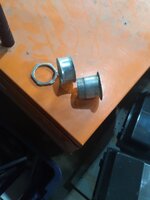
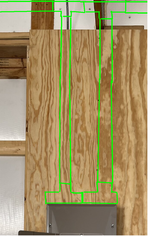
For each hole, a terminal adapter on top with male thread end going into the panel (+ locknut + bushing), stack the tees on top of the terminal adapters female ends, glue in a box adapter from the inside of the tee. Now there's 2 paths from panel to each vertical wireway. Paint everything below the top tees to match the panel and they'll blend right in. Don't forget to ground the wireways.
1755034610664.png
1755033728203.png


OP needs a circuit layout first.
Don't need that to spend OPs money.
 

Norcal

Well-known member
Joined
Mar 16, 2008
Messages
13,752
uh huh. conduit fill not the primary issue.

Now vs. then.
Now OP has 2 conduits and 6CCC in each.
Then OP needs to add a couple more circuits.
10CCC? No problem, either upsize ALL the wires in the conduit or put in another conduit.

OP could put in 4 x 2" conduits and that could probably be more than enough. Still has the minor issue of fishing new circuits in conduit that already has wires. Only suggested using the wireway because OP has it, and its real easy to open up the covers to run additional wires. And it would look cool.


30CCC is typically 15 circuits.
Possible to exceed that depending on what's going on.
Was thinking 2 vertical wireways,
2 tees at top to horizontal,
2 tees at bottom to transition to panel,
Looks like the cover of the panel sticks up a bit over the top edge,
punch 4 x 2" holes in top of panel and 2 x 2" holes in 'bottom' of each tee.
For each hole, a terminal adapter on top with male thread end going into the panel (+ locknut + bushing), stack the tees on top of the terminal adapters female ends, glue in a box adapter from the inside of the tee. Now there's 2 paths from panel to each vertical wireway. Paint everything below the top tees to match the panel and they'll blend right in. Don't forget to ground the wireways.

1755034610664.png
1755033728203.png


Don't need that to spend OPs money.
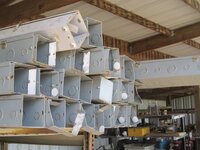
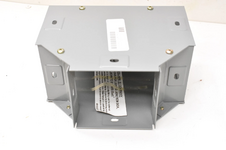
There is a flange to bring the gutter into the panel would be a lot cleaner then a couple of tee's & easier to bring conductor into the panel.
 
OP
B

bronc076

Well-known member
Joined
Jul 17, 2023
Messages
190
Location
Ozarks
Thanks for all the input guys! The shop is 30'x40' and I am using thhn/thwn wire, all in emt or flex except for the MC I already ran that was a quick reaction requirement to make sure garage door openers worked as advertised before I made final payment. All wire will be #12 or larger where necessary based on the need (compressor, welder, lift, etc.)

The conduit and the trough have fill requirements that you may never get close to exceeding. Conductors in conduit are subject to derating. Hopefully you plan on using thhn/thwn conductors which will provide some room for ampacity derating.

You may want to consider two 2" conduits out of the panel into the trough since you're right there doing one. The left conduit feeds everything on the left side of the shop, similar for rightside or whatever......

All receptacles need to gfci protected either by a gfci recept or cb.

mm0822, thank you, I'll go with 2x 2" emt. You are correct, I will not approach the fill requirements based on table C1 in the back of my 2023 handbook.

Derating is very confusing. 310.16 shows #12 thhn as 30 amps. If I have 10-20 in a 2" conduit it looks like I reduce that to 15 amps based on table 310.15(C)(1)? Looks like I need to read informative annex B as I will have diverse loads.

thanks all!
 
OP
B

bronc076

Well-known member
Joined
Jul 17, 2023
Messages
190
Location
Ozarks
After reading about derating i'm wondering if 3 x 1-1/2" conduits would be better than 2 x 2" conduits since it does not appear that conduit size is a factor regarding derating.

it seems like big conduit is for big wires, but more conduit is for more wires.
 

mm08822

Well-known member
Joined
Jan 13, 2012
Messages
5,856
Location
NJ
Derating is based on # of ccc simultaneously possible. Without looking up the exceptions, IIRC, the only exception is for interlocked loads being mutually exclusive, such as heat/ac, etc.

3 conduits could be done, but now you are starting to get into whether wireways are practical.

Make a list of the circuits, respective wire sizes, and possibly which vertical conduit each circuit could use. (Which one used is not cast in stone but may be just for conductor management.)

Include some room for future additions in each.

The list will really help rationalize your needs.
 
OP
B

bronc076

Well-known member
Joined
Jul 17, 2023
Messages
190
Location
Ozarks
Latest plan!

Im going with 2x2" conduits, I bought some of the stuff today. I'm going to run #10 from my 20A breakers through my left 2" conduit to the first box (light switch/receptacle, etc.) so I make it through the "derate zone" with room to spare, then from the first receptacle or light switch to the rest of the drops on that circuit I'll use the #12 I already have for the remainder of the circuit. My few 30A circuits (water heater, mini split, lift, compressor). I'll run #10 (or larger if necessary) through the right 2" conduit, and minimize derating by keeping the CCC count as low as possible. I think the office area might get a sub panel. My welder outlet is directly below the panel as of about an hour ago.

I'm doing my best to follow the rules in rural Missouri where there is no such thing as a building inspector, I want it to be safe, and I'll sell this place some day and I want it to be right. Doing it myself saves a lot of money, I got that stack of wireway for what about 3 pieces cost new, so I can afford a couple spools of #10 THHN.

Does that all sound legal?
 

Bert_

Well-known member
Joined
Dec 24, 2016
Messages
9,699
Location
NW Iowa
How long will the conduits above the panel be?

******* do not require derating based on number of current carrying conductors. I think the maximum length is 24"
 
OP
B

bronc076

Well-known member
Joined
Jul 17, 2023
Messages
190
Location
Ozarks
How long will the conduits above the panel be?

******* do not require derating based on number of current carrying conductors. I think the maximum length is 24"

I don't know the exact dimensions yet as I have been super busy with other stuff an have not had time to actually work in this, but it is farther than 24".

i guess another option is I put a pull box half ay between the panel and the trough so i have two shorter *******.
 
OP
B

bronc076

Well-known member
Joined
Jul 17, 2023
Messages
190
Location
Ozarks
So this is where I am at. In the attached image you can see I went with a pull box as the conduits would be longer than 24". Work travel has dominated my life so progress is slow. I only have one piece of wireway up but that will go around the perimeter of the shop. All the lighting goes through the 8x8 box above the doors.

Now I have a question about grounds. The conduit and wireway (when it is installed correctly) per code meet the grounding requirement as far as I can tell. My electrician friend said if I can I should run ground wires anyway, and I have a couple rolls of #12 green thhn so why not.

Is it okay to put a ground bus in the 6x6x24 box above the panel, and run one wire from there to the ground bus in the panel (#8 maybe?), then terminate circuit grounds at that buss so there are fewer wires cluttering up the panel? Since I have all emt does it matter? Better to be safe than sorry, I have lots of wire.

I did put a ground bus in the 8x8 box which is connected to the panel with a #10 green. My conduit out of that box uses a concentric knockout and I was not happy with that even though it ohmed out okay, so I ran a ground from the bus in that box to the first ceiling box and grounded that box with a #12. From there the conduit network handles it. Ceiling boxes have outlets and UFO lights have plugs. Also the MC out to my porch ceiling lights is grounded there.

I appreciate the advice!

thanks!
Rob
 

Attachments

  • IMG_8979.jpeg
    IMG_8979.jpeg
    748 KB · Views: 87

rharman

Well-known member
Joined
Apr 22, 2012
Messages
8,737
Location
SoCal
I'm curious why they're standing so far off the wall. I would have assumed surface mounted for relatively straight drops down (or, up).
 
To avoid these ads, REGISTER NOW!
OP
B

bronc076

Well-known member
Joined
Jul 17, 2023
Messages
190
Location
Ozarks
The trough is 12" from the wall. They have hinged lids so I can't have them against the wall, instead of spacing them out an inch or so I decided I wanted enough room to 90* into the back side so I can use the knockouts. In the future as I add drops I won't have to pull holes in the bottom where there will be wires in the way.

I have room on my strut between the trough and the wall where I can run an air line or anything else I want to. I can also hang some task lighting from the struts, above my lathe for example.

The trough is 9' from the floor so it's not in the way of any equipment, shelves or cabinets I may have in the future.
 
Last edited:

rharman

Well-known member
Joined
Apr 22, 2012
Messages
8,737
Location
SoCal
I've always mounted gutter against the wall with the cover facing into the room. Just like you did with the short piece above the panel.

KIMG2292.JPG

That's how I had seen it in all the electrical vaults at a former employer.

After reading his explanation, I better understand @bronc076's reasoning.
 

sparky 1971

Well-known member
Joined
Oct 9, 2018
Messages
7,966
Location
Central Iowa
I've always mounted gutter against the wall with the cover facing into the room. Just like you did with the short piece above the panel.

KIMG2292.JPG
Nice. Did you use rigid couplings and chase ******* or gutter connectors to connect the panels to the trough? I walk into the supply house and ask for gutter connectors and get nothing but the deer in the headlights look. Also, since we are on the subject of gutters, if it has a hinged cover, make sure the effing cover swings down! I have one customer with an 8X8X96 above three panels and it's hinged up so I have to jam two pieces of EMT 85" long (I keep them in the electrical room standing in a corner) from floor to cover to keep them up. I'm usually pissed off just thinking about having to deal with it.
 

Bert_

Well-known member
Joined
Dec 24, 2016
Messages
9,699
Location
NW Iowa
Nice. Did you use rigid couplings and chase ******* or gutter connectors to connect the panels to the trough? I walk into the supply house and ask for gutter connectors and get nothing but the deer in the headlights look. Also, since we are on the subject of gutters, if it has a hinged cover, make sure the effing cover swings down! I have one customer with an 8X8X96 above three panels and it's hinged up so I have to jam two pieces of EMT 85" long (I keep them in the electrical room standing in a corner) from floor to cover to keep them up. I'm usually pissed off just thinking about having to deal with it.
Yes lots of chase *******. I've never figured out how to use a gutter connector for 6" gutter on a 6" deep panel. I usually use a 4" chase ****** into the side of the big panel.

You got me on the covers. I usually swing them up. You have a point there's really no reason too, just habit I guess. I always take the cover off if I'm doing much inside.
 

mike93lx

ALLIANCE MEMBER
Joined
Dec 9, 2013
Messages
37,384
Location
Richmond, VA
Yes lots of chase *******. I've never figured out how to use a gutter connector for 6" gutter on a 6" deep panel. I usually use a 4" chase ****** into the side of the big panel.

You got me on the covers. I usually swing them up. You have a point there's really no reason too, just habit I guess. I always take the cover off if I'm doing much inside.
 

sparky 1971

Well-known member
Joined
Oct 9, 2018
Messages
7,966
Location
Central Iowa
Yes lots of chase *******. I've never figured out how to use a gutter connector for 6" gutter on a 6" deep panel. I usually use a 4" chase ****** into the side of the big panel.

You got me on the covers. I usually swing them up. You have a point there's really no reason too, just habit I guess. I always take the cover off if I'm doing much inside.
I'm probably using the wrong term for the gutter connector I'm thinking of, that's just what we've always called them but I haven't been able to find one in the last 20 years. It's not much different than the coupling/chase ****** combination that I've been using for a long time, but everything comes together as a kit that I could get at the supply house before everyone that has a clue retired. I think I have a 1" version at the shop that I've been saving for a special occasion, if I think of it I will take a picture and post it because Google sure as the world isn't helping me find one.
 

Bert_

Well-known member
Joined
Dec 24, 2016
Messages
9,699
Location
NW Iowa
I'm probably using the wrong term for the gutter connector I'm thinking of, that's just what we've always called them but I haven't been able to find one in the last 20 years. It's not much different than the coupling/chase ****** combination that I've been using for a long time, but everything comes together as a kit that I could get at the supply house before everyone that has a clue retired. I think I have a 1" version at the shop that I've been saving for a special occasion, if I think of it I will take a picture and post it because Google sure as the world isn't helping me find one.
Now that I think about it, I'm pretty sure I know what you're talking about. Kind of a long version of a chase ******, a spacer, then I think a locknut inside the box.

I've never used one but I have seen them on 40-50 year old installs
 

sparky 1971

Well-known member
Joined
Oct 9, 2018
Messages
7,966
Location
Central Iowa
Now that I think about it, I'm pretty sure I know what you're talking about. Kind of a long version of a chase ******, a spacer, then I think a locknut inside the box.

I've never used one but I have seen them on 40-50 year old installs
Yep. I got thirsty and the shop is only a couple miles out of the way so I swung on in. It's 1-1/4 and much shorter than I remember. Maybe someone on here knows the official name so I can get some more.
 

Attachments

  • 20251011_192946.jpg
    20251011_192946.jpg
    402 KB · Views: 28
  • 20251011_192934.jpg
    20251011_192934.jpg
    340.3 KB · Views: 28

mm08822

Well-known member
Joined
Jan 13, 2012
Messages
5,856
Location
NJ
Yes lots of chase *******. I've never figured out how to use a gutter connector for 6" gutter on a 6" deep panel. I usually use a 4" chase ****** into the side of the big panel.

You got me on the covers. I usually swing them up. You have a point there's really no reason too, just habit I guess. I always take the cover off if I'm doing much inside.
Are you using a locknut on the shoulder side of each chase ****** digging into the enclosure?
 

mm08822

Well-known member
Joined
Jan 13, 2012
Messages
5,856
Location
NJ
Yep. I got thirsty and the shop is only a couple miles out of the way so I swung on in. It's 1-1/4 and much shorter than I remember. Maybe someone on here knows the official name so I can get some more.
Not exactly what you pictured but could do similar function...........Check out Southwire Adjust-it box to box connector. 2 lengths in 2" dia only.

At least it has locknuts biting into both enclosures.
 

whateg01

Well-known member
Joined
Mar 13, 2006
Messages
11,194
Location
doo dah, kansas, usa
Nice. Did you use rigid couplings and chase ******* or gutter connectors to connect the panels to the trough? I walk into the supply house and ask for gutter connectors and get nothing but the deer in the headlights look. Also, since we are on the subject of gutters, if it has a hinged cover, make sure the effing cover swings down! I have one customer with an 8X8X96 above three panels and it's hinged up so I have to jam two pieces of EMT 85" long (I keep them in the electrical room standing in a corner) from floor to cover to keep them up. I'm usually pissed off just thinking about having to deal with it.
easy for me to say, but I would 3D print a couple of things to stick in the gutter itself to hold the doors open. make them small enough to live in the corner, or right or wrong, just leave them laying in the gutter.
 
OP
B

bronc076

Well-known member
Joined
Jul 17, 2023
Messages
190
Location
Ozarks
I put a ground block in my 8x8 box for my lighting circuit and one in the horizontal trough above my panel. Is it okay to ground branch circuits to those blocks or do they have to come all the way back to the panel? Those blocks have #10 wire back to the ground bus in the panel as I'm not relying on those connections for ground.

thanks!
 

dscheidt

Well-known member
Joined
Apr 26, 2017
Messages
2,882
I put a ground block in my 8x8 box for my lighting circuit and one in the horizontal trough above my panel. Is it okay to ground branch circuits to those blocks or do they have to come all the way back to the panel? Those blocks have #10 wire back to the ground bus in the panel as I'm not relying on those connections for ground.

thanks!
It's acceptable to tie grounds together in a box (generally required, actually.) If a ground is run in conduit, you only need one, sized for the largest circuit in the conduit.
 
OP
B

bronc076

Well-known member
Joined
Jul 17, 2023
Messages
190
Location
Ozarks
Thanks dscheidt! Here is the architecture.

In the ceiling I have 8 4x4 boxes with one duplex receptacle in each, I used mud rings and self grounding receptacles (with the little spring clip that hold in one screw). They are all connected with 1/2" emt, I am confident that the emt connections are secure and I have good continuity throughout the network of boxes. That network of boxes connects back to the 8x8 box with 3/4 emt. Again I'm confident in the connections but the 8x8 has concentric knockouts and the code book says I can't rely on that as a path for ground if I'm reading it correctly. So one ceiling box I ran a ground wire form the screw in the box back to a ground bus in the 8x8 box. I know functionally it will provide a good path for fault current but not sure if it meets code. The 8x8 box ground bar is tied to the ground in the panel with a #10. Lighting is 8 UFO lights that plug into the outlets.

The horizontal box above the panel will also get a ground bus tied to the bus in the panel. My branch circuits throughout the shop for receptacles will be emt into the knockouts in the wireway, 4x4 metal boxes, self grounding receptacles, and crushed corner covers, I've always heard them called garvin covers. I'll run a ground wire from the screw in the box to the bus bar in the horizontal box. Don't think I need a pig tail to the outlets.

All 240 circuits (compressor, AC, lift) I will run the ground back to the panel appropriately sized.

wireway will have a ground wire to the bus in the horizontal box and I'm taking care to clean paint off at the connection brackets where the pieces join so i have continuity.

I think this meets or exceeds requirements. I'm very open to advice and constructive criticism.

Thanks!

Rob.
 

dscheidt

Well-known member
Joined
Apr 26, 2017
Messages
2,882
The usual way to do this would be to use a bonding bushing, which is a locknut that has a clamp to hold a wire. A wire is run from the clamp to the grounding screw in the box. A ground wire is sometimes run from the box with the concentric knockouts to the next box, probably because the person who put it up didn't have a bonding bushing. split bushings are made, at least in larger sizes, so they can be added after wires are pulled.

the reason grounding wires aren't usually run in metallic conduit systems is because they don't do anything. The ground only carries current when a short has occurred until the breaker trips and clears the short, and the conduit is so low impedance that all of the fault current is carried through it, not the wire. If the current were flowing for more than 1/2 a cycle or so, current would flow through the wire, but that shouldn't ever happen.

Unless you're worried that you conduit is going to get damaged, you're probably overthinking this. If you are worried about physical damage, I'd think protecting the conduit from that damage would be a better use of effort. outside conduit is sometimes run with a ground, because it can get damaged, and no one fixes it.
 
To avoid these ads, REGISTER NOW!
Top Bottom