To avoid these ads, REGISTER NOW!

Conduit run to house and Generator

Shovelhead

Well-known member
Joined
Dec 22, 2018
Messages
397
Location
DEEP EAST TEXAS
New construction.
Shop being built before house, so service entrance coming to shop first, then feed thru lugs to house. 200A
Want the Generator next to the house due to reasons of propane tank location.

House will be ~30' from meter base on side of shop. I'll have 12' of concrete porch on the shop to go under.

Question is concerning the 2" feed out the meter base to the house.
I'm thinking I need to route that 2" run towards a spot on the (not yet built) house to where I think the transfer switch box for the generator will be located.

In other words, don't run the 2" to where my house load center will be.

Make any sense?

This way the conduit will exit the ground straight up to the generator panel, from there to the load center.

The main feed needs to contact the generator before the load center. Correct?

It's going to be a bit of a challenge to get it dead nutts.
Would be so much easier to run that conduit straight from the meter base, instead of trying to angle it.
 
To avoid these ads, REGISTER NOW!
OP
S

Shovelhead

Well-known member
Joined
Dec 22, 2018
Messages
397
Location
DEEP EAST TEXAS
Well hell.
Let’s back up a bit here.
Is there a required or desired distance the xfer switch can be from the genset?

If that box could be 10’ from the genset it would solve my overthinking.
 

dcg9381

Well-known member
Joined
Jun 20, 2018
Messages
12,086
Location
Austin, TX
I'm doing a house/shop/ATS/Generator now..
Can you put up a diagram of what you're asking about? 2" conduit is sufficient for a 20KW generator. Note, depending on the type of control wires (ATS/generator) you use, they may or may not be able to go through the same conduit as the power wire.
 
OP
S

Shovelhead

Well-known member
Joined
Dec 22, 2018
Messages
397
Location
DEEP EAST TEXAS
The conduit placement is my concern, not the size.
The feed from the meter at the shop.

I was initially going to also bury another 2" to get back to the shop from the genset, but really have no good reason to need to power the entire shop panel during an outage.

I figure I'll run a circuit or two from my house panel in an 1 1/4 back to the shop to feed a couple lights and a refrigerator.

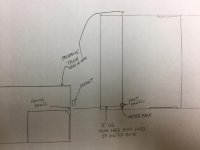
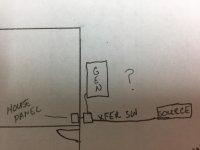
Here's a drawing.
 

Attachments

  • IMG_1631.jpg
    IMG_1631.jpg
    77.9 KB · Views: 35
  • IMG_1632.jpg
    IMG_1632.jpg
    75.3 KB · Views: 31

dcg9381

Well-known member
Joined
Jun 20, 2018
Messages
12,086
Location
Austin, TX
Question is concerning the 2" feed out the meter base to the house.
I'm thinking I need to route that 2" run towards a spot on the (not yet built) house to where I think the transfer switch box for the generator will be located.


Yes. Electrical service and the generator will both feed into an ATS (Automatic Transfer Switch)... Output of that ATS will go to your load center

Note, there are two types of ATS - "Service Entrance Rated" and not. If you're coming right out of the meter, you'll need a service rated ATS. Everything downstream is considered a sub-panel.

Also note, depending on type of signal wire for the genset, you may or may not be able to run it in the same conduit as generator power.


Roughly:

Meter------------>S.E. ATS-----------> Load Center

Generator feeds the ATS also (ATS takes input from generator and meter, one output)


How you gonna get from the ATS to the load center?


Right now Generac's stuff is on a massive back order - generators, ATS, etc - Looks like till March.
 
OP
S

Shovelhead

Well-known member
Joined
Dec 22, 2018
Messages
397
Location
DEEP EAST TEXAS
Everything downstream is considered a sub-panel.


Oh good God. The ole sub panel discussion. Yer telling me my house panel would be considered a sub panel just because it's tied to a Generator?? I don't think that's right.
Does that involve the ole splitting grounds/neutrals and bonding/unbonding / add 57 more ground rods......... ****?


How you gonna get from the ATS to the load center?

back underground and up through the slab in to the bedroom closet, or through the wall

Thanks
 

dcg9381

Well-known member
Joined
Jun 20, 2018
Messages
12,086
Location
Austin, TX
back underground and up through the slab in to the bedroom closet, or through the wall

Thanks

ATS to load panel, right?
The answer is "it depends". I wouldn't want to cut 200A of aluminum wire through studs. If it's a straight shot through the wall, that might be better.
 
OP
S

Shovelhead

Well-known member
Joined
Dec 22, 2018
Messages
397
Location
DEEP EAST TEXAS
ATS to load panel? Yes, that's how I understand them to be wired.

I seen an old co-workers setup last week. Same deal. 200A feed thru panel on a xfmr pole, UG to the genset "box", out that box to his main panel in the house.
No mention of any "sub panel" thing.

But, he did his after the house was built so outside by the genset the conduit is somewhat of a **** mess. I don't like a **** mess, that's why I'm asking about all this prior to the concrete trucks rollin down my road.

Seriously doubt I'd go through the exterior wall unless I got extremely lucky and they were perfectly back to back.
 

Noltz

Well-known member
Joined
Mar 10, 2020
Messages
377
Location
Ontario, Canada
What about this?


Making the house panel a Sub is just a different set of connections for the electricians. A good buddy has a 200A panel put in his garage for electric car charging. The new Main supplies the house 125A, making the original Main a Sub. Was much less expensive for him to buy a small 200A panel, add two 60A breakers and a 125A circuit to feed the house. Makes zero difference to everyday operations.
 

wyliesdiesels

Well-known member
Joined
Aug 14, 2012
Messages
20,256
Location
Modesto, CA
New construction.
Shop being built before house, so service entrance coming to shop first, then feed thru lugs to house. 200A
Want the Generator next to the house due to reasons of propane tank location.

House will be ~30' from meter base on side of shop. I'll have 12' of concrete porch on the shop to go under.

Question is concerning the 2" feed out the meter base to the house.
I'm thinking I need to route that 2" run towards a spot on the (not yet built) house to where I think the transfer switch box for the generator will be located.

In other words, don't run the 2" to where my house load center will be.

Make any sense?

This way the conduit will exit the ground straight up to the generator panel, from there to the load center.

The main feed needs to contact the generator before the load center. Correct?

It's going to be a bit of a challenge to get it dead nutts.
Would be so much easier to run that conduit straight from the meter base, instead of trying to angle it.

Not a good idea to have unfused wire like that on the property

The main feed does not "need to contact the generator", it connects to the transfer switch. Transfer switches are very rarely located in the same spot as the generator and they arent mounted on the generator so...

The conduit placement is my concern, not the size.
The feed from the meter at the shop.

I was initially going to also bury another 2" to get back to the shop from the genset, but really have no good reason to need to power the entire shop panel during an outage.

I figure I'll run a circuit or two from my house panel in an 1 1/4 back to the shop to feed a couple lights and a refrigerator.

Here's a drawing.

This will create some issues for you. Code does not permit multiple feeds to a building.
 
Last edited:

wyliesdiesels

Well-known member
Joined
Aug 14, 2012
Messages
20,256
Location
Modesto, CA
Oh good God. The ole subpanel discussion. Yer telling me my house panel would be considered a sub panel just because it's tied to a Generator?? I don't think that's right.
Does that involve the ole splitting grounds/neutrals and bonding/unbonding / add 57 more ground rods......... ****?

back underground and up through the slab in to the bedroom closet, or through the wall.

Thanks

If youre doing a service rated ATS right off the meter, then yes every panel after that is considered a subpanel by code. This means the shop panel and house panel are both subpanels. not sure why you would think thats not right but it is. you cannot have 2 or more main service panels (which have the bonded neutral) on the same service.

yes, it involves isolating the neutral bar(s) and making sure the EGcs are on their own bar(s).

57 ground rods eh? you mean 2? :headscrat :dunno: Ive never seen a service with 57 ground rods and Ive done rods for microwave towers. no where near 57 rods....

ATS to load panel? Yes, that's how I understand them to be wired.

I seen an old co-workers setup last week. Same deal. 200A feed thru panel on a xfmr pole, UG to the genset "box", out that box to his main panel in the house.
No mention of any "sub panel" thing.


But, he did his after the house was built so outside by the genset the conduit is somewhat of a **** mess. I don't like a **** mess, that's why I'm asking about all this prior to the concrete trucks rollin down my road.

Seriously doubt I'd go through the exterior wall unless I got extremely lucky and they were perfectly back to back.

That feed thru panel would be the main service panel with a bonded neutral. again, you can't have the neutral bonded in 2 or more places on the same service. If you did, you would have neutral return current flowing on pathways you dont want it flowing on. this is what youre having a hard time understanding.

IF your coworkers setup instead had just a meter pan and then the gen transfer switch, the transfer switch would be the main service panel, with a bonded neutral, since it would have a disconnect in it.

Remember, neutral is bonded at the first means of disconnect on a service, then it is isolated in every panel after that.

so what you want to do, requires the house and shop panels to be subpanels. there is no way around this no matter how much you think otherwise.

Also, keep in mind that with an ATS, the generator must be sized to handle the entire connected load, or you need to utilize load shedding capabilities... this adds more cost and complexity...
 

wyliesdiesels

Well-known member
Joined
Aug 14, 2012
Messages
20,256
Location
Modesto, CA
Do you really need it to be automatic transfer?

If not, you could do interlocks in both panels, keeping them main service panels and avoiding all the mess you have envisioned.
 
OP
S

Shovelhead

Well-known member
Joined
Dec 22, 2018
Messages
397
Location
DEEP EAST TEXAS
Thanks Wylie.
Believe me, I'm not trying to out think anyone here. I am not an electrician. I wouldn't be asking these questions if I thought I was.
My nearly 40 yr career involved 12-138kv work.

Yes, the service entrance/meter being at the Shop first has created visions of confusion for me..

First, when I said 57 grounds rods, I was joking.
Second, When I said contact the generator first, I meant the xfer switch for the generator. Service to genset(whatever contraption of a box that's needed for the throwover) to load panel.

Really not sure how they work in regards to disconnecting from the utility source in order to throwover and feed the house, and the shop(if desired). So,,,,
After pondering it more, I decided I don't need to feed the shop with the genset.

What's the reason for not being able to run two ckts out my house panel to feed a refrigerator and light in my shop, other than code? This will be inspected by no one.

And yes, I am thoroughly confused on the matter of not being able to land neutrals and grounds on the same bus.

The ground is the ground is the ground, right?
The panels will all be grounded via a ground rod.
Bonding, unbonding??

I really want to understand it in order to do it right, as well as why was the 3 wire feeder ok until 2008?

I know I found a couple youtube videos about it when I first heard of it, but I don't believe everthing I see on youtube.
I need to go back and study more I reckon.

Appreciate y'alls help
 

dcg9381

Well-known member
Joined
Jun 20, 2018
Messages
12,086
Location
Austin, TX
And yes, I am thoroughly confused on the matter of not being able to land neutrals and grounds on the same bus.

The ground is the ground is the ground, right?
The panels will all be grounded via a ground rod.
Bonding, unbonding??

I really want to understand it in order to do it right, as well as why was the 3 wire feeder ok until 2008?


Yea, this issue was confusing to me too. I can't tell you why it suddenly became "wrong" via NEC, but I can tell you when I was a kid that I felt current through residential plumbing systems on homes built in the 1980s.

You should look up "service entrance vs sub-panel ground wiring"

Basically only ONE panel gets to have a ground and neutral on a common bus, and that's the first panel - main panel - everything downstream has separate neutral and ground. I think the second place it can be bonded may be in the meter box - but Wylie can be more helpful than I can.

Here's a decent discussion:
https://www.garagejournal.com/forum/showthread.php?t=291565


I really like the ATS system for generators - they're $500-$850 options. They turn on the power for you, can be used to monitor your generator, the ATS I just bought also has a function that helps sort out what is pulling power in your home. In my case, the ATS is necessary as I have load shed modules that need control by an ATS.


Note, if you have a generac, the "service rated" ATS can also be wired as a sub-panel (you can unbond the neutral). However SOME electrical panels do not swap roles as service-entrance and sub-panel as the neutral cannot unbond.
 

wyliesdiesels

Well-known member
Joined
Aug 14, 2012
Messages
20,256
Location
Modesto, CA
Thanks Wylie.
Believe me, I'm not trying to out think anyone here. I am not an electrician. I wouldn't be asking these questions if I thought I was.
My nearly 40 yr career involved 12-138kv work.

Yes, the service entrance/meter being at the Shop first has created visions of confusion for me..

First, when I said 57 grounds rods, I was joking.
Second, When I said contact the generator first, I meant the xfer switch for the generator. Service to genset(whatever contraption of a box that's needed for the throwover) to load panel.

Really not sure how they work in regards to disconnecting from the utility source in order to throwover and feed the house, and the shop(if desired). So,,,,
After pondering it more, I decided I don't need to feed the shop with the genset.

The "contraption" is called a transfer switch. the automatic flavor has a motorized disconnect that automatically switches the feed connection from the utility to the generator feed.

What's the reason for not being able to run two ckts out my house panel to feed a refrigerator and light in my shop, other than code? This will be inspected by no one.

Safety. having 2 sources of power from 2 different panels creates the potential for shock hazard.

If you want to make this way easier, put the transfer switch on the shop or house, and do a branch feeder to the other building from the subpanel in the building with the transfer switch. this way the generator will power one panel which will in turn power the other one through the feeder. eg. put transfer switch on shop, feed subpanel in shop from transfer switch, then feed house off of shop subpanel.

EDIT: Just because its not being inspected doesnt mean it shouldnt be wired correctly. the lack of an inspection is not a green light to do shoddy wiring.

And yes, I am thoroughly confused on the matter of not being able to land neutrals and grounds on the same bus.

The ground is the ground is the ground, right?
The panels will all be grounded via a ground rod.
Bonding, unbonding??

since you worked in utility power which has no EGCs, i can see why you would be confused.

on the load side of the meter, neutrals aka the grounded conductor and EGCs/equipment grounding conductors aka grounding conductors ARE NOT ONE IN THE SAME. this is where your confusion comes in. The EGC is for providing a low impedance pathway for fault current to flow to enable the breakers to clear (open the circuit) the fault. under normal operation, no current flows on an EGC and thus an EGC can be uninsulated.

The neutral, on the other hand, is for neutral return current. under normal operation current does flow on this wire and thus it must be insulated.

now you bring up ground rods, which is another entirely different animal than an EGC. ground rods/electrodes are mainly for shunting lightning, limiting voltage potential to earth and shunting high voltage primary current for if and when primary lines contact and energize secondary lines.

A ground rod is most definitely NOT the same as an EGC or even a neutral. no where close. so when you say "the ground is the ground is the ground", its incorrect.

confusing these things and wiring these things improperly(bonded neutral past the main) will cause a potential for shock.

The reason for the bonding of the neutral in the main panel is so the breaker can clear the fault current. without that bond, breakers would not be able to open when there is a short to something that should not be energized such as the metal frame of an appliance. This is also why you want to bond metal water and gas lines in addition to the building steal. you dont want it becoming energized...

now the reason to not have a bonded neutral past the main is because you dont want neutral return current flowing on unintended pathways. for example, if you have a bonded neutral in a subpanel in the shop, the neutral develops a bad connection and you have a water pipe nearby, you will have a shock hazard potential. say you lean against the metal enclosure of the electrical panel(which is bonded to the neutral with a bad connection) and touch a water line. current can now flow through you.


I really want to understand it in order to do it right, as well as why was the 3 wire feeder ok until 2008?

I know I found a couple youtube videos about it when I first heard of it, but I don't believe everything I see on youtube.

I need to go back and study more I reckon.

Appreciate y'alls help

i explain this stuff in post #3 in the electrical FAQ sticky here:

https://www.garagejournal.com/forum/showthread.php?t=356460

it was allowed up til 2008 because they hadnt realize the potential for shock hazard. also it was only allowed if there were no parallel metallic pathways between the buildings, eg: electrical conduit, water or gas line, cable TV line, phone line, etc
 
Last edited:
OP
S

Shovelhead

Well-known member
Joined
Dec 22, 2018
Messages
397
Location
DEEP EAST TEXAS
Yessir, I know the difference between a ground and a neutral, and the purpose of a neutral in a 120v circuit.

You are referring to the EGC as the wire that grounds the panel enclosure itself, right? You are saying the ground rod which has a wire connected to it from the panel is different than the EGC? Are they not tied together.

I still don’t understand how one circuit running from the house panel to a single dedicated receptacle in the shop would have two sources of power from two panels. Or two circuits, one to a receptacle and a lighting circuit. They would not be tied to anything in the shop panel. ?

Thanks again, please don’t lose yer patience with me. LOL
I’ll read over this again in the morning over coffee, instead of this glass of whiskey.
 
To avoid these ads, REGISTER NOW!

Fasthotrod

Well-known member
Joined
Dec 14, 2015
Messages
218
Location
Oklahoma
There's a couple of different ways to do what you want... Wylie is trying to help you do them right. The guy knows his stuff.

You mentioned that you are building the shop and that the meter will be located there. My question is, what size is the service going to be? I ask because a typical 200A service meter only has one set of lugs for conductors. That's fine if the panel in the shop has a set of feed through lugs that you intend on sending over to the house, just understand that if you need to shut off the shop panel for any reason, you are also dropping the house. Not a big deal, just be aware of that.

Another option would be to ask the POCO to install 320A or 400A service. Typically, a service meter of that size has two sets of lugs, so you could run one set to the shop and the other set to the house. You would likely have two disconnects located right there at the meter, one for each feeder. That way you could kill power in the shop without any impact to the house. Just something to think about.

Now, if you are set on the idea of feeding the house panel from the shop panel, that's totally fine. You could run the feeder from the shop to the house and into an Automatic Transfer Switch (ATS) that hangs on the side of the house. (3R rated enclosure.) The feed could come straight up into the bottom into the ATS, and the feed from the generator could also come in from the bottom. If you wanted to, you could likely have the feed from the ATS to the house come out of the bottom, too. I just checked the dimensions on a Kohler single-phase ATS, and it's 24.5" tall, 13.2" wide, and 7.1" deep. (The Service Entrance rated ATS with a breaker is slightly bigger at 28.9" tall, 16.4" wide, and 6.9" deep.) So imagine three, 2" conduits running in parallel from the ground up into the ATS in a straight line.

http://www.kohlerpower.com/home/home-generators/products?prodNum=RXT-JFNC-0200A-QS7

A typical 20kW residential generator is good for about 80-85A. (Technically 83.33A) If you have done a load study and know that your house loads will be under 80A, then you're good. If not, then you need an ATS that has an automatic load shed function that can shed certain loads under higher load demands. Typically, the load shed function has a set of current transformers (CT's) that monitor the load on the system, and has load shed relays that can dump big current draw items such as your HVAC, or electric Oven. The Kohler ATS I linked to above has the option for load shedding if you wanted/needed it. (Kohler refers to it as a "Power Relay Module." You can connect up to four of them to the ATS )

The concern about sending a couple of circuits from the house back to the shop for a light or a fridge has to do with safety. The concern is that someone would come into the shop, trip the breakers in the breaker panel except for the main, and assume that everything in the shop is dead. If they didn't know/realize that the main panel had feed through lugs, and the house still had power, and that those two circuits from the house to the shop still had power... they would be in for one hell of a surprise. (Which could be deadly.)

It doesn't really matter where your generator is located in reference to the ATS. Personally, I wouldn't want my generator right next to my house due to the noise... but that's just my opinion. My in-laws didn't have much choice, being in town on a small lot. I installed their 20kW generator 5' from the house and poured a concrete pad for it, with an extension/dog leg that extended to the house. That way, I had a solid foundation from the generator to the house for mounting the conduits and fuel line. (One 2" conduit for power, and a 3/4" for control circuits. Pic attached during installation for reference.) It's setup to do a test run once a week, every Saturday at noon. They can hear it, but it's next to the garage vs. a bedroom, so it's not that bad.

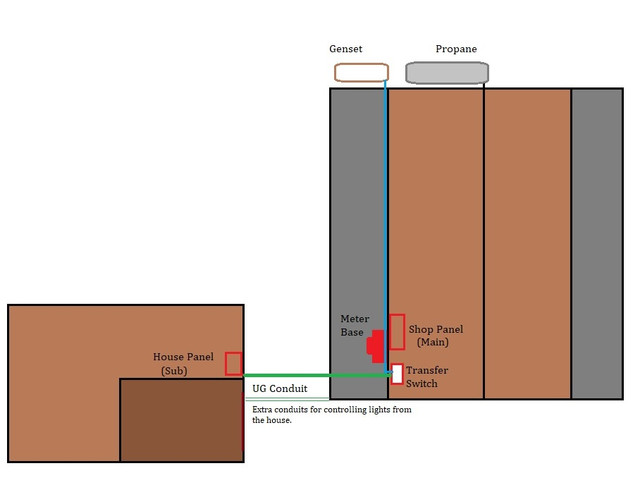
For a propane unit, I'd likely want my generator closer to the tank. The drawing that Noltz did is kinda like I would be thinking. Not only is it close to the tank, but it's all hidden behind the shop. Out of sight, out of mind... especially when it comes to thieves.

A residential propane unit will likely be a vapor withdraw system, so you'll need a decent sized fuel line from the tank to the generator. Looking at the Kohler spec sheet for a 20RESCL and it's saying you'll want a 3/4" line up to 25 ft. from the tank, 50-100 ft. requires a 1" line, and 100-200 ft. needs 1 1/4" line for LP.

So if this were my project to design/build, the first thing I'd be asking the home owner is what they want... do you want it to be as least expensive as possible? If so, then you will likely be giving up some aesthetics. (It might not look pretty.) If you don't mind that the generator and LP tank is right next to the house, then we can hang the ATS on the side of the house with a short run from the generator to the ATS.

To me, I like the thought of the tank and generator behind the shop. I'd mount the ATS right next to the power panel in the shop and stub into it there, and run a set of conduits from the generator to the ATS, then run a conduit from the ATS directly to the panel in the house. (Two conduits if you needed to use the load shed function at the house, or wanted remote monitoring of the ATS and generator in the house.)

Hope this helps.

Mark
 

Attachments

  • 20160402_175423.jpg
    20160402_175423.jpg
    141.5 KB · Views: 20
OP
S

Shovelhead

Well-known member
Joined
Dec 22, 2018
Messages
397
Location
DEEP EAST TEXAS
There's a couple of different ways to do what you want... Wylie is trying to help you do them right. The guy knows his stuff.

You mentioned that you are building the shop and that the meter will be located there. My question is, what size is the service going to be? I ask because a typical 200A service meter only has one set of lugs for conductors.

200A service. The Co-op will not let me do the 400A with two 200A disconnects. Their reason is that they will only run one 200A service.
I still can't figure out their reasoning.
They did approve a Meter base like this
>>https://www.homedepot.com/p/Milbank...Socket-Load-Center-R5168-XTL-200-KK/202504170


The concern about sending a couple of circuits from the house back to the shop for a light or a fridge has to do with safety. The concern is that someone would come into the shop, trip the breakers in the breaker panel except for the main, and assume that everything in the shop is dead.

Ok, I agree that makes perfect sense. But,,(not to be a smartass)too bad for the dead man. Never assume anything is dead.
Proper labeling would be in place for that circuit, and in the Shop Bkr panel.
The one "get ya" even if only the receptacle was labeled would be someone performing service to whatever is plugged in, like the poor Appliance man.
I'd have no worries as long as I lived there, but I can see how it could sure be a liability for the next feller.


Hope this helps.

Mark

Thank you very much Mark. Well explained.

I had a suggestion from someone else about locating the ATS at the Shop.
That would be a ~60' run from that ATS to the Genset if it were behind the shop.
And then I'd have to get someone to plumb the propane line.
Not having the equipment in place, or the house, makes this more of a challenge that I hoped for.
 

wyliesdiesels

Well-known member
Joined
Aug 14, 2012
Messages
20,256
Location
Modesto, CA
Yessir, I know the difference between a ground and a neutral, and the purpose of a neutral in a 120v circuit.

You are referring to the EGC as the wire that grounds the panel enclosure itself, right?

yes, the EGC on a subpanel feeder bonds the subpanel enclosure.

You are saying the ground rod which has a wire connected to it from the panel is different than the EGC? Are they not tied together.

Correct. it is called a GEC- grounding electrode conductor and is for shunting lightning to the ground rods. The GEC has nothing to do with bonding appliance frames, panel enclosures, and metal conduit to prevent them from becoming energized.

And just because they terminate to the same bar (or as you called it "tied together") doesnt mean they do the same thing.

Again, you need to learn the purpose of each. An EGC is to prevent a shock hazard. A GEC is for shunting lightning to rods.

I still don’t understand how one circuit running from the house panel to a single dedicated receptacle in the shop would have two sources of power from two panels. Or two circuits, one to a receptacle and a lighting circuit. They would not be tied to anything in the shop panel. ?

Thanks again, please don’t lose yer patience with me. LOL
I’ll read over this again in the morning over coffee, instead of this glass of whiskey.

The dedicated receptacle is not what i was referring to as having 2 sources of power. The building having 2 sources of power is what i was referring to. That is NOT permissible.
 

wyliesdiesels

Well-known member
Joined
Aug 14, 2012
Messages
20,256
Location
Modesto, CA
Shovelhead- can you please not nest your reply inside the quote? when one clicks the quote button, it excludes whatever reply you made inside the person whom you are quoting, so then one has to copy and paste your reply in the new quote, to get it to work properly.
 
Last edited:

wyliesdiesels

Well-known member
Joined
Aug 14, 2012
Messages
20,256
Location
Modesto, CA
200A service. The Co-op will not let me do the 400A with two 200A disconnects. Their reason is that they will only run one 200A service.
I still can't figure out their reasoning.
They did approve a Meter base like this >>https://www.homedepot.com/p/Milbank-...0-KK/202504170Thank you very much Mark. Well explained.

That is NOT a meter base/pan. That is a combination meter main service panel. That panel will complicate things since it has a bonded neutral. you would need an ATS that switches the neutral and has a bonded neutral on the generator feed side.

A divorced meter pan(meter only; no disconnect), with a service rated ATS, would be better.

Also, if you went with that panel you would have to have 2 transfer switches- one in between the main breaker and load center in the shop... because you have no way to wire the ATS in between the meter feed and the main breaker..... and one in between the feed to the house and the load center in the house. both load centers would need to be subpanels because you cannot have multiple neutral bonds...

Ok, I agree that makes perfect sense. But,,(not to be a smartass)too bad for the dead man. Never assume anything is dead.
Proper labeling would be in place for that circuit, and in the Shop Bkr panel.
The one "get ya" even if only the receptacle was labeled would be someone performing service to whatever is plugged in, like the poor Appliance man.
I'd have no worries as long as I lived there, but I can see how it could sure be a liability for the next feller.

I had a suggestion from someone else about locating the ATS at the Shop.
That would be a ~60' run from that ATS to the Genset if it were behind the shop.
And then I'd have to get someone to plumb the propane line.
Not having the equipment in place, or the house, makes this more of a challenge than I hoped for.

If you don't care about following code and wiring things safely ("no inspections here") why even bother getting advice on how to wire any of this? you won't get much advice here to wire things incorrectly.
 
Last edited:

dcg9381

Well-known member
Joined
Jun 20, 2018
Messages
12,086
Location
Austin, TX
That is NOT a meter base/pan. That is a combination meter main service panel. That panel will complicate things since it has a bonded neutral. you would need an ATS that switches the neutral and has a bonded neutral on the generator feed side.


Isn't this the same as a non-service-entrance ATS? non-SE ATS' are actually a little less expensive.

Generator should have it's own ground, makes sense that the ground and neutral are bonded at the generator as it's the "service entrance" when it's on. The bonding is at the generator, not in the ATS.

As far as I can tell, regardless of SE or non-SE ATS, neutrals do not switch at the ATS. The only difference is if you jumper that bond.
 
Last edited:
OP
S

Shovelhead

Well-known member
Joined
Dec 22, 2018
Messages
397
Location
DEEP EAST TEXAS
yes, the EGC on a subpanel feeder bonds the subpanel enclosure.


Correct. it is called a GEC- grounding electrode conductor and is for shunting lightning to the ground rods. The GEC has nothing to do with bonding appliance frames, panel enclosures, and metal conduit to prevent them from becoming energized.

And just because they terminate to the same bar (or as you called it "tied together") doesnt mean they do the same thing.

Again, you need to learn the purpose of each. An EGC is to prevent a shock hazard. A GEC is for shunting lightning to rods.


The dedicated receptacle is not what i was referring to as having 2 sources of power. The building having 2 sources of power is what i was referring to. That is NOT permissible.

Ok, understood.
 
OP
S

Shovelhead

Well-known member
Joined
Dec 22, 2018
Messages
397
Location
DEEP EAST TEXAS
Shovelhead- can you please not nest your reply inside the quote? when one clicks the quote button, it excludes whatever reply you made inside the person whom you are quoting, so then one has to copy and paste your reply in the new quote, to get it to work properly.

Sorry, did not realize that.
 
OP
S

Shovelhead

Well-known member
Joined
Dec 22, 2018
Messages
397
Location
DEEP EAST TEXAS
If you don't care about following code and wiring things safely ("no inspections here") why even bother getting advice on how to wire any of this? you won't get much advice here to wire things incorrectly.

I certainly do care about wiring things safely.

I will just take advice from you professionals and not voice anymore of my thoughts on Code.
 
OP
S

Shovelhead

Well-known member
Joined
Dec 22, 2018
Messages
397
Location
DEEP EAST TEXAS
That is NOT a meter base/pan. That is a combination meter main service panel. That panel will complicate things since it has a bonded neutral. you would need an ATS that switches the neutral and has a bonded neutral on the generator feed side.

A divorced meter pan(meter only; no disconnect), with a service rated ATS, would be better.

Also, if you went with that panel you would have to have 2 transfer switches- one in between the main breaker and load center in the shop... because you have no way to wire the ATS in between the meter feed and the main breaker..... and one in between the feed to the house and the load center in the house. both load centers would need to be subpanels because you cannot have multiple neutral bonds...

Good grief. There is nothing in this entire job that I thought I had somewhat of an idea on that is correct.

Let's disregard any ability to feed the shop from the Generator.

How is that meter main service panel any different than a regular panel coming off a separate meter can? That panel would also have a bonded neutral wouldn't it. It's the utility service entrance.

I have to have something that has feed thru lugs no matter what.
I thought using that meter main service panel would simply eliminate another "box" on the side of the shop.

How bout I head your way in my pickup and carry you back to East Texas for a few days. My old lady is the best cook in the State. You like to fish?:D
 

wyliesdiesels

Well-known member
Joined
Aug 14, 2012
Messages
20,256
Location
Modesto, CA
Isn't this the same as a non-service-entrance ATS? non-SE ATS' are actually a little less expensive.

Generator should have it's own ground, makes sense that the ground and neutral are bonded at the generator as it's the "service entrance" when it's on. The bonding is at the generator, not in the ATS.

As far as I can tell, regardless of SE or non-SE ATS, neutrals do not switch at the ATS. The only difference is if you jumper that bond.

not all ATSs switch the neutral

Ive seen some 480/277 ones that didnt. It was for a storm drain pumping station. The disconnect only switched the 3 phase legs.

Yes the generator feeder should have an EGC in the feeder, but that has NOTHING to do with a bonded neutral.

I havent seen a fixed stationary generator with a bonded neutral. theyre 4-wire. only gens with a bonded neutral are portables.
 

wyliesdiesels

Well-known member
Joined
Aug 14, 2012
Messages
20,256
Location
Modesto, CA
Good grief. There is nothing in this entire job that I thought I had somewhat of an idea on that is correct.

Let's disregard any ability to feed the shop from the Generator.

How is that meter main service panel any different than a regular panel coming off a separate meter can? That panel would also have a bonded neutral wouldn't it. It's the utility service entrance.

I have to have something that has feed thru lugs no matter what.
I thought using that meter main service panel would simply eliminate another "box" on the side of the shop.

How bout I head your way in my pickup and carry you back to East Texas for a few days. My old lady is the best cook in the State. You like to fish?:D

yes however in that case you would be the SE rated ATS in between the meter and main service panel and the main service panel would then need to be converted to a subpanel by unbonding the neutral and running an EGC to it.
 

dcg9381

Well-known member
Joined
Jun 20, 2018
Messages
12,086
Location
Austin, TX
not all ATSs switch the neutral

Ive seen some 480/277 ones that didnt. It was for a storm drain pumping station. The disconnect only switched the 3 phase legs.

Yes the generator feeder should have an EGC in the feeder, but that has NOTHING to do with a bonded neutral.

I havent seen a fixed stationary generator with a bonded neutral. theyre 4-wire. only gens with a bonded neutral are portables.

It sure looks to me like Generacs don't switch the neutral - they'll probably be the most common consumer-grade generator... These are single phase 120/240V.


I have to have something that has feed thru lugs no matter what.
I thought using that meter main service panel would simply eliminate another "box" on the side of the shop.

I had one heck of a time finding a feed through non-SE panel that was exterior grade and had minimal breakers. I ended up buying a Siemens PW0816B1200TC.
 

Attachments

  • 2020_generac_service_entrance_wiring.jpg
    2020_generac_service_entrance_wiring.jpg
    143.6 KB · Views: 13

Fasthotrod

Well-known member
Joined
Dec 14, 2015
Messages
218
Location
Oklahoma
Generator should have it's own ground, makes sense that the ground and neutral are bonded at the generator as it's the "service entrance" when it's on. The bonding is at the generator, not in the ATS.

From my experience, most residential style ATS's do not have a switched neutral. One might be able to use a three-phase ATS and simply use one set of contacts as the switched neutral, but then you might run counter to UL Listing and Code as it's likely not designed to operate this way.

But to your point about the neutral/ground bond, this is correct in a Separately Derived System. Each source (commercial power and generator power) would have their own neutral/ground bond at the service point. So for commercial it's at the Main, and for the generator it's at the alternator. When the ATS transfers, it lifts the phase conductors as well as the neutral conductor for each source, keeping each separate.

For a Non-Separately Derived Source, there is only one neutral/ground bond, and it's at the Main. There is not a neutral/ground bond in the generator. Instead, the neutral and ground are independent of each other, and both conductors travel all the way back to the Main and terminate at that location. While all of the grounds can be connected to each other along the way, the neutral must stay isolated from ground all the way back to the Main service point.

Reference NEC Article 250.30 Grounding Separately Derived Alternating-Current Systems. I've included an attachment that shows the difference between the two types below.

This article helps explain the safety aspect of it:

https://www.ascopower.com/us/en/res...hen-to-separately-ground-backup-generator.jsp

As far as I can tell, regardless of SE or non-SE ATS, neutrals do not switch at the ATS. The only difference is if you jumper that bond.

For many residential type ATS's, that is the case.

Hope this helps.

Mark
 

Attachments

  • Separately Derived or not.jpg
    Separately Derived or not.jpg
    21.9 KB · Views: 8
To avoid these ads, REGISTER NOW!
Top Bottom