To avoid these ads, REGISTER NOW!

Control joints or no control joints ?

5wndwcpe

Well-known member
Joined
May 1, 2007
Messages
1,143
Location
Southeastern, PA
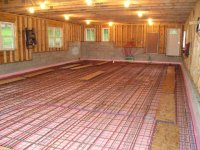
I know most of you guys have recommended using control joints in a new slab, but I've also noted some that have no joints and no cracks. Currently I'm getting ready to pour a 27 x 57 slab @ 6" thick, 4000# with fiber. It has radiant heat so the slab is bordered on all sides by 2" eps. Additionally, there is a 2" ledge all the way around the perimeter supporting the slab. There is 4x4 wwr on top of 150 pc of #4 rebar on 12" centers, sitting on 1.5" slab bolsters. My concrete guy doesn't seem to think the control joints will be necessary, though he's more than willing to do them, so I don't believe he's just trying to get out of doing the work. My dilemma is trying to work around the base plates of the 2 post lift I want to install without making these odd size "sections" with the saw cuts. Given the above info, what's the concensus ? Do I need them or not ?
 
To avoid these ads, REGISTER NOW!

porschedude996TT

Well-known member
Joined
Oct 28, 2007
Messages
2,384
Location
Santa Maria, California
I plan not to use joints, but plan to saw cut about 1" every ten feet and then fill the joint with elastic filler and paint the floor. 30' x 40' x 6" Thick with 3/8 rebar on 18" centers. I too am considering polyfiber in the concrete.
 

Mike83

Well-known member
Joined
Jan 24, 2008
Messages
2,156
Location
Wisconsin
I would use joints if it was mine. There are 2 guarantees with concrete: it will get hard and it will crack. I have witnessed both.
 

swgray

Well-known member
Joined
May 18, 2005
Messages
402
Location
maryland
My slab is 23 X 34 more or less. Also with rebar with similar spacing, some 1/2 and some 5/8. Only expansion joint is around perimeter using zip strip. I have no cracking. Its 7 years old now.
 

Stuart in MN

Well-known member
Joined
Sep 8, 2005
Messages
23,174
Location
Minneapolis
The slab in my garage is 24x40, and it was poured with no expansion joints almost 15 years ago. It did develop one crack right across the middle after about three or four years, but there's been no separation or settling since then so it's mainly a cosmetic thing. If I had it to do over I would have insisted on the concrete guy putting them in (I asked him about it at the time and he said they weren't necessary; I didn't know better at the time.)
 

Jaguar Fan

Well-known member
Joined
Mar 13, 2008
Messages
5,507
Location
Park City for Ski Season; Las Vegas for Poker Seas
I suspect your local conditions will govern the answer. For example if you have highly expansive heavy clay soil, or if you have a fair bit of seismic activity, you're better putting in the joints. If you are in a dry sandy area, maybe not. You might try finding a neighbor to see if (or how badlly) their slab has cracked...

For a new house I'm having built, the garage slab is post tensioned concrete and even so the engineer spec'd joints. I asked hiim why - it is based on local conditions and the type of load factors from cars/lifts. The house slab (also post tensioned) at about 6000 sq ft has no joints, of course: different loading factors.
 

jamm

Well-known member
Joined
Oct 31, 2007
Messages
139
Add the control joints, even the best concrete will crack. Even though you have plenty of reinforcement its' purpose is to limit movement on either side of a crack, not stop cracking. A properly cut control joint will make the crack follow the joint. If you're worried about the joint, fill it with suitable caulking.
 
To avoid these ads, REGISTER NOW!

kbs2244

Well-known member
Joined
Nov 11, 2006
Messages
14,065
This is a case of going with the local knowledge of a contractor you can trust.
Freezing, soil conditions, etc. will play into it.
 

Kevin54

MEMBER EMERITUS
Joined
Jan 12, 2005
Messages
29,341
Location
Urbana, Ohio
I plan not to use joints, but plan to saw cut about 1" every ten feet and then fill the joint with elastic filler and paint the floor.

That is a control joint.

I know most of you guys have recommended using control joints in a new slab, but I've also noted some that have no joints and no crack

Personally I would put the control joints in. Concrete shrinks as it cures and if there is the least little void underneath when it does that, it will crack. If the contractor says you don't need them and it will not crack, can you take that to the bank? And then...what if it DOES crack. Which way will the crack go? It will run at a jagged diagonal right across the floor. Then what do you do? You have to have the crack cut out and filled. About the only way to keep it from cracking and it is no guarantee, is to slowly backfill the area to be poured, have a vibratory tamper, compact everything, backfill a little more, compact, etc, until all of the fill is just as hard as the concrete going on top. Also with radiant heat, you will be introducing heating and cooling into the slab which can cause expansion/contraction, and although it will be miniscule can still cause stress. So you might want to consider cutting them in, in the first place, then go back and fill them after they crack. At least it will be a controlled crack.

My dilemma is trying to work around the base plates of the 2 post lift I want to install without making these odd size "sections" with the saw cuts.

If you know where EXACTLY the two post is going, pour your piers in those areas and have it wrote down on a piece of paper the dimensions from the wall each way. After the floor is poured, have a control joint cut around the area of the piers and either right under the baseplate of the lift or right outside of the base plate of the lift. Because if you figure, you will have two points of contact/weight concentrated in two small areas, add to that the weight of a full size car, so if something is going to crack, that will be a prime spot. With a control joint sawed in at that area, it would prevent any crack from expanding out to the floor. 4000# concrete with fiber mesh is strong, but it is chopped up pieces of fiberglass. IT WILL STILL CRACK. It has in the past hundreds of times and it will do so in the future., The 4" wire helps to strengthen the concrete by keeping it from pulling apart but it will still stretch. Rebar keeps the top surface level after it cracks by keeping one side from dropping down. But both the wire mesh and rebar are additives in the concrete to help control any movement but will not keep the concrete from cracking. There has been many formulas for concrete over the years and not one yet has kept it from cracking, only to help strengthen it. But even in that case, concrete that was poured back in the 30's was a hell of a lot tougher than what we have today. So after rattling on for 5 minutes of your reading time and probably 20 minutes of my limited typing time:lol_hitti My vote would be for control joints cut in, filled after the fact, floor done in your choice of designer colors, and kick back and enjoy.:lol: It would be a shame to have something like the size of the floor that you have, go out and sit in the garage enjoying the area after it is all built and done, have a cold on while kicking back,:beer: and staring at the huge crooked crack running from corner to corner and thinking DAMN:willy_nil:lol:

BTW...I did a quick search and i did run across this... Just a few of the articles on control joints and cracking. There is a multitude of articles out there. Just do a search for "concrete control joints" http://www.canzac.com/jfs/control_joints.html
http://www.concretenetwork.com/concrete/slabs/controljoints.htm
http://www.concretedecor.net/Abstracts/CD204_Joints.cfm
http://www.concreteconstruction.net/industry-news.asp?sectionID=986&articleID=483111
 
Last edited:

buening

Well-known member
Joined
Dec 17, 2007
Messages
1,338
Location
Decatur, IL
The PO of my house poured the slab inside the garage without control joints and put control joints in the slab of the drive. I have some pretty bad cracking in the garage from the lack of control joints. While local conditions may say otherwise, when I design floor slabs the spacing of control joints is twice the number of the slab thickness so to speak. If you are pouring a 6" slab, then maximum control joint spacing should be 12'. If an 8" slab, then 16' spacing. This is assuming your concrete will contain less than 3/4" aggregate.
 

dcjredline

Well-known member
Joined
Mar 15, 2008
Messages
109
I have them in my 28x30 and there is only one teeny tiny little crack that is visible or not in a joint. The contractor told me what others have been telling you and he is a 3rd generation mason "The slab will crack" I am also hopefully this year going to seal the cracks with caulk so **** doesnt keep getting stuck in there.
 

Mr. Welsh

Well-known member
Joined
May 21, 2007
Messages
1,425
imo, proper concrete contractors would put the joints in.

For homeowners, there are no downsides to the joints. For commercial operations, the joints can cause problems (and downtime) due to heavy forklift traffic, etc. Then it becomes an issue.

I know that some people here have done 2-3 car garages with no joints. They are taking a risk. For what?
 
OP
5

5wndwcpe

Well-known member
Joined
May 1, 2007
Messages
1,143
Location
Southeastern, PA
Thanks for the replies fellas. You've pretty much convinced me of what I've heard before: waters wet, wood splinters and concrete cracks. I was leaning towards the joints anyway and with your input I've decided to put them in. The pour is tomorrow a.m. Wish me luck !
 

Attachments

  • P1010118-gj.jpg
    P1010118-gj.jpg
    65.6 KB · Views: 40
To avoid these ads, REGISTER NOW!
Top Bottom