To avoid these ads, REGISTER NOW!

Control joints

6togo

Well-known member
Joined
Nov 7, 2016
Messages
173
Location
Harford co , MD
I'm getting ready to epoxy my 35x50' garage floor and it is saw cut into basically 10' blocks. I would like to fill the joints before applying the epoxy and flake so it's a seamless job. Is this a bad idea? The floor is 3 months old and I will more than likely be using Versatile products unless I find something better.
 
To avoid these ads, REGISTER NOW!

Armorpoxy

Well-known member
Joined
Aug 18, 2013
Messages
3,735
Location
NJ
Here is our official word on this often-asked topic.

The joints are there to allow for natural movement and expansion and contraction of the slab. The epoxy is hard and not flexible, hence when/if the slabs move you will get cracks along the joints. For this reason we normally don't recommend filling them and covering over with epoxy since over time the floor will get cracks, then water and dirt can get into the epoxy and the concrete causing the concrete to swell and you can get bigger cracks and delamination along these areas. This is the same problem with wood floors why epoxy especially in commercial kitchens is a disaster waiting to happen.

Our recommendation is to either leave them be and just let the epoxy/flecks run into the joints. Alternately do the floor and then fill the joints with backer rod foam and color-coordinated joint filler. There is a product by Metzger and Mcguire called RS-88 which comes in 100 colors so you can coordinate your caulk with your floor to minimize the look of the caulk, and you aren't married to just gray or white caulk available everywhere.

As long as you are aware of above cracking potential if coated over, at least your expectations are reasonable for whatever choice you make.
 

LegacyIndustrial

ALLIANCE MEMBER
Joined
Jun 7, 2010
Messages
7,994
Location
deerfield, IL
They are basically dead once the concrete has cured and a small crack has occurred in the bottom.
Check yours, I will bet the crack is there.
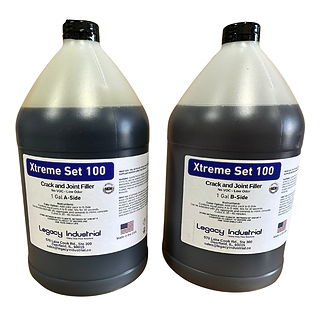
Fill them with our XtremeSet100, trusted by thousands of DIY and Pro-Installers across the USA.

The perimeter joints should be treated with a flexible but paintable caulk product.


FJ4FUN

Well-known member
Joined
Jul 28, 2014
Messages
625
Location
NorCal
We're in the same camp as Benwah, with a couple additional pointers; chamfer the edge of the saw cuts with an angle grinder/diamond cup wheel before filling, consider backer rod if the cut depth exceeds 2".

We have seen coatings crack over filled joints but only when filling larger hand troweled joints. Caster wheels common on tool carts, floor jacks, engine hoists put a lot of pressure on a small contact area. When rolled over wide filled joints the flexible fillers cannot support that weight and will flex and crack the coating. Saw cut joints are typically less than 3/8" and do not see the same pressure/displacement when filled as the larger hand troweled joints.
 
OP
6

6togo

Well-known member
Joined
Nov 7, 2016
Messages
173
Location
Harford co , MD
Yes if you look at the joints where they go to the walls and the saw stopped there are small hairline cracks from the cut to the wall. There are no expansion joints around the perimeter walls which I did on purpose. Knowing concrete shrinks most of the time curing which it has to a small degree. Most garages finish to the stem walls anyways so nothing new there. The cuts are about 3/16" wide the width of a diamond saw blade.
 

FJ4FUN

Well-known member
Joined
Jul 28, 2014
Messages
625
Location
NorCal
Yes if you look at the joints where they go to the walls and the saw stopped there are small hairline cracks from the cut to the wall. There are no expansion joints around the perimeter walls which I did on purpose. Knowing concrete shrinks most of the time curing which it has to a small degree. Most garages finish to the stem walls anyways so nothing new there. The cuts are about 3/16" wide the width of a diamond saw blade.
Fill 'em with our IntegraFlex 1921 then coat it all with one of our Wolverine Coating systems.... ;)
 

benwah

Well-known member
Joined
May 21, 2014
Messages
980
Location
Crested Butte, Colorado
Have any filled joints ever cracked?
Haven't got a call back for one that did yet.....

Currently on a floor as I type.

In the first pic there are 2 joints, one running vertically and the other horizontal. The vertical "joint" is filled with felt, between the stem wall and the slab. I cut the felt out and fill with Sikaflex SL AFTER the floor is completed.

In the second pic, you see a sawcut joint. I zoomed in so you can see it has already cracked beneath the sawcut, which is supposed to happen. I have already run the grinder over it, softening the 90° edges. This will get filled flush with a "flexible" 100% solids epoxy joint filler. Then the coating system (primer, body coat w/flake, top coat) will be applied over that. This slab was poured in 2005 and I am not worried about it cracking anymore.

That's not to say it cannot happen, but the chances are much less likely on a 17yr old slab. 3rd pic shows what the Sika SL looks like
 

Attachments

  • 20220830_152944.jpg
    20220830_152944.jpg
    409.9 KB · Views: 59
  • 20220830_153207.jpg
    20220830_153207.jpg
    761.1 KB · Views: 59
  • IMG_6485.jpg
    IMG_6485.jpg
    387.1 KB · Views: 59
OP
6

6togo

Well-known member
Joined
Nov 7, 2016
Messages
173
Location
Harford co , MD
So using a flexible product in the joint will flex with the joint some but the coating on top will not correct? Just wondering if a non flexible product would be better and if a crack happens most likely not be in the fill area.
 

benwah

Well-known member
Joined
May 21, 2014
Messages
980
Location
Crested Butte, Colorado
It's pretty standard for epoxy joint fillers to be somewhat flexible in my experience. That doesn't mean you can bend them like rubber or anything, but they may have a lower hardness rating to absorb some slab flex if it happens.

I would suggest using one of the 2 mentioned above
 
To avoid these ads, REGISTER NOW!
OP
6

6togo

Well-known member
Joined
Nov 7, 2016
Messages
173
Location
Harford co , MD
When I chatted with Versatile they have a few product for filling joints but thought their 1010 would work fine for this task. It's a non flex epoxy mortar.
 
OP
6

6togo

Well-known member
Joined
Nov 7, 2016
Messages
173
Location
Harford co , MD
I don't even know that a full broadcast floor is ideal for my shop. I found with moving shop equipment around it's not very forgiving. Looks great but for a working shop I'm not so sure.
 

FJ4FUN

Well-known member
Joined
Jul 28, 2014
Messages
625
Location
NorCal
I don't even know that a full broadcast floor is ideal for my shop. I found with moving shop equipment around it's not very forgiving. Looks great but for a working shop I'm not so sure.
For a working shop environment we suggest our 2 layer solid color CFLC system. Apply a coat of our BondTite 1101 100% solids primer followed with a generous coat of our 100% solids LiquaTile 1143 CFLC and your done. The full ceramic formulation makes this one of the most durable epoxy coatings available. No clear coat means a significantly reduced return-to-service and makes future repairs or recoat efforts a snap.
 
OP
6

6togo

Well-known member
Joined
Nov 7, 2016
Messages
173
Location
Harford co , MD
How is the product with a jack with metal wheels lifting a vehicle? I made that mistake with the Roll on Rock floor in my last garage left two wheel indents and also a motorcycle kickstand left a divot. Just seemed like a thick but soft product I assume most are probably the same but I have no experience with any other brands.
 

FJ4FUN

Well-known member
Joined
Jul 28, 2014
Messages
625
Location
NorCal
So using a flexible product in the joint will flex with the joint some but the coating on top will not correct? Just wondering if a non flexible product would be better and if a crack happens most likely not be in the fill area.
We've never experienced cracking when filling saw cuts with our IntegraFlex 1921. We have seen it when customers fill large hand troweled joints. For most applications that involve hand troweled joints we encourage customers to fill them post coating with any number of joint fillers as product compatibility is not an issue. For true seamless applications where joints, cracks, holes need to be filled first, we recommend our TrowelEase 1162 epoxy mortar binder.
 

FJ4FUN

Well-known member
Joined
Jul 28, 2014
Messages
625
Location
NorCal
How is the product with a jack with metal wheels lifting a vehicle? I made that mistake with the Roll on Rock floor in my last garage left two wheel indents and also a motorcycle kickstand left a divot. Just seemed like a thick but soft product I assume most are probably the same but I have no experience with any other brands.
Metal wheels/casters may scratch it but will not compromise its integrity. Kickstands are the bane of the industry and can be hit or miss, it won't dent it but it may gouge it. I think it has a lot to do with the size of bike and profile of the kickstand. Most people throw down a small piece of carpet of plywood under the stand.
 
OP
6

6togo

Well-known member
Joined
Nov 7, 2016
Messages
173
Location
Harford co , MD
Yes it was a learning experience when I first did the other floor. I kinda went in thinking it was bullet proof but quickly found out it was not. I learned quickly to roll metal wheels gently and if using a jack or stands to place a thick vinyl pad under them.
 
OP
6

6togo

Well-known member
Joined
Nov 7, 2016
Messages
173
Location
Harford co , MD
I knew better about my Harley kick stand however my cousin dropped his Big touring Harley off one day when I wasn't home and it left a nice mark!
 

FJ4FUN

Well-known member
Joined
Jul 28, 2014
Messages
625
Location
NorCal
I knew better about my Harley kick stand however my cousin dropped his Big touring Harley off one day when I wasn't home and it left a nice mark!
jack stands won't be a problem as they are a static load. When you think about how the leading edge of a kickstand gets loaded it starts to make sense why they can do so much damage. Center stands aren't a problem either it's the jiffy stand/sidestand that's an issue.
 

Armorpoxy

Well-known member
Joined
Aug 18, 2013
Messages
3,735
Location
NJ
For a working shop we would recommend (we sell several thousand of these per month) one of our Job on a Pallet Kits. Fill the joints after with our Flexible Joint Filler. Foolproof and sold for over 25 years without issue. Specified by the US Coast Guard and Air Force for their hangars over 100 times.
 

arctictq

Active member
Joined
Sep 5, 2023
Messages
28
Location
East Bethel, MN
This was a lot of good info, I just had a slab poured and have saw cut CJ's
I was wondering if I should or could fill them. But it sounds like maybe I should wait a while before filling them, to possibly let them do there job? I'm not in a hurry to Epoxy for a while anyway, but at 1st I was thinking dirt and maybe oil or something will get in there with it open. It might be a while before I did any epoxy, guess I'm kinda undecided right now.
 
To avoid these ads, REGISTER NOW!
Top Bottom