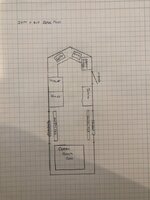
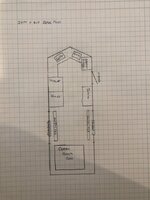
Okay, great... think of your batteries like your bank account. If you are frugal, your funds can go a long way... but if you spend like a drunken sailor, you better have more in reserve. (More batteries can be added if needed.) My assumption is that your truck has a 7-prong plug with a power port that can help power the trailer when it's plugged in? That will help keep it topped off as you are getting to where you are going.
Good deal... each of those lights are 12 VDC and pull 0.6A each. So if all six are on, you're pulling 3.6 amperes... not a whole lot, really. Total power to run the lights would be = 12 VDC * 3.6 Amps = 43.2 watts. Run them for an hour: 3.6 Ah, or 43.2 watt/hr. Odds are, you won't be keeping them on 24/7 so the draw won't be constant.
Looking at the installation manual, it looks like it has a 4A slo-blow fuse. Let's assume that it won't pull more than 4A, but use 4A as the 'worst case' for power draw. 12 VDC * 4 A = 48 watts. 4A/h or 48 watts/hr. It looks to be a variable speed fan with three speeds... and depending on the climate where you are going to be, you may chose to run that fan to keep your trailer cool most of the time?
I'd have to look to see what's available... but I'd think that any RV type store will have options for a 12 VDC pump.

Charging phones and power tools... so we're thinking USB ports/chargers and a few 120 VAC outlets to charge a DeWalt or Milwaukee style battery pack? Or did you mean that you wanted to run a 120 VAC tool like a circular saw, drill motor, etc...?
Gotcha... does it use a typical 120 VAC plug? If so, you could probably plug it into an inverter and have the ability to power it either way.
That's a slick little heater!
Fair enough... but you can do it if you plan for it. I was looking at some small RV style microwaves and they were like 900 Watts on the output side. I'd venture to guess that they need about 1,400 watts to run them, and that is certainly possible to get from an inverter. (I put a 2,000 Watt inverter into my father in law's van to power his home oxygen unit. He has COPD and needs constant flow of air, so running a full size home unit in the vehicle was a game changer for his mobility needs. It only pulls about 350 - 400 watts, but I used the 2,000 watt inverter so that it could easily handle the in-rush current from the motor starting on the machine. It works like a champ!)
The fact that you are already going with a lot of 12 VDC or propane equipment tells me that your 120 VAC needs will be pretty minimal.
What about a TV? I thought you mentioned it before... I was looking at a LG 43" 4k for less than $300 at Best Buy. Manufacturer's data says that it typically pulls 49.6W but can pull upwards of 95 watts. Just something to think about.
So if it were me, I think I'd buy a robust battery charger that you can plug in as 'shore power' to charge your batteries. If you get one that has a bit more 'oomph' you can also run some lights and stuff while charging the batteries. There is a link to one above, but if you are charging multiple batteries I'd think you'd want something a bit bigger. Perhaps something like this:
https://www.amazon.com/dp/B00F8MC45E/?tag=atomicindus08-20
Looking at the battery specifications, they appear to be designed for a UPS application. Typically, UPS's are designed to provide backup power for a short period of time. (Typically 15 minutes, give or take.) If you look at the battery specs, they say that the battery can produce 398 watts in 15 minutes of run time, discharging the battery down to 1.67 VDC per cell. (10.02 VDC for the battery.) If we average the discharge voltage to a nominal 12 VDC (rather than the range of 13.5 VDC down to 10 VDC then we're looking at about 32 amperes during discharge. (Multiplied by four if you are using all four batteries in parallel.)
The reason I'm bringing this up is that battery specs are given based on the application. Some are shown for use in a quick discharge over a short period of time, whereas others are shown for a slower discharge over a longer period of time. (The quick discharge is hard on the battery life, as well as available capacity. Google "Peukert effect" for more info.) I don't claim to be a battery expert by any means... but I really don't have a way to know the 'life' of those batteries for your application.
My recommendation, because you already have them, is to simply try them out and see what your results are. An inexpensive battery monitor will help you with how much power you're using, and keep you from running them down too far. Something like this:
https://www.amazon.com/dp/B01JOUZELG/?tag=atomicindus08-20
...or this:
https://www.amazon.com/dp/B013PKYILS/?tag=atomicindus08-20
One of those might come in handy for you. You might even consider getting two... one between the charger and the batteries, and one between the batteries and the loads. That way you can monitor what comes in, and what's going out.
As for an inverter, I'd likely start with something like this one:
https://www.amazon.com/dp/B00VPYUSU2/?tag=atomicindus08-20
It's capable of 1,000 Watt output with a 2,000 Watt surge capacity. More than enough to power up some small loads you might have. This is a Modified Sine Wave (MSW) inverter (square wave) so some electronics won't like it... the instructions say: "DO NOT plug in battery chargers for cordless power tools if the charger carries a warning that dangerous voltages are present at the battery terminals." So you'll want to check what devices you are plugging in to make sure that's not the case. More info here:
https://www.manualshelf.com/manual/powerdrive/pd1000/energy-guide-english/page-3.html
If you wanted to go with the 'microwave' option, then the 2,000 Watt inverter isn't that much more from a cost perspective, and gives you more surge current available for the startup of bigger loads:
https://www.amazon.com/dp/B00VPYUY6A/?tag=atomicindus08-20
This is the one that I installed in my father in law's van... I tested it with a big shop fan and it handled that with ease.
The cool thing about those inverters is that they have USB charging ports right on the front... makes it easy to charge up your phones and not have to carry around additional chargers that might get lost. They also have an automatic low-voltage shutdown so if you forget to turn it off, it doesn't completely destroy your battery bank.
If it were me, I'd be looking at installing the charger, batteries, and inverter close to one another. That way you can cut down on the cost of the big wiring between the three. Car audio type wiring and connectors will come in handy for this project... there is a lot out there, some that is way over-priced, some more reasonable. I've got a few ideas on how to wire this stuff up if that's the way you want to go. Just let me know.
Hope this helps,
Mark