Generating three phase power is theoretically impossible since the single phase output is ALWAYS going to be 180 degrees apart. The best you can do is to have two of the phases 180 degrees apart and then make a third phase in the middle.
Hi Eric!
Don't glue yourself into theory... What you have here, is a statement that seems logical, but in reality, it is NOT correct. When you build a rotary converter, you actually DO generate three phases, and they're very close to 120 degrees apart, but the phase relationship will vary slightly based on change of output load and line frequency.
The reason: When you load a rotary phase converter, you're not using the neutral lead... it is irrelevant.
The neutral centerpoint is in the I realm- it is there, but although there is no physical 'neutral', like what you'd expect out of a 240v Y-wired generator, but the output is genuine, bona-fide true three-phase 120-degree power less a few degrees of skew on balance of XC and XL. The finite details of the explanation appear in the Fitch-Williams white paper.
Imagine it this way. Put two dots on a piece of paper... 2.4 inches apart. Mark the centerpoint, and draw a line going straight up. Now take your compass, set it to the 2.4" radius, land the spike on one dot, and find the point where the radius crosses your vertical mark. Repeat for the other point. Put a third point at that three-way intersection.
Your UTILITY NEUTRAL point is where the horizontal and vertical lines intersect.
Your TRUE NEUTRAL point occurs slightly up that vertical line a ways.
Regardless, it doesn't matter to an electric motor, as long as you're fairly close.
But I wouldn't run a 3-phase welder off a rotary converter... it's simply not necessary. Phase-shifting the center leg of the welding transformer is a whole lot more 'stiff' when welding at higher power levels, and you don't have that 'other' gadget running, and the extra 3-phase extension cord hanging around and limiting your reach.
As for comparing the utility of an industrial-grade machine against a portable lunchbox welder, that's a pretty poor comparison, and I didn't develop this conversion to pit the two, as it's like riding a moped to Sturgis.
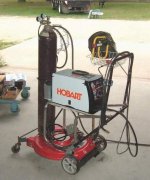
I've used Century, Lincoln, Miller, and even imported lunchbox MIGs, and own an original Hobart Handler (made in like... '87?) that I use all the time, and I even put it in my service truck and take it along on jobs when I need to squirt wire to tack parts together in-situ, where a stick isn't practical. I would NOT, however, trade my Handler, or even consider using it for anything other than extremely light work. Why? Duty cycle and output. Very few lunchbox welders have duty ratings over 25%... they simply don't have enough iron in the transformer core, and many use aluminum windings to reduce package weight (portability).
Look at this one:
http://www.lincolnelectric.com/en-us/Equipment/Pages/product.aspx?product=K2471-1#target2
20% duty cycle @ 90A. $600.
Now look at what they rate as more of a 'commercial' or 'light industrial':
http://www.lincolnelectric.com/en-us/Equipment/Pages/product.aspx?product=K2701-2
A little better... 40% @ 250. $2800.
Now read the ratings of a Miller CP-200...
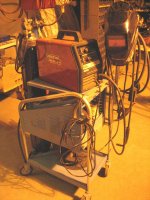
100% @ 200A. Typical Price: $400 or so (including some capacitors).
Pocket welders have their place. The reason I did this, and other conversions, is because there's a whole WORLD of superior machines- real industrial machines... out there, available for literally PENNIES on the dollar... and many times, FREE. (yep, my favorite four-letter F-word)
As far as the 'trouble' and 'f-ing around', well, if you're taking time to work on things, and you want to learn a few things, and see the DIRECT RESULT of learning and dilligent effort, have at it, and enjoy the fruits of my labor... many have (I get calls and questions every couple weeks, and only a scant few are actually engineers, technicians, or electricians)... and my general attitude always applies- If it doesn't seem to 'work', I'll volley emails and phone calls to help solve the problems... 'cause it ain't that difficult.
If someone's not interested, or have no need for a really powerful, really sweet, and really inexpensive welder, it doesn't break my heart. I have no pecuniary interest in someone else's success here, and I don't sell anything. This project is very simple: I was faced with a personal challenge, came up with an idea, invested my time and effort to make it work, then I published the results of my work. I owe credit and a big thank-you to Peter Haas, formerly of PG&E for his efforts double-checking my math and concepts. I then released it into the wild for the benefit of any and all, with a promise that it really DOES work... so consider it worth AT LEAST, and if you try it, MORE than what you paid for. I kinda doubt you'd find a better deal anywhere.


 but it is doable.
 Much different than what I had in mind!