That should have been Learmonth. Sorry for the spelling errors.
I was going to "ball park" an equipment selection for you. These are not sized the same way as a conventional DX cooling system. Instead here are some general guidelines.
For those who have been following this thread, an evaporative cooling system does not have a compressor. Nor does it have refrigerant, condenser, expansion valve, evaporator coil, etc.
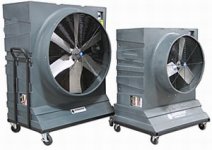
Instead the unit consists primarily of a supply air fan, a water absorbing mat, and a water regulating valve. [This is also the same description as a residential humidifier]. Upon a call for cooling, outdoor air is drawn into the unit by the fan, blown across the water soaked mat (where cooling takes place due to evaporation, or more accurately adiabatic cooling), and then discharged into the occupied space anywhere from 10-20 degrees cooler than the ambient temperature. Operating costs are typically anywhere from 30-70% less than standard air conditioning. Additionally, the weight of these units is about half that of standard roof top units, simplifying installation. So for areas such as the US southwest, where the relative humidity is typically low, these devices are often utilized. Higher humidity levels reduces the efficiency of these devices so that they are generally not used in other locales.
The downside of an evaporative cooler is that the conditioned supply air (and there is plenty of it) is entering the space at relatively high humidity levels. This prevents these units from being applied for office applications. I have used them successfully however, in warehouse and some light manufacturing facilities, and they are often seen in green houses where the added moisture is a benefit. Additionally, there are some units that have entered the market that are "indirect evaporative coolers" that utilize a heat exchanger, and thus reduce the moisture brought into the space. These indirect devices are the ones that are at the lower end of the efficiency scale, and are typically not seen in most light commercial jobs. I do not have experience with these.
I would be cautious about using these for a wood working applications as the increased humidity of the nearly saturated supply air will impact the stability of wood. Also this will affect paints and varnishes which may "blush" from the elevated moisture. So you have to be sure this is a good application for this technology.
As for the OP's needs (now that everyone else has nodded off), a very rough, long distance estimate for 1800 square feet would be, IMO, two rooftop-mounted units of about 5,000 cfm each, with a modest discharge duct at the bottom of each unit. Two units will reduce the roof loading, minimize the throw requirement for the air, and will provide some redundancy if one of the units is off line. Two smaller units may also have less visual impact. The design intent would be to achieve indoor dry bulb temperatures of about 80-85 degrees when outside temps approach 100 F.
Service requirements are simple. Maintain the air and water filters. Monitor for mold or mildew (Ligeonella likes these conditions). Fan should be designed for this application. Better units have a bleed down mechanism to remove minerals and dirt. Keep the sump pan clean.
The other concern is that you have to vent all the outside air that you have just brought into the space. I would suggest that you operate the units with a garage door opened at least 18". You can experiment with this or provide an automated relief air system. Your choice.
I hope this provides some guidance for you. You should have an actual load calculation performed by the vendor or a knowledgeable engineer or contractor. I also noticed that the big three no longer list evap coolers in their catalogs. You will have to go to a specialty manufacturer. I suspect that there are several in Australia to choose from.
Good luck with your project. Take pics and keep us informed.


 They work great,,, it gets to 120*F in Vegas,,,, and i've used mine as a roll around,, then i decided to place it outside, cut the hole, and duct the air in.