To avoid these ads, REGISTER NOW!

Copper Air Fitting Setup

gmhill33

Well-known member
Joined
Oct 5, 2009
Messages
539
Location
Ohio
Greetings,

Can someone post a good picture of how they setup their air fittings for the copper line.

I think I am going to go from the 3/4" pipe to a 3/4"-1/2"-3/4" T. Then near where I want the air fitting, I will put a 1/2" T and out of the T I will put the air fitting (with some adapters) and out of the bottom of the T I will run a short 1/2" pipe with a valve to drain the water. What do you think (assuming that made sense).

Thanks,
Gary
 
To avoid these ads, REGISTER NOW!

Cryptic1911

Well-known member
Joined
May 24, 2008
Messages
2,884
Location
Willimantic, CT
Thats exactly how its done usually. You may want to toss a 22*? fitting off the last 1/2" T fititng so that your air chuck doesnt stick straight out, but other than that, everything sounds good to me
 

AmickRacing

Well-known member
Joined
Apr 17, 2006
Messages
148
Location
Rapid City, SD
I've never heard of anyone saying it has to be brazed before (not saying it's right or wrong). No doubt it'd be more stout against vibration than plumbing solder though.

Any thoughts on the silver bearing soft solder (think HVAC type).
 

wbrian63

Well-known member
Joined
Mar 31, 2010
Messages
843
Location
Houston, TX
According to the copper tubing handbook I have, standard lead solder is good to 175psi in 1/2" copper tube. That's right at the limit of some more modern compressors, like the Quincy I have. Silver solder or brazing make a joint that is as strong as the metal itself. Lead solder doesn't, but unless you've got some exotic high-pressure compressor, you should be OK with proper joint preparation. If you do have an exotic high-pressure system, you shouldn't be using copper in the first place.

My solution is to use a regulator at the compressor to reduce the pressure in the lines to a more usable (175psi is too much for most all air tools) level.
 

Torque1st

MEMBER EMERITUS
Joined
Sep 14, 2008
Messages
5,668
Location
KC Metro, Kansas
The problem with using plumbing solder besides the strength considerations is temperature. It will let go with just a smoldering fire or spontaneous combustion releasing the compressed air which will immediately produce a very serious fire. It is kind of like the requirement for fire rated walls and doors in buildings. It is a matter of safety and can make the difference between life and death when seconds count while trying to escape a fire. Some local codes do not allow copper for compressed air.

Regulating high pressure down to a low line pressure wastes energy. It is better to adjust the pressure switch for the pressure needed. Unfortunately some low cost pressure switches are non adjustable.
 
Last edited:
OP
G

gmhill33

Well-known member
Joined
Oct 5, 2009
Messages
539
Location
Ohio
So is everyone saying that regular plumbing solder is NO good? Because I have most of it put together and that is what we used.

Thanks,
Gary
 

fflintstone

Well-known member
Joined
Jul 18, 2010
Messages
2,722
Location
MOFnowhere Mi.
So is everyone saying that regular plumbing solder is NO good? Because I have most of it put together and that is what we used.

Thanks,
Gary

My GUESS is that at least 90% of the copper air lines in GJ were installed with plumbing solder. This is the first time I have heard of brazing. The arguments for it are compelling though. Since I have never brazed copper pipe before, I don’t know how hard it is, given my general lack of success brazing in general, I think this would put me over the edge to use back pipe.
Don’t even mention PVC, it seams to twist a lot of peoples ******* here.
 

MichaelP

Well-known member
Joined
Jul 27, 2009
Messages
908
Location
IL/WI border
After some research, I used 95-5 solder with my 3/4" type "L" copper pipes. I would avoid regular leaded solder as a borderline acceptable for higher temperatures that can easily develop closer to the compressor output.

As for silver brazing, I decided not to do it for three reasons: more expensive, more time consuming and it involves higher temperatures that may anneal (soften) copper pipe decreasing its pressure resistance.

This is the above mentioned copper pipe book ("The Copper Tube Handbook", to be precise) where you can find a lot of helpful info: http://www.copper.org/publications/pub_list/pdf/copper_tube_handbook.pdf
Take a look at the Table 4 on page 28 that would help you choose solder type.

As for the original question, take a look at my setup here: http://www.garagejournal.com/forum/showthread.php?p=1040181#post1040181 (check photos in posts #2 and #36).

At the outputs I used 3/4" Ts, followed by 3/4" sweated-to-1/2" female threaded adaptor, then 1/2"-to-female 1/4" reducer followed by 1/4" female quick disconnect with 1/4" male threading. Naturally, you can use the Ts you mentioned with differently sized adaptors.

Here it is (sorry for poor photo quality: I used my phone camera):
 

Attachments

  • Air output.jpg
    Air output.jpg
    57.6 KB · Views: 316
Last edited:

Torque1st

MEMBER EMERITUS
Joined
Sep 14, 2008
Messages
5,668
Location
KC Metro, Kansas
My GUESS is that at least 90% of the copper air lines in GJ were installed with plumbing solder. This is the first time I have heard of brazing.
If you had been around longer you would have heard about it. Your GUESS may be in the ballpark over the long run. Most people just don't know any better and do what they think is OK (same with that plastic ****). Edumication can avoid lots of errors and omissions. It is surprising to see all the errors. Plumbing solder won't kill you until that little oops called fire. On the other hand many people have installed copper properly. :beer:
 

Steve in Mi

Well-known member
Joined
Mar 13, 2007
Messages
1,042
Location
Mid Michigan
The way I installed my air lines in the walls, fwiw.

http://www.garagejournal.com/forum/showthread.php?p=116465&highlight=floaters#post116465

I wish I had thought to stub in 2 or 3 drops from the ceiling. I still can do it but it is going to be more work to do it now (ceiling is installed and painted) - would have been eaiser during the build. I have 20 outlets for air now, 2 are outside at opposite ends of the shop. 15' of hose will reach from an outlet to any spot in the shop but the ceiling drops would allow me to hook up to a couple of machines without any air hose on the floor.
 

ponjohn

Well-known member
Joined
Jan 1, 2006
Messages
237
Location
CT
I'm not concerned about the compressed air and fire. I only turn on my compressor when it is needed.

Why is that they tap off the top side?...moisture?
 

Torque1st

MEMBER EMERITUS
Joined
Sep 14, 2008
Messages
5,668
Location
KC Metro, Kansas
I'm not concerned about the compressed air and fire. I only turn on my compressor when it is needed.

Even if you do that it can fan the flames from a hot spark left smouldering etc. It is best just not to take a cxhance. Kind of like cleaning parts in gasoline.

Why is that they tap off the top side?...moisture?

That is correct. Water runs along the bottom of the pipe.
 

rodm1

Well-known member
Joined
Feb 17, 2008
Messages
2,270
A good article on solder that I think will be helpful. I don't see any problem in using ASTM alloy SB-5 (95/5 Tin, Antimony) in a home shop at 175psi. If you depressor it after use in case of fire.

http://www.thathomesite.com/forums/load/plumbing/msg1014345026196.html?7

Charts for working psi of copper pipe.
http://www.copper.org/applications/plumbing/techref/cth/tables/cthindex_table.html


Quote:
"For the same �" Type L hard drawn copper pipe the standard 50/50 Tin/Lead solder (ASTM SN-5) produced joints with a maximum safe working pressure of 200psi whereas the Lead Free 95/5 Tin/Antimony solder (ASTM SB-5) produces joints with a maximum working pressure of 1090psi. As you can see, the 95/5 will produce joints far in excess of any conditions, which might be found in the residential potable water system. On the other hand, if the hard drawn copper pipe is heated in excess of 850degF during the soldering process it will anneal the pipe and once the copper pipe is annealed the safe working pressure is reduced to approximately 50% of its rating. This means the safe working pressure would then be reduced to approximately 500psi, still well above any condition which might be found in the home, but annealing the pipe introduces a number of other problems and it is a prime consideration when selecting the type of torch one uses to make the solder joints. This goes back to what I said in my first post, most of the problems that are encountered by the novice when soldering copper pipe are a direct result of too much heat."
 
Last edited:

fflintstone

Well-known member
Joined
Jul 18, 2010
Messages
2,722
Location
MOFnowhere Mi.
A good article on solder that I think will be helpful. I don't see any problem in using ASTM alloy SB-5 (95/5 Tin, Antimony) in a home shop at 175psi. If you depressor it after use in case of fire.

You are far more likely to have a fire when you are working in a shop (unfortunately I know this first hand)Than when not in there. The 95/5 solder is much stronger but melts at the same temperature. While we are talking worst-case scenario here, it still is “safer” to braze the connections.
 
To avoid these ads, REGISTER NOW!

Identaltech

Well-known member
Joined
Dec 20, 2008
Messages
514
Location
Norwalk Iowa
^^^anybody worry about the hose reel in the fire scenario?
Not to mention the plastic and ruber diaphragm in the pressure switch.
we spec out for air lines to be silver solder or brazed.
but because of the price of copper most the contractors have been using pex for the air lines against our recommendations.
I wonder how they get that to pass code?
 

fireguy

Well-known member
Joined
May 25, 2008
Messages
530
When hard plastic (PVC, CPVC) comes apart under pressure, it shatters, sending pieces of plastic pipe everywhere.

That is why you are not to use plastic pipe.
 

babzog

Well-known member
Joined
Apr 20, 2009
Messages
2,117
Location
Eastern Ontario, Canada
That is correct. Water runs along the bottom of the pipe.

Interesting about the fire aspect... was searching for a reason to not use plumbing solder and you're the first person to pose a valid reason.

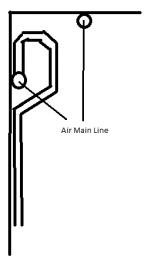
How do you take a drop off the top of a main line when that line is run along the ceiling or the wall? If the ceiling, the line prevents a top tap and if on the wall, the drop would necessarily form a loop at the top in order to come back to the wall underneath the main line. You'd have to suspend the main line, I would think, in order to make that work (or, have no ceiling), which is probably more work than most people care to get into. Wouldn't it be just as effective to have a moisture trap at the bottom of each drop?
 

4StarCstms

Well-known member
Joined
Mar 14, 2008
Messages
938
Location
Kentucky
That's the way I did mine. I'm sure somebody will tell me that I'm stupid and should have done it that way but I've done it this way before and it seems to workwith no issues.
 

trbomax

Well-known member
Joined
Mar 21, 2010
Messages
2,556
Location
starvation lake,mi.
I used "M" copper and 50/50 solder on my old shop in 1973,all of it in the walls.Still works just fine and I ran 175 lb tank/line pressure on it all those years,never shut the compressor down because it never leaked.The new systen will probably be threaded end because it will be surface mounted,but maybe not.
 

jj mack

Member
Joined
Dec 28, 2009
Messages
11
Did you consider using Transair?

It is aluminum pipe, not copper, but very easy to use, fast and not that expensive (imo).

JJ
 

Torque1st

MEMBER EMERITUS
Joined
Sep 14, 2008
Messages
5,668
Location
KC Metro, Kansas
^^^anybody worry about the hose reel in the fire scenario?
Not to mention the plastic and ruber diaphragm in the pressure switch.
we spec out for air lines to be silver solder or brazed.
but because of the price of copper most the contractors have been using pex for the air lines against our recommendations.
I wonder how they get that to pass code?

I imagine that we will see many places adopt codes that call for using steel pipe only for air lines. If they have adopted some of the mechanical codes it may already be required. There are a few places where rubber and other plastics can not be avoided such as hoses and to some extent pressure switches. Some pressure switches use a metal diaphragm.

Some municipalities specifically disallow copper for regular compressed air service. They seem to allow it for HVAC control runs though. There may be a concern that the lower melting temperature solder joints would fail with a smoldering fire which would accelerate the fire. Since they can not tell what type of soldering or brazing material was used they just disallow the material altogether. I have never seen a good explanation for the reasons that copper is disallowed.

If copper is used it may be wise to braze it anyway.
 

Steve_P

Well-known member
Joined
Sep 15, 2010
Messages
5,181
shop002.jpg


The compressor is a 7.5 HP quincy

shop003.jpg


A shot of the piping and filters. If you look at the compressor pic the air comes out of the compressor from the large OD orange/red hose, goes up to the ceiling, over to the wall, into 3/4 copper tube, runs down the garage wall, drops down the wall, runs back on the wall towards the compressor, goes up the wall, then reduces to 1/2 and goes thru the filter. For regular use the air then goes up the wall again and back down in the small orange hose which enters the hose reel. There is a bypass option for a better filter shown on the top in this pic- that's only for painting and I use a dedicated hose for it. There are several drip legs for water collection with ball valves to drain.

this was done with plumbing solder and the thin wall cu tubing from Home Depot. I run 160 psi thru it, no leaks, no issues, 7+ yrs.
 

Torque1st

MEMBER EMERITUS
Joined
Sep 14, 2008
Messages
5,668
Location
KC Metro, Kansas
Interesting about the fire aspect... was searching for a reason to not use plumbing solder and you're the first person to pose a valid reason.

How do you take a drop off the top of a main line when that line is run along the ceiling or the wall? If the ceiling, the line prevents a top tap and if on the wall, the drop would necessarily form a loop at the top in order to come back to the wall underneath the main line. You'd have to suspend the main line, I would think, in order to make that work (or, have no ceiling), which is probably more work than most people care to get into. Wouldn't it be just as effective to have a moisture trap at the bottom of each drop?

I thought someone had posted the link to diagrams for compressed air piping. If not check out the link below. Substitute the fitting terminology of choice. TP tools has a number of interesting tools.
http://www.tptools.com/StaticText/airline-piping-diagram.pdf
http://www.tptools.com/
 

babzog

Well-known member
Joined
Apr 20, 2009
Messages
2,117
Location
Eastern Ontario, Canada
I thought someone had posted the link to diagrams for compressed air piping. If not check out the link below. Substitute the fitting terminology of choice. TP tools has a number of interesting tools.
http://www.tptools.com/StaticText/airline-piping-diagram.pdf
http://www.tptools.com/

I've seen that before, but, with a finished garage, how would you put in a riser if the pipe is attached to the ceiling? Nowhere to go. Likewise, if the pipe is attached to the wall, you can go up, but in order to come down again, you're going to have to make a "funky copper fitting loop" to get the drop back to the wall for attachment.

funky air line.jpg

Which would look rather silly and be a PITA to assemble. So, you'd have to suspend the mainline, I would think, in order to have a riser at all and still have a way to attach it to something and not have it look like something from the Black Lagoon. Suspending the line also sounds like a PITA (if you were to do it like they do in commercial electrical and plumbing installations with the rods and crossmembers).

How far off the bottom of the pipe would be sufficient to be considered a riser? It occurs to me that you could attach 2x4 blocks to the ceiling and come off the main at a 45 and run tight along the ceiling to the wall where your drop is going. Not much of an overall rise either...
 
Last edited:

Torque1st

MEMBER EMERITUS
Joined
Sep 14, 2008
Messages
5,668
Location
KC Metro, Kansas
You mount the main runs off the wall with standoffs. The downleg goes behind the main line and down the wall just like the drawing. The main lines should be 8-12" below the ceiling. Do not attach the main lines directly to the ceiling. If you have to run a main line across the ceiling make sure it is at least 8" below the ceiling. The main lines need to be in free air for cooling. The main lines can also be run along the wall down low at at least 8" off the floor with the risers coming straight off the top of the line to the outlets.

People that run the lines inside the wall have done it wrong no matter how "pretty" it looks. Compressed air systems have been around for a while now and those in the industry have figured out how to do it fairly well. Plastic lines of any type do not cool the air and separate the water properly. It isn't rocket science but it does require attention to detail.
 

glockman

Well-known member
Joined
Dec 4, 2010
Messages
143
Location
Northern Utah
People that run the lines inside the wall have done it wrong no matter how "pretty" it looks. Compressed air systems have been around for a while now and those in the industry have figured out how to do it fairly well. Plastic lines of any type do not cool the air and separate the water properly. It isn't rocket science but it does require attention to detail.[/QUOTE]

I work in a multi billion dollar facility. The floor I work on is 70,000 sq ft. We run production equipment that moves parts via air cylinders/soleniods. ALL of our air lines are ran under suspended floors in grey PVC pipe. At the machine the feed is flex poly hose. We run anywhere from 80-150 psi in our tools. The city/state has inspected and signed off on every fitting and pipe. We have had zero failures in over 10 years. Plastic can and does work if the correct product is used. Sprinkler PVC pipe is not the correct product.
 

Charles (in GA)

Well-known member
Joined
Jan 11, 2006
Messages
12,489
Location
50 mi south of Atlanta
I work in a multi billion dollar facility. The floor I work on is 70,000 sq ft. We run production equipment that moves parts via air cylinders/soleniods. ALL of our air lines are ran under suspended floors in grey PVC pipe. At the machine the feed is flex poly hose. We run anywhere from 80-150 psi in our tools. The city/state has inspected and signed off on every fitting and pipe. We have had zero failures in over 10 years. Plastic can and does work if the correct product is used. Sprinkler PVC pipe is not the correct product.

If you are using PVC, then OSHA hasn't caught up with you yet. They forbid it for compressed air many years ago in facilities they regulate. There is no PVC pipe manufacturer who has or will approve PVC for compressed gasses of any kind. (I know, flat *** statement, someone will find an exception).

ABS pipe material has been manufactured for compressed gasses. Nibco has a line of such pipe, that has all the approvals. The did manufacture one specifically for compressed air (Chemair) but it was discontinued for lack of sales (apparently people keep using the wrong stuff, and their market didn't materialize).

Charles
 

pcmeiners

Well-known member
Joined
Aug 13, 2009
Messages
7,832
Location
In the only town in Pennsylvania, Bloomsburg.
I agree with Torque1st about the fire hazard...

My issue is the loss of strength with the brazing as we were once required to braze water supply pipe in NYC, brazing drastically reduces the strength. I plan to build a garage upon retirement in a couple years, I will use silver solder but I also plan to have heat senors which will trigger a relay to cut off power to the compressor and remove power from a N/O solenoid valve (closed when power is on) to dump the air from the tank to the outside in the event of a fire.
A properly sealed garage, with fire-code wall board (especially fire code C type) will not maintain a fire. Should copper pipe let go and dump a large receiver of air into a burning space, considering the burning materials producing gases, a flash over is likely to occur. Basically a flash-over is a explosion, opening a fairly airtight area to fresh air.
 

Torque1st

MEMBER EMERITUS
Joined
Sep 14, 2008
Messages
5,668
Location
KC Metro, Kansas
I work in a multi billion dollar facility. The floor I work on is 70,000 sq ft. We run production equipment that moves parts via air cylinders/soleniods. ALL of our air lines are ran under suspended floors in grey PVC pipe. At the machine the feed is flex poly hose. We run anywhere from 80-150 psi in our tools. The city/state has inspected and signed off on every fitting and pipe. We have had zero failures in over 10 years. Plastic can and does work if the correct product is used. Sprinkler PVC pipe is not the correct product.
In a facility of that size the air is probably dried right after the compressor with some sort of mechanical refrigeration therefore the water separation properties are not needed.

As noted OSHA just has not caught you yet. They probably have bigger concerns at the plant.


pcmeiners:
There are many different types of brazing material. Check the Copper Handbook.
 
Last edited:

PontiacFan

Well-known member
Joined
Apr 25, 2007
Messages
102
People that run the lines inside the wall have done it wrong no matter how "pretty" it looks. Compressed air systems have been around for a while now and those in the industry have figured out how to do it fairly well. Plastic lines of any type do not cool the air and separate the water properly. It isn't rocket science but it does require attention to detail.

I work in a multi billion dollar facility. The floor I work on is 70,000 sq ft. We run production equipment that moves parts via air cylinders/soleniods. ALL of our air lines are ran under suspended floors in grey PVC pipe. At the machine the feed is flex poly hose. We run anywhere from 80-150 psi in our tools. The city/state has inspected and signed off on every fitting and pipe. We have had zero failures in over 10 years. Plastic can and does work if the correct product is used. Sprinkler PVC pipe is not the correct product.

Where is it that you work exactly?
 

kbs2244

Well-known member
Joined
Nov 11, 2006
Messages
14,065
Anybody notice on the Steve P PIC how hw put his connectors at a 45 degree angle?
I like that.
It reduces the bend in the hose a lot.

The TP tools diagram shows them coming straight down.
That’s even better for the hose, but it would mean too much plumbing for me.
They also show a pressure regulator with a moisture trap before each connector.
Unless you are painting, I think that is overkill.

You do want your drops off the top of the main line.
The moisture will kill you otherwise.
This type of system is a tool.
Function comes before form.

If you don’t like the “look” build a soffit.
 
To avoid these ads, REGISTER NOW!
Top Bottom