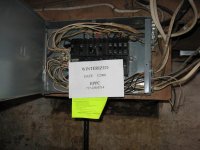
Actually that could run on a 30. 80% is for continuous loads. Since its got its own thermal it protects the wire, the breaker then becomes short circuit protection and a larger one prevents nuisance trips. A 30 would work on a 14 in pipe (wired direct) or a 12 cable which are better than the cord it comes with.
The main issue is a receptacle that has a breaker higher than its design. I saw a sump pump in a closet out of the way had a 12 wire 30 brkr installed by a master a while back. It had a duplex but it was hidden unless one looked for it and he is a genius but not supper fussy, every other circuit in the place was properly protected.
I have one special out of the hundreds of circuits, these little comps, some welders and some saws will trip a 20 especially short circuits close to the panel. I carry 60 ft of 14 cord for roofing due to this. Sometimes when a machine is super new and crisp things are ok but some are problematic and there isn't much you can do.
The main concern is to deny access to the recept to other equipment that wouldn't be able to rated handle it due to short circuit. This doesn't mean plugging in anything that trips a breaker but limited to pieces that need and can tolerate it, usually with limited duty cycle and some other factors such as cord size, internal equipment design, etc, just generalization here and not meant to be super specific.
The factory made chop saw that comes 15 end actually draws 40 on a good cut, I am surprised the 30 doesn't trip. It tripped a 20 on starts every 3rd or 4th time especially with a thicker wheel on it.
I did it, I didn't say it should be done but it is. But,,, what would you do in your garage with a saw or a comp that was problematic?
Before you get your ******* in a wad I am a code believer. As I said in the ramble it is not specific but a generalization about some fundamental theory which despite an array of masters on this forum who are good at picking code are dam near pitiful explaining some fundamental theory about the nature of the equipment design.
I have worked on other threads where people want to make a 50 to 20 adapter but didn't get much help with that, now you here to nitpick me especially when I carefully add that this was a generalization about the design aspects which ensure that something is safe.
I never did say it was correct. That part was missed somewhere along the line. My point is that we got some real smart guys that seemed to be confused about the difference between thermal overload and short circuit and how it relates to plug and recept design.
*************************************
If this compressor was hardwired, it would need to be wired with 10’s. FLC = 24a for 2 HP @120vac.
24 x1.25 = 30a. (Big jump from nameplate FLA’s of 15a.!)
Since the compressor is purchased as plug & cord connected with FLA’s = 15a, it must be on a 20a general purpose branch circuit(#12’s). No single piece of equipment can be over 80% of ckt rating. See 210.23(A)(1). 12a = max allowed on 15A ckt. 16a = max allowed on 20A ckt.
The 30A for the chop saw probably trips pulling 40A somewhere between 1 and 7 minutes depending on cb tolerance. High start-up current. For high startup current - use 14 awg ext cord here also.
The confusion is on your end regarding thermal o/l…………..
The problem is, you are violating established premises wiring requirements detailed in the code - NEC 210.21(B)(1) and 210.21(B)(3) for general purpose branch circuits. The concept you are trying to apply to a general-purpose branch circuit is that of the exception used only for dedicated motor branch circuits found in art 430.
Motor circuits are dedicated to hard-wired connected motors. The cb provides the s.c./g.f. protection for the supply conductors and the hard-wired motor (or its controller) provides the o/l protection to the motor and indirectly back to the circuit conductors. There is no randomness as to the motor load that is attached to this hard-wired circuit – it is a matched system.
For an improperly wired general purpose branch circuit, the compressor can be unplugged and removed at any time from the receptacle leaving the 20A recept wired with 12’s on a 30a cb. Anyone can plug in virtually any random thing to this incorrectly protected circuit at any time. Pieces of tape placed over receptacle faces or sharpie scribble won’t stop anyone from connecting other loads to it. That is how the inspector will look at this and fail it. (There are no qualified people or supervision to otherwise monitor/prevent this from happening.)
Although short circuit and ground fault protection is provided by the 30a cb, there is not the proper o/l protection for the hard-wired premises wiring. An excess of 20a and less than 30a can easily be connected to the receptacle and there will be no o/l response action performed by the cb. The circuit conductors and recept could easily be loaded with 28-30a and start deterioration of the insulation/recept from the excess heat created. This 50% o/l could go on indefinitely and the cb is still performing as it was designed to do - it never gets into the trip range.


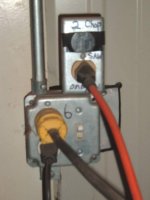
 What you've done with 12 AWG / 20A circuit and outlet is more than enough.