EE here. Or at least that's what it said on some piece of paper that is pretty old.
You have a 240V unit. Trying to keep it simple, but your voltage is the difference of one of those hot legs and the other hot leg.. The current is how much power is THRU both wires.
If the 240V circuit is a hose, current is how much water is going through them.
If you measure current on either leg, it's going to be exactly the same.. Essentially it's one wire, with a load in the middle. You're measuring the current that goes through BOTH wires.
Correct. It may have been a few years since that piece of paper with the BSEE was printed, but you've obviously remembered a thing or two.

I’m pretty sure this is not correct, but could I think of each hot wire as being the neutral for the other hot wire? It sorta makes sense to me if I do that.
No, he's right... we just need to say it in such a way that you can fully understand it.
Electricity is one of those things that some people can't wrap their heads around, normally because they cannot 'see' it. I find that if someone can explain it in a way that the other person can relate to it, it makes that light bulb come on... figuratively and literally speaking.
Alternating current (AC - like your wall outlet) and direct current (DC - like a battery) are similar in that electrons flow when the circuit is completed. Where they are different is that current flow in a DC circuit never changes. Positive is always positive, negative is always negative. Current flows in one direction.
For AC, the polarity changes from positive to negative, and back again. How? Rotating electromagnetic fields. Think of how a magnet reacts to another magnet: N pulls to S, N pushes against N. Electrons do the same thing. So as a pole moves/changes from N to S, it either pulls or pushes the electrons.
The 'cycle' is the motion where it changes from a position of zero to positive, to zero, then to negative, and returns to zero. The amount of times it changes over a period of time can be called cycles per second, also known as Hertz. In America, our electrical power is set at 60 Hz, or 60 cycles per second.
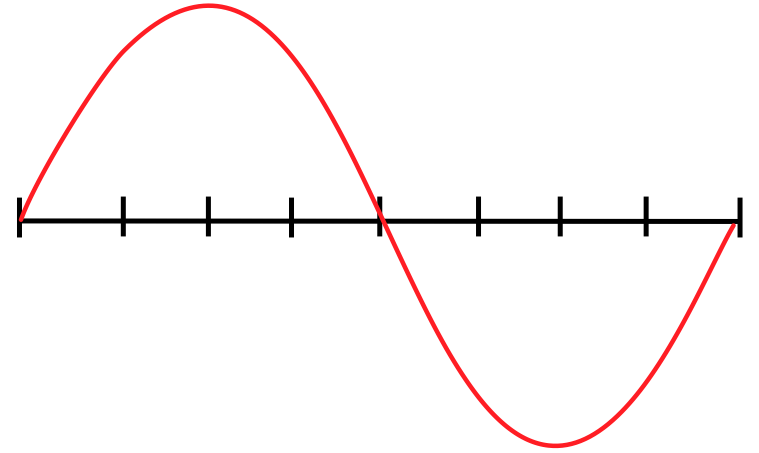
If we slow that down to visualize it over time, and we could 'draw' it on paper relative to time, a cycle would look like this:
This represents it going from zero on the left, positive (upwards) returning to zero, then going negative (downward) and returning to zero. This is known as a sine wave. If this was us looking at one cycle of a 60 Hz sine wave, that would be 1/60th of a second.
When we create AC power, we typically do that by converting mechanical, rotational energy into electricity using a generator/alternator that is basically a set of electrical wires in bundles known as poles, and using a rotating magnetic field in the center to cause the poles to change from positive to negative and back again. This causes the electrons in the wiring to move one direction, stop, reverse direction, stop, and move again. When this happens, we're creating a alternating current with a given potential/voltage:

For a typical home, you will see what is called 'single phase' power, which is somewhat misleading. The house receives two voltage sources, each 120 VAC when referenced to ground/neutral. The difference is, they are 180 degrees apart from one another. So when one phase is 120 VAC at the positive side, the other is 120 VAC at the negative side. If you measure both in reference to ground/neutral (zero) they are 120 VAC. If you measure them relative to each other, they are additive: 120 VAC + 120 VAC = 240 VAC.
In this picture, we see the two sine waves that are opposite of each other... and in the upper right side, we see a picture of a transformer. The primary side is the left side with one 'coil' and the secondary side is on the right with the two coils. L1 and L2 are the 'legs' of the transformer that feed your house. Notice how the center has a 'tap' that is called N - Neutral and has a symbol that goes downward with three lines? That's the ground.
Here's the thing... if you connect a light bulb from L1 to N, you get 120 VAC to the bulb and it lights up. Current flows from L1 through the lamp, and returns to N, then flows from N back to L1. It does this 60 times in a second.
If you disconnect the wire from N and connect it to L2, you now have 240 VAC, and current flows from L1 to L2, then back again, 60 times per second. N is not connected, so no current can flow through there.
So what the heck is going on here? Well... think of it like using a hand saw on some lumber. You push, the saw cuts. You pull, the saw cuts. If it's just you, you do all the effort, and the other end of the saw is just hanging out there, doing nothing. (One human power?) Zero work is being done when the saw stops moving.
Now I come into your shop with a saw that has handles on both ends. When you push, I pull. When you pull, I push. (Two human power) For the same amount of work being done, we are each using half of our strength. The saw is still moving back and forth, right? The difference is that we have more potential energy when working together. We can provide the same amount of wood cut per hour, but we both work half as hard... or we can both work hard and cut twice the amount of wood.
So when we measure one leg of current, we are basically measuring the force/current on that wire. It's direction changes, just like the saw. I can measure it on your side (L1) or I can measure it on my side (L2) and their overall measurement of 'force' will be the same if we're connected and working together.
Now... if you had a piece of lumber and started sawing, and I grabbed another piece of lumber and started sawing, we would need to measure both of our efforts independently... and the same would hold true for two different loads on each L1 and L2 leg that is referenced back to Neutral.
Hope this helps.
Mark