To avoid these ads, REGISTER NOW!

Cost to run 18k mini split

vavet

Well-known member
Joined
Mar 6, 2012
Messages
5,323
Location
Ashland, VA
I’m on furlough again this week, so I’ve been in my garage a bit the last few days. I don’t normally keep the mini split on all the time, but knowing I’m home this week makes it worthwhile. I turned in on Friday afternoon and attached the current clamp Sunday afternoon.

Temps at night have been in the mid 20s, daytime highs have been in the 50s.

The garage is a 24x32x12, R13 in the walls, R38 in the ceiling, 18x8 insulated roll up door, a single man door, and six 2x4 transom windows.

I’m measuring current on only one of the hot wires, there is no neutral. According to an EE friend, this arrangement measures all the current. I was afraid I was only measuring half. If he’s right, it costs me about $1/day to keep the place warm.

I don’t fully understand why measuring on one hot wire measures all the current, but he’s never led me astray on electrical theory before. I’ll get a better explanation at some point so I can actually understand it...or so I hope.

I’m writing this just to provide a data point to anyone who might be wondering about cost to keep a shop space conditioned. There are many variables, but this at least provides a data point.
 
To avoid these ads, REGISTER NOW!

Steve W.

Well-known member
Joined
Mar 27, 2019
Messages
1,245
Location
Southwest oHIo
That's encouraging. :thumbup:

My shop is just a bit smaller at 24 x 30 x 8 with attic trusses for a room upstairs. R13 in the walls, attic ceiling and in the floor/ceiling between the two levels. I don't have the mini-split yet, was hoping the 18k I was considering would be adequate. Right now, my only heat is a kerosene torpedo that runs for about 3 minutes per hour to maintain 60°, and that is costing almost $4 per day. (No, I don't need any preaching to on the dangers of unvented combustion heaters.)

.
 

Showkey

"MEMBER EMERITUS"
Joined
Aug 9, 2014
Messages
8,638
Location
Wausau WI
Encouraging ? Depends on your point of view and the available alternatives.

Nat GAS might be $1 per day for the same space in far colder climate.
Propane at $1.00 to $1.30 might also be competitive.
What was the cost of the mini split vs alternative, how often is the space being heated.
Is AC apart of the plan ?


Measuring the current on one leg of the 240v two wire device is correct.
 

theoldwizard1

Well-known member
Joined
Feb 22, 2011
Messages
43,147
Location
SE MI
Nat GAS might be $1 per day for the same space in far colder climate.
Propane at $1.00 to $1.30 might also be competitive.
What was the cost of the mini split vs alternative, how often is the space being heated.
Your numbers a guess-estimates. OP's numbers are based on data.

Is AC apart of the plan ?
Heat pump is an AC running backwards. To cool, you run it forward.
 
OP
V

vavet

Well-known member
Joined
Mar 6, 2012
Messages
5,323
Location
Ashland, VA
Encouraging ? Depends on your point of view and the available alternatives.

Nat GAS might be $1 per day for the same space in far colder climate.
Propane at $1.00 to $1.30 might also be competitive.
What was the cost of the mini split vs alternative, how often is the space being heated.
Is AC apart of the plan ?


Measuring the current on one leg of the 240v two wire device is correct.

Natural Gas is not available where I live. We have propane for a few things in the house. This mini-split unit cost me ~$900 for everything, including the installation supplies. Air conditioning in the summer to go along with my heat in the winter is nice.

This would not be reasonable in colder climates because it can't keep up at really low temps, but I think it's reasonable for our climate here.

I didn't really intend to debate a mini split vs alternatives. I wanted to know how much it cost to keep the space heated 24/7 and I figured that out. I just wanted to share with anyone else who might be wondering and wanting a ballpark idea. Like I said, it's a data point. There are lots of variables - temp swings, cost of electricity in various parts of the country (or world), size of the space to be heated, desired temp, insulation, number of doors and windows, amount of tree cover, amount of sun exposure, roof color, etc.
 

kelpaso1

MEMBER EMERITUS
Joined
Sep 28, 2009
Messages
3,962
Location
New Brunswick
I have an 18K mini in my 22X24 attached garage. R-13 in the walls and R-20 in the ceiling. I keep it heated 24/7 on the lowest setting 62 deg F. My equalized billing went up $30/month. Very affordable. I rarely cool in the summer. One thing though is very cold days/nights it doesn't heat as well. I find I get about 30 degree difference between outdoor and indoor temps. So if it is -10C out I get +20C in, -20C out I get +10C in. A little cool when it's that cold but we don't get that cold too often here.
 

casmurbax

Well-known member
Joined
Sep 25, 2012
Messages
2,758
Location
Wilton, NY
That is very interesting on the cost of the heating. Plus you get the benefit of a A/C with that all in one unit.

Did I miss at what temp you were heating/maintaining up to? is that on timer? lower temp at night, meaning not in your shop?
 
OP
V

vavet

Well-known member
Joined
Mar 6, 2012
Messages
5,323
Location
Ashland, VA
That is very interesting on the cost of the heating. Plus you get the benefit of a A/C with that all in one unit.

Did I miss at what temp you were heating/maintaining up to? is that on timer? lower temp at night, meaning not in your shop?

You’re right, I failed to mentioned the temp. I have it set for 62F. That is the lowest it’ll go and it’s the only thing I don’t like about it, I wish it would let me set a lower temp.

I started another thread this morning looking for help on how to merge a raspberry pi and this MR Cool to effective change the set point, getting a temp sensor for a raspberry pi or arduino is easy. I just don’t know how to make it act on that to turn the mr cool on or off.
 

casmurbax

Well-known member
Joined
Sep 25, 2012
Messages
2,758
Location
Wilton, NY
Dam I didn't realize that they would have set a low heat temp on them. But even then with you found, it really isn't that bad price wise.
 

ericm

Well-known member
Joined
Apr 17, 2016
Messages
1,963
Location
Southern Oregon
I started another thread this morning looking for help on how to merge a raspberry pi and this MR Cool to effective change the set point, getting a temp sensor for a raspberry pi or arduino is easy. I just don’t know how to make it act on that to turn the mr cool on or off.

Shouldn't be too hard to reverse-engineer the TCP protocol on wifi between the app and the unit. Assuming that the app talks directly to the Mr Cool, not to a server somewhere. If that's the case it's more complex but could still be doable.

That's if the 46 degree freeze protection setting isn't good enough for your purposes.
 

justinjoyal

Well-known member
Joined
Apr 30, 2015
Messages
888
Location
Quebec
You’re right, I failed to mentioned the temp. I have it set for 62F. That is the lowest it’ll go and it’s the only thing I don’t like about it, I wish it would let me set a lower temp.

I dont know your exact model but if you have a MrCool with the 'Silence FP' button on the remote, you can try pressing it for a few seconds. Some models have the 'FP' (freeze protection) function which is a 46*F setpoint.
 

dcg9381

Well-known member
Joined
Jun 20, 2018
Messages
11,748
Location
Austin, TX
I don’t fully understand why measuring on one hot wire measures all the current, but he’s never led me astray on electrical theory before. I’ll get a better explanation at some point so I can actually understand it...or so I hope.

EE here. Or at least that's what it said on some piece of paper that is pretty old.

You have a 240V unit. Trying to keep it simple, but your voltage is the difference of one of those hot legs and the other hot leg.. The current is how much power is THRU both wires.

If the 240V circuit is a hose, current is how much water is going through them.

If you measure current on either leg, it's going to be exactly the same.. Essentially it's one wire, with a load in the middle. You're measuring the current that goes through BOTH wires.
 
OP
V

vavet

Well-known member
Joined
Mar 6, 2012
Messages
5,323
Location
Ashland, VA
EE here. Or at least that's what it said on some piece of paper that is pretty old.

You have a 240V unit. Trying to keep it simple, but your voltage is the difference of one of those hot legs and the other hot leg.. The current is how much power is THRU both wires.

If the 240V circuit is a hose, current is how much water is going through them.

If you measure current on either leg, it's going to be exactly the same.. Essentially it's one wire, with a load in the middle. You're measuring the current that goes through BOTH wires.

I’m pretty sure this is not correct, but could I think of each hot wire as being the neutral for the other hot wire? It sorta makes sense to me if I do that.
 
To avoid these ads, REGISTER NOW!

jvitez

Well-known member
Joined
Nov 30, 2009
Messages
2,429
Location
Big Sky Country, Canada
The penny finally dropped for me when I thought about it as electron flow in an alternating current.

The electrons are wooshing down one hot wire, through the heater, then out and back through the other hot wire. This goes back and forth 60 times a second. When I visualize it this way I can see why there's no need for a neutral wire.
 

DHCrocks

Well-known member
Joined
May 2, 2008
Messages
1,349
Location
Hawaii
In a 240v setup you have two 120v hots which are 180-degrees out of phase with each other. What happens is that when one leg is at peak positive potential +120v the other is at -120v and the combined differential in potential is 240v. since current is running in a loop thru the circuit each leg is seeing the same current which is why you only need to measure across one leg. If the legs had a different current in them then you have a big problem and something is shorting to ground.
 

Dogmeat

Well-known member
Joined
Jan 20, 2017
Messages
181
Location
S. Mich.
I have it set for 62F. That is the lowest it’ll go and it’s the only thing I don’t like about it, I wish it would let me set a lower temp.

Do what I did....many, many years ago when I was not exactly swimmin' in the money, in order to lower the temp in my house when I wasn't home was to set a 20 or 30 watt light bulb below the t'stat so the heat from the bulb would "trick" the t'stat into thinking it was warmer in the house than it really was!! You can always re-position the bulb according to what the temp is when you come home each day...OH, I was single at the time, so I didn't have someone always saying that "It's Cold in here!!"
 

Jackfre

Well-known member
Joined
Dec 26, 2010
Messages
4,410
Location
N CA
I a gasser, as I have proven over so many posts on so many topics, but it will not be long before everything in climate control will be compressor bearing.
 

mobetta

Well-known member
Joined
Feb 10, 2010
Messages
370
Location
twin cities, mn
Aside from this week its been a fairly mild winter.
My power bill is up about$20/mo

New Build 2020
24k mr cool Hyper heat -FP setting 90% of the time, 62 when I'm out there
24x28x 9-12' vault
r15/r32+

Also so far coldest at -14F overnite no issues, 46F inside...
 

elmo_4_vt

Member
Joined
Oct 1, 2009
Messages
9
Location
Northern Delaware
I dont know your exact model but if you have a MrCool with the 'Silence FP' button on the remote, you can try pressing it for a few seconds. Some models have the 'FP' (freeze protection) function which is a 46*F setpoint.

That really changes things for me - The 62deg F was a deal breaker for me, and this is the first time I've heard about this option. Is there any way to tell which units have this option on the brochures? I've sent them a request on through their website, and if I hear from Mr. Cool first, I'll post.

Don

-
 

SALIV8

Well-known member
Joined
Dec 11, 2008
Messages
2,114
Location
chicago and s/w michigan
Do what I did....many, many years ago when I was not exactly swimmin' in the money, in order to lower the temp in my house when I wasn't home was to set a 20 or 30 watt light bulb below the t'stat so the heat from the bulb would "trick" the t'stat into thinking it was warmer in the house than it really was!! You can always re-position the bulb according to what the temp is when you come home each day...OH, I was single at the time, so I didn't have someone always saying that "It's Cold in here!!"

Why wouldn’t you just lower the thermostat?
 

Fasthotrod

Well-known member
Joined
Dec 14, 2015
Messages
218
Location
Oklahoma
EE here. Or at least that's what it said on some piece of paper that is pretty old.

You have a 240V unit. Trying to keep it simple, but your voltage is the difference of one of those hot legs and the other hot leg.. The current is how much power is THRU both wires.

If the 240V circuit is a hose, current is how much water is going through them.

If you measure current on either leg, it's going to be exactly the same.. Essentially it's one wire, with a load in the middle. You're measuring the current that goes through BOTH wires.

Correct. It may have been a few years since that piece of paper with the BSEE was printed, but you've obviously remembered a thing or two. :thumbup:


I’m pretty sure this is not correct, but could I think of each hot wire as being the neutral for the other hot wire? It sorta makes sense to me if I do that.

No, he's right... we just need to say it in such a way that you can fully understand it.

Electricity is one of those things that some people can't wrap their heads around, normally because they cannot 'see' it. I find that if someone can explain it in a way that the other person can relate to it, it makes that light bulb come on... figuratively and literally speaking.

Alternating current (AC - like your wall outlet) and direct current (DC - like a battery) are similar in that electrons flow when the circuit is completed. Where they are different is that current flow in a DC circuit never changes. Positive is always positive, negative is always negative. Current flows in one direction.

For AC, the polarity changes from positive to negative, and back again. How? Rotating electromagnetic fields. Think of how a magnet reacts to another magnet: N pulls to S, N pushes against N. Electrons do the same thing. So as a pole moves/changes from N to S, it either pulls or pushes the electrons.

The 'cycle' is the motion where it changes from a position of zero to positive, to zero, then to negative, and returns to zero. The amount of times it changes over a period of time can be called cycles per second, also known as Hertz. In America, our electrical power is set at 60 Hz, or 60 cycles per second.

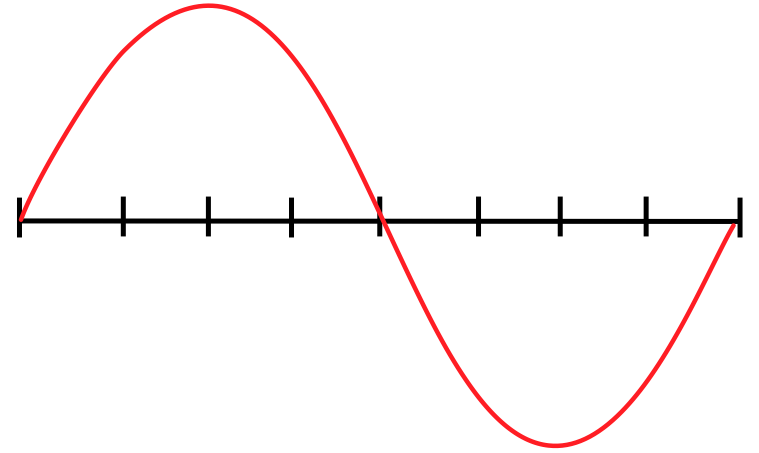
If we slow that down to visualize it over time, and we could 'draw' it on paper relative to time, a cycle would look like this:

Sine-Wave-e1533077966309.png


This represents it going from zero on the left, positive (upwards) returning to zero, then going negative (downward) and returning to zero. This is known as a sine wave. If this was us looking at one cycle of a 60 Hz sine wave, that would be 1/60th of a second.

When we create AC power, we typically do that by converting mechanical, rotational energy into electricity using a generator/alternator that is basically a set of electrical wires in bundles known as poles, and using a rotating magnetic field in the center to cause the poles to change from positive to negative and back again. This causes the electrons in the wiring to move one direction, stop, reverse direction, stop, and move again. When this happens, we're creating a alternating current with a given potential/voltage:

accircuits-acp29.gif


For a typical home, you will see what is called 'single phase' power, which is somewhat misleading. The house receives two voltage sources, each 120 VAC when referenced to ground/neutral. The difference is, they are 180 degrees apart from one another. So when one phase is 120 VAC at the positive side, the other is 120 VAC at the negative side. If you measure both in reference to ground/neutral (zero) they are 120 VAC. If you measure them relative to each other, they are additive: 120 VAC + 120 VAC = 240 VAC.

main-qimg-5c045532cb0d967ec8cc4f5ed543375f


In this picture, we see the two sine waves that are opposite of each other... and in the upper right side, we see a picture of a transformer. The primary side is the left side with one 'coil' and the secondary side is on the right with the two coils. L1 and L2 are the 'legs' of the transformer that feed your house. Notice how the center has a 'tap' that is called N - Neutral and has a symbol that goes downward with three lines? That's the ground.

Here's the thing... if you connect a light bulb from L1 to N, you get 120 VAC to the bulb and it lights up. Current flows from L1 through the lamp, and returns to N, then flows from N back to L1. It does this 60 times in a second.

If you disconnect the wire from N and connect it to L2, you now have 240 VAC, and current flows from L1 to L2, then back again, 60 times per second. N is not connected, so no current can flow through there.

So what the heck is going on here? Well... think of it like using a hand saw on some lumber. You push, the saw cuts. You pull, the saw cuts. If it's just you, you do all the effort, and the other end of the saw is just hanging out there, doing nothing. (One human power?) Zero work is being done when the saw stops moving.

Now I come into your shop with a saw that has handles on both ends. When you push, I pull. When you pull, I push. (Two human power) For the same amount of work being done, we are each using half of our strength. The saw is still moving back and forth, right? The difference is that we have more potential energy when working together. We can provide the same amount of wood cut per hour, but we both work half as hard... or we can both work hard and cut twice the amount of wood.

So when we measure one leg of current, we are basically measuring the force/current on that wire. It's direction changes, just like the saw. I can measure it on your side (L1) or I can measure it on my side (L2) and their overall measurement of 'force' will be the same if we're connected and working together.

Now... if you had a piece of lumber and started sawing, and I grabbed another piece of lumber and started sawing, we would need to measure both of our efforts independently... and the same would hold true for two different loads on each L1 and L2 leg that is referenced back to Neutral.

Hope this helps.

Mark
 

theoldwizard1

Well-known member
Joined
Feb 22, 2011
Messages
43,147
Location
SE MI
... think of it like using a hand saw on some lumber. You push, the saw cuts. You pull, the saw cuts. If it's just you, you do all the effort, and the other end of the saw is just hanging out there, doing nothing. (One human power?) Zero work is being done when the saw stops moving.

(For DC power, the balde would be removed from the cut and repositioned for another push.)

Now I come into your shop with a saw that has handles on both ends. When you push, I pull. When you pull, I push.

One of the best explanations of alternating current I have seen !
 

HotrodHR

Well-known member
Joined
Nov 22, 2009
Messages
445
Location
North Alabama
I have an 18k Mr cool... not too concern about how much energy it uses, just the actual cost $$ to run, which has been nominal ($20 to 30 bucks max). Having a cool shop in the summer and cutting the chill in the winter is worth the cost...
 
To avoid these ads, REGISTER NOW!
Top Bottom